TO)pot Festival: Walking-with Changes
23–27 September 2025
Cukrarna Gallery, Sečovlje Salina Nature Park, City Museum of Ljubljana and public spaces
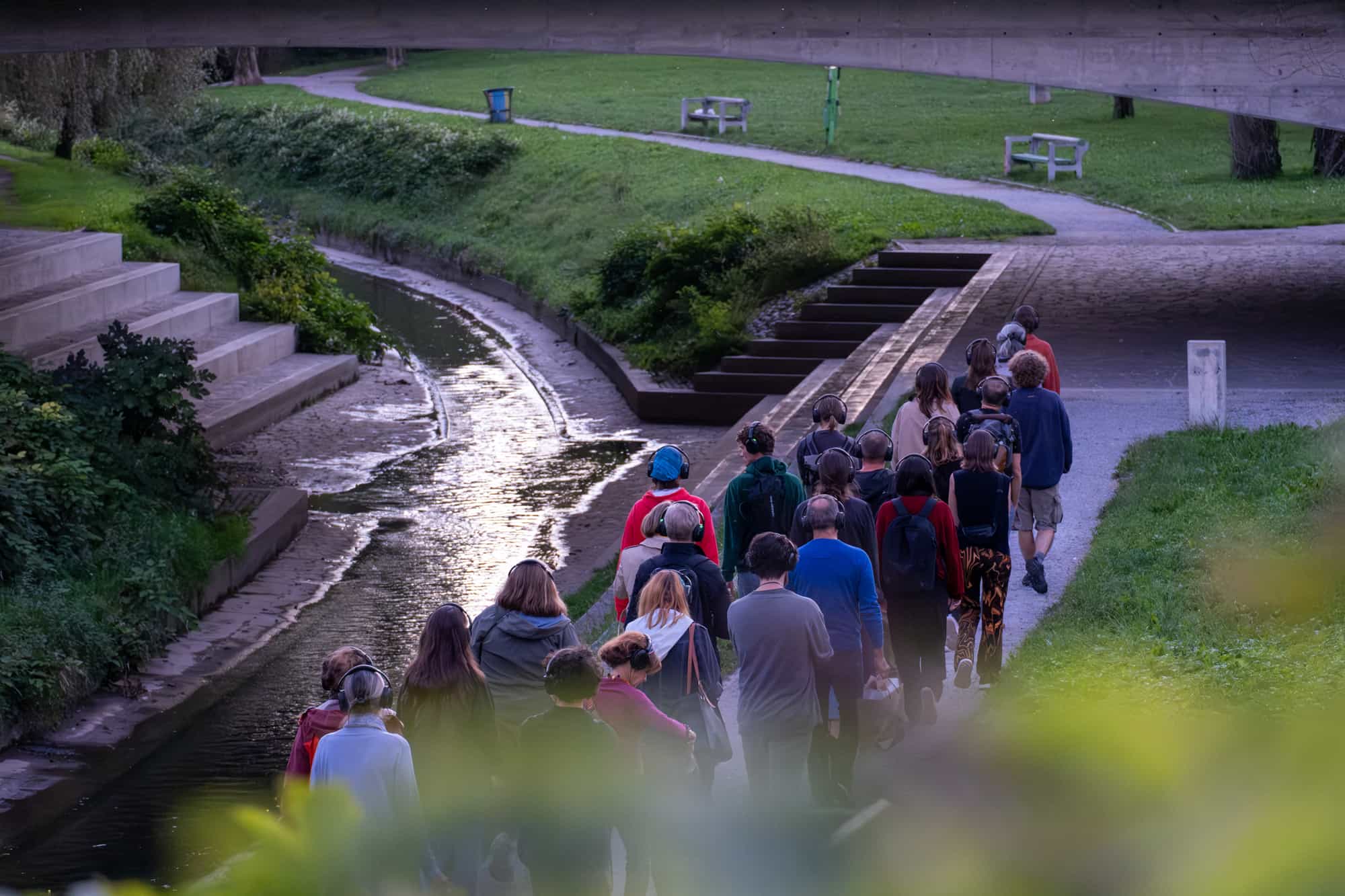
TO)pot, a festival of soundwalks, concerts and critical reflection, brings together artists, theorists and curious walkers in dialogue with spaces, their temporalities and more-than-human entities. The festival’s title, Walking-with Changes, points to the potential of walking and listening as practices that foster a deeper understanding of place and its shifting constant. Through attentive listening, walkers are invited to adopt a critical approach to the environments they inhabit – or, in the context of migration, are still learning to inhabit – and to attune themselves to both local and global landscapes.
In an era of hyper-production and constant acceleration, walking offers an alternative – a pause, a moment of silence and the space for reflection. Listening to places – both those we inhabit in the present moment and those undergoing turbulent transformation – becomes a means of creating necessary distance. Yet this distance is not about withdrawal; rather, it enables a form of attentive, sensitive and critical listening in a time that moves too quickly.
Walking, as an artistic practice, is not only a reflection of the moving body but also a way of attuning to and embedding oneself within an environment through listening. Walking art created in dialogue with specific spaces opens possibilities for a deeper understanding of the temporality and transformation of the places we inhabit daily. For political, economic or ecological reasons, some environments are no longer hospitable, even to their long-time inhabitants, who find themselves displaced and striving to take root in unfamiliar landscapes. At the same time, these landscapes, shaped by both human and natural forces, are themselves taking on new forms and roles. In this evolving relationship, a profound interconnectedness emerges between spaces and their human and more-than-human inhabitants. In some contexts, these bonds are so intimate and interdependent that the boundaries between place and dweller begin to blur. The festival’s artworks pose questions such as: What can we learn from beings that have endured centuries of migration, colonisation and adaptation? And: What role does memory – personal and collective – play in making sense of shifting space and time?
The festival invites you to listen with all your senses. It engages with the concept of multiple temporalities, where past, present and future, as well as parallel temporalities of the same places intertwine. This opens space for reflection on how we live-with spaces, how we might come to understand them more deeply, and how we can endure even when they become (in)hospitable or unfamiliar. How can we come to recognise that space is the foundation for a well-anchored root system – one that sustains all living beings and other entities that dwell there – and that mutual care and interdependence are essential to our shared, more resilient future?
◆
As part of the TO)pot festival, Cona, in collaboration with the ZRS Koper, is co-organising this year’s CENSE (Central European Network for Sonic Ecologies) symposium: Beyond Listening 2025: Walking-with Changes. Continuing its tradition, Cona is also organising field trips for in-situ listening and sound recording. This year, these excursions are enriched by a full-day visit to the Sečovlje Salina Nature Park, which will also host part of the symposium programme (symposium in the field).
◆
This year’s TO)pot festival presents three premieres of soundwalks produced by Cona in 2025 – Bodies of Water by Eva Mulej Vrabič (Oka) and Jaka Bombač, Following by Neža Knez and VRTATYS’ by Tetiana Khoroshun and Felisa Ko – as well as tremolo, a sound event by Brane Zorman and Boštjan Perovšek.
The soundwalks Bodies of Water and Following were selected through TO)pot festival’s open call and share a common focus on engaging with a selected environmental body. In Following, artist Neža Knez explores the sky in relation to the study, observation and forecasting of weather. In her soundwalk, participants follow a weather balloon on an imaginary journey through the sky, experiencing the atmosphere’s constant changes. In Bodies of Water, artists Eva Mulej Vrabič (Oka) and Jaka Bombač focus on a journey that weaves imagination with reality along the flow of a changing river – from the babbling of spring waters to thick dead waters. In this work, water becomes a medium for imaginative imagery and an extension of our connective tissues, shaping the way we listen to and engage with the landscape.
The relationship to the environment is also explored in the sound events tremolo and Detunements which are featured in the festival’s opening concert.
In tremolo, artists Boštjan Perovšek and Brane Zorman, together with scientist Juan José López Díez, combine artistic and scientific research to investigate the sonority of insects. Their project centres on the sonic expressions of small organisms that subtly shape the world through vibrations, while also engaging with the concept of third landscapes – abandoned urban areas untouched by intensive human planning. The work raises questions about the hospitality of these fragile, ephemeral environments and the kinds of organisms that inhabit them.
Anna Friz’s Detunements offers a reflection on understanding the environment through artistic inquiry. She challenges the relationship between artistic and empirical scientific research in explaining the sonic environment. Through critical listening to the sounds of industrialisation, Friz reimagines the Atacama Desert in Chile, creating a soundwork filled with mirages, sonic distortions and camouflage.
Garden of the Earthly Delights by Martyna Poznańska is a guided listening walk that invites participants to engage in a multisensory exploration of their surroundings, with a focus on bodily awareness as a form of environmental communication. This work also highlights the significance of artistic research. According to the artist, such an approach enables a shift away from purely scientific knowledge towards a more intuitive, sensorial experience.
To round out the festival programme, we are presenting soundwalks by Tetiana Khoroshun and Felisa Ko and Anna Khvyl and Piotr Armianovski. These two soundwalks explore the (in)hospitability of space – its transformation, displacement and commemoration in the aftermath of war.
The soundwalk by Tetiana Khoroshun and Felisa Ko weaves together personal memories, dreamlike landscapes and the harsh realities of the war in Ukraine. Set as an audio walk through an urban park, it shifts between realistic and surreal worlds, narrating true stories through the mindscape of an injured Ukrainian soldier.
Anna Khvyl and Piotr Armianovski’s work distils urgent questions: How do we remember the events we wish to forget? How do we tell stories we long to keep silent? And how do we dare to ask the questions we fear the answers to?
Finally, the festival highlights young creators who have chosen a deeply challenging theme. The soundwalk by a group of students comprising Nikola Drole, Lina Eržen, Tadej Grum, Zala Kramperšek, Maša Milčinski, and Ajda Pirtovšek takes place in a cemetery. This enclosed space becomes a site to explore transition, dying and death, capturing the emotions of an individual navigating mourning within this intimate yet socially regulated moment.
The festival invites us to reconsider our relationships with the environment and all its beings and entities, imagining a different and better social, ecological and political framework through attentive listening to the (in)hospitality of spaces and the questions they pose.
Irena Pivka, Cona
TO)pot, a festival of soundwalks, concerts and critical reflection, brings together artists, theorists and curious walkers in dialogue with spaces, their temporalities and more-than-human entities. The festival’s title, Walking-with Changes, points to the potential of walking and listening as practices that foster a deeper understanding of place and its shifting constant. Through attentive listening, walkers are invited to adopt a critical approach to the environments they inhabit – or, in the context of migration, are still learning to inhabit – and to attune themselves to both local and global landscapes.
In an era of hyper-production and constant acceleration, walking offers an alternative – a pause, a moment of silence and the space for reflection. Listening to places – both those we inhabit in the present moment and those undergoing turbulent transformation – becomes a means of creating necessary distance. Yet this distance is not about withdrawal; rather, it enables a form of attentive, sensitive and critical listening in a time that moves too quickly.
Walking, as an artistic practice, is not only a reflection of the moving body but also a way of attuning to and embedding oneself within an environment through listening. Walking art created in dialogue with specific spaces opens possibilities for a deeper understanding of the temporality and transformation of the places we inhabit daily. For political, economic or ecological reasons, some environments are no longer hospitable, even to their long-time inhabitants, who find themselves displaced and striving to take root in unfamiliar landscapes. At the same time, these landscapes, shaped by both human and natural forces, are themselves taking on new forms and roles. In this evolving relationship, a profound interconnectedness emerges between spaces and their human and more-than-human inhabitants. In some contexts, these bonds are so intimate and interdependent that the boundaries between place and dweller begin to blur. The festival’s artworks pose questions such as: What can we learn from beings that have endured centuries of migration, colonisation and adaptation? And: What role does memory – personal and collective – play in making sense of shifting space and time?
The festival invites you to listen with all your senses. It engages with the concept of multiple temporalities, where past, present and future, as well as parallel temporalities of the same places intertwine. This opens space for reflection on how we live-with spaces, how we might come to understand them more deeply, and how we can endure even when they become (in)hospitable or unfamiliar. How can we come to recognise that space is the foundation for a well-anchored root system – one that sustains all living beings and other entities that dwell there – and that mutual care and interdependence are essential to our shared, more resilient future?
◆
As part of the TO)pot festival, Cona, in collaboration with the ZRS Koper, is co-organising this year’s CENSE (Central European Network for Sonic Ecologies) symposium: Beyond Listening 2025: Walking-with Changes. Continuing its tradition, Cona is also organising field trips for in-situ listening and sound recording. This year, these excursions are enriched by a full-day visit to the Sečovlje Salina Nature Park, which will also host part of the symposium programme (symposium in the field).
◆
This year’s TO)pot festival presents three premieres of soundwalks produced by Cona in 2025 – Bodies of Water by Eva Mulej Vrabič (Oka) and Jaka Bombač, Following by Neža Knez and VRTATYS’ by Tetiana Khoroshun and Felisa Ko – as well as tremolo, a sound event by Brane Zorman and Boštjan Perovšek.
The soundwalks Bodies of Water and Following were selected through TO)pot festival’s open call and share a common focus on engaging with a selected environmental body. In Following, artist Neža Knez explores the sky in relation to the study, observation and forecasting of weather. In her soundwalk, participants follow a weather balloon on an imaginary journey through the sky, experiencing the atmosphere’s constant changes. In Bodies of Water, artists Eva Mulej Vrabič (Oka) and Jaka Bombač focus on a journey that weaves imagination with reality along the flow of a changing river – from the babbling of spring waters to thick dead waters. In this work, water becomes a medium for imaginative imagery and an extension of our connective tissues, shaping the way we listen to and engage with the landscape.
The relationship to the environment is also explored in the sound events tremolo and Detunements which are featured in the festival’s opening concert.
In tremolo, artists Boštjan Perovšek and Brane Zorman, together with scientist Juan José López Díez, combine artistic and scientific research to investigate the sonority of insects. Their project centres on the sonic expressions of small organisms that subtly shape the world through vibrations, while also engaging with the concept of third landscapes – abandoned urban areas untouched by intensive human planning. The work raises questions about the hospitality of these fragile, ephemeral environments and the kinds of organisms that inhabit them.
Anna Friz’s Detunements offers a reflection on understanding the environment through artistic inquiry. She challenges the relationship between artistic and empirical scientific research in explaining the sonic environment. Through critical listening to the sounds of industrialisation, Friz reimagines the Atacama Desert in Chile, creating a soundwork filled with mirages, sonic distortions and camouflage.
Garden of the Earthly Delights by Martyna Poznańska is a guided listening walk that invites participants to engage in a multisensory exploration of their surroundings, with a focus on bodily awareness as a form of environmental communication. This work also highlights the significance of artistic research. According to the artist, such an approach enables a shift away from purely scientific knowledge towards a more intuitive, sensorial experience.
To round out the festival programme, we are presenting soundwalks by Tetiana Khoroshun and Felisa Ko and Anna Khvyl and Piotr Armianovski. These two soundwalks explore the (in)hospitability of space – its transformation, displacement and commemoration in the aftermath of war.
The soundwalk by Tetiana Khoroshun and Felisa Ko weaves together personal memories, dreamlike landscapes and the harsh realities of the war in Ukraine. Set as an audio walk through an urban park, it shifts between realistic and surreal worlds, narrating true stories through the mindscape of an injured Ukrainian soldier.
Anna Khvyl and Piotr Armianovski’s work distils urgent questions: How do we remember the events we wish to forget? How do we tell stories we long to keep silent? And how do we dare to ask the questions we fear the answers to?
Finally, the festival highlights young creators who have chosen a deeply challenging theme. The soundwalk by a group of students comprising Nikola Drole, Lina Eržen, Tadej Grum, Zala Kramperšek, Maša Milčinski, and Ajda Pirtovšek takes place in a cemetery. This enclosed space becomes a site to explore transition, dying and death, capturing the emotions of an individual navigating mourning within this intimate yet socially regulated moment.
The festival invites us to reconsider our relationships with the environment and all its beings and entities, imagining a different and better social, ecological and political framework through attentive listening to the (in)hospitality of spaces and the questions they pose.
Irena Pivka, Cona


Matej Tomažin
Production: Brane Zorman, Irena Pivka, Matej Tomažin, Karmen Ponikvar, Alja Petric
Coordination for Cukrarna: Alenka Trebušak
Technical support: Brane Zorman and the Cona support team, Martin Lovšin and Cukrarna technical team
Public relations: Matej Tomažin (Cona), Mojca Podlesek (Cukrarna)
Design of the festival’s visual identity: Matej Tomažin
Translation into English and Slovenian and proofreading: Melita Silič and Petra Berlot Kužner
English language editing and proofreading: Jana Renée Wilcoxen
Festival partners: Ljubljana City Gallery
Soundwalks partners: Academy of Theatre, Radio, Film and Television, University of Ljubljana, National Institute of Biology, Krater Creative Laboratory, Ministry of the Environment, Climate and Energy and the Slovenian Environment Agency (ARSO)
Festival coproduction: Cukrarna
Festival produced and organised by: Cona, for the Steklenik Gallery.
The Sejalke project is co-financed by the Ministry of Culture of the Republic of Slovenia from the Climate Change Fund of the Ministry of Environment, Climate and Energy of the Republic of Slovenia. Illustration for the Sejalke project by Jovana Djukić.

Programme
- Prikaži vse
- Soundwalk
- Concert
- Sound exhibition
- Lecture