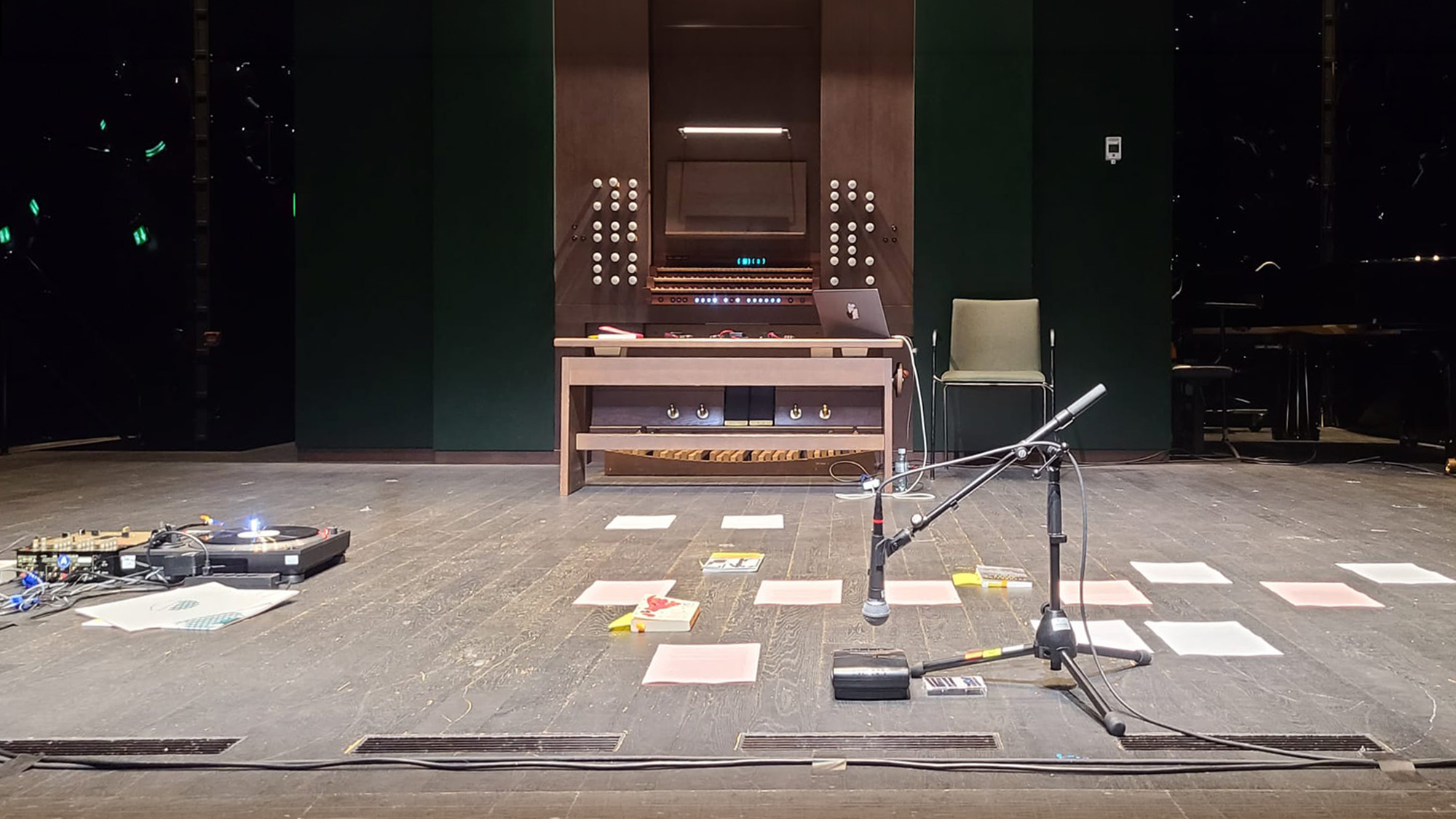
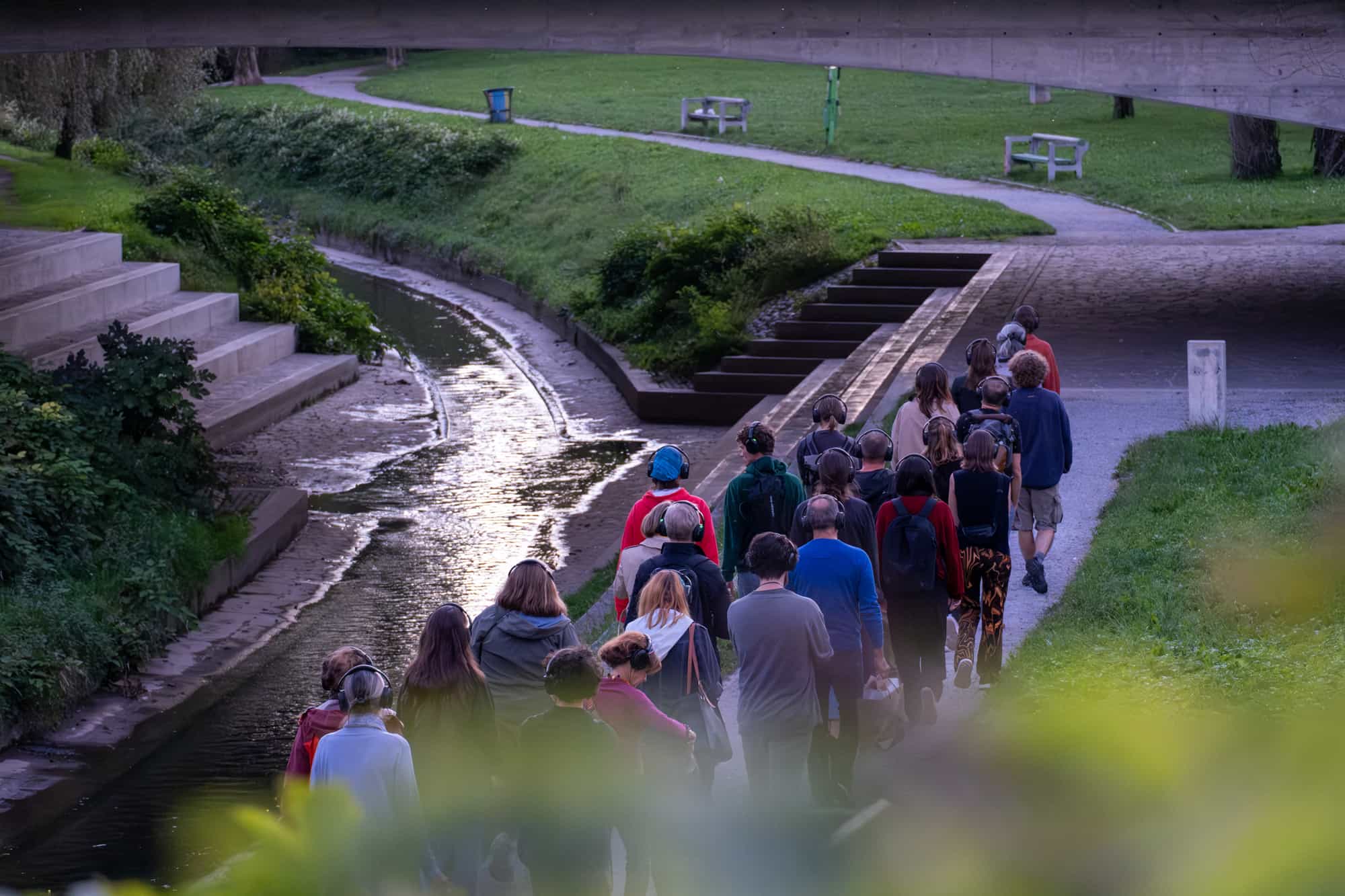
This is a curatorial performance, i.e. a presentation in which I do not read a paper, but perform ideas by playing sounds and reciting poetry, reading texts and proposing text-scores, while moving and standing still. Using this format I aim to rethink the notion of “no signal“ – not as noise or a loss of connection – but as an opportunity to hear silence and the silenced, and thus as an opportunity to start hearing things. “No signal“ appears valueless in relation to communication. It is the fuzzy sound of a bad connection, which imparts nothing, and carries no worth. It implies a lack and describes the undesirable that needs to be cleaned up and erased in order to create a clear meaning and sense. The expectation is that we overcome this lack in order to organise sound into something we can make (visual) sense of.
However, what if we focus on the lack of connection and the fuzzy sound rather than the signal? What if we abandon the differentiation? – I will query the “no signal“ as that which opens an alternative audition. To get to a prior meaning, before signification. A preliminary sense that lies beyond legibility and enables a different response.
This is a curatorial performance, i.e. a presentation in which I do not read a paper, but perform ideas by playing sounds and reciting poetry, reading texts and proposing text-scores, while moving and standing still. Using this format I aim to rethink the notion of “no signal“ – not as noise or a loss of connection – but as an opportunity to hear silence and the silenced, and thus as an opportunity to start hearing things. “No signal“ appears valueless in relation to communication. It is the fuzzy sound of a bad connection, which imparts nothing, and carries no worth. It implies a lack and describes the undesirable that needs to be cleaned up and erased in order to create a clear meaning and sense. The expectation is that we overcome this lack in order to organise sound into something we can make (visual) sense of.
However, what if we focus on the lack of connection and the fuzzy sound rather than the signal? What if we abandon the differentiation? – I will query the “no signal“ as that which opens an alternative audition. To get to a prior meaning, before signification. A preliminary sense that lies beyond legibility and enables a different response.
Salomé Voegelin
An artist and writer engaged in listening and sound making as a socio-political practice. She writes articles and papers, books, texts and text-scores for performances and publication. Her most recent book Uncurating Sound: Knowledge with Voiceand Hands (2023) moves curation through the double negative of not not to ‘uncuration’: untethering knowledge from the expectations of reference and a canonical frame, and reconsidering art as political – not in its message or aim – but by the way it confronts the institution. While Unperforming the Dream House ActiveRat (2023) discusses the impact of the 1960 and 70s American dream on the present-day global nightmare. She is a Professor of Sound at CRiSAP, University of the Arts London, UK as well as the Bern Academy of Arts, Switzerland.
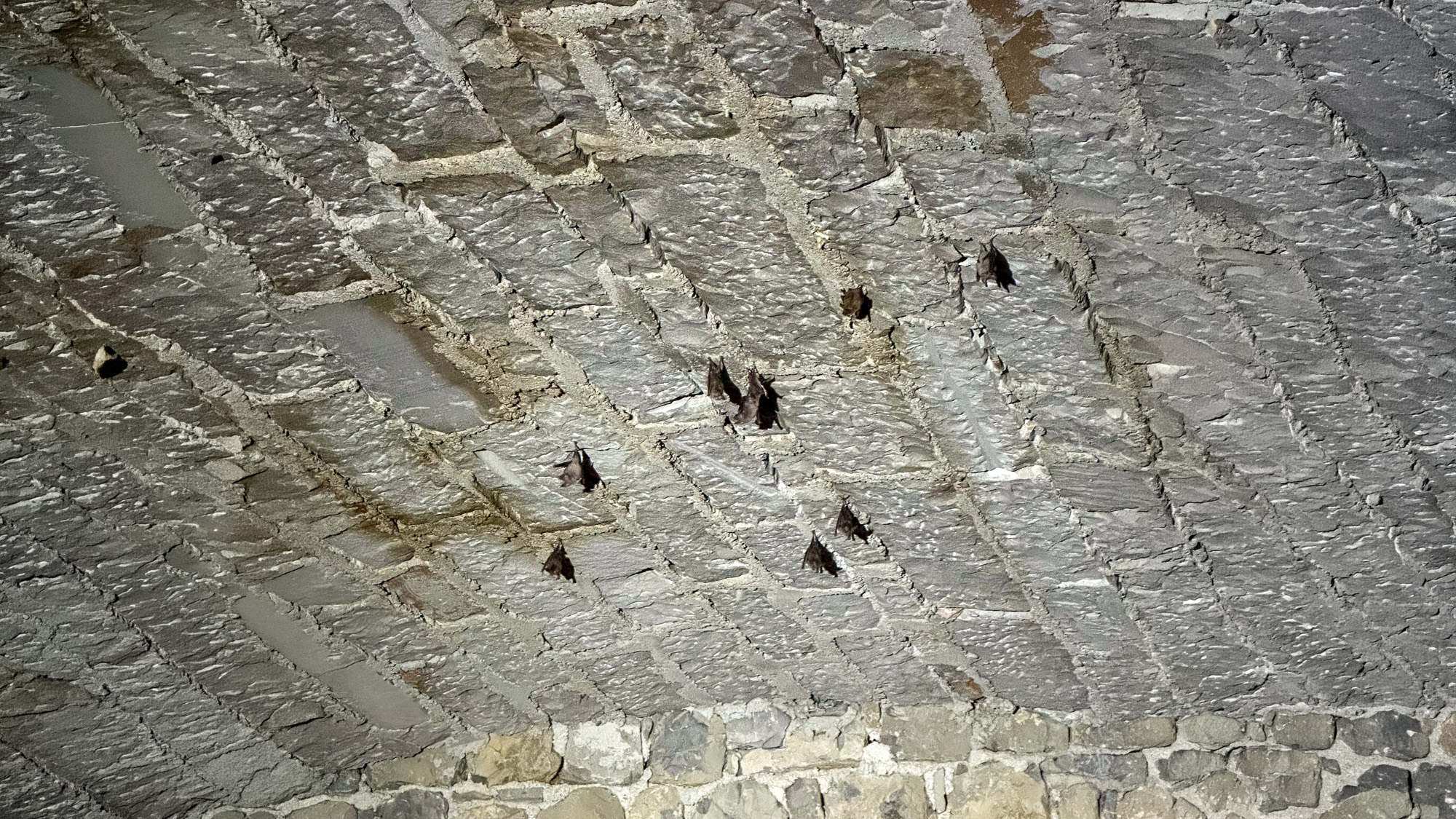
The bioacoustic sound sculpture Inaudible – Audible, among the Bats reveals an almost inaudible world of frequency ranges emitted by bats that are usually inaccessible to humans. The project is positioned between sound ecology and bioacoustic music, as it processes the sounds of the night environment and bats from the ultrasonic spectrum and transposes them into the human audible range.
The composition consists of audible night sounds, joined by transposed bat voices and other nocturnal sound sources. The final sound space consists of an inner – castle, distant forest and central space, represented by the external platform surrounding the castle. The composition includes electroacoustic processing of the sound material and is played as a spatial, 3D or 360-degree sound projection.
The bioacoustic sound sculpture Inaudible – Audible, among the Bats reveals an almost inaudible world of frequency ranges emitted by bats that are usually inaccessible to humans. The project is positioned between sound ecology and bioacoustic music, as it processes the sounds of the night environment and bats from the ultrasonic spectrum and transposes them into the human audible range.
The composition consists of audible night sounds, joined by transposed bat voices and other nocturnal sound sources. The final sound space consists of an inner – castle, distant forest and central space, represented by the external platform surrounding the castle. The composition includes electroacoustic processing of the sound material and is played as a spatial, 3D or 360-degree sound projection.
Boštjan Perovšek
A musician, composer and sound space designer who creates experimental and electroacoustic music. He is particularly interested in bioacoustic music, which is based on the sounds of animals, especially insects, and the connection between science and art. He collaborates with the groups SAETA and Jata C and the duo BBtrem, as well as creates music for film, theatre, performances, multimedia installations, museums and galleries. In 2013, he received the honorary Valvasor Award for his work in the field of sound spaces for museum installations.
Kolofon / Colophon
Concept and realisation: Boštjan Perovšek
produced by SAETA – Zavod za kulturne in promocijske aktivnosti Expert associates: dr. Klemen Koselj, expert on the life of bats, Slovenia, and dr. Roland Mühlethaler, expert in the field of bioacoustics and biodiversity, Germany. Photo: Boštjan Perovšek
The project was created for the European Capital of Culture GO! 2025 Nova Gorica – Gorizia and was co-financed within the framework of the GO! 2025 program.
The reduced ticket price applies to secondary school students, university students, pensioners, and self-employed professionals in the cultural sector.
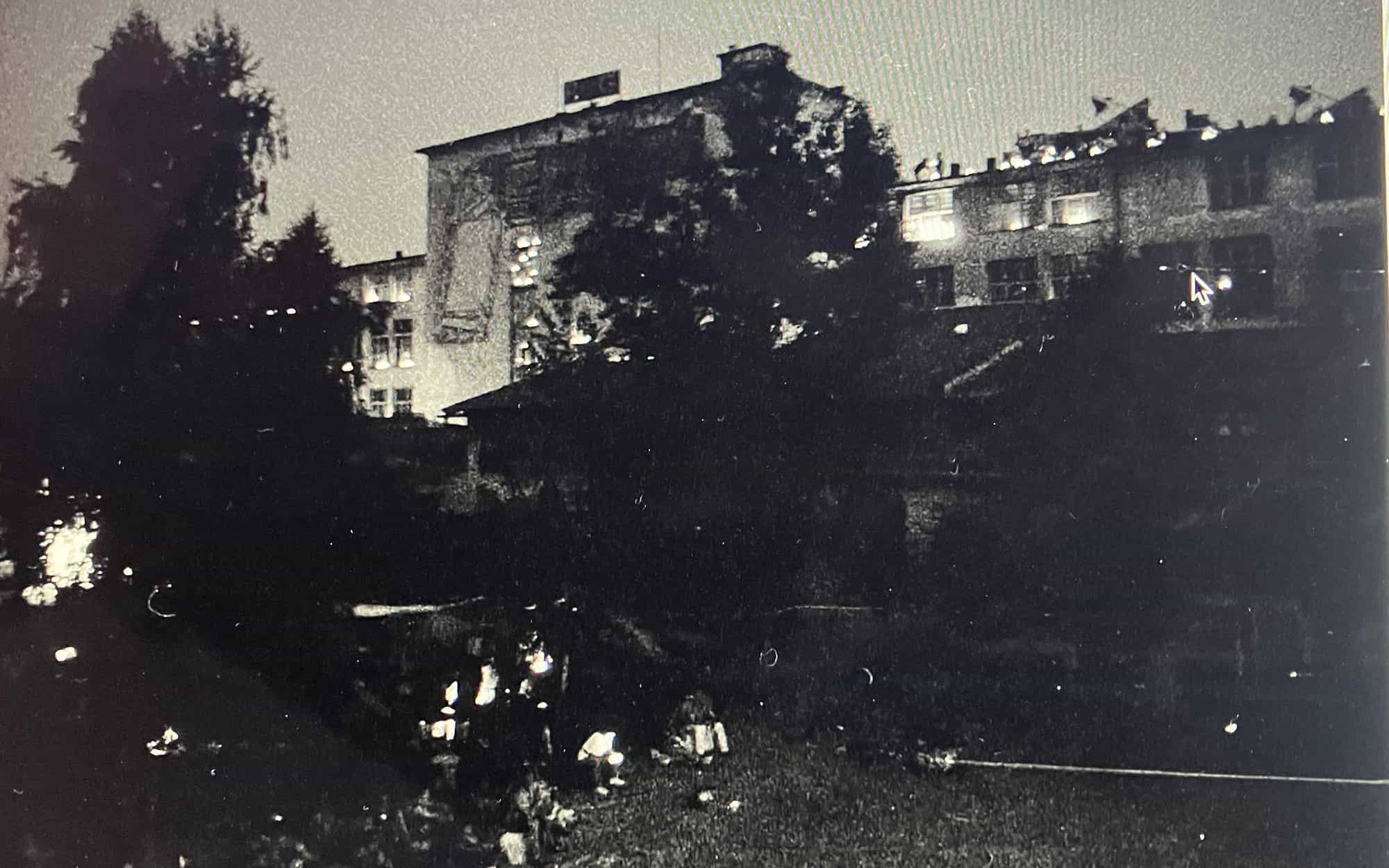
The soundwalk Odjek strela is an artistic research that uses guided listening to open questions of memory, archiving and silence within the urban space. The listening session stems from years of researching the relationship between documentation and forgetting. The walk is based on the layering of sound materials – archival recordings, text fragments, field recordings and contemporary sound interventions – that are intertwined with sounds taken from the immediate surroundings. This establishes a tension between the mediated and the directly experienced, the written and the elusive. The central motif of the soundwalk is the echo of a gunshot – a sound that returns, moves away and comes closer, as a point of orientation and as a disturbance. It refers to the former symbol of the pink gun on the facade of the former Rog factory and opens questions linked to the history of the space: from industrial production to autonomous practices, erasure and transformation. What happens to the story when the gun is not fired? The author treats the lack of the gunshot as silence – an active and meaningful absence. The soundscape shifts between the echoes of live radio transmissions emitted from the roof of the former factory building and low-frequency pulses in its basement, which act almost physically, like a subterranean recording. The path leads through the urban space as through an invisible archive, in which layered histories and repressed memories are revealed. Speculative questions are raised: what would the trees remember if they were still standing, and what traces do the new trees extract from the soil? The conclusion at the former Rog factory, at the monument to the erased, establishes a temporary, invisible monument – a space of reflection on what remains unspoken but persistently present.
The soundwalk Odjek strela is an artistic research that uses guided listening to open questions of memory, archiving and silence within the urban space. The listening session stems from years of researching the relationship between documentation and forgetting. The walk is based on the layering of sound materials – archival recordings, text fragments, field recordings and contemporary sound interventions – that are intertwined with sounds taken from the immediate surroundings. This establishes a tension between the mediated and the directly experienced, the written and the elusive. The central motif of the soundwalk is the echo of a gunshot – a sound that returns, moves away and comes closer, as a point of orientation and as a disturbance. It refers to the former symbol of the pink gun on the facade of the former Rog factory and opens questions linked to the history of the space: from industrial production to autonomous practices, erasure and transformation. What happens to the story when the gun is not fired? The author treats the lack of the gunshot as silence – an active and meaningful absence. The soundscape shifts between the echoes of live radio transmissions emitted from the roof of the former factory building and low-frequency pulses in its basement, which act almost physically, like a subterranean recording. The path leads through the urban space as through an invisible archive, in which layered histories and repressed memories are revealed. Speculative questions are raised: what would the trees remember if they were still standing, and what traces do the new trees extract from the soil? The conclusion at the former Rog factory, at the monument to the erased, establishes a temporary, invisible monument – a space of reflection on what remains unspoken but persistently present.
Sava šumi [Urška Savič]
Intermedia artist and journalist working in the field of culture. In her work, she explores the relationships between documentation, archives and memory, and the tensions between recording and forgetting. Between 2019 and 2025 she led the RADAR platform on Radio Študent, while she currently works as an external collaborator at the Academy of Fine Arts and Design and Radio ARS, and is also active as a member of the photography collective Kela.
Kolofon / Colophon
Artist: Sava šumi [Urška Savič]
In cooperation with: Modri kot, Maya Al Khaldi.
Special thanks: Radio Študent, Archive of Neomejen Rog uporabe
Produced by: Cona, 2026
The author of the walk was selected through the Open Call for New Sound Walks of the TO)pot Festival in 2025.
The price includes a meal and is payable directly to No. 01 Baza.
REPAST is a shared lunch for artists and visitors to the TO)pot festival. It is conceived as a space for gathering, taking a break, and informally engaging with the ideas and themes explored through the work of Cona and the TO)pot festival.
The BAZA space welcomes visitors with a soundscape featuring compositions from the Cona archive, alongside a selection of books, specialist publications, and booklets from the archive of Cona’s projects.
REPAST is a shared lunch for artists and visitors to the TO)pot festival. It is conceived as a space for gathering, taking a break, and informally engaging with the ideas and themes explored through the work of Cona and the TO)pot festival.
The BAZA space welcomes visitors with a soundscape featuring compositions from the Cona archive, alongside a selection of books, specialist publications, and booklets from the archive of Cona’s projects.
The reduced ticket price applies to primary and secondary school students, university students, pensioners, unemployed people, and people with disabilities.
This guided soundwalk leads us from the Monument to Ivan Hribar, across the Triple Bridge, past Prešeren’s statue, along the Hribar Embankment, streets, buildings, networks – concrete spaces that were in a way gifted to us by Ivan Hribar’s vision and which open our minds to reflections, meetings and events in his life. Vinko Möderndorfer draws on professional and literary texts through which he depicts the irresistible ethical stance, wealth of spirit and vision of a thinker, mayor, politician, a sensitive supporter of art and culture, a man who helped reshape the post-earthquake Ljubljana and for whom politics meant the honour of “being able to selflessly serve people“.
The soundwalk recreates a walk through his silences, which are full of reminiscences and reflections from his life, silences that allow us to explore our own reflections and question our period and values. Ivan Hribar’s final walk in 1941, silent within the sonority of the city, but a clear “yes“ to his personal values and his rebellion against foreign occupation and unprincipledness, is in reality not the final walk, as we only have to open our senses to hear and feel the “light breeze“ of his spirit.
Vinko Möderndorfer, Saška Rakef, Ingrid Mačus, Matjaž Miklič
This guided soundwalk leads us from the Monument to Ivan Hribar, across the Triple Bridge, past Prešeren’s statue, along the Hribar Embankment, streets, buildings, networks – concrete spaces that were in a way gifted to us by Ivan Hribar’s vision and which open our minds to reflections, meetings and events in his life. Vinko Möderndorfer draws on professional and literary texts through which he depicts the irresistible ethical stance, wealth of spirit and vision of a thinker, mayor, politician, a sensitive supporter of art and culture, a man who helped reshape the post-earthquake Ljubljana and for whom politics meant the honour of “being able to selflessly serve people“.
The soundwalk recreates a walk through his silences, which are full of reminiscences and reflections from his life, silences that allow us to explore our own reflections and question our period and values. Ivan Hribar’s final walk in 1941, silent within the sonority of the city, but a clear “yes“ to his personal values and his rebellion against foreign occupation and unprincipledness, is in reality not the final walk, as we only have to open our senses to hear and feel the “light breeze“ of his spirit.
Vinko Möderndorfer
Director, writer, poet and playwright, born in 1958 in Celje, graduated in theatre and radio directing from AGRFT. He has written more than eighty radio plays, many of which have been performed on Radio Slovenia, Radio Trieste A, as well as in Germany, Czechia, Slovakia and Croatia. He has published over thirty works in the fields of prose, poetry, drama and essays. He has received numerous awards for his work.
Saška Rakef
A playwright, director and researcher of experiences triggered by sound. She is employed as a radio director at Radio Slovenia and teaches radio directing at the Academy of Theatre, Radio, Film and Television in Ljubljana.
Ingrid Mačus
A composer and pianist. She explores the space between sound and word in collaboration with poets as well as collaborates with filmmakers. She graduated in composition from the Jacopo Tomadini State Conservatory in Udine.
Matjaž Miklič
A sound engineer at Radio Slovenia with a rich opus of radio plays, many of which have been nominated and awarded at international festivals.
Kolofon / Colophon
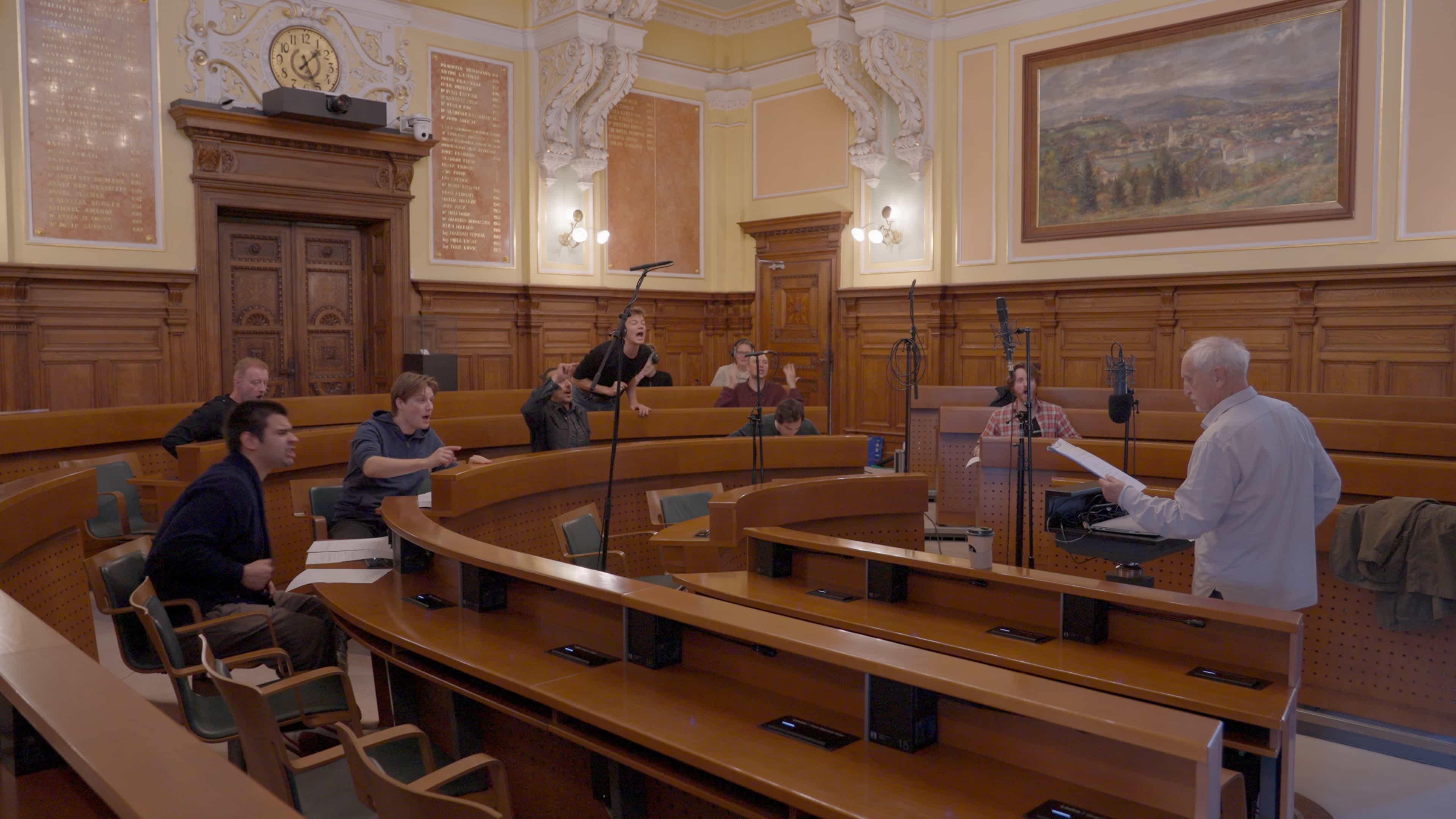
Text: Vinko Möderndorfer Director: Saška Rakef Music composition: Ingrid Mačus Sound engineer: Matjaž Miklič Dramaturgy: Ana Krauthaker, Vilma Štritof Overall vocal concept: Mateja Juričan Sound assistance: Martin Florjančič Coordination: Tina Ogrin Radio Drama Programme Editor: Alen Jelen Cast: Vladimir Jurc (Ivan Hribar), Borut Veselko (Ivan Tavčar), Matej Puc (Maks Fabiani), Primož Pirnat (Anton Aškerc), Branko Završan (Bishop Anton Jeglič), Helena Peršuh (Marija Hribar), Matija Vastl (imperial envoy), Francesco Borchi (Emilio Grazioli), Matej Recer, Nejc Kravos, Peter Podgoršek, Maksim Mićković, Aleksandar Jovanovski, Jakob Podjavoršek, Marko Rafolt (councillors), Tina Ogrin (secretary) Photo: Igor Velše
Acknowledgements: City of Ljubljana, Irena Žmuc
The event is produced by RTV Slovenia – Radio Slovenia 3 – Ars Programme and the Museum and Galleries of Ljubljana, in co-production with ŠKUC Theatre.
The reduced ticket price applies to secondary school students, university students, pensioners, and self-employed professionals in the cultural sector.
Due to rain, the walk has been postponed to Tuesday, 15 September, at 7 p.m. Tickets purchased for Thursday will also be valid for the rescheduled date.
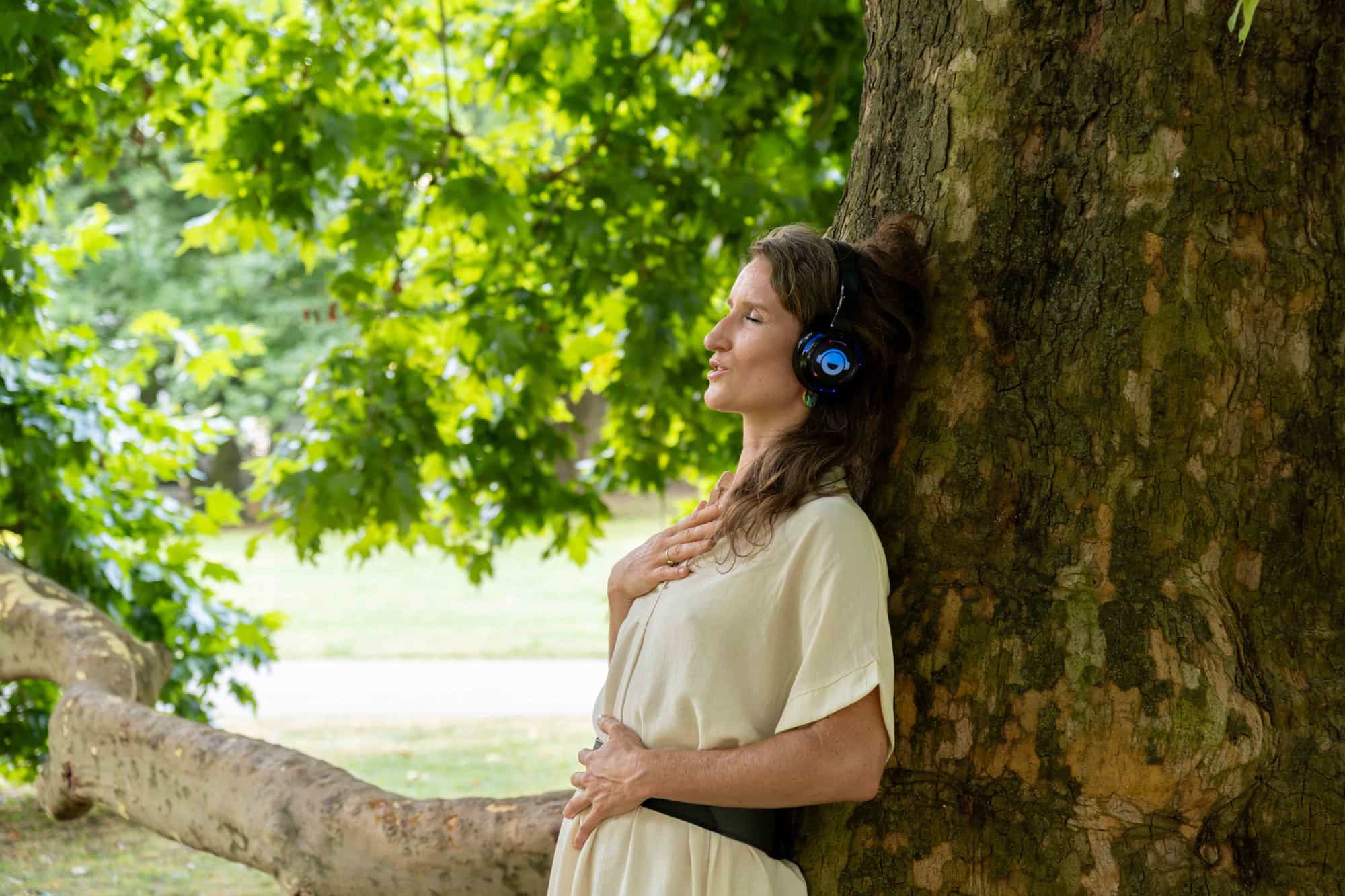
Voice shapes unique compositions with the complex musical instrument of our bodies every day. A unique composition that follows the individual’s paths is created through the multi-layered structure of predominantly improvised responses to the numerous stimuli to which we are exposed daily and situationally.
The voice, even when not expressed, resides in the inner silence of an individual, thus forming a living entity in which continuous communication between multiple sub-personalities takes place. Only through a conscious decision does it become audible, flexibly transitioning between different roles: communication, warning, messaging, expression of power, creation, social networking, calming or a therapeutic tool.
The GLASnaPOT soundwalk takes us gradually from the loud city streets to inner landscapes – on a journey during which we get to know the musical instrument that we inhabit, inviting us to curiously explore all its hidden corners.
Voice shapes unique compositions with the complex musical instrument of our bodies every day. A unique composition that follows the individual’s paths is created through the multi-layered structure of predominantly improvised responses to the numerous stimuli to which we are exposed daily and situationally.
The voice, even when not expressed, resides in the inner silence of an individual, thus forming a living entity in which continuous communication between multiple sub-personalities takes place. Only through a conscious decision does it become audible, flexibly transitioning between different roles: communication, warning, messaging, expression of power, creation, social networking, calming or a therapeutic tool.
The GLASnaPOT soundwalk takes us gradually from the loud city streets to inner landscapes – on a journey during which we get to know the musical instrument that we inhabit, inviting us to curiously explore all its hidden corners.
Allja Petric
Singer, vocal pedagogue and sound artist working in the field of contemporary, improvised and cross-genre music. Her work consists of independent projects, original music and collaborations in various musical, sound, performative and interdisciplinary productions. In addition to holding concerts, she has also been leading individual and group singing workshops for over ten years.
Kolofon / Colophon
Authorship and performance: Allja Petric Consultation: Brane Zorman, Irena Pivka Language and stylistic review: Mateja Juričan Photography: Matej Tomažin Production: Cona, 2026
The author of the walk was selected through the Open Call for New Sound Walks of the TO)pot Festival in 2025.
The reduced ticket price applies to secondary school students, university students, pensioners, and self-employed professionals in the cultural sector.
Voice shapes unique compositions with the complex musical instrument of our bodies every day. A unique composition that follows the individual’s paths is created through the multi-layered structure of predominantly improvised responses to the numerous stimuli to which we are exposed daily and situationally.
The voice, even when not expressed, resides in the inner silence of an individual, thus forming a living entity in which continuous communication between multiple sub-personalities takes place. Only through a conscious decision does it become audible, flexibly transitioning between different roles: communication, warning, messaging, expression of power, creation, social networking, calming or a therapeutic tool.
The GLASnaPOT soundwalk takes us gradually from the loud city streets to inner landscapes – on a journey during which we get to know the musical instrument that we inhabit, inviting us to curiously explore all its hidden corners.
Voice shapes unique compositions with the complex musical instrument of our bodies every day. A unique composition that follows the individual’s paths is created through the multi-layered structure of predominantly improvised responses to the numerous stimuli to which we are exposed daily and situationally.
The voice, even when not expressed, resides in the inner silence of an individual, thus forming a living entity in which continuous communication between multiple sub-personalities takes place. Only through a conscious decision does it become audible, flexibly transitioning between different roles: communication, warning, messaging, expression of power, creation, social networking, calming or a therapeutic tool.
The GLASnaPOT soundwalk takes us gradually from the loud city streets to inner landscapes – on a journey during which we get to know the musical instrument that we inhabit, inviting us to curiously explore all its hidden corners.
Allja Petric
Singer, vocal pedagogue and sound artist working in the field of contemporary, improvised and cross-genre music. Her work consists of independent projects, original music and collaborations in various musical, sound, performative and interdisciplinary productions. In addition to holding concerts, she has also been leading individual and group singing workshops for over ten years.
Kolofon / Colophon
Authorship and performance: Allja Petric Consultation: Brane Zorman, Irena Pivka Language and stylistic review: Mateja Juričan Photography: Matej Tomažin Production: Cona, 2026
The author of the walk was selected through the Open Call for New Sound Walks of the TO)pot Festival in 2025.
The reduced ticket price applies to secondary school students, university students, pensioners, and self-employed professionals in the cultural sector.
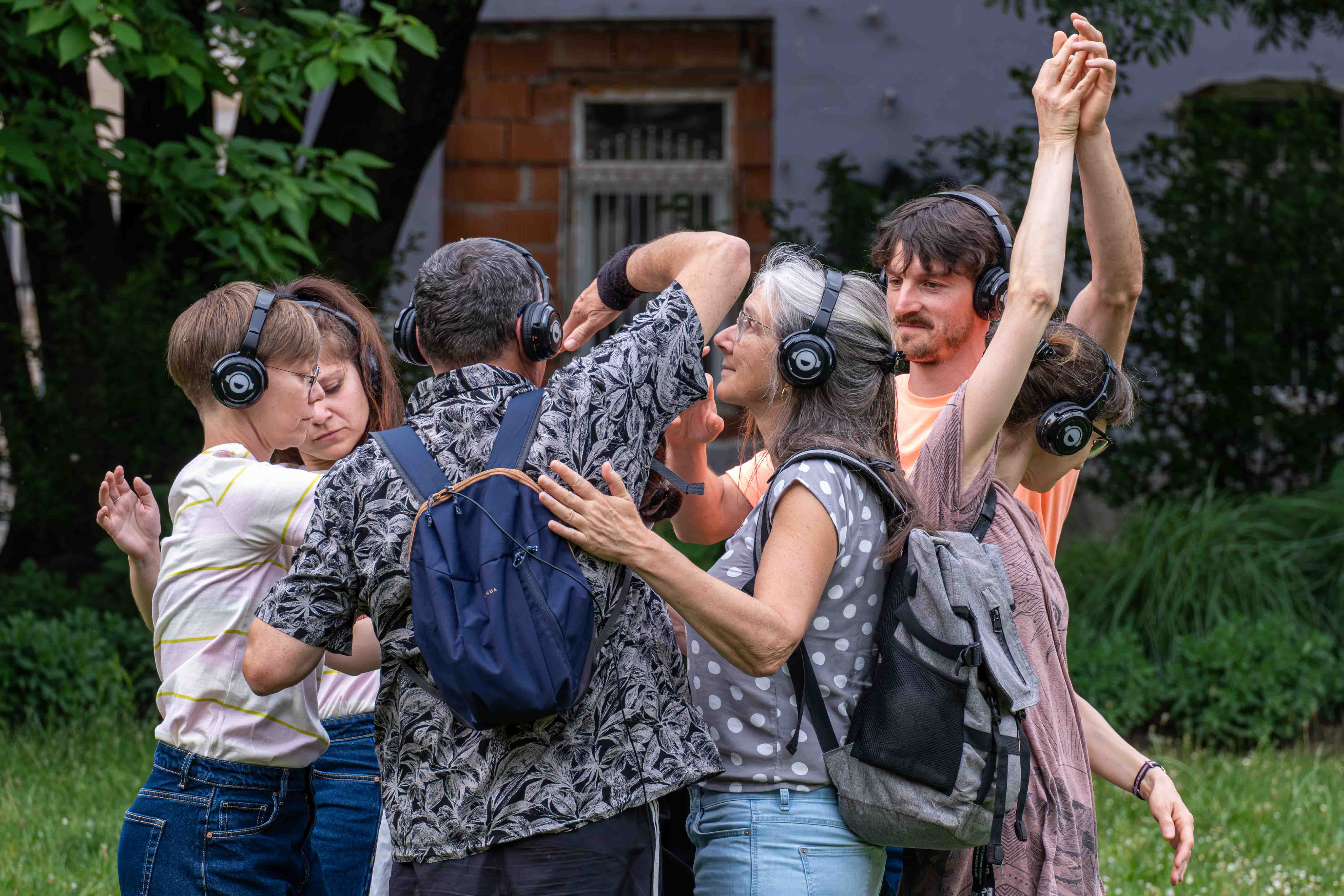
Tu, čisto blizu is an invitation for participants to transform from passive walkers into active co-creators of the urban landscape, leaving behind a more visible imprint, a more visible trace.
On the level of both the individual and the group, the walk explores how we inhabit and move through the city, and what defines the nature of our encounters and interactions. It foregrounds the bodily dimension of experiencing the city and asks how the body might be placed within the predictable dynamics of urban life in a different way. It highlights the power of the moment when individuals step out of individualistic, fleeting observation of their surroundings and become aware of, give meaning to, and perhaps even alter their automated urban routes.
Through different situations and stops in the city, Tu, čisto blizu invites participants to walk through the city in a playful and liberated way, and to actively situate themselves within it.
Tu, čisto blizu is an invitation for participants to transform from passive walkers into active co-creators of the urban landscape, leaving behind a more visible imprint, a more visible trace.
On the level of both the individual and the group, the walk explores how we inhabit and move through the city, and what defines the nature of our encounters and interactions. It foregrounds the bodily dimension of experiencing the city and asks how the body might be placed within the predictable dynamics of urban life in a different way. It highlights the power of the moment when individuals step out of individualistic, fleeting observation of their surroundings and become aware of, give meaning to, and perhaps even alter their automated urban routes.
Through different situations and stops in the city, Tu, čisto blizu invites participants to walk through the city in a playful and liberated way, and to actively situate themselves within it.
Urša Sekirnik
A dancer and creator working in the field of contemporary performing arts. In her projects, audience involvement in both the process and performance is one of her main areas of interest, which is why in recent years she has focused on creating participatory performances.
Aja Zupanec
A dancer, dance pedagogue and choreographer, she moves between these areas of contemporary dance. As an artist, she is most interested in artistic explorations of ideals shaped by society and of the world that exists within our bodies.
Beti Strgar
Musician, music producer and actress who combines various artistic practices in her work. In her projects she explores human identity, sonority and the authenticity of stage expression.
Kolofon / Colophon
Authorship and performance: Aja Zupanec and Urša Sekirnik Music and sound design: Beti Strgar Production and consulting: Irena Pivka and Brane Zorman Photography: Matej Tomažin Partner: KUD NUM Production: CONA, 2026
The authors of the walk were selected through the Open Call for New Sound Walks of the TO)pot Festival in 2025.
The reduced ticket price applies to secondary school students, university students, pensioners, and self-employed professionals in the cultural sector.
The sound walk addresses Ljubljana’s underpasses, largely abandoned areas, reveal the city’s inability to imagine new urban uses and meanings. Neglected underpasses beneath the paving stones of orderly streets and squares are becoming shelters for those unheard on the margins of society.
The author listens closely to the Ajdovščina underpass. Through real-time sound capture and processing, everyday noises, silences, footsteps and echoes are transformed into an immersive sonic experience that opens up a space for what has been left unspoken. It reveals moments of unexpected beauty and places the listener in relation to space as a living, multilayered organism of unheard realities.
The Ajdovščina underpass, built on the site of a former Emona cemetery, carries deeper historical layers. Walking through these underground corridors becomes a movement through the temporalities of the city, where life, death, memory and forgetting intertwine.
Pod(hod) is conceived as a collection of associations from a day in the lives of individuals on the margins of society. The titles of the sound segments, Tunings, Silent Prayers, Gatherings of the Found, Walk of Shame, Lives Before Shop Windows, Lullaby, Morning Again and A Fragile Confrontation with Reality, do not interpret these lives, but create a space of listening in which a sensitive, open relationship to the other and to the world can emerge.
The world holds you, like it or not.
It moves you with fire and wind when it’s hot.
You’re chasing your sleep and wasting your spot —
you better start living.
The world has you turning the dirt, unforgiving,
old gravity is pulling — but love, oh love,
the night that embraced you unraveled the night.
The sound walk addresses Ljubljana’s underpasses, largely abandoned areas, reveal the city’s inability to imagine new urban uses and meanings. Neglected underpasses beneath the paving stones of orderly streets and squares are becoming shelters for those unheard on the margins of society.
The author listens closely to the Ajdovščina underpass. Through real-time sound capture and processing, everyday noises, silences, footsteps and echoes are transformed into an immersive sonic experience that opens up a space for what has been left unspoken. It reveals moments of unexpected beauty and places the listener in relation to space as a living, multilayered organism of unheard realities.
The Ajdovščina underpass, built on the site of a former Emona cemetery, carries deeper historical layers. Walking through these underground corridors becomes a movement through the temporalities of the city, where life, death, memory and forgetting intertwine.
Pod(hod) is conceived as a collection of associations from a day in the lives of individuals on the margins of society. The titles of the sound segments, Tunings, Silent Prayers, Gatherings of the Found, Walk of Shame, Lives Before Shop Windows, Lullaby, Morning Again and A Fragile Confrontation with Reality, do not interpret these lives, but create a space of listening in which a sensitive, open relationship to the other and to the world can emerge.
The world holds you, like it or not.
It moves you with fire and wind when it’s hot.
You’re chasing your sleep and wasting your spot —
you better start living.
The world has you turning the dirt, unforgiving,
old gravity is pulling — but love, oh love,
the night that embraced you unraveled the night.
ACCOMPANYING PROGRAMME
Luka Uršič The Gift of Failure
4. 6.–30. 8. 2026, MGLC Grad Tivoli
On Thursday, June 4, 2026, at 19.30, the exhibition The Gift of Failure by Luka Uršič will open at the International Centre of Graphic Arts (Pod turnom 3, Ljubljana).
Failure as a point of departure for potential future success is today a key part of the artistic process. What might elsewhere be understood as an error or anomaly can become an expressive value and a space of freedom in art. With new works produced this year in the MGLC Print Studio, Luka Uršič explores the potential of his artistic practice as a reparative mechanism.
Through screenprinting interventions on the unsuccessful and discarded Polaroid photographs by others, the artist returns to the source of failure and symbolically takes on the blame and responsibility for failed actions. In this way, he confronts his own and others’ unease, while simultaneously attempting to approach the liberating possibility of redemptive correction and improvement.
Curator of the exhibition: Yasmín Martín Vodopivec
The exhibition will be on view at MGLC Grad Tivoli until 30 August.
INTRODUCTORY TEXT
The Metalka business building in Ljubljana is one of the key examples of Slovenian late modernism and early post-war commercial architecture. Metalka was built in 1963 according to plans by architects Edo Mihevc and Boris Leskovec, and was the first modern business high-rise in Slovenia. It emerged at a time when Ljubljana sought to develop as a modern socialist capital with a clearly articulated business centre.
In the sound walk Pod(hod), however, the artist approaches the exploration of space from another, non-architectural perspective. His interest lies in spontaneous use: in the time after design, construction, planning, and the comprehensive vision of the building and its wider project have run their course. How long, and with what degree of quality, can a space continue to live within a constantly changing environment and society? What, and who, inhabits the space unexpectedly?
The sound walk addresses the underpass, today a largely abandoned area that reveals the difficulty of imagining new urban contents. Neglected underpasses beneath the paving stones of orderly streets and squares become refuges for those unheard at the margins of society. The artist approaches the listening of space in an authorial and intimate way, giving voice to the unseen users of an abandoned space, as well as to the space itself, to its membrane. In doing so, he reflects on shifting, unstable social conditions and on the fragility of the spaces embedded within them.
Through the capture and processing of sound in real time, everyday noises, silences, footsteps, and echoes are transformed into an immersive sonic experience that opens a space for what has remained unspoken. The listener is placed in relation to space as a living, multilayered organism of unheard realities.
Kalu [Luka Uršič]
A visual artist, musician, and performer living and working in Ljubljana. His practice develops at the intersection of image and sound, where, through an intuitive process, he explores relationships between space, materiality, and perception. In his works, he creates suggestive, sensory experiences, while as a music producer he shapes soundscapes for various artistic projects and composes music for his own and collaborative productions.
Kolofon / Colophon
Authorship and performance: Kalu [Luka Uršič] Consulting: Brane Zorman Producer: Alja Petric Text preparation: Martina Valášková, Irena Pivka Photography: Matej Tomažin Partner: Skladišče 172 Production: Cona, 2026
The author of the walk was selected through the Open Call for New Sound Walks of the TO)pot Festival in 2025.
The reduced ticket price applies to secondary school students, university students, pensioners, and self-employed professionals in the cultural sector. The ticket already includes a return funicular ride.
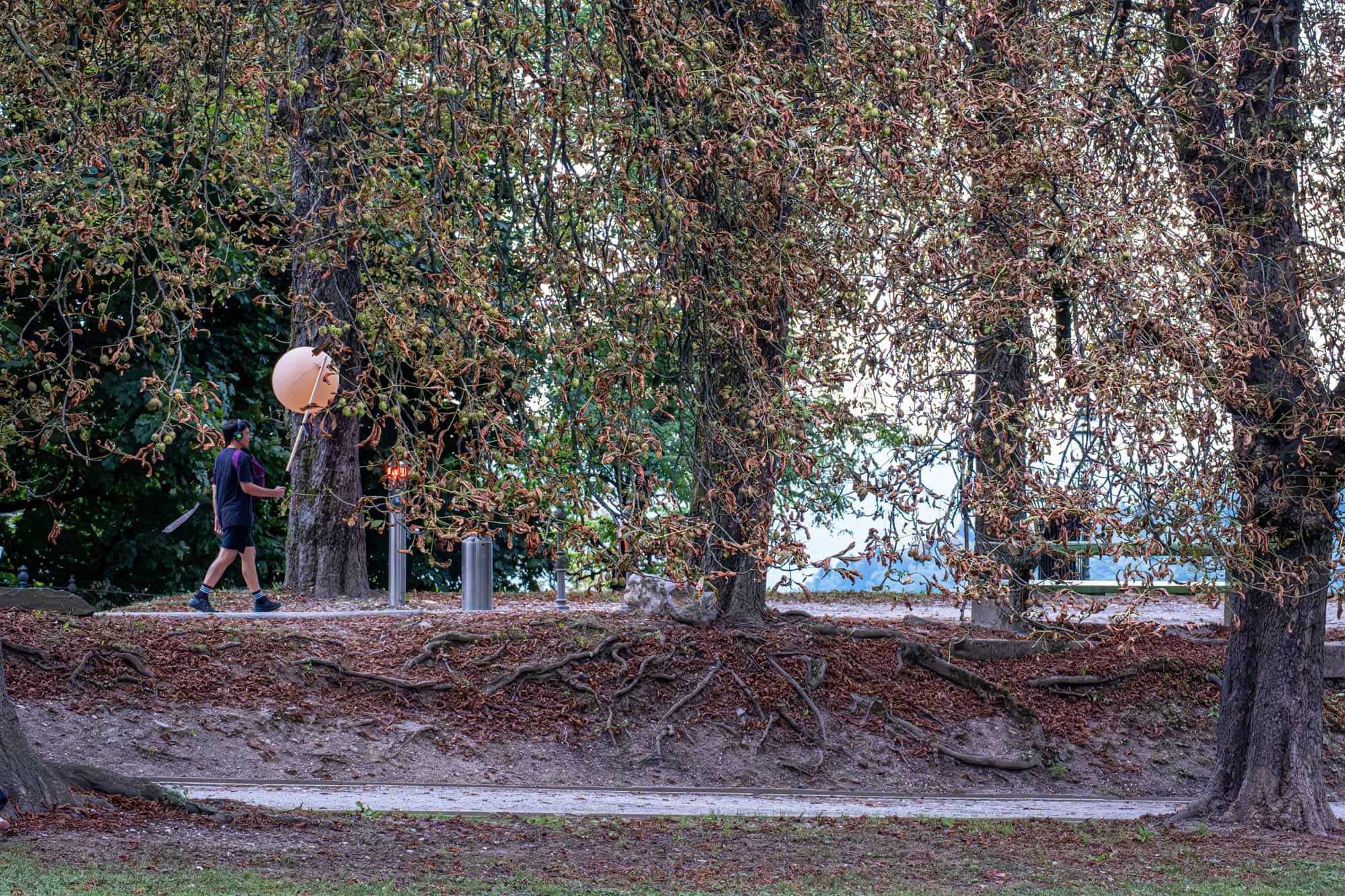
The artist takes a weather balloon as the starting point for her research and sonic journey. Used worldwide for meteorological measurements and weather forecasting, over 800 weather balloons are released daily. They rise through the atmosphere, exposed to changing air pressure, temperature, density and wind.
Our atmospheric imaginary journey begins at the entrance to the Ljubljana Castle funicular, which will carry us up to the castle. Once we reach a certain height, we will travel even further – following the tension and transformation of the balloon as it stretches to its breaking point: the sudden burst and fall. Afterwards, we will return by funicular to the foot of the castle hill.
The 40-minute sound composition combines recordings from meteorological instruments, field and studio sessions, interviews with experts and the tracking of the balloon’s path by an observer who descends, follows and collects data. We will follow the metaphorical journey of release, lifting, stretching, bursting, falling and landing. The sonic experience is guided by the artist’s voice, which explores moments of change, transformation, direction, speed, temperature, humidity, wind and more.
The layered soundscape shifts between the dreamlike and the scientific, offering intimate, physical, auditory and tactile stimuli that create a rich, multisensory experience.
The artist takes a weather balloon as the starting point for her research and sonic journey. Used worldwide for meteorological measurements and weather forecasting, over 800 weather balloons are released daily. They rise through the atmosphere, exposed to changing air pressure, temperature, density and wind.
Our atmospheric imaginary journey begins at the entrance to the Ljubljana Castle funicular, which will carry us up to the castle. Once we reach a certain height, we will travel even further – following the tension and transformation of the balloon as it stretches to its breaking point: the sudden burst and fall. Afterwards, we will return by funicular to the foot of the castle hill.
The 40-minute sound composition combines recordings from meteorological instruments, field and studio sessions, interviews with experts and the tracking of the balloon’s path by an observer who descends, follows and collects data. We will follow the metaphorical journey of release, lifting, stretching, bursting, falling and landing. The sonic experience is guided by the artist’s voice, which explores moments of change, transformation, direction, speed, temperature, humidity, wind and more.
The layered soundscape shifts between the dreamlike and the scientific, offering intimate, physical, auditory and tactile stimuli that create a rich, multisensory experience.
Neža Knez
Explores hybrid formats that blend discursive and poetic approaches to artistic practice, considering them inseparable from daily life. Her work investigates the relationships and interactions within forms such as moving images, sound, language and mixed media installations. She focuses on subtle, often invisible and fragile processes within media and material.
Kolofon / Colophon
Artist: Neža Knez Sound consulting: Tetiana Khoroshun Event photography: Matej Tomažin Translation into English: Melita Silič Production and consulting: Irena Pivka and Brane Zorman Production: Cona, 2025
The soundwalk Following was produced in collaboration with the Ministry of the Environment, Climate and Energy and the Slovenian Environment Agency. Thanks to: Andrej Vuga, Blaž Šter, Filip Štucin, and Ivana Furać, Vjeran Magjarević from the Croation Meteorological and Hydrological Service.
The author was selected through the Call for New Sound Walks by the TO)pot festival in 2024.
The reduced ticket price applies to secondary school students, university students, pensioners, and self-employed professionals in the cultural sector.
Tu, čisto blizu is an invitation for participants to transform from passive walkers into active co-creators of the urban landscape, leaving behind a more visible imprint, a more visible trace.
On the level of both the individual and the group, the walk explores how we inhabit and move through the city, and what defines the nature of our encounters and interactions. It foregrounds the bodily dimension of experiencing the city and asks how the body might be placed within the predictable dynamics of urban life in a different way. It highlights the power of the moment when individuals step out of individualistic, fleeting observation of their surroundings and become aware of, give meaning to, and perhaps even alter their automated urban routes.
Through different situations and stops in the city, Tu, čisto blizu invites participants to walk through the city in a playful and liberated way, and to actively situate themselves within it.
Tu, čisto blizu is an invitation for participants to transform from passive walkers into active co-creators of the urban landscape, leaving behind a more visible imprint, a more visible trace.
On the level of both the individual and the group, the walk explores how we inhabit and move through the city, and what defines the nature of our encounters and interactions. It foregrounds the bodily dimension of experiencing the city and asks how the body might be placed within the predictable dynamics of urban life in a different way. It highlights the power of the moment when individuals step out of individualistic, fleeting observation of their surroundings and become aware of, give meaning to, and perhaps even alter their automated urban routes.
Through different situations and stops in the city, Tu, čisto blizu invites participants to walk through the city in a playful and liberated way, and to actively situate themselves within it.
Urša Sekirnik
A dancer and creator working in the field of contemporary performing arts. In her projects, audience involvement in both the process and performance is one of her main areas of interest, which is why in recent years she has focused on creating participatory performances.
Aja Zupanec
A dancer, dance pedagogue and choreographer, she moves between these areas of contemporary dance. As an artist, she is most interested in artistic explorations of ideals shaped by society and of the world that exists within our bodies.
Beti Strgar
Musician, music producer and actress who combines various artistic practices in her work. In her projects she explores human identity, sonority and the authenticity of stage expression.
Kolofon / Colophon
Authorship and performance: Aja Zupanec and Urša Sekirnik Music and sound design: Beti Strgar Production and consulting: Irena Pivka and Brane Zorman Photography: Matej Tomažin Partner: KUD NUM Production: CONA, 2026
The authors of the walk were selected through the Open Call for New Sound Walks of the TO)pot Festival in 2025.
The reduced ticket price applies to secondary school students, university students, pensioners, and self-employed professionals in the cultural sector.
Tu, čisto blizu is an invitation for participants to transform from passive walkers into active co-creators of the urban landscape, leaving behind a more visible imprint, a more visible trace.
On the level of both the individual and the group, the walk explores how we inhabit and move through the city, and what defines the nature of our encounters and interactions. It foregrounds the bodily dimension of experiencing the city and asks how the body might be placed within the predictable dynamics of urban life in a different way. It highlights the power of the moment when individuals step out of individualistic, fleeting observation of their surroundings and become aware of, give meaning to, and perhaps even alter their automated urban routes.
Through different situations and stops in the city, Tu, čisto blizu invites participants to walk through the city in a playful and liberated way, and to actively situate themselves within it.
Tu, čisto blizu is an invitation for participants to transform from passive walkers into active co-creators of the urban landscape, leaving behind a more visible imprint, a more visible trace.
On the level of both the individual and the group, the walk explores how we inhabit and move through the city, and what defines the nature of our encounters and interactions. It foregrounds the bodily dimension of experiencing the city and asks how the body might be placed within the predictable dynamics of urban life in a different way. It highlights the power of the moment when individuals step out of individualistic, fleeting observation of their surroundings and become aware of, give meaning to, and perhaps even alter their automated urban routes.
Through different situations and stops in the city, Tu, čisto blizu invites participants to walk through the city in a playful and liberated way, and to actively situate themselves within it.
Urša Sekirnik
A dancer and creator working in the field of contemporary performing arts. In her projects, audience involvement in both the process and performance is one of her main areas of interest, which is why in recent years she has focused on creating participatory performances.
Aja Zupanec
A dancer, dance pedagogue and choreographer, she moves between these areas of contemporary dance. As an artist, she is most interested in artistic explorations of ideals shaped by society and of the world that exists within our bodies.
Beti Strgar
Musician, music producer and actress who combines various artistic practices in her work. In her projects she explores human identity, sonority and the authenticity of stage expression.
Kolofon / Colophon
Authorship and performance: Aja Zupanec and Urša Sekirnik Music and sound design: Beti Strgar Production and consulting: Irena Pivka and Brane Zorman Photography: Matej Tomažin Partner: KUD NUM Production: CONA, 2026
The authors of the walk were selected through the Open Call for New Sound Walks of the TO)pot Festival in 2025.
The reduced ticket price applies to secondary school students, university students, pensioners, and self-employed professionals in the cultural sector.
The sound walk addresses Ljubljana’s underpasses, largely abandoned areas, reveal the city’s inability to imagine new urban uses and meanings. Neglected underpasses beneath the paving stones of orderly streets and squares are becoming shelters for those unheard on the margins of society.
The author listens closely to the Ajdovščina underpass. Through real-time sound capture and processing, everyday noises, silences, footsteps and echoes are transformed into an immersive sonic experience that opens up a space for what has been left unspoken. It reveals moments of unexpected beauty and places the listener in relation to space as a living, multilayered organism of unheard realities.
The Ajdovščina underpass, built on the site of a former Emona cemetery, carries deeper historical layers. Walking through these underground corridors becomes a movement through the temporalities of the city, where life, death, memory and forgetting intertwine.
Pod(hod) is conceived as a collection of associations from a day in the lives of individuals on the margins of society. The titles of the sound segments, Tunings, Silent Prayers, Gatherings of the Found, Walk of Shame, Lives Before Shop Windows, Lullaby, Morning Again and A Fragile Confrontation with Reality, do not interpret these lives, but create a space of listening in which a sensitive, open relationship to the other and to the world can emerge.
The world holds you, like it or not.
It moves you with fire and wind when it’s hot.
You’re chasing your sleep and wasting your spot —
you better start living.
The world has you turning the dirt, unforgiving,
old gravity is pulling — but love, oh love,
the night that embraced you unraveled the night.
The sound walk addresses Ljubljana’s underpasses, largely abandoned areas, reveal the city’s inability to imagine new urban uses and meanings. Neglected underpasses beneath the paving stones of orderly streets and squares are becoming shelters for those unheard on the margins of society.
The author listens closely to the Ajdovščina underpass. Through real-time sound capture and processing, everyday noises, silences, footsteps and echoes are transformed into an immersive sonic experience that opens up a space for what has been left unspoken. It reveals moments of unexpected beauty and places the listener in relation to space as a living, multilayered organism of unheard realities.
The Ajdovščina underpass, built on the site of a former Emona cemetery, carries deeper historical layers. Walking through these underground corridors becomes a movement through the temporalities of the city, where life, death, memory and forgetting intertwine.
Pod(hod) is conceived as a collection of associations from a day in the lives of individuals on the margins of society. The titles of the sound segments, Tunings, Silent Prayers, Gatherings of the Found, Walk of Shame, Lives Before Shop Windows, Lullaby, Morning Again and A Fragile Confrontation with Reality, do not interpret these lives, but create a space of listening in which a sensitive, open relationship to the other and to the world can emerge.
The world holds you, like it or not.
It moves you with fire and wind when it’s hot.
You’re chasing your sleep and wasting your spot —
you better start living.
The world has you turning the dirt, unforgiving,
old gravity is pulling — but love, oh love,
the night that embraced you unraveled the night.
ACCOMPANYING PROGRAMME
Luka Uršič The Gift of Failure
4. 6.–30. 8. 2026, MGLC Grad Tivoli
On Thursday, June 4, 2026, at 19.30, the exhibition The Gift of Failure by Luka Uršič will open at the International Centre of Graphic Arts (Pod turnom 3, Ljubljana).
Failure as a point of departure for potential future success is today a key part of the artistic process. What might elsewhere be understood as an error or anomaly can become an expressive value and a space of freedom in art. With new works produced this year in the MGLC Print Studio, Luka Uršič explores the potential of his artistic practice as a reparative mechanism.
Through screenprinting interventions on the unsuccessful and discarded Polaroid photographs by others, the artist returns to the source of failure and symbolically takes on the blame and responsibility for failed actions. In this way, he confronts his own and others’ unease, while simultaneously attempting to approach the liberating possibility of redemptive correction and improvement.
Curator of the exhibition: Yasmín Martín Vodopivec
The exhibition will be on view at MGLC Grad Tivoli until 30 August.
INTRODUCTORY TEXT
The Metalka business building in Ljubljana is one of the key examples of Slovenian late modernism and early post-war commercial architecture. Metalka was built in 1963 according to plans by architects Edo Mihevc and Boris Leskovec, and was the first modern business high-rise in Slovenia. It emerged at a time when Ljubljana sought to develop as a modern socialist capital with a clearly articulated business centre.
In the sound walk Pod(hod), however, the artist approaches the exploration of space from another, non-architectural perspective. His interest lies in spontaneous use: in the time after design, construction, planning, and the comprehensive vision of the building and its wider project have run their course. How long, and with what degree of quality, can a space continue to live within a constantly changing environment and society? What, and who, inhabits the space unexpectedly?
The sound walk addresses the underpass, today a largely abandoned area that reveals the difficulty of imagining new urban contents. Neglected underpasses beneath the paving stones of orderly streets and squares become refuges for those unheard at the margins of society. The artist approaches the listening of space in an authorial and intimate way, giving voice to the unseen users of an abandoned space, as well as to the space itself, to its membrane. In doing so, he reflects on shifting, unstable social conditions and on the fragility of the spaces embedded within them.
Through the capture and processing of sound in real time, everyday noises, silences, footsteps, and echoes are transformed into an immersive sonic experience that opens a space for what has remained unspoken. The listener is placed in relation to space as a living, multilayered organism of unheard realities.
Kalu [Luka Uršič]
A visual artist, musician, and performer living and working in Ljubljana. His practice develops at the intersection of image and sound, where, through an intuitive process, he explores relationships between space, materiality, and perception. In his works, he creates suggestive, sensory experiences, while as a music producer he shapes soundscapes for various artistic projects and composes music for his own and collaborative productions.
Kolofon / Colophon
Authorship and performance: Kalu [Luka Uršič] Consulting: Brane Zorman Producer: Alja Petric Text preparation: Martina Valášková, Irena Pivka Photography: Matej Tomažin Partner: Skladišče 172 Production: Cona, 2026
The author of the walk was selected through the Open Call for New Sound Walks of the TO)pot Festival in 2025.
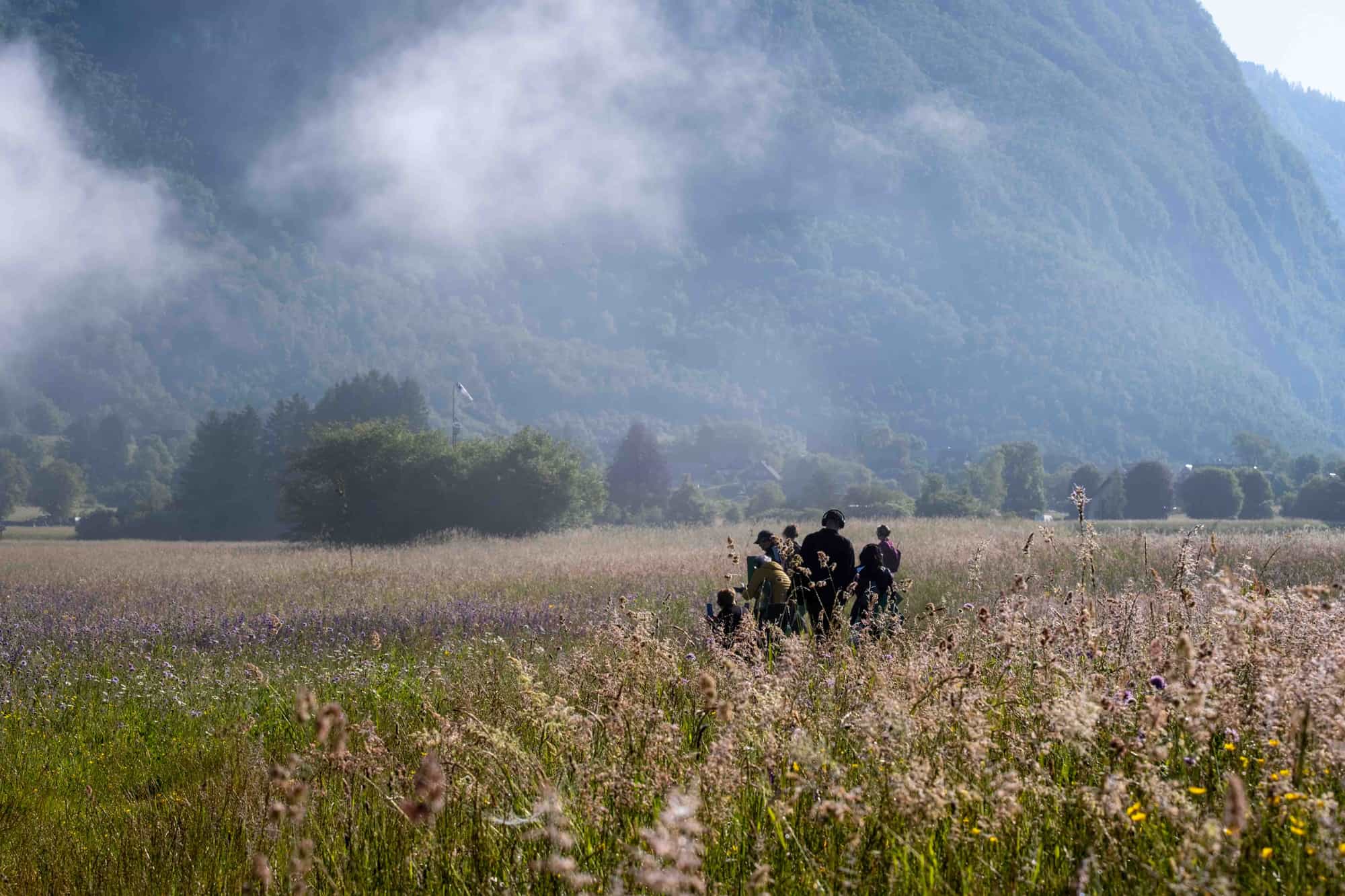
This deep listening experience enables a closer connection with the space and landscape, with the meadows that surround us. The walk directs attention to the sonic traces of wild nature persisting within the cultural landscape. It highlights an acoustic ecology shaped through the collaboration of nature and people. What can we hear when we listen to the meadows?
This deep listening experience enables a closer connection with the space and landscape, with the meadows that surround us. The walk directs attention to the sonic traces of wild nature persisting within the cultural landscape. It highlights an acoustic ecology shaped through the collaboration of nature and people. What can we hear when we listen to the meadows?
Irena Pivka
An artist and producer. She works in the areas of new media, sound and performance arts. In recent years, she has been focusing her artistic expressions on the preparations of sound-walk performances, co-authored by Brane Zorman, which, by means of transmission tools and sound pictures, through walking and listening establish space anew and reflect social reality.
The reduced ticket price applies to secondary school students, university students, pensioners, and self-employed professionals in the cultural sector.
The sound walk addresses Ljubljana’s underpasses, largely abandoned areas, reveal the city’s inability to imagine new urban uses and meanings. Neglected underpasses beneath the paving stones of orderly streets and squares are becoming shelters for those unheard on the margins of society.
The author listens closely to the Ajdovščina underpass. Through real-time sound capture and processing, everyday noises, silences, footsteps and echoes are transformed into an immersive sonic experience that opens up a space for what has been left unspoken. It reveals moments of unexpected beauty and places the listener in relation to space as a living, multilayered organism of unheard realities.
The Ajdovščina underpass, built on the site of a former Emona cemetery, carries deeper historical layers. Walking through these underground corridors becomes a movement through the temporalities of the city, where life, death, memory and forgetting intertwine.
Pod(hod) is conceived as a collection of associations from a day in the lives of individuals on the margins of society. The titles of the sound segments, Tunings, Silent Prayers, Gatherings of the Found, Walk of Shame, Lives Before Shop Windows, Lullaby, Morning Again and A Fragile Confrontation with Reality, do not interpret these lives, but create a space of listening in which a sensitive, open relationship to the other and to the world can emerge.
The world holds you, like it or not.
It moves you with fire and wind when it’s hot.
You’re chasing your sleep and wasting your spot —
you better start living.
The world has you turning the dirt, unforgiving,
old gravity is pulling — but love, oh love,
the night that embraced you unraveled the night.
The sound walk addresses Ljubljana’s underpasses, largely abandoned areas, reveal the city’s inability to imagine new urban uses and meanings. Neglected underpasses beneath the paving stones of orderly streets and squares are becoming shelters for those unheard on the margins of society.
The author listens closely to the Ajdovščina underpass. Through real-time sound capture and processing, everyday noises, silences, footsteps and echoes are transformed into an immersive sonic experience that opens up a space for what has been left unspoken. It reveals moments of unexpected beauty and places the listener in relation to space as a living, multilayered organism of unheard realities.
The Ajdovščina underpass, built on the site of a former Emona cemetery, carries deeper historical layers. Walking through these underground corridors becomes a movement through the temporalities of the city, where life, death, memory and forgetting intertwine.
Pod(hod) is conceived as a collection of associations from a day in the lives of individuals on the margins of society. The titles of the sound segments, Tunings, Silent Prayers, Gatherings of the Found, Walk of Shame, Lives Before Shop Windows, Lullaby, Morning Again and A Fragile Confrontation with Reality, do not interpret these lives, but create a space of listening in which a sensitive, open relationship to the other and to the world can emerge.
The world holds you, like it or not.
It moves you with fire and wind when it’s hot.
You’re chasing your sleep and wasting your spot —
you better start living.
The world has you turning the dirt, unforgiving,
old gravity is pulling — but love, oh love,
the night that embraced you unraveled the night.
ACCOMPANYING PROGRAMME
Luka Uršič The Gift of Failure
4. 6.–30. 8. 2026, MGLC Grad Tivoli
On Thursday, June 4, 2026, at 19.30, the exhibition The Gift of Failure by Luka Uršič will open at the International Centre of Graphic Arts (Pod turnom 3, Ljubljana).
Failure as a point of departure for potential future success is today a key part of the artistic process. What might elsewhere be understood as an error or anomaly can become an expressive value and a space of freedom in art. With new works produced this year in the MGLC Print Studio, Luka Uršič explores the potential of his artistic practice as a reparative mechanism.
Through screenprinting interventions on the unsuccessful and discarded Polaroid photographs by others, the artist returns to the source of failure and symbolically takes on the blame and responsibility for failed actions. In this way, he confronts his own and others’ unease, while simultaneously attempting to approach the liberating possibility of redemptive correction and improvement.
Curator of the exhibition: Yasmín Martín Vodopivec
The exhibition will be on view at MGLC Grad Tivoli until 30 August.
INTRODUCTORY TEXT
The Metalka business building in Ljubljana is one of the key examples of Slovenian late modernism and early post-war commercial architecture. Metalka was built in 1963 according to plans by architects Edo Mihevc and Boris Leskovec, and was the first modern business high-rise in Slovenia. It emerged at a time when Ljubljana sought to develop as a modern socialist capital with a clearly articulated business centre.
In the sound walk Pod(hod), however, the artist approaches the exploration of space from another, non-architectural perspective. His interest lies in spontaneous use: in the time after design, construction, planning, and the comprehensive vision of the building and its wider project have run their course. How long, and with what degree of quality, can a space continue to live within a constantly changing environment and society? What, and who, inhabits the space unexpectedly?
The sound walk addresses the underpass, today a largely abandoned area that reveals the difficulty of imagining new urban contents. Neglected underpasses beneath the paving stones of orderly streets and squares become refuges for those unheard at the margins of society. The artist approaches the listening of space in an authorial and intimate way, giving voice to the unseen users of an abandoned space, as well as to the space itself, to its membrane. In doing so, he reflects on shifting, unstable social conditions and on the fragility of the spaces embedded within them.
Through the capture and processing of sound in real time, everyday noises, silences, footsteps, and echoes are transformed into an immersive sonic experience that opens a space for what has remained unspoken. The listener is placed in relation to space as a living, multilayered organism of unheard realities.
Kalu [Luka Uršič]
A visual artist, musician, and performer living and working in Ljubljana. His practice develops at the intersection of image and sound, where, through an intuitive process, he explores relationships between space, materiality, and perception. In his works, he creates suggestive, sensory experiences, while as a music producer he shapes soundscapes for various artistic projects and composes music for his own and collaborative productions.
Kolofon / Colophon
Authorship and performance: Kalu [Luka Uršič] Consulting: Brane Zorman Producer: Alja Petric Text preparation: Martina Valášková, Irena Pivka Photography: Matej Tomažin Partner: Skladišče 172 Production: Cona, 2026
The author of the walk was selected through the Open Call for New Sound Walks of the TO)pot Festival in 2025.
The story opens perspectives on the architecture of Edvard Ravnikar and his collaborators in the construction of Cankarjev dom.
The authors incorporated numerous quotes and reflections by architects, as well as politicians and cultural figures connected with the building of Cankarjev dom. These are interwoven with poetry and drama by selected artists. The subtle and semantically multilayered soundwalk outlines the period of construction and the architecture of the building itself in the context of the present, offering a deeper understanding of its historical and cultural background.
The audio narrative also touches upon Ravnikar’s wider creative oeuvre, from the design of Republic Square as a demanding and long-term spatial intervention to his pedagogical work at the School of Architecture in Ljubljana. In his characteristic understanding of urban space, Ravnikar involved numerous architects and students who, in dialogue with politics and the broader professional field, laid the foundations for high-quality spatial design in a modernist Mediterranean spirit.
The story opens perspectives on the architecture of Edvard Ravnikar and his collaborators in the construction of Cankarjev dom.
The authors incorporated numerous quotes and reflections by architects, as well as politicians and cultural figures connected with the building of Cankarjev dom. These are interwoven with poetry and drama by selected artists. The subtle and semantically multilayered soundwalk outlines the period of construction and the architecture of the building itself in the context of the present, offering a deeper understanding of its historical and cultural background.
The audio narrative also touches upon Ravnikar’s wider creative oeuvre, from the design of Republic Square as a demanding and long-term spatial intervention to his pedagogical work at the School of Architecture in Ljubljana. In his characteristic understanding of urban space, Ravnikar involved numerous architects and students who, in dialogue with politics and the broader professional field, laid the foundations for high-quality spatial design in a modernist Mediterranean spirit.
Irena Pivka
Curator and author of sound-based works operating at the intersection of art, space and research practices. Her projects frequently take the form of soundwalks and contextual narratives addressing social, architectural and environmental themes.
Brane Zorman
Intermedia artist, composer and sound designer whose work encompasses sound compositions, spatial sound installations and research into the relationship between sound, architecture and listening.
Kolofon / Colophon
Concept and text: Irena Pivka Concept and sound composition: Brane Zorman Voice interpretation: Nada Vodušek, Robert Vrtovšek, Toni Cahunek, Jure Longika, Nataša Živkovič Expert review of the text: dr. Bogo Zupančič, dr. Miloš Kosec Expert review of technical descriptions: Karmen Klučar Project manager: Saša Globačnik (Cankarjev dom) Proofreading: Melita Silič Design: Edin Alibešter (Cankarjev dom) Production: Cankarjev dom, September 2023 (on the occasion of the year of Edvard Ravnikar), represented by Uršula Cetinski, General Director
The reduced ticket price applies to secondary school students, university students, pensioners, and self-employed professionals in the cultural sector.
Even before water becomes something we need to protect, it is the stuff of dreams. This soundwalk begins with the awareness that we ourselves are bodies of water and that our responsibility to water is deeply connected to how we remember and imagine the world. Water, as an element, becomes a material conduit for our imagination and an extension of our connective tissues.
We draw on the works of Gaston Bachelard and Ivan Illich, thinkers deeply engaged with water, who argued that imagination is not merely the ability to form mental images but an embodied capacity that enables creative coexistence with the world. Bachelard describes water as the “eye of the world”—not only because it reflects the sky, but because its depths hold fragments of the past; deep water is a silent memory, an embodied symbol of how the past continually inhabits the present.
Our journey moves from clear, lively spring and river waters to heavier, dormant and dead waters. We walk among songs, verses and images, navigating the temporalities of different bodies of water – from surface currents to the riverbed depths; from the river of forgetfulness to the lake of memories. In an era of constant flow – of information, people, currencies and traffic – while navigating the rapids of time, we will build a temporary harbour at the “pool that contains the whole world”, in the “moment of the dream that contains the whole soul”.
Even before water becomes something we need to protect, it is the stuff of dreams. This soundwalk begins with the awareness that we ourselves are bodies of water and that our responsibility to water is deeply connected to how we remember and imagine the world. Water, as an element, becomes a material conduit for our imagination and an extension of our connective tissues.
We draw on the works of Gaston Bachelard and Ivan Illich, thinkers deeply engaged with water, who argued that imagination is not merely the ability to form mental images but an embodied capacity that enables creative coexistence with the world. Bachelard describes water as the “eye of the world”—not only because it reflects the sky, but because its depths hold fragments of the past; deep water is a silent memory, an embodied symbol of how the past continually inhabits the present.
Our journey moves from clear, lively spring and river waters to heavier, dormant and dead waters. We walk among songs, verses and images, navigating the temporalities of different bodies of water – from surface currents to the riverbed depths; from the river of forgetfulness to the lake of memories. In an era of constant flow – of information, people, currencies and traffic – while navigating the rapids of time, we will build a temporary harbour at the “pool that contains the whole world”, in the “moment of the dream that contains the whole soul”.
Oka [Eva Mulej Vrabič]
Vocalist, performer, producer, DJ and sound artist. Her work spans electro-acoustic, ambient and experimental music, with a focus on the poetics of the voice. Using a variety of instruments, objects and field recordings, she explores the tonal qualities of melodies, words and sounds to create intimate, immersive soundscapes.
Jaka Bombač
Philosopher, researcher, critic and performer. His work explores diverse performance formats that interweave movement, sound and speech. In his academic practice, he focuses on embodied approaches to philosophy and psychology. He also experiments with new ways of communicating theoretical ideas, from podcasts to immersive lectures.
Kolofon / Colophon
Design and concept: Eva Mulej Vrabič and Jaka Bombač Music composition: Eva Mulej Vrabič Text: Jaka Bombač Translation: Melita Silič Event photography: Matej Tomažin Cover illustration: Kaja Horvat Production and consulting: Irena Pivka and Brane Zorman Production: Cona, 2025
The authors were selected through the Call for New Sound Walks by the TO)pot festival in 2024.
The story opens perspectives on the architecture of Edvard Ravnikar and his collaborators in the construction of Cankarjev dom.
The authors incorporated numerous quotes and reflections by architects, as well as politicians and cultural figures connected with the building of Cankarjev dom. These are interwoven with poetry and drama by selected artists. The subtle and semantically multilayered soundwalk outlines the period of construction and the architecture of the building itself in the context of the present, offering a deeper understanding of its historical and cultural background.
The audio narrative also touches upon Ravnikar’s wider creative oeuvre, from the design of Republic Square as a demanding and long-term spatial intervention to his pedagogical work at the School of Architecture in Ljubljana. In his characteristic understanding of urban space, Ravnikar involved numerous architects and students who, in dialogue with politics and the broader professional field, laid the foundations for high-quality spatial design in a modernist Mediterranean spirit.
The story opens perspectives on the architecture of Edvard Ravnikar and his collaborators in the construction of Cankarjev dom.
The authors incorporated numerous quotes and reflections by architects, as well as politicians and cultural figures connected with the building of Cankarjev dom. These are interwoven with poetry and drama by selected artists. The subtle and semantically multilayered soundwalk outlines the period of construction and the architecture of the building itself in the context of the present, offering a deeper understanding of its historical and cultural background.
The audio narrative also touches upon Ravnikar’s wider creative oeuvre, from the design of Republic Square as a demanding and long-term spatial intervention to his pedagogical work at the School of Architecture in Ljubljana. In his characteristic understanding of urban space, Ravnikar involved numerous architects and students who, in dialogue with politics and the broader professional field, laid the foundations for high-quality spatial design in a modernist Mediterranean spirit.
Irena Pivka
Curator and author of sound-based works operating at the intersection of art, space and research practices. Her projects frequently take the form of soundwalks and contextual narratives addressing social, architectural and environmental themes.
Brane Zorman
Intermedia artist, composer and sound designer whose work encompasses sound compositions, spatial sound installations and research into the relationship between sound, architecture and listening.
Kolofon / Colophon
Concept and text: Irena Pivka Concept and sound composition: Brane Zorman Voice interpretation: Nada Vodušek, Robert Vrtovšek, Toni Cahunek, Jure Longika, Nataša Živkovič Expert review of the text: dr. Bogo Zupančič, dr. Miloš Kosec Expert review of technical descriptions: Karmen Klučar Project manager: Saša Globačnik (Cankarjev dom) Proofreading: Melita Silič Design: Edin Alibešter (Cankarjev dom) Production: Cankarjev dom, September 2023 (on the occasion of the year of Edvard Ravnikar), represented by Uršula Cetinski, General Director