Diego Losa: Composing and mastering for octophonic sound systems with GRM Tools Spaces
–
Cona Zavod za procesiranje sodobne umetnosti Ljubljana
Workshop, Arts and cultural education
Schema version: 1.2; generated: ; total events: 326.
–
Cona Zavod za procesiranje sodobne umetnosti Ljubljana
Workshop, Arts and cultural education
–
Cona Zavod za procesiranje sodobne umetnosti Ljubljana
Concert, Music
–
Cona Zavod za procesiranje sodobne umetnosti Ljubljana
Soundwalk, Performance, Music
The story opens perspectives on the architecture of Edvard Ravnikar and his collaborators in the construction of Cankarjev dom.
The authors incorporated numerous quotes and reflections by architects, as well as politicians and cultural figures connected with the building of Cankarjev dom. These are interwoven with poetry and drama by selected artists. The subtle and semantically multilayered soundwalk outlines the period of construction and the architecture of the building itself in the context of the present, offering a deeper understanding of its historical and cultural background.
The audio narrative also touches upon Ravnikar’s wider creative oeuvre, from the design of Republic Square as a demanding and long-term spatial intervention to his pedagogical work at the School of Architecture in Ljubljana. In his characteristic understanding of urban space, Ravnikar involved numerous architects and students who, in dialogue with politics and the broader professional field, laid the foundations for high-quality spatial design in a modernist Mediterranean spirit.
The story opens perspectives on the architecture of Edvard Ravnikar and his collaborators in the construction of Cankarjev dom.
The authors incorporated numerous quotes and reflections by architects, as well as politicians and cultural figures connected with the building of Cankarjev dom. These are interwoven with poetry and drama by selected artists. The subtle and semantically multilayered soundwalk outlines the period of construction and the architecture of the building itself in the context of the present, offering a deeper understanding of its historical and cultural background.
The audio narrative also touches upon Ravnikar’s wider creative oeuvre, from the design of Republic Square as a demanding and long-term spatial intervention to his pedagogical work at the School of Architecture in Ljubljana. In his characteristic understanding of urban space, Ravnikar involved numerous architects and students who, in dialogue with politics and the broader professional field, laid the foundations for high-quality spatial design in a modernist Mediterranean spirit.
Curator and author of sound-based works operating at the intersection of art, space and research practices. Her projects frequently take the form of soundwalks and contextual narratives addressing social, architectural and environmental themes.
Intermedia artist, composer and sound designer whose work encompasses sound compositions, spatial sound installations and research into the relationship between sound, architecture and listening.
Concept and text: Irena Pivka
Concept and sound composition: Brane Zorman
Voice interpretation: Nada Vodušek, Robert Vrtovšek, Toni Cahunek, Jure Longika, Nataša Živkovič
Expert review of the text: dr. Bogo Zupančič, dr. Miloš Kosec
Expert review of technical descriptions: Karmen Klučar
Project manager: Saša Globačnik (Cankarjev dom)
Proofreading: Melita Silič
Design: Edin Alibešter (Cankarjev dom)
Production: Cankarjev dom, September 2023 (on the occasion of the year of Edvard Ravnikar), represented by Uršula Cetinski, General Director

–
Cona Zavod za procesiranje sodobne umetnosti Ljubljana
Soundwalk, Performance, Music
The speculative story of the soundwalk performance garden GOround points to the problematic relationship between people and plants, which is geared to mainly benefit people. The colonialism itself and the human-mediated dispersal of plants capitalize on the subjection and exploitation of nature. It is vital to radically change this attitude if we want to deal effectively with the existential threat of ecological crisis and contemplate a brighter scenario for the future. To become more familiar with the world of plants, garden GOroundgoes into the temporal dimension. Through the prism of the journeys of these two utterly different temporalities of humans and plants, seemingly offering no possible point of encounter, it speculates on the development of a future solidarity-based coexistence of humans and plants. Plants, the most populous species on the planet, live at their own pace in their own time, walking the paths we cannot access. garden GOround will take us along the paths of a possible future scenario for our overstressed, noisy planet mirrored through the development of local greenways. Can we learn from plants to build a more solidarity-oriented future?
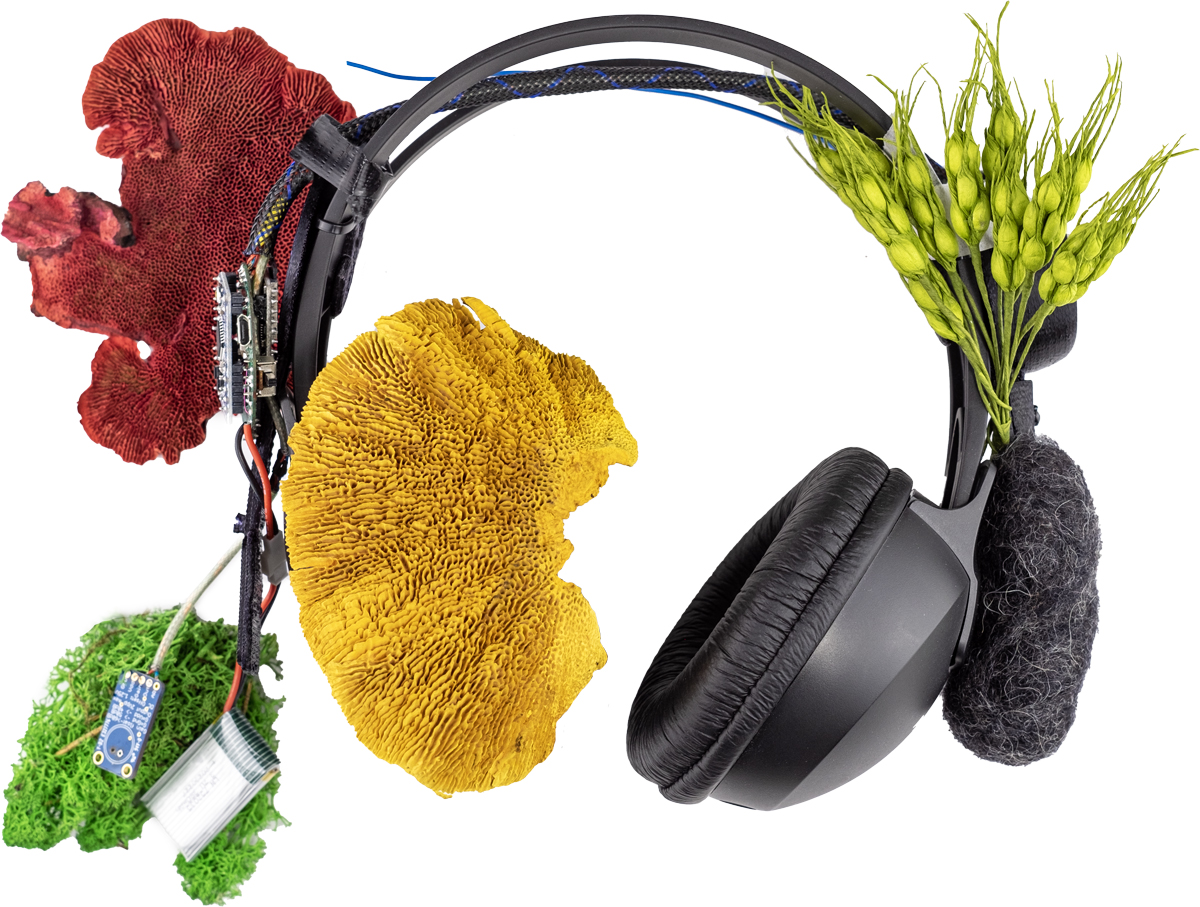
The audience experiences the soundwalk through specially developed headphones used as a tool to speculate the world and the sonic landscape of the future. The world is getting too loud and harmful for our sensitive ears, which have failed to adapt to aggressive frequencies. To survive outdoors, we will need headphones that will both mute and sharpen the sound image and, at the same time, take us into the acoustic narrative.
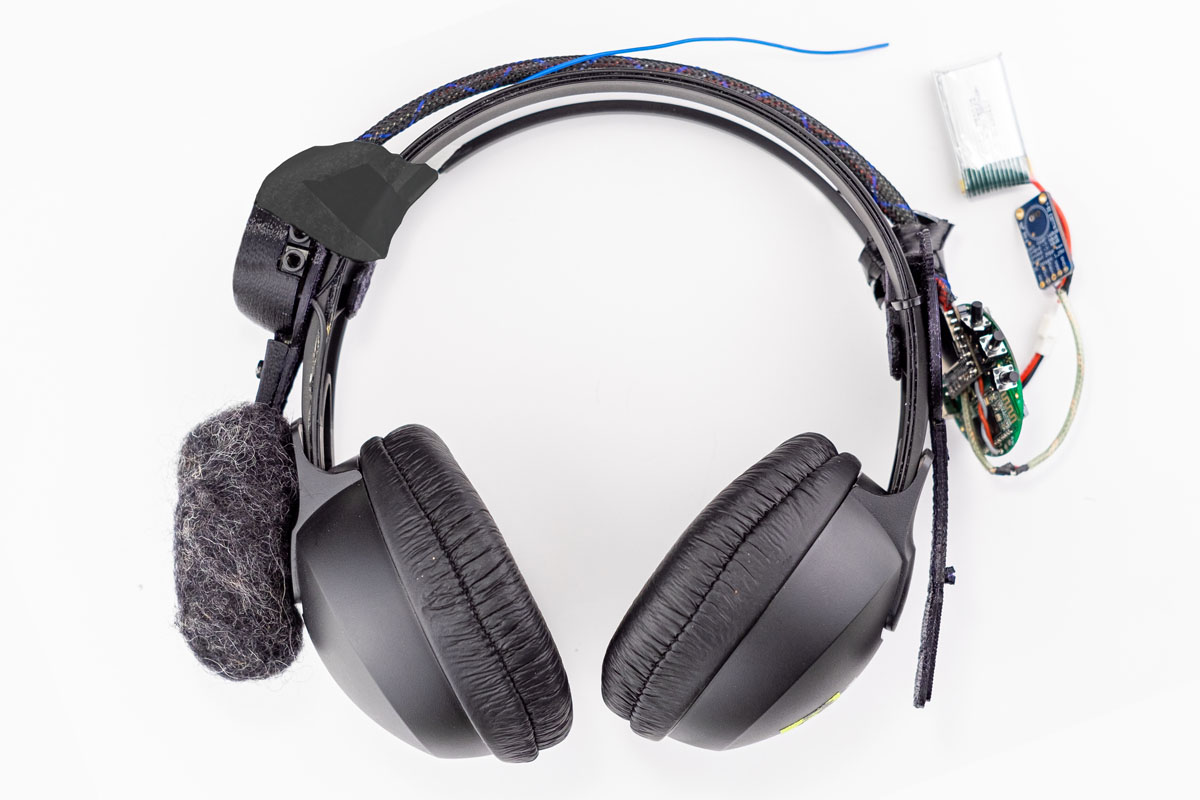
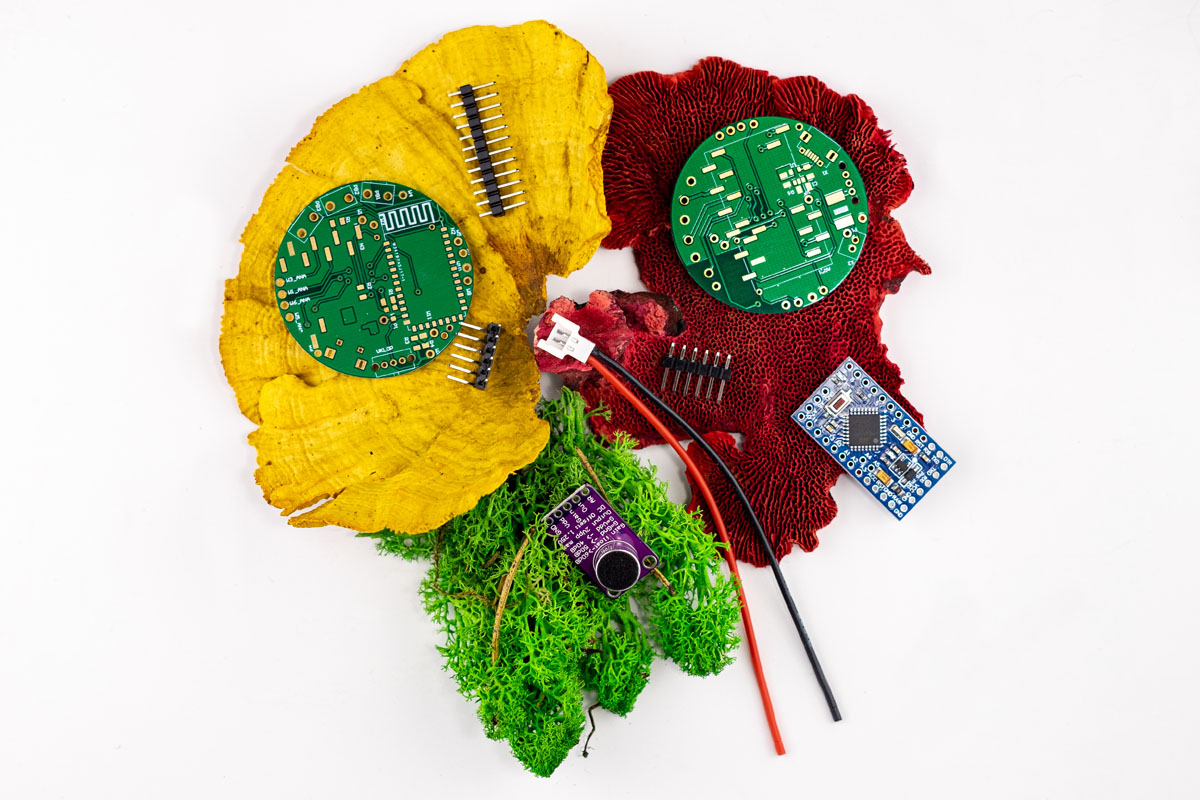
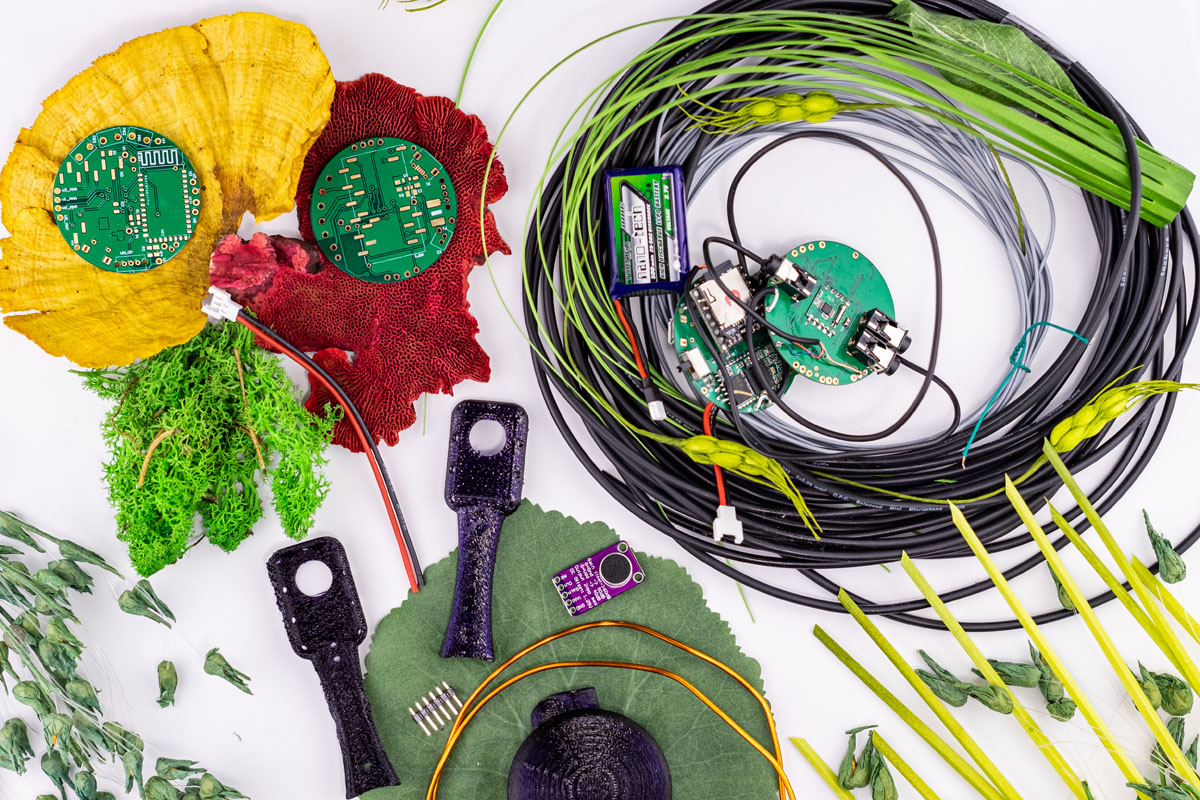
The soundwalk is broadcast on an AR (augmented reality) headset, the result of an innovative in-depth collaboration between the artist and hardware and software developers. The AR headset allows for simultaneous amplified, binaural ambient listening and audio co-composition. They also include an FM receiver module and an EMS sensor input.
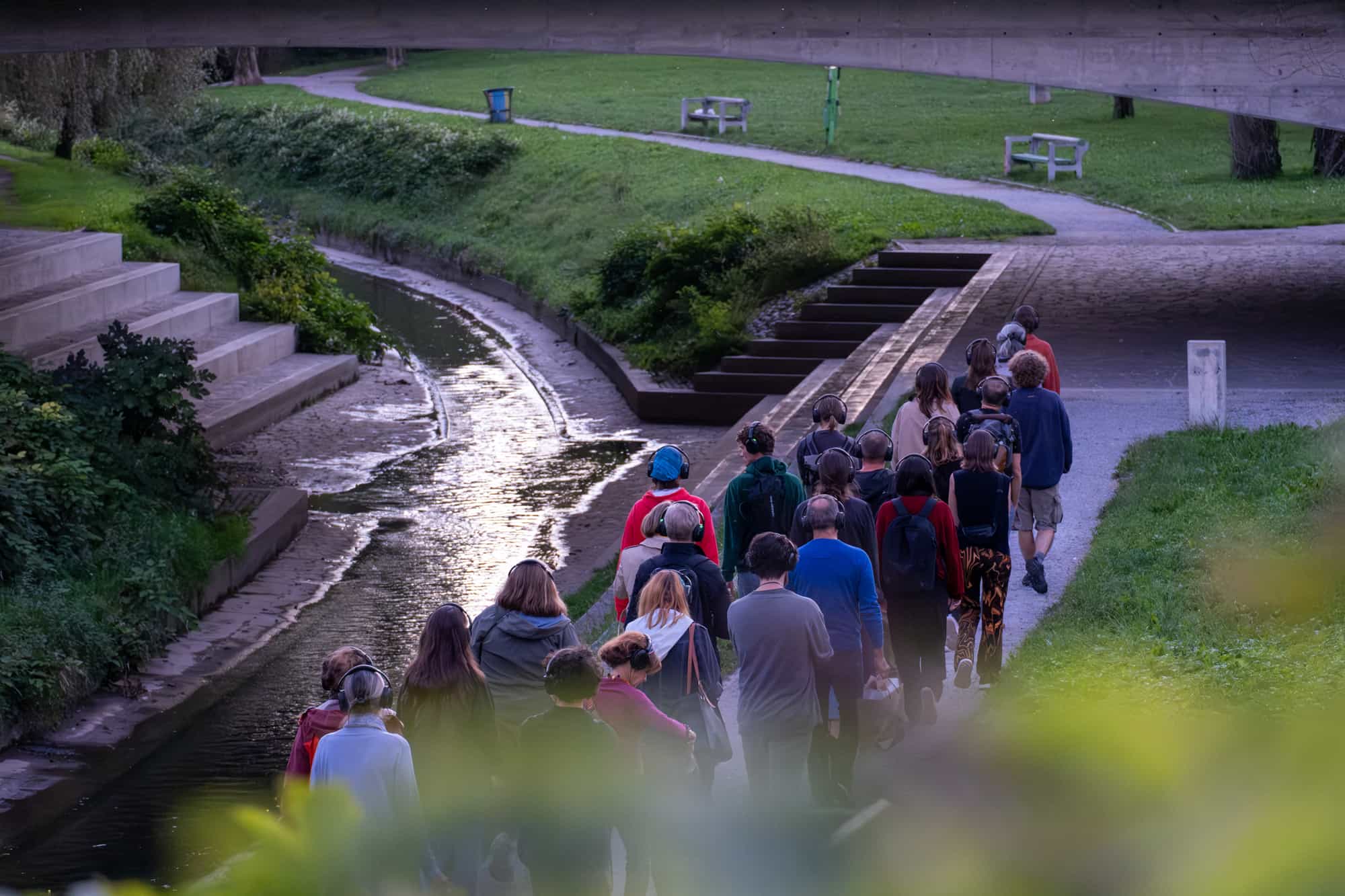
The soundwalk path connects the Orangerie Park in Strasbourg and the Tivoli Park in Ljubljana, both designed during the reign of Napoleon. The featured photograph was taken in a disrupted avenue locked today between a road and a railway. It is part of a larger avenue complex in the Tivoli Park, designed by the French at the time of the Illyrian Provinces. The vocalist, dressed in a Slovene folk costume, wears original AR headphones and listens to the landscape.
A testimony form one of the participants of the AR soundwalk:
The speculative story of the soundwalk performance garden GOround points to the problematic relationship between people and plants, which is geared to mainly benefit people. The colonialism itself and the human-mediated dispersal of plants capitalize on the subjection and exploitation of nature. It is vital to radically change this attitude if we want to deal effectively with the existential threat of ecological crisis and contemplate a brighter scenario for the future. To become more familiar with the world of plants, garden GOroundgoes into the temporal dimension. Through the prism of the journeys of these two utterly different temporalities of humans and plants, seemingly offering no possible point of encounter, it speculates on the development of a future solidarity-based coexistence of humans and plants. Plants, the most populous species on the planet, live at their own pace in their own time, walking the paths we cannot access. garden GOround will take us along the paths of a possible future scenario for our overstressed, noisy planet mirrored through the development of local greenways. Can we learn from plants to build a more solidarity-oriented future?
The audience experiences the soundwalk through specially developed headphones used as a tool to speculate the world and the sonic landscape of the future. The world is getting too loud and harmful for our sensitive ears, which have failed to adapt to aggressive frequencies. To survive outdoors, we will need headphones that will both mute and sharpen the sound image and, at the same time, take us into the acoustic narrative.
The soundwalk is broadcast on an AR (augmented reality) headset, the result of an innovative in-depth collaboration between the artist and hardware and software developers. The AR headset allows for simultaneous amplified, binaural ambient listening and audio co-composition. They also include an FM receiver module and an EMS sensor input.
The soundwalk path connects the Orangerie Park in Strasbourg and the Tivoli Park in Ljubljana, both designed during the reign of Napoleon. The featured photograph was taken in a disrupted avenue locked today between a road and a railway. It is part of a larger avenue complex in the Tivoli Park, designed by the French at the time of the Illyrian Provinces. The vocalist, dressed in a Slovene folk costume, wears original AR headphones and listens to the landscape.
A testimony form one of the participants of the AR soundwalk:
The audience experiences the sound work through specially developed author-designed AR headphones, which function as an artistic-technological interface between the listener, the space, and the composition. The headphones are conceived as a speculative tool that reflects on future auditory landscapes and possible modes of orientation within acoustically overloaded environments. They are based on the premise that contemporary sonic space is increasingly shaped by noise, frequency saturation, and aggressive acoustic pressures, as a result of which listening is becoming ever more a matter of perception, protection, and selection.
The AR headphones are the result of an in-depth collaboration between the artists and hardware and software developers. Their design enables the simultaneous binaural listening of the immediate surroundings and the playback of a sound composition, thereby creating a layered and dynamic sonic situation in which real acoustic space interweaves with an artificially generated or transmitted sonic narrative. A key feature of the system is that it does not exclude the surrounding environment, but rather acoustically modulates, filters, and accentuates it, so that listening is not separated from space, but remains actively embedded within it.
The headphones include an FM receiver module, which enables the wireless transmission and reception of audio signals, as well as an input for an EMS sensor, through which the system can also be connected to biometric or bodily impulses. The device therefore functions not merely as a playback unit, but as an expanded listening apparatus that combines environmental perception, technological mediation, and compositional layering into a unified listening experience. In this sense, the work addresses not only the future of sound, but also the future of listening as a technologically supported, situated, and selective practice.
An artist and producer. She works in the areas of new media, sound and performance arts. In recent years, she has been focusing her artistic expressions on the preparations of sound-walk performances, co-authored by Brane Zorman, which, by means of transmission tools and sound pictures, through walking and listening establish space anew and reflect social reality.
A composer, sound and radio artist. His work explores the possibilities of processing, presenting, perceiving, understanding, positioning and reinterpreting sound, space and ecology. By employing analogue and digital technologies and techniques, his work traverses the fields of music, multimedia, and visual space, using both sophisticated and simple tools, strategies, methods, and interactive interpretation models, soundscapes, evolving electronic and acoustic sound sculptures.
Concept, text and headphones design: Irena Pivka
Sound composition and editing, sensorial headset concept: Brane Zorman
Vocal: Alja Petric
Voices: Lučka Počkaj, Alja Petric, Toni Cahunek (Slovene)Jana Wilcoxen, Alja Petric, Toni Cahunek (English)Nataša Živkovič, Suzana Koncut, Loup Abramovici (French)
Proofreading, English translation: Melita Silič
English editing and proofreading: Jana Wilcoxen
French translation: Anne-Cécile Lamy-Joswiak
French editing: Suzana KoncutPhotography, design: Matej Tomažin
Illustration: Jovana DjukićHardware and software development and testing, android application: Brane Ždralo
PCB printing, electronics assembling: Zdravko Janšovec
Electronics assembling: Ivan Kvasič
3D printing: Cveto Kunešević, 3Dimension
Headphones assembling: Staš VrenkoProduced by CONA, 2023
VITAL creates an innovative ecosystem that respects the environment and, through art, participates in the fight against global warming and air pollution.
VITAL is co-funded by the Creative Europe programme by the three-year “Strasbourg European Capital” Contract and supported by the Ministry of Public Administration of the Republic of Slovenia and the City of Ljubljana, Departmen of Culture.
Text sources:
Gray, Ros and Sheikh, Shela (ed.). “The Wretched Earth: Botanical Conflicts and Artistic Interventions”. Third Text32(2–3).Kunst, Bojana. “Rastlinsko življenje in prostori umetnosti: o nedostopnem in vzajemnem”. Ana Mizerit (ed.). Zasilni izhod [Exhibition catalogue]. Ljubljana: Moderna galerija, 2022.Thorsen, Line Marie (ed.). Moving Plants. Rønnebæksholm, Næstved: Narayana Press, 2017.Sagan, Dorion. “The Human is More than Human: Interspecies Communities and the New “Facts of Life”.” Theorizing the Contemporary. Fieldsights, 18 Nov 2011.Raja, Vicente. “Moving the Green: Plant Behavior in the Human World“. EuropeNow 45, Nov 2021.Sidebottom, Kay. “Education for a More-Than-Human World”. EuropeNow 45, Nov 2021.Marder, Michael. “Resist Like a Plant! On the Vegetal Life of Political Movements“. Peace Studies Journal 5(1), Jan 2012.Brkič, Vanja. “Mestni park Tivoli: Tivolski drevoredi so bili Ljubljančanom od nekdaj v ponos“. Dnevnik, 10 Oct 2015.Strasbourg Park, https://data.strasbourg.eu/explore/dataset/lieux_arbres-remarquables/table/
More about the work and the authors

–
Cona Zavod za procesiranje sodobne umetnosti Ljubljana
Soundwalk, Performance, Music
Even before water becomes something we need to protect, it is the stuff of dreams. This soundwalk begins with the awareness that we ourselves are bodies of water and that our responsibility to water is deeply connected to how we remember and imagine the world. Water, as an element, becomes a material conduit for our imagination and an extension of our connective tissues.
We draw on the works of Gaston Bachelard and Ivan Illich, thinkers deeply engaged with water, who argued that imagination is not merely the ability to form mental images but an embodied capacity that enables creative coexistence with the world. Bachelard describes water as the “eye of the world”—not only because it reflects the sky, but because its depths hold fragments of the past; deep water is a silent memory, an embodied symbol of how the past continually inhabits the present.
Our journey moves from clear, lively spring and river waters to heavier, dormant and dead waters. We walk among songs, verses and images, navigating the temporalities of different bodies of water – from surface currents to the riverbed depths; from the river of forgetfulness to the lake of memories. In an era of constant flow – of information, people, currencies and traffic – while navigating the rapids of time, we will build a temporary harbour at the “pool that contains the whole world”, in the “moment of the dream that contains the whole soul”.
Even before water becomes something we need to protect, it is the stuff of dreams. This soundwalk begins with the awareness that we ourselves are bodies of water and that our responsibility to water is deeply connected to how we remember and imagine the world. Water, as an element, becomes a material conduit for our imagination and an extension of our connective tissues.
We draw on the works of Gaston Bachelard and Ivan Illich, thinkers deeply engaged with water, who argued that imagination is not merely the ability to form mental images but an embodied capacity that enables creative coexistence with the world. Bachelard describes water as the “eye of the world”—not only because it reflects the sky, but because its depths hold fragments of the past; deep water is a silent memory, an embodied symbol of how the past continually inhabits the present.
Our journey moves from clear, lively spring and river waters to heavier, dormant and dead waters. We walk among songs, verses and images, navigating the temporalities of different bodies of water – from surface currents to the riverbed depths; from the river of forgetfulness to the lake of memories. In an era of constant flow – of information, people, currencies and traffic – while navigating the rapids of time, we will build a temporary harbour at the “pool that contains the whole world”, in the “moment of the dream that contains the whole soul”.
Vocalist, performer, producer, DJ and sound artist. Her work spans electro-acoustic, ambient and experimental music, with a focus on the poetics of the voice. Using a variety of instruments, objects and field recordings, she explores the tonal qualities of melodies, words and sounds to create intimate, immersive soundscapes.
Philosopher, researcher, critic and performer. His work explores diverse performance formats that interweave movement, sound and speech. In his academic practice, he focuses on embodied approaches to philosophy and psychology. He also experiments with new ways of communicating theoretical ideas, from podcasts to immersive lectures.
Design and concept: Eva Mulej Vrabič and Jaka Bombač
Music composition: Eva Mulej Vrabič
Text: Jaka Bombač
Translation: Melita Silič
Event photography: Matej Tomažin
Cover illustration: Kaja Horvat
Production and consulting: Irena Pivka and Brane Zorman
Production: Cona, 2025
The authors were selected through the Call for New Sound Walks by the TO)pot festival in 2024.
–
Cona Zavod za procesiranje sodobne umetnosti Ljubljana
Exhibition, Education, Arts and cultural education, Visual arts
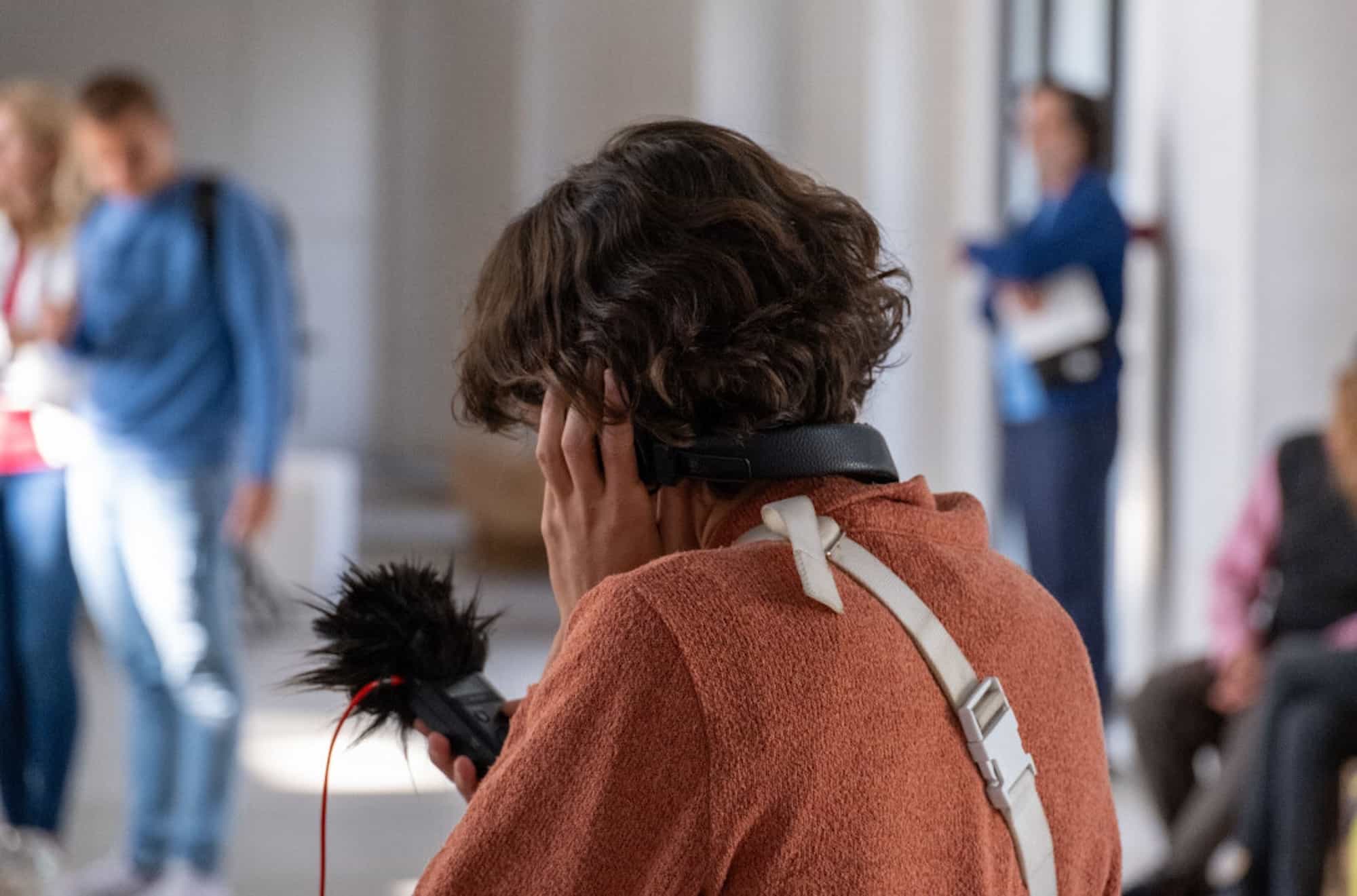
Echoing the Youth Palace is a sound workshop developed by Mladi zmaji in collaboration with the Cona Institute. The programme offers hands-on work with sound, from equipment basics and production foundations to field recording and collaborative editing.
Through soundwalking, recording, and composing, participants explore the acoustic landscape of the emerging Youth Palace centre. The resulting sound composition was used in the documentary Palača Cukrarna and later presented in an exhibition context.
Echoing the Youth Palace is a sound workshop developed by Mladi zmaji in collaboration with the Cona Institute. The programme offers hands-on work with sound, from equipment basics and production foundations to field recording and collaborative editing.
Through soundwalking, recording, and composing, participants explore the acoustic landscape of the emerging Youth Palace centre. The resulting sound composition was used in the documentary Palača Cukrarna and later presented in an exhibition context.
An artist and producer exploring the intersections of place, sound, and digital tools, with a focus on sound-geolocation practices.
A composer and intermedia artist researching sound through new technologies for theatre and intermedia projects.
A professor of ethnology and cultural anthropology researching sound, music, and subcultures and their social significance.
A music producer and sound designer specialised in Reaper software, active in film, theatre, and audio production.
Project lead: Nika Rupnik
Workshop mentors: Irena Pivka, Brane Zorman, Rajko Muršič, Jure Anžiček
Location: ČMC Šiška and fieldwork in public spaces in Ljubljana
Production: Mladi zmaji and Cona, 2025
The workshop result was used as the sound base for the film Palača Cukrarna (Kinodvor, 13 June 2025) and presented in the exhibition format Dragon Front: A Space for Youth Breakthroughs (Historical Atrium of the City Hall, 8 October–13 November 2025).
–
Cona Zavod za procesiranje sodobne umetnosti Ljubljana
Soundwalk, Performance, Music
After a funeral, we often try to move on quickly. Our world is about life, not death. For most of us, there is no clear before and after until it happens.
This soundwalk opens public space to what is usually unsaid, unspoken or suppressed, yet remains present as a shared feeling.
Why is there a wall between the dead and the living?
The soundwalk begins and ends at the same location and unfolds as a collective walk, where space, voice and sound intertwine in a reflection on memory, community and our relationship to death.
After a funeral, we often try to move on quickly. Our world is about life, not death. For most of us, there is no clear before and after until it happens.
This soundwalk opens public space to what is usually unsaid, unspoken or suppressed, yet remains present as a shared feeling.
Why is there a wall between the dead and the living?
The soundwalk begins and ends at the same location and unfolds as a collective walk, where space, voice and sound intertwine in a reflection on memory, community and our relationship to death.
Works in the field of performing arts, focusing on acting, facilitation and spoken word in collective and public contexts.
Author and screenwriter whose work explores narrative structures and social themes across media.
Engaged in journalism and radio art, exploring sound as a narrative medium.
Journalist and creator working at the intersection of speech, storytelling and sound formats.
Works with language, speech and pronunciation, collaborating on sound-based and performative projects.
Playwright and performer exploring personal and social themes through theatre and sound.
Creative team: Nikola Drole, Lina Eržen, Tadej Grum, Zala Kramperšek, Maša Milčinski, Ajda Pirtovšek
Music: Jasmin Avdić, Teja Gorenc
Sound design: Urban Gruden
Mentors: Saška Rakef, Tomaž Gubenšek
Proofreading: Mateja Juričan
Photo: Tina Urbajs
Production: UL AGRFT, partner Cona 2024/2025.
The soundwalk The Wall Between the Dead and the Living is part of the Death – Life project, funded by the University of Ljubljana Fund for the Arts, and co-produced by the Academy of Theatre, Radio, Film and Television, University of Ljubljana, and the Cona institute.

–
Cona Zavod za procesiranje sodobne umetnosti Ljubljana
Soundwalk, Performance, Music
After a funeral, we often try to move on quickly. Our world is about life, not death. For most of us, there is no clear before and after until it happens.
This soundwalk opens public space to what is usually unsaid, unspoken or suppressed, yet remains present as a shared feeling.
Why is there a wall between the dead and the living?
The soundwalk begins and ends at the same location and unfolds as a collective walk, where space, voice and sound intertwine in a reflection on memory, community and our relationship to death.
After a funeral, we often try to move on quickly. Our world is about life, not death. For most of us, there is no clear before and after until it happens.
This soundwalk opens public space to what is usually unsaid, unspoken or suppressed, yet remains present as a shared feeling.
Why is there a wall between the dead and the living?
The soundwalk begins and ends at the same location and unfolds as a collective walk, where space, voice and sound intertwine in a reflection on memory, community and our relationship to death.
Works in the field of performing arts, focusing on acting, facilitation and spoken word in collective and public contexts.
Author and screenwriter whose work explores narrative structures and social themes across media.
Engaged in journalism and radio art, exploring sound as a narrative medium.
Journalist and creator working at the intersection of speech, storytelling and sound formats.
Works with language, speech and pronunciation, collaborating on sound-based and performative projects.
Playwright and performer exploring personal and social themes through theatre and sound.
Creative team: Nikola Drole, Lina Eržen, Tadej Grum, Zala Kramperšek, Maša Milčinski, Ajda Pirtovšek
Music: Jasmin Avdić, Teja Gorenc
Sound design: Urban Gruden
Mentors: Saška Rakef, Tomaž Gubenšek
Proofreading: Mateja Juričan
Photo: Tina Urbajs
Production: UL AGRFT, partner Cona 2024/2025.
The soundwalk The Wall Between the Dead and the Living is part of the Death – Life project, funded by the University of Ljubljana Fund for the Arts, and co-produced by the Academy of Theatre, Radio, Film and Television, University of Ljubljana, and the Cona institute.
–
Cona Zavod za procesiranje sodobne umetnosti Ljubljana
Soundwalk, Performance, Music
Even before water becomes something we need to protect, it is the stuff of dreams. This soundwalk begins with the awareness that we ourselves are bodies of water and that our responsibility to water is deeply connected to how we remember and imagine the world. Water, as an element, becomes a material conduit for our imagination and an extension of our connective tissues.
We draw on the works of Gaston Bachelard and Ivan Illich, thinkers deeply engaged with water, who argued that imagination is not merely the ability to form mental images but an embodied capacity that enables creative coexistence with the world. Bachelard describes water as the “eye of the world”—not only because it reflects the sky, but because its depths hold fragments of the past; deep water is a silent memory, an embodied symbol of how the past continually inhabits the present.
Our journey moves from clear, lively spring and river waters to heavier, dormant and dead waters. We walk among songs, verses and images, navigating the temporalities of different bodies of water – from surface currents to the riverbed depths; from the river of forgetfulness to the lake of memories. In an era of constant flow – of information, people, currencies and traffic – while navigating the rapids of time, we will build a temporary harbour at the “pool that contains the whole world”, in the “moment of the dream that contains the whole soul”.
Even before water becomes something we need to protect, it is the stuff of dreams. This soundwalk begins with the awareness that we ourselves are bodies of water and that our responsibility to water is deeply connected to how we remember and imagine the world. Water, as an element, becomes a material conduit for our imagination and an extension of our connective tissues.
We draw on the works of Gaston Bachelard and Ivan Illich, thinkers deeply engaged with water, who argued that imagination is not merely the ability to form mental images but an embodied capacity that enables creative coexistence with the world. Bachelard describes water as the “eye of the world”—not only because it reflects the sky, but because its depths hold fragments of the past; deep water is a silent memory, an embodied symbol of how the past continually inhabits the present.
Our journey moves from clear, lively spring and river waters to heavier, dormant and dead waters. We walk among songs, verses and images, navigating the temporalities of different bodies of water – from surface currents to the riverbed depths; from the river of forgetfulness to the lake of memories. In an era of constant flow – of information, people, currencies and traffic – while navigating the rapids of time, we will build a temporary harbour at the “pool that contains the whole world”, in the “moment of the dream that contains the whole soul”.
Vocalist, performer, producer, DJ and sound artist. Her work spans electro-acoustic, ambient and experimental music, with a focus on the poetics of the voice. Using a variety of instruments, objects and field recordings, she explores the tonal qualities of melodies, words and sounds to create intimate, immersive soundscapes.
Philosopher, researcher, critic and performer. His work explores diverse performance formats that interweave movement, sound and speech. In his academic practice, he focuses on embodied approaches to philosophy and psychology. He also experiments with new ways of communicating theoretical ideas, from podcasts to immersive lectures.
Design and concept: Eva Mulej Vrabič and Jaka Bombač
Music composition: Eva Mulej Vrabič
Text: Jaka Bombač
Translation: Melita Silič
Event photography: Matej Tomažin
Cover illustration: Kaja Horvat
Production and consulting: Irena Pivka and Brane Zorman
Production: Cona, 2025
The authors were selected through the Call for New Sound Walks by the TO)pot festival in 2024.
–
Cona Zavod za procesiranje sodobne umetnosti Ljubljana
Soundwalk, Performance, Music
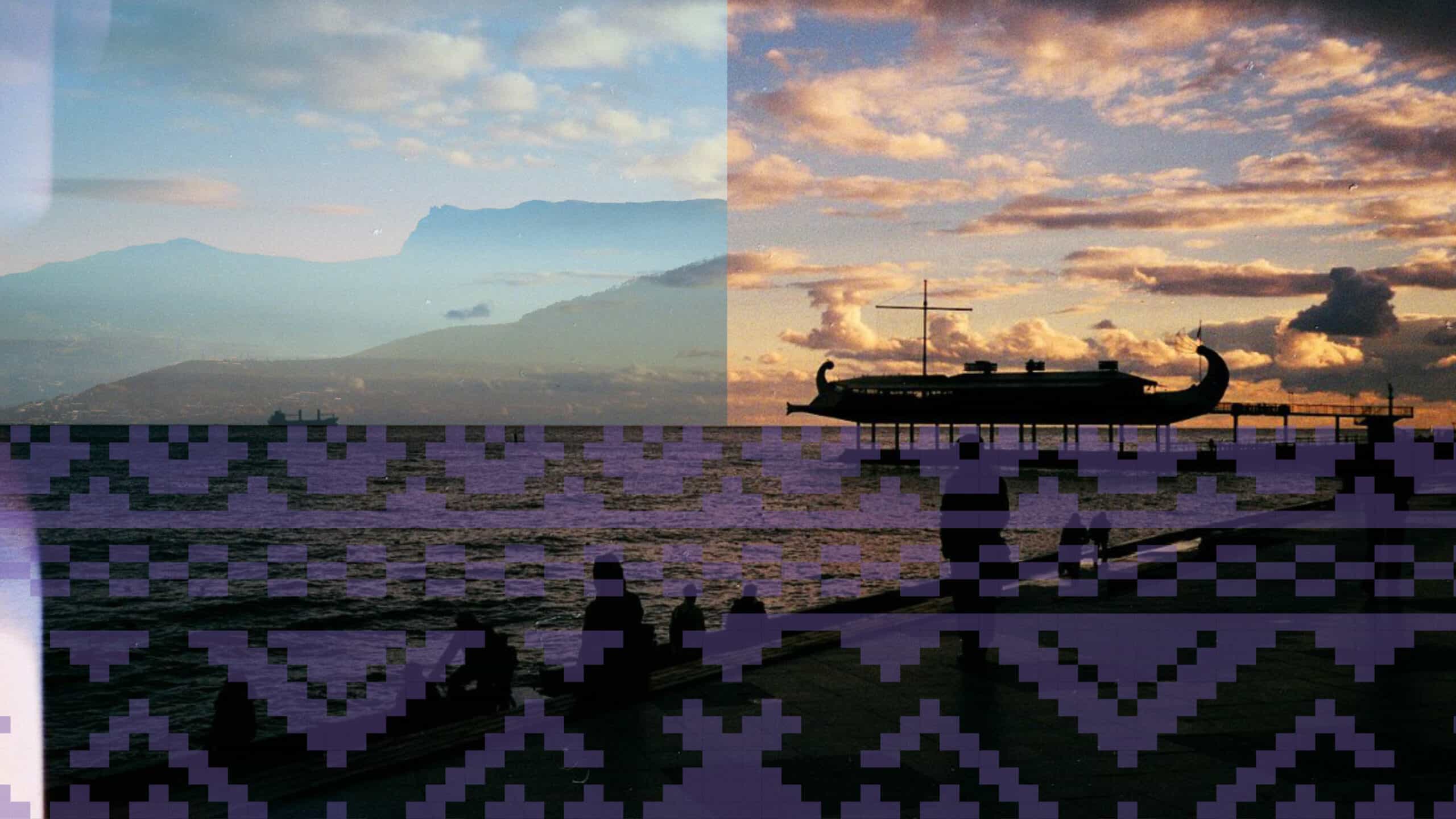
The soundwalk weaves together personal memories, dreamlike landscapes and the brutal reality of the war in Ukraine. Conceived as an audio walk through an urban park, it alternates between realistic and surreal worlds – telling the real stories through the mindscape of an injured Ukrainian soldier. Dedicated to the Park Rastoče knjige, through multilingual narration (Slovenian, Ukrainian), VRTATYS’ sound walk brings to the audience diverse literature resources – Ukrainian baroque poetry by Hryhorii Skovoroda, Slovenian modernist prose by Ivan Cankar, an authentic Crimeantatar poem by Alie Kendzhe-Ali, as well as personal narrations and sound environments from people who are currently in Ukraine and on occupied Ukrainian territories. The project highlights the tensions between home and exile, roots and transplantation, past and future. It merges an artistic approach with documentary precision and poetic sensitivity.
The soundwalk weaves together personal memories, dreamlike landscapes and the brutal reality of the war in Ukraine. Conceived as an audio walk through an urban park, it alternates between realistic and surreal worlds – telling the real stories through the mindscape of an injured Ukrainian soldier. Dedicated to the Park Rastoče knjige, through multilingual narration (Slovenian, Ukrainian), VRTATYS’ sound walk brings to the audience diverse literature resources – Ukrainian baroque poetry by Hryhorii Skovoroda, Slovenian modernist prose by Ivan Cankar, an authentic Crimeantatar poem by Alie Kendzhe-Ali, as well as personal narrations and sound environments from people who are currently in Ukraine and on occupied Ukrainian territories. The project highlights the tensions between home and exile, roots and transplantation, past and future. It merges an artistic approach with documentary precision and poetic sensitivity.
A composer, sound artist and performer from Ukraine. She explores themes of memory, space and time through acoustic and electroacoustic music, as well as theatrical and documentary performances.
Also known as Maiia Kovalenko, is a writer and a linguist working in Slavic languages and English, exploring the inner world of individuals. Felisa is working with several kinds of texts, including short stories, novels and more.
Concept and composition: Tetiana Khoroshun
Writing and dramaturgy: Felisa Ko
Narration in Slovene: Felisa Ko, Neža Dvorščak, Irena Pivka, Peter Podgoršek, Marko Rafolt
Narration in Ukrainian: Tetiana Khoroshun, Valeriia Chudentsova, Andrii Anisimov, Artem Makshayev, Alla Zahaikevych, Anastasiia Alyoshina, Margarita Cherenkof
Photography: Aleksandr Lis, Katya Schigol
Mentors: Irena Pivka, Brane Zorman
Design and event photography: Matej Tomažin
The text of the soundwalk includes excerpts and poems by Hryhorii Skovoroda, Ivan Cankar, Alie Kendzhe-Ali, Anastasiia Alyoshina, Alla Zahaikevych and Margarita Cherenkof.
This project is supported by “Culture Helps / Культура допомагає” – a project implemented by Insha Osvita (UA) and zusa (DE) and co-funded by the European Union under a dedicated call for proposals to support Ukrainian displaced people and the Ukrainian Cultural and Creative Sectors.
Production: Cona 2025
–
Cona Zavod za procesiranje sodobne umetnosti Ljubljana
Soundwalk, Performance, Music
Even before water becomes something we need to protect, it is the stuff of dreams. This soundwalk begins with the awareness that we ourselves are bodies of water and that our responsibility to water is deeply connected to how we remember and imagine the world. Water, as an element, becomes a material conduit for our imagination and an extension of our connective tissues.
We draw on the works of Gaston Bachelard and Ivan Illich, thinkers deeply engaged with water, who argued that imagination is not merely the ability to form mental images but an embodied capacity that enables creative coexistence with the world. Bachelard describes water as the “eye of the world”—not only because it reflects the sky, but because its depths hold fragments of the past; deep water is a silent memory, an embodied symbol of how the past continually inhabits the present.
Our journey moves from clear, lively spring and river waters to heavier, dormant and dead waters. We walk among songs, verses and images, navigating the temporalities of different bodies of water – from surface currents to the riverbed depths; from the river of forgetfulness to the lake of memories. In an era of constant flow – of information, people, currencies and traffic – while navigating the rapids of time, we will build a temporary harbour at the “pool that contains the whole world”, in the “moment of the dream that contains the whole soul”.
Even before water becomes something we need to protect, it is the stuff of dreams. This soundwalk begins with the awareness that we ourselves are bodies of water and that our responsibility to water is deeply connected to how we remember and imagine the world. Water, as an element, becomes a material conduit for our imagination and an extension of our connective tissues.
We draw on the works of Gaston Bachelard and Ivan Illich, thinkers deeply engaged with water, who argued that imagination is not merely the ability to form mental images but an embodied capacity that enables creative coexistence with the world. Bachelard describes water as the “eye of the world”—not only because it reflects the sky, but because its depths hold fragments of the past; deep water is a silent memory, an embodied symbol of how the past continually inhabits the present.
Our journey moves from clear, lively spring and river waters to heavier, dormant and dead waters. We walk among songs, verses and images, navigating the temporalities of different bodies of water – from surface currents to the riverbed depths; from the river of forgetfulness to the lake of memories. In an era of constant flow – of information, people, currencies and traffic – while navigating the rapids of time, we will build a temporary harbour at the “pool that contains the whole world”, in the “moment of the dream that contains the whole soul”.
Vocalist, performer, producer, DJ and sound artist. Her work spans electro-acoustic, ambient and experimental music, with a focus on the poetics of the voice. Using a variety of instruments, objects and field recordings, she explores the tonal qualities of melodies, words and sounds to create intimate, immersive soundscapes.
Philosopher, researcher, critic and performer. His work explores diverse performance formats that interweave movement, sound and speech. In his academic practice, he focuses on embodied approaches to philosophy and psychology. He also experiments with new ways of communicating theoretical ideas, from podcasts to immersive lectures.
Design and concept: Eva Mulej Vrabič and Jaka Bombač
Music composition: Eva Mulej Vrabič
Text: Jaka Bombač
Translation: Melita Silič
Event photography: Matej Tomažin
Cover illustration: Kaja Horvat
Production and consulting: Irena Pivka and Brane Zorman
Production: Cona, 2025
The authors were selected through the Call for New Sound Walks by the TO)pot festival in 2024.
–
Cona Zavod za procesiranje sodobne umetnosti Ljubljana
Soundwalk, Performance, Music
How to remember the events you want to forget? How to tell stories you wish to keep silent about? How to ask questions you are afraid to hear answers to? What is the role of sound and silence in resistance to violence, the search for justice and our attempt to be together?
The soundwalk was created for a journey through the dunes of The Hague. It encompasses personal memories, the historical memory of the place and reflections on the concept of a city of peace and justice.
How to remember the events you want to forget? How to tell stories you wish to keep silent about? How to ask questions you are afraid to hear answers to? What is the role of sound and silence in resistance to violence, the search for justice and our attempt to be together?
The soundwalk was created for a journey through the dunes of The Hague. It encompasses personal memories, the historical memory of the place and reflections on the concept of a city of peace and justice.
A Ukrainian sound artist, composer and researcher based in The Hague. Her work explores the role of sound in acts of commemoration and collective experience, creating temporary nomadic acoustic communities through site-specific performances.
A Ukrainian artist, performer and director from Donetsk, now based in Kyiv. His work explores memory, loss and social constructs of everyday life through video, performance and virtual reality.
Artists: Anna Khvyl, Piotr Armianovski
Photo: Matej Tomažin

–
Cona Zavod za procesiranje sodobne umetnosti Ljubljana
Talk
–
Cona Zavod za procesiranje sodobne umetnosti Ljubljana
Peripatetic lecture, Education
This lecture addresses time as a key dramaturgical category in the creation of spaces of perception, wonder and attunement. The authors approach temporality as an active agent that structures experience, opens possibilities for alternative modes of attention, and enables the emergence of relational and sensitive spaces between participants, environment and the event itself.
This lecture addresses time as a key dramaturgical category in the creation of spaces of perception, wonder and attunement. The authors approach temporality as an active agent that structures experience, opens possibilities for alternative modes of attention, and enables the emergence of relational and sensitive spaces between participants, environment and the event itself.
The lecture unfolds as a reflection and exchange on temporal structures in contemporary artistic and research practices.
Dramaturg and researcher focusing on contemporary performative practices, dramaturgy of process, time and participation.
Dramaturg, theorist and critic working in the field of performing arts, with a focus on dramaturgy of time and the relationship between theory and practice.
Authors: Saška Rakef, Pia Brezavšček
Photo: Matej Tomažin

–
Cona Zavod za procesiranje sodobne umetnosti Ljubljana
Lecture, Education
H2O Interface explores the role of water in the Anthropocene, highlighting its connections to both human and non-human entities. Inspired by Bruno Latour’s Parliament of Things, the project challenges conventional distinctions between natural and social phenomena and invites a reconsideration of human and non-human actors as part of larger hybrid networks.
Within this framework, water appears as an active participant in interconnected systems, while acoustic ecologies are foregrounded as a key means of understanding relationships between living organisms, water and objects. Sound art reveals complex interdependencies that shape our environment, presenting water as a dynamic force within intertwined ecosystems.
H2O Interface explores the role of water in the Anthropocene, highlighting its connections to both human and non-human entities. Inspired by Bruno Latour’s Parliament of Things, the project challenges conventional distinctions between natural and social phenomena and invites a reconsideration of human and non-human actors as part of larger hybrid networks.
Within this framework, water appears as an active participant in interconnected systems, while acoustic ecologies are foregrounded as a key means of understanding relationships between living organisms, water and objects. Sound art reveals complex interdependencies that shape our environment, presenting water as a dynamic force within intertwined ecosystems.
An artist, curator and researcher focusing on the New Tendencies movement and early digital art. He is the author of Digital Art in Croatia 1968–1984 and the founder and programme director of the contemporary and media art space grey) (area.
Author: Darko Fritz
Photo: Matej Tomažin

–
Cona Zavod za procesiranje sodobne umetnosti Ljubljana
Lecture, Education
What does it mean to be at home? Can listening practices be connected to a broader sense of home? In this presentation, the author connects Arne Næss’s concept of ecosophy with soundwalking and the practice of connected listening as developed by Abigail Gardner, in order to propose her own interpretation of rural futurism (Leandro Pisano).
She argues that sound walks carried out with the intention of creating new connections and emotional circuits can contribute to the development of frameworks for a multilayered understanding of relationships between humans and the natural environment, thus expanding the idea of ruralism. The work explores feelings of belonging—to household, natural environment, community, person, or animals—that emerge from connected listening and soundwalking practices, and examines how these contribute to a deeper understanding of ecosophy.
Rural futurism is also addressed as a sensitive process of emotions and values reflected in sound practices.
What does it mean to be at home? Can listening practices be connected to a broader sense of home? In this presentation, the author connects Arne Næss’s concept of ecosophy with soundwalking and the practice of connected listening as developed by Abigail Gardner, in order to propose her own interpretation of rural futurism (Leandro Pisano).
She argues that sound walks carried out with the intention of creating new connections and emotional circuits can contribute to the development of frameworks for a multilayered understanding of relationships between humans and the natural environment, thus expanding the idea of ruralism. The work explores feelings of belonging—to household, natural environment, community, person, or animals—that emerge from connected listening and soundwalking practices, and examines how these contribute to a deeper understanding of ecosophy.
Rural futurism is also addressed as a sensitive process of emotions and values reflected in sound practices.
Radio producer, sound artist, and sound researcher based in Bucharest. She creates music-experimental radio programs, and her documentaries and contributions have been nominated at various international competitions. Her work has been presented in solo and group exhibitions. She actively develops her own artistic practice and promotes soundwalking within the Romanian art scene, particularly through the project Sunete care umblă (Sounds That Walk), traveling festivals, and smaller cultural initiatives across the country.
Lecturer: Maria Balabas
Photo: Matej Tomažin

–
Cona Zavod za procesiranje sodobne umetnosti Ljubljana
Soundwalk, Performance, Music
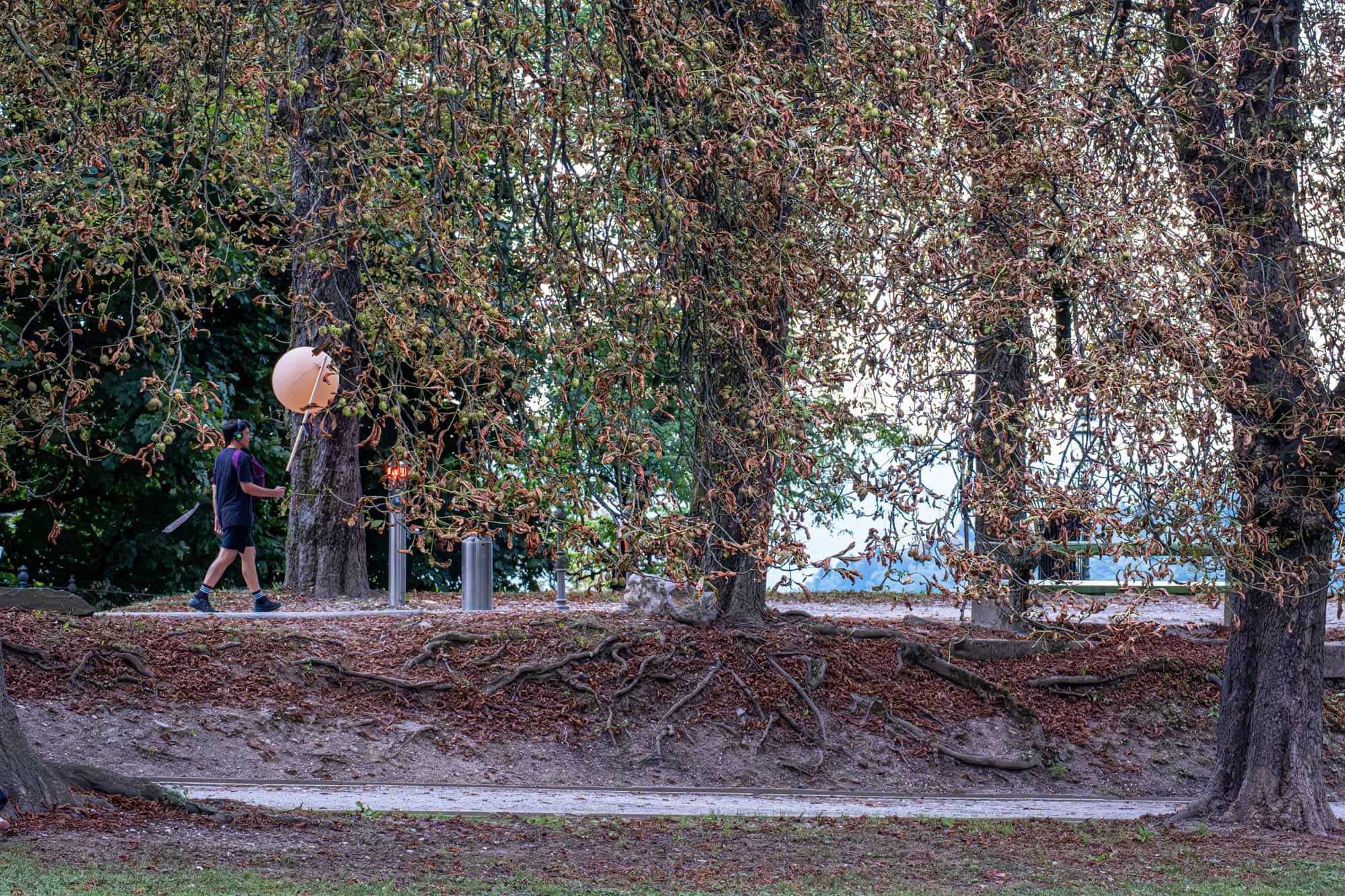
The artist takes a weather balloon as the starting point for her research and sonic journey. Used worldwide for meteorological measurements and weather forecasting, over 800 weather balloons are released daily. They rise through the atmosphere, exposed to changing air pressure, temperature, density and wind.
Our atmospheric imaginary journey begins at the entrance to the Ljubljana Castle funicular, which will carry us up to the castle. Once we reach a certain height, we will travel even further – following the tension and transformation of the balloon as it stretches to its breaking point: the sudden burst and fall. Afterwards, we will return by funicular to the foot of the castle hill.
The 40-minute sound composition combines recordings from meteorological instruments, field and studio sessions, interviews with experts and the tracking of the balloon’s path by an observer who descends, follows and collects data. We will follow the metaphorical journey of release, lifting, stretching, bursting, falling and landing. The sonic experience is guided by the artist’s voice, which explores moments of change, transformation, direction, speed, temperature, humidity, wind and more.
The layered soundscape shifts between the dreamlike and the scientific, offering intimate, physical, auditory and tactile stimuli that create a rich, multisensory experience.
The artist takes a weather balloon as the starting point for her research and sonic journey. Used worldwide for meteorological measurements and weather forecasting, over 800 weather balloons are released daily. They rise through the atmosphere, exposed to changing air pressure, temperature, density and wind.
Our atmospheric imaginary journey begins at the entrance to the Ljubljana Castle funicular, which will carry us up to the castle. Once we reach a certain height, we will travel even further – following the tension and transformation of the balloon as it stretches to its breaking point: the sudden burst and fall. Afterwards, we will return by funicular to the foot of the castle hill.
The 40-minute sound composition combines recordings from meteorological instruments, field and studio sessions, interviews with experts and the tracking of the balloon’s path by an observer who descends, follows and collects data. We will follow the metaphorical journey of release, lifting, stretching, bursting, falling and landing. The sonic experience is guided by the artist’s voice, which explores moments of change, transformation, direction, speed, temperature, humidity, wind and more.
The layered soundscape shifts between the dreamlike and the scientific, offering intimate, physical, auditory and tactile stimuli that create a rich, multisensory experience.
Explores hybrid formats that blend discursive and poetic approaches to artistic practice, considering them inseparable from daily life. Her work investigates the relationships and interactions within forms such as moving images, sound, language and mixed media installations. She focuses on subtle, often invisible and fragile processes within media and material.
Artist: Neža Knez
Sound consulting: Tetiana Khoroshun
Event photography: Matej Tomažin
Translation into English: Melita Silič
Production and consulting: Irena Pivka and Brane Zorman
Production: Cona, 2025
The soundwalk Following was produced in collaboration with the Ministry of the Environment, Climate and Energy and the Slovenian Environment Agency. Thanks to: Andrej Vuga, Blaž Šter, Filip Štucin, and Ivana Furać, Vjeran Magjarević from the Croation Meteorological and Hydrological Service.
The author was selected through the Call for New Sound Walks by the TO)pot festival in 2024.
–
Cona Zavod za procesiranje sodobne umetnosti Ljubljana
Talk
–
Cona Zavod za procesiranje sodobne umetnosti Ljubljana
Peripatetic lecture, Education
The Muzofil Association presents contemporary saltworking as practised at salt field N19 in the Lera area. The contribution focuses on current salt production practices and an understanding of seasonal labour within the Sečovlje Salina Nature Park.
The presentation includes a screening of the short experimental documentary film SALTforSALT by Hana Vodeb, offering insight into the working processes and conditions of contemporary saltmaking. The event concludes with a poetic performative eavesdropping surprise, prepared in collaboration with the association at the initiative of the Cona Institute.
The Muzofil Association presents contemporary saltworking as practised at salt field N19 in the Lera area. The contribution focuses on current salt production practices and an understanding of seasonal labour within the Sečovlje Salina Nature Park.
The presentation includes a screening of the short experimental documentary film SALTforSALT by Hana Vodeb, offering insight into the working processes and conditions of contemporary saltmaking. The event concludes with a poetic performative eavesdropping surprise, prepared in collaboration with the association at the initiative of the Cona Institute.
A voluntary, non-profit and independent association of individuals united by an interest in musical creativity and research. It operates across culture, humanities, arts, social sciences and other music-related fields, fostering the development of musical awareness among individuals and communities.
Authors: Muzofil Association
Photo: Matej Tomažin

–
Cona Zavod za procesiranje sodobne umetnosti Ljubljana
Peripatetic lecture, Education
This presentation explores the concept of “sonic solastalgia” through fieldwork conducted on the Greek island of Samothraki, where shifting environmental and cultural soundscapes reveal deep connections between place, memory, and identity. Drawing on walking-with and listening-with methods, I document how residents relate to the natural sounds of their environment – waves, wind, goat bells – and how these become imagined echoes in the mind. This lecture invites participants to consider how movement, place, and listening intersect, creating opportunities to reflect on the emotional and ecological dimensions of sound in transition.
This presentation explores the concept of “sonic solastalgia” through fieldwork conducted on the Greek island of Samothraki, where shifting environmental and cultural soundscapes reveal deep connections between place, memory, and identity. Drawing on walking-with and listening-with methods, I document how residents relate to the natural sounds of their environment – waves, wind, goat bells – and how these become imagined echoes in the mind. This lecture invites participants to consider how movement, place, and listening intersect, creating opportunities to reflect on the emotional and ecological dimensions of sound in transition.
Sound artist and researcher exploring sonic memory, ethnography and environmental change through participatory and place-based listening practices.
Author: George Edmondson
Photo: Matej Tomažin

–
Cona Zavod za procesiranje sodobne umetnosti Ljubljana
Soundwalk, Education, Performance, Music
The walk takes place in the Lera area, covering 294 hectares and divided into a crystallisation zone and a seawater concentration zone. The route follows a 1.3-kilometre-long path connecting the St. Bartholomew Canal to Canal Grando.
Participants are introduced to traditional salt production methods based on medieval practices and to the saltworks as a living cultural landscape and heritage site.
The walk takes place in the Lera area, covering 294 hectares and divided into a crystallisation zone and a seawater concentration zone. The route follows a 1.3-kilometre-long path connecting the St. Bartholomew Canal to Canal Grando.
Participants are introduced to traditional salt production methods based on medieval practices and to the saltworks as a living cultural landscape and heritage site.
An organisation managing the Sečovlje Salina area, dedicated to preserving traditional saltworking, cultural heritage and the natural environment of the salt pans.
Guided tour: Soline, Pridelava soli, d.o.o.
Photo: Matej Tomažin

–
Cona Zavod za procesiranje sodobne umetnosti Ljubljana
Soundwalk, Performance, Music
How can we listen beyond sound, and what does it mean to learn to listen in different ways?
Drawing on acoustic epistemology, speculative philosophy of perception and states of focused listening, the work explores listening as a complex act, emphasizing the diversity of hearing that which is expressed as an instance that is both individual and collective. Participants are guided toward modes of walking, approaching spaces, and perceiving their surroundings and sounds, while exploring concepts of deep listening beyond the mere identification of sound sources.
How can we listen beyond sound, and what does it mean to learn to listen in different ways?
Drawing on acoustic epistemology, speculative philosophy of perception and states of focused listening, the work explores listening as a complex act, emphasizing the diversity of hearing that which is expressed as an instance that is both individual and collective. Participants are guided toward modes of walking, approaching spaces, and perceiving their surroundings and sounds, while exploring concepts of deep listening beyond the mere identification of sound sources.
A sound artist studying sound at the Institute of Sonology in The Hague, the Netherlands. Through microtonal sound structures, sculpted spatial imaginaries and speculative philosophies of perception, she explores an intimate relationship between sound, space and place.
Author: Karmen Ponikvar
Photo: Matej Tomažin

–
Cona Zavod za procesiranje sodobne umetnosti Ljubljana
Guided tour, Education
During a visit to the Museum of Salt-Making, visitors are introduced to the history and heritage of salt production, as well as to the development of traditional knowledge, practices and the everyday labour of saltworkers. The presentation also highlights the founding of the museum as a guardian of tangible and intangible heritage, and traces changes in its role over time, in dialogue with the natural environment, landscape conservation and contemporary approaches to heritage preservation.
During a visit to the Museum of Salt-Making, visitors are introduced to the history and heritage of salt production, as well as to the development of traditional knowledge, practices and the everyday labour of saltworkers. The presentation also highlights the founding of the museum as a guardian of tangible and intangible heritage, and traces changes in its role over time, in dialogue with the natural environment, landscape conservation and contemporary approaches to heritage preservation.
Research Councillor and curator for early maritime history at the Maritime Museum – Museo del mare »Sergej Mašera« Piran – Pirano.
Curator and conservator at the Institute for the Protection of Cultural Heritage of Slovenia, Piran Regional Unit, and assistant at the Mediterranean Institute for Environmental Studies, Science and Research Centre Koper.
Lecturers: Flavio Bonin, Matjaž Kljun
Photo: Matej Tomažin
Guided tour of the Museum of Salt-Making was made possible by: Maritime Museum – Museo del mare »Sergej Mašera« Piran – Pirano.

–
Cona Zavod za procesiranje sodobne umetnosti Ljubljana
Peripatetic lecture, Education
Moving slowly downstream the Dragonja River towards its mouth at the sea, participants become acquainted with the habitat of the Sečovlje Salina Nature Park, its importance for conservation, the bird species commonly encountered there, and methods for identifying their characteristic songs.
Through walking and listening, the project brings together field observation, acoustic perception and ecological knowledge, creating space for a deeper understanding of the relationship between landscape, sound and biodiversity.
Moving slowly downstream the Dragonja River towards its mouth at the sea, participants become acquainted with the habitat of the Sečovlje Salina Nature Park, its importance for conservation, the bird species commonly encountered there, and methods for identifying their characteristic songs.
Through walking and listening, the project brings together field observation, acoustic perception and ecological knowledge, creating space for a deeper understanding of the relationship between landscape, sound and biodiversity.
Research Councillor at the Marine Biology Station Piran of the National Institute of Biology, working in the fields of marine biology, ecology and habitat conservation.
Author: Daniel Bosch Ibáñez
Photo: Matej Tomažin

–
Cona Zavod za procesiranje sodobne umetnosti Ljubljana
Soundwalk, Performance, Music
Walk to a Place of Strength is an artistic contribution in which the author explores walking as a political-somatic practice through which the body enters into a relationship with territory, ecosystems and collective presence, fundamentally offering a space for public encounters – a temporary community.
The project unfolds through a practice based on three fundamental actions: breathing, walking and stillness. These are approached as “choreopolitical” gestures – movements with political and poetic power that shape human awareness of self in relation to place. Beyond their usual function, these actions open up space for deeper reflection and invite participants to inhabit their bodies differently and to listen more attentively to the landscapes they traverse. In this way, Walk to a Place of Strength becomes an exercise in presence, perceptual reorientation and the re-establishment of collective movement as an aesthetic and political gesture.
Walk to a Place of Strength is an artistic contribution in which the author explores walking as a political-somatic practice through which the body enters into a relationship with territory, ecosystems and collective presence, fundamentally offering a space for public encounters – a temporary community.
The project unfolds through a practice based on three fundamental actions: breathing, walking and stillness. These are approached as “choreopolitical” gestures – movements with political and poetic power that shape human awareness of self in relation to place. Beyond their usual function, these actions open up space for deeper reflection and invite participants to inhabit their bodies differently and to listen more attentively to the landscapes they traverse. In this way, Walk to a Place of Strength becomes an exercise in presence, perceptual reorientation and the re-establishment of collective movement as an aesthetic and political gesture.
A dancer who experiments with scores and choreographic compositions. Her work engages in dialogue with outdoor spaces, landscapes and natural environments, posing questions such as: What motivates us to move? Where are we heading?
Author: Sara Anjo
Photo: Matej Tomažin
This research and paper presentation is funded by the Slovenian Research and Innovation Agency (ARIS) through the research project Grain of Salt, Crystallising Cohabitation (J6-50196) and the research programme Liminal Spaces (P6-0279).
