Further details of the residency programme are in preparation.
BBtrem [Brane Zorman, Boštjan Perovšek]
Brane Zorman is an intermedia artist, composer, sound manipulator, producer and curator. He creates sound compositions for theatre, intermedia and dance performances, and performs electroacoustic works and spatial sound improvisations in collaboration with both local and international artists. His practice explores the relationship between sound and space through diverse strategies, techniques and interactive modules. He records and reinterprets soundscapes, using advanced tools to craft electronic and acoustic sound sculptures.
Boštjan Perovšek, artist, composer and sound designer known for his experimental electroacoustic music. He specialises in bioacoustic compositions based on animal sounds, particularly those of insects. He collaborates with the groups Jata C and SAETA and creates music for film, theatre, performances, multimedia installations and soundscapes for museums and galleries.
Karmen Ponikvar
A sound artist studying sound at the Institute of Sonology in The Hague, the Netherlands. Through microtonal sound structures, sculpted spatial imaginaries and speculative philosophies of perception, she explores an intimate relationship between sound, space and place.
Tetiana Khoroshun
Composer, sound designer, performer, and tutor from Ukraine, working in the fields of electronic, electroacoustic, contemporary, and experimental music. She is the author of sound performances, sound installations, music for cinema, theatre, and dance performances, chamber and orchestral music. She is a co-author and performer in the electroacoustic duo Guma, a member of the First_Tape group, and works as a composer and sound designer at Daraba Studio. She leads the Sed Contra Ensemble and is a member of the Ukrainian Association of Electroacoustic Music.
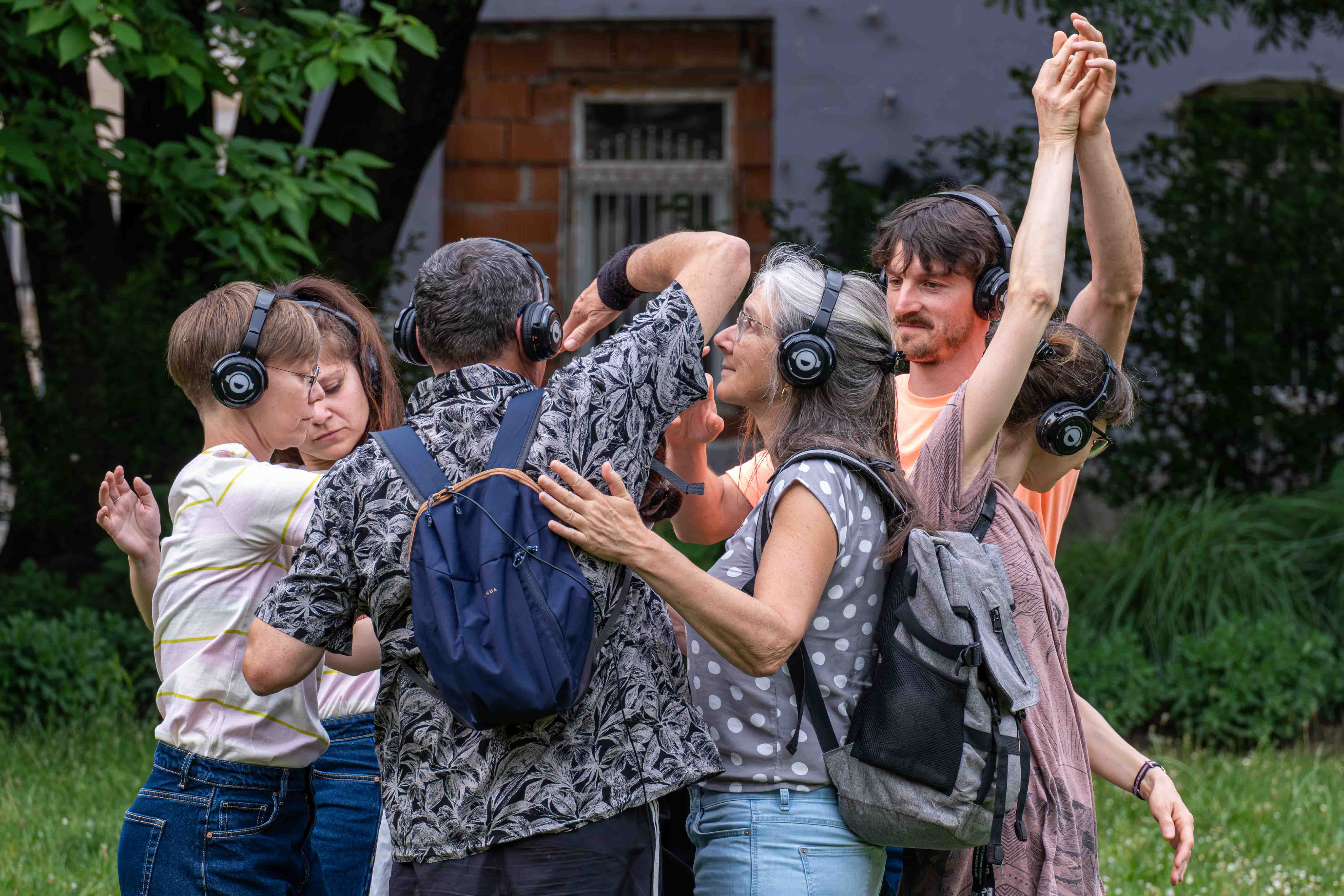
Tu, čisto blizu is an invitation for participants to transform from passive walkers into active co-creators of the urban landscape, leaving behind a more visible imprint, a more visible trace.
On the level of both the individual and the group, the walk explores how we inhabit and move through the city, and what defines the nature of our encounters and interactions. It foregrounds the bodily dimension of experiencing the city and asks how the body might be placed within the predictable dynamics of urban life in a different way. It highlights the power of the moment when individuals step out of individualistic, fleeting observation of their surroundings and become aware of, give meaning to, and perhaps even alter their automated urban routes.
Through different situations and stops in the city, Tu, čisto blizu invites participants to walk through the city in a playful and liberated way, and to actively situate themselves within it.
Tu, čisto blizu is an invitation for participants to transform from passive walkers into active co-creators of the urban landscape, leaving behind a more visible imprint, a more visible trace.
On the level of both the individual and the group, the walk explores how we inhabit and move through the city, and what defines the nature of our encounters and interactions. It foregrounds the bodily dimension of experiencing the city and asks how the body might be placed within the predictable dynamics of urban life in a different way. It highlights the power of the moment when individuals step out of individualistic, fleeting observation of their surroundings and become aware of, give meaning to, and perhaps even alter their automated urban routes.
Through different situations and stops in the city, Tu, čisto blizu invites participants to walk through the city in a playful and liberated way, and to actively situate themselves within it.
Urša Sekirnik
A dancer and creator working in the field of contemporary performing arts. In her projects, audience involvement in both the process and performance is one of her main areas of interest, which is why in recent years she has focused on creating participatory performances.
Aja Zupanec
A dancer, dance pedagogue and choreographer, she moves between these areas of contemporary dance. As an artist, she is most interested in artistic explorations of ideals shaped by society and of the world that exists within our bodies.
Beti Strgar
Musician, music producer and actress who combines various artistic practices in her work. In her projects she explores human identity, sonority and the authenticity of stage expression.
Kolofon / Colophon
Authorship and performance: Aja Zupanec and Urša Sekirnik Music and sound design: Beti Strgar Production and consulting: Irena Pivka and Brane Zorman Photography: Matej Tomažin Partner: KUD NUM Production: CONA, 2026
The authors of the walk were selected through the Open Call for New Sound Walks of the TO)pot Festival in 2025.
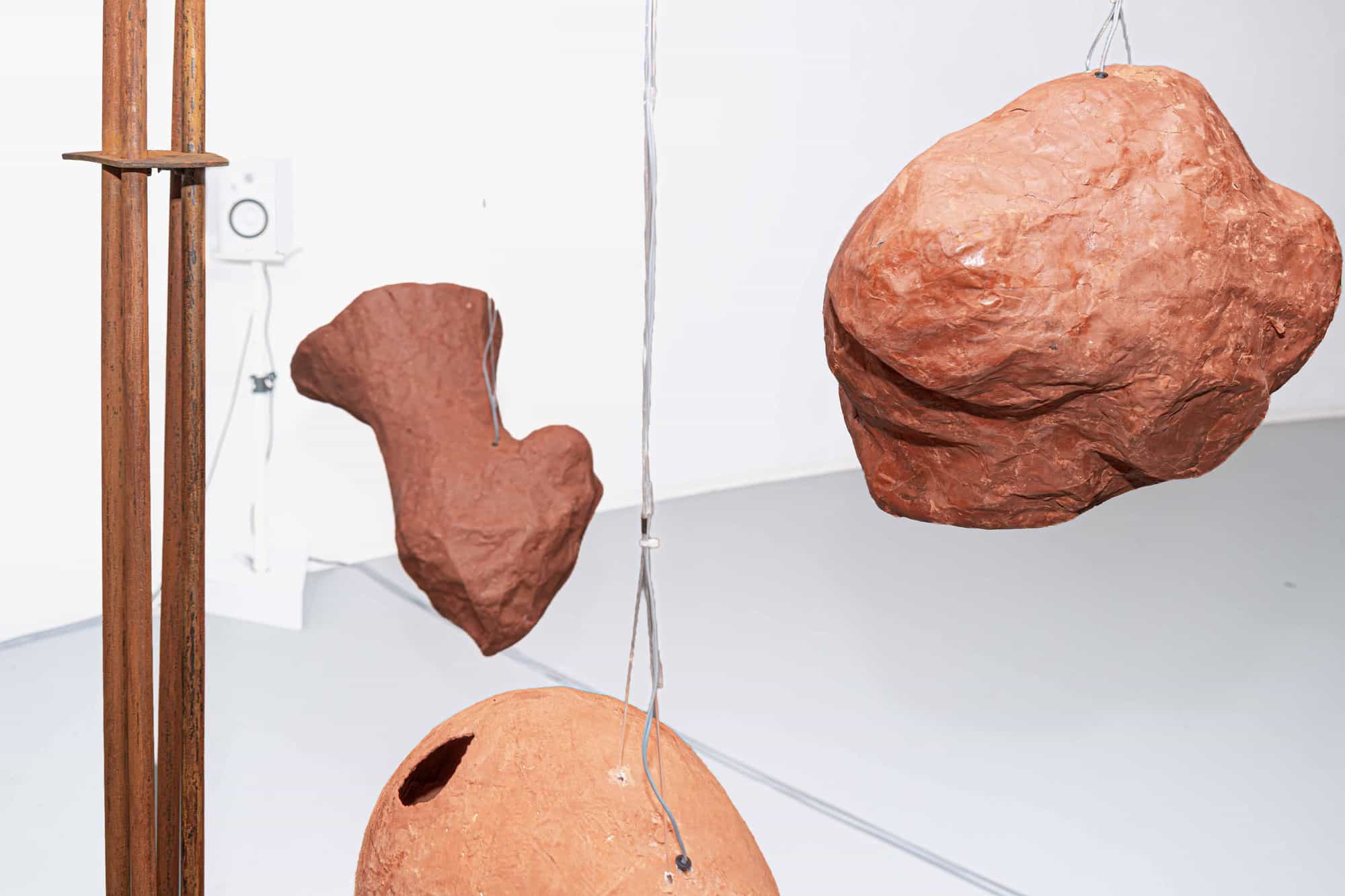
tremolo is an interdisciplinary musical work and haptic installation exploring the vibrational communication of insects. It asks how listening into the micro-world of insects can transform our perception of landscapes, and how landscapes and organisms are entangled in relations of mutual interdependence.
tremolo proposes listening as an ethics of coexistence, revealing subtle, inaudible layers of vibration within natural-cultural landscapes. By turning our attention towards forms of communication that largely escape the human ear, the work invites us to perceive the landscape not as a passive backdrop, but as a living field of interconnected organisms, materials and vibrations.
The musical composition is based on recordings made primarily in the landscape of Krater using equipment designed for tremological recording. Through sound transmitted across natural materials, the artists reveal invisible layers of communication that are largely inaudible to human ears. The haptic installation extends this experience into the tactile realm, allowing the vibrations of insects to be encountered through the body.
tremolo is an interdisciplinary musical work and haptic installation exploring the vibrational communication of insects. It asks how listening into the micro-world of insects can transform our perception of landscapes, and how landscapes and organisms are entangled in relations of mutual interdependence.
tremolo proposes listening as an ethics of coexistence, revealing subtle, inaudible layers of vibration within natural-cultural landscapes. By turning our attention towards forms of communication that largely escape the human ear, the work invites us to perceive the landscape not as a passive backdrop, but as a living field of interconnected organisms, materials and vibrations.
The musical composition is based on recordings made primarily in the landscape of Krater using equipment designed for tremological recording. Through sound transmitted across natural materials, the artists reveal invisible layers of communication that are largely inaudible to human ears. The haptic installation extends this experience into the tactile realm, allowing the vibrations of insects to be encountered through the body.
BBtrem [Brane Zorman, Boštjan Perovšek]
Brane Zorman is an intermedia artist, composer, sound manipulator, producer and curator. He creates sound compositions for theatre, intermedia and dance performances, and performs electroacoustic works and spatial sound improvisations in collaboration with both local and international artists. His practice explores the relationship between sound and space through diverse strategies, techniques and interactive modules. He records and reinterprets soundscapes, using advanced tools to craft electronic and acoustic sound sculptures.
Boštjan Perovšek, artist, composer and sound designer known for his experimental electroacoustic music. He specialises in bioacoustic compositions based on animal sounds, particularly those of insects. He collaborates with the groups Jata C and SAETA and creates music for film, theatre, performances, multimedia installations and soundscapes for museums and galleries.
Paola Korošec
Sculptor working across sculpture, conservation and material research. Her practice often focuses on space, materiality and the boundaries between different forms of perception. She collaborates on sculptural and conservation projects in Slovenia and internationally, as well as with museums and research institutions in the fields of archaeological ceramics and 3D modelling. Her work explores different materials, their properties, and the relationships between material, space and concept.
Kolofon / Colophon
Sound research and musical composition:BBtrem (Boštjan Perovšek, Brane Zorman) Source recordings: Juan José López Díez and the National Institute of Biology Live sound performance:BBtrem (Boštjan Perovšek, Brane Zorman) Haptic sound installation: Paola Korošec, Boštjan Perovšek, Brane Zorman Video: Matej Tomažin Partners: National Institute of Biology, Krater (Trajna), Mestna galerija Nova Gorica Production: Cona, 2026 Supported by: Ministry of Culture of the Republic of Slovenia; City of Ljubljana, Department of Culture; Mestna galerija Nova Gorica
tremolo is an interdisciplinary musical work and haptic installation exploring the vibrational communication of insects. It asks how listening into the micro-world of insects can transform our perception of landscapes, and how landscapes and organisms are entangled in relations of mutual interdependence.
tremolo proposes listening as an ethics of coexistence, revealing subtle, inaudible layers of vibration within natural-cultural landscapes. By turning our attention towards forms of communication that largely escape the human ear, the work invites us to perceive the landscape not as a passive backdrop, but as a living field of interconnected organisms, materials and vibrations.
The musical composition is based on recordings made primarily in the landscape of Krater using equipment designed for tremological recording. Through sound transmitted across natural materials, the artists reveal invisible layers of communication that are largely inaudible to human ears. The haptic installation extends this experience into the tactile realm, allowing the vibrations of insects to be encountered through the body.
tremolo is an interdisciplinary musical work and haptic installation exploring the vibrational communication of insects. It asks how listening into the micro-world of insects can transform our perception of landscapes, and how landscapes and organisms are entangled in relations of mutual interdependence.
tremolo proposes listening as an ethics of coexistence, revealing subtle, inaudible layers of vibration within natural-cultural landscapes. By turning our attention towards forms of communication that largely escape the human ear, the work invites us to perceive the landscape not as a passive backdrop, but as a living field of interconnected organisms, materials and vibrations.
The musical composition is based on recordings made primarily in the landscape of Krater using equipment designed for tremological recording. Through sound transmitted across natural materials, the artists reveal invisible layers of communication that are largely inaudible to human ears. The haptic installation extends this experience into the tactile realm, allowing the vibrations of insects to be encountered through the body.
BBtrem [Brane Zorman, Boštjan Perovšek]
Brane Zorman is an intermedia artist, composer, sound manipulator, producer and curator. He creates sound compositions for theatre, intermedia and dance performances, and performs electroacoustic works and spatial sound improvisations in collaboration with both local and international artists. His practice explores the relationship between sound and space through diverse strategies, techniques and interactive modules. He records and reinterprets soundscapes, using advanced tools to craft electronic and acoustic sound sculptures.
Boštjan Perovšek, artist, composer and sound designer known for his experimental electroacoustic music. He specialises in bioacoustic compositions based on animal sounds, particularly those of insects. He collaborates with the groups Jata C and SAETA and creates music for film, theatre, performances, multimedia installations and soundscapes for museums and galleries.
Paola Korošec
Sculptor working across sculpture, conservation and material research. Her practice often focuses on space, materiality and the boundaries between different forms of perception. She collaborates on sculptural and conservation projects in Slovenia and internationally, as well as with museums and research institutions in the fields of archaeological ceramics and 3D modelling. Her work explores different materials, their properties, and the relationships between material, space and concept.
Kolofon / Colophon
Sound research and musical composition:BBtrem (Boštjan Perovšek, Brane Zorman) Source recordings: Juan José López Díez and the National Institute of Biology Live sound performance:BBtrem (Boštjan Perovšek, Brane Zorman) Haptic sound installation: Paola Korošec, Boštjan Perovšek, Brane Zorman Video: Matej Tomažin Partners: National Institute of Biology, Krater (Trajna), Mestna galerija Nova Gorica Production: Cona, 2026 Supported by: Ministry of Culture of the Republic of Slovenia; City of Ljubljana, Department of Culture; Mestna galerija Nova Gorica
tremolo is an interdisciplinary musical work and haptic installation exploring the vibrational communication of insects. It asks how listening into the micro-world of insects can transform our perception of landscapes, and how landscapes and organisms are entangled in relations of mutual interdependence.
tremolo proposes listening as an ethics of coexistence, revealing subtle, inaudible layers of vibration within natural-cultural landscapes. By turning our attention towards forms of communication that largely escape the human ear, the work invites us to perceive the landscape not as a passive backdrop, but as a living field of interconnected organisms, materials and vibrations.
The musical composition is based on recordings made primarily in the landscape of Krater using equipment designed for tremological recording. Through sound transmitted across natural materials, the artists reveal invisible layers of communication that are largely inaudible to human ears. The haptic installation extends this experience into the tactile realm, allowing the vibrations of insects to be encountered through the body.
tremolo is an interdisciplinary musical work and haptic installation exploring the vibrational communication of insects. It asks how listening into the micro-world of insects can transform our perception of landscapes, and how landscapes and organisms are entangled in relations of mutual interdependence.
tremolo proposes listening as an ethics of coexistence, revealing subtle, inaudible layers of vibration within natural-cultural landscapes. By turning our attention towards forms of communication that largely escape the human ear, the work invites us to perceive the landscape not as a passive backdrop, but as a living field of interconnected organisms, materials and vibrations.
The musical composition is based on recordings made primarily in the landscape of Krater using equipment designed for tremological recording. Through sound transmitted across natural materials, the artists reveal invisible layers of communication that are largely inaudible to human ears. The haptic installation extends this experience into the tactile realm, allowing the vibrations of insects to be encountered through the body.
BBtrem [Brane Zorman, Boštjan Perovšek]
Brane Zorman is an intermedia artist, composer, sound manipulator, producer and curator. He creates sound compositions for theatre, intermedia and dance performances, and performs electroacoustic works and spatial sound improvisations in collaboration with both local and international artists. His practice explores the relationship between sound and space through diverse strategies, techniques and interactive modules. He records and reinterprets soundscapes, using advanced tools to craft electronic and acoustic sound sculptures.
Boštjan Perovšek, artist, composer and sound designer known for his experimental electroacoustic music. He specialises in bioacoustic compositions based on animal sounds, particularly those of insects. He collaborates with the groups Jata C and SAETA and creates music for film, theatre, performances, multimedia installations and soundscapes for museums and galleries.
Paola Korošec
Sculptor working across sculpture, conservation and material research. Her practice often focuses on space, materiality and the boundaries between different forms of perception. She collaborates on sculptural and conservation projects in Slovenia and internationally, as well as with museums and research institutions in the fields of archaeological ceramics and 3D modelling. Her work explores different materials, their properties, and the relationships between material, space and concept.
Kolofon / Colophon
Sound research and musical composition:BBtrem (Boštjan Perovšek, Brane Zorman) Source recordings: Juan José López Díez and the National Institute of Biology Live sound performance:BBtrem (Boštjan Perovšek, Brane Zorman) Haptic sound installation: Paola Korošec, Boštjan Perovšek, Brane Zorman Video: Matej Tomažin Partners: National Institute of Biology, Krater (Trajna), Mestna galerija Nova Gorica Production: Cona, 2026 Supported by: Ministry of Culture of the Republic of Slovenia; City of Ljubljana, Department of Culture; Mestna galerija Nova Gorica
Admission is free for children under the age of 12 when accompanied by an adult. The accompanying adult purchases one ticket for themselves and states the number of children accompanying them during the booking process. Children count towards the event’s total capacity. Visitors aged 12 and over require their own paid ticket.
As great as children’s happiness is, children’s sadness is also deep. Full ofquestions. Deep, painful, important.
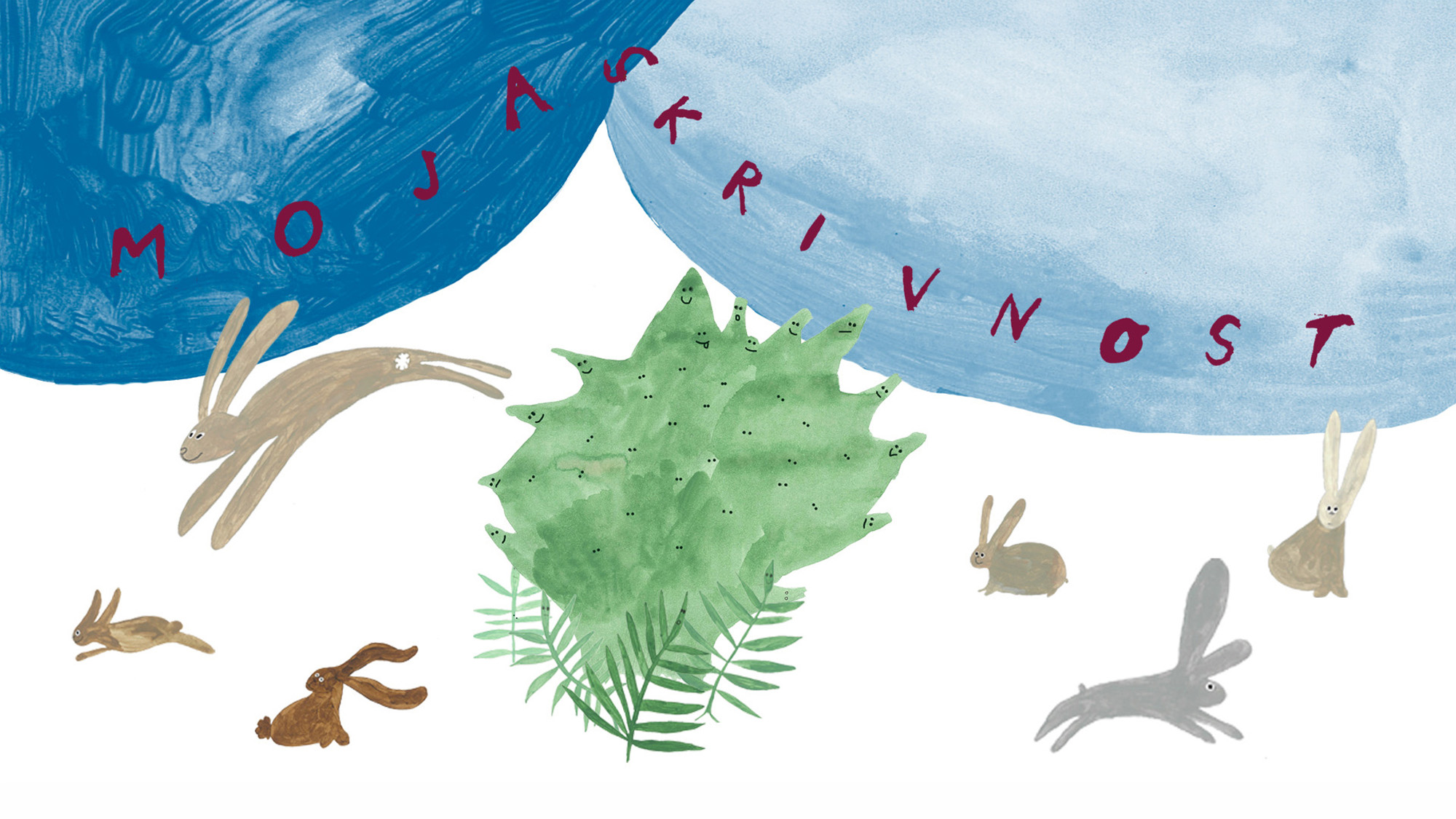
In the forest amongst moss and dreams, rabbits and ferns have made a bet, which is why they have found themselves in full preparations for a very special Olympics. The sporting event between the squabbling forest creatures who stopped talking to each other, is framed by the story of two best friends, Lara and Igor, who, as all friends sometimes do, fell out one day. Through a series of humorous twists, hurdles and with a strong desire to win, which is overcome by friendship and joy, a space opens up for a range of emotions that accompany the painful clash between a girl and a boy.
The play is designed as a soundwalk for children and their parents. When the children run into the forest together with the actors, the ambiance of the real space and the play start intertwining. By listening, moving around the space, and exploring small art installations, children and parents, together with the actors, immerse themselves in the action, thus becoming part of the story revolving around a very special competition in the forest…
Saška Rakef, Urban Gruden, Lucija Zucchiati, Nina Kokelj, Ingrid Mačus
As great as children’s happiness is, children’s sadness is also deep. Full ofquestions. Deep, painful, important.
In the forest amongst moss and dreams, rabbits and ferns have made a bet, which is why they have found themselves in full preparations for a very special Olympics. The sporting event between the squabbling forest creatures who stopped talking to each other, is framed by the story of two best friends, Lara and Igor, who, as all friends sometimes do, fell out one day. Through a series of humorous twists, hurdles and with a strong desire to win, which is overcome by friendship and joy, a space opens up for a range of emotions that accompany the painful clash between a girl and a boy.
The play is designed as a soundwalk for children and their parents. When the children run into the forest together with the actors, the ambiance of the real space and the play start intertwining. By listening, moving around the space, and exploring small art installations, children and parents, together with the actors, immerse themselves in the action, thus becoming part of the story revolving around a very special competition in the forest…
Saška Rakef
A playwright, director and researcher of experiences triggered by sound. She is employed as a radio director at Radio Slovenia and teaches radio directing at the Academy of Theatre, Radio, Film and Television in Ljubljana.
Urban Gruden
A sound engineer working at Radio Slovenia with a rich opus of radio plays, many of which have been nominated and awarded at international festivals.
Lucija Zucchiati
A designer, illustrator and set designer. She graduated in visual communications from the Academy of Fine Arts and Design, where she is currently studying for a master's degree in painting. Lately she has been mainly involved in theatre set design.
Nina Kokelj
A writer, publicist, screenwriter, an award-winning author of six novels and numerous picture books. A large, valuable part of her work takes place in collaborative tandems and teams. She publishes interviews and reports in a wide range of media.
Ingrid Mačus
A composer and pianist. She explores the space between sound and word in collaboration with poets as well as collaborates with filmmakers. She graduated in composition from the Jacopo Tomadini State Conservatory in Udine.
Kolofon / Colophon
Text: Saška Rakef, Nina Kokelj directed and dramaturgy by: Saška Rakef music: Ingrid Mačus sound design: Urban Gruden set design and illustrations: Lucija Zucchiati drawings and texts recorded for the diary: Leja Šetinc, Ana Tereza Perko, Lucija Zucchiati choreography: Ajda Pirtovšek language advisor: Mateja Juričan expert associate: Katarina Lia Kompan Erzar language editing: Aleš Učakar editor: Alen Jelen. Actors in the play: Ajda Pirtovšek and Daniel Petković. Interpretation of the characters in the radio play: Mojka Končar, Tines Špik, Petra Štibelj, Peter Alojz Marn, Blaž Šef, Uroš Smolej, Ana Tereza Perko, Luka Maslaković, Tibor Bezlaj Milčinski, Mila Koščak, Leja Šetinc, Nace Žerjal. Sound effects and singing: nOrkester 2025, Atelje Sarasvati. The recording was recorded at the Vinko Vodopivec Music School in Ajdovščina. Produced by: ŠKUC Gledališče and Radio Slovenia 3 – Ars Programme. Coproduced by Kolaž institute. Photo: Authors’ archive
The reduced ticket price applies to secondary school students, university students, pensioners, and self-employed professionals in the cultural sector.
Admission is free for children under the age of 12 when accompanied by an adult. The accompanying adult purchases one ticket for themselves and states the number of children accompanying them during the booking process. Children count towards the event’s total capacity. Visitors aged 12 and over require their own paid ticket.
The performance on Sunday, 4 October 2026, is adapted to the setting of Koseze Pond in Ljubljana.
Earthling Gaia is a performance which through sound, walking and the inclusion of space aims at the sensibilization of young people and the promotion of outdoor activities. In addition to experiencing and reflecting on the ecology, it prompts the development of mindfulness.
From an indoor site, such as a theatre, cinema or gallery, the performance invites us outdoors, in nature. A forest as a stage, and the audience trading comfortable chairs for walking shoes and heading off to the performance.
Some locations along the way are natural venues – natural auditoriums complete with architecturally superb observation posts, offering magnificent views of the landscape which intoxicates with its beauty and triggers imagination by constantly changing. We can imagine looking into the future, exploring possible scenarios for the days to come.
A dystopian story of Earthling Gaia recounts a possible future of the Lake Cerknica area. We experience the sound performance while walking a selected part of the Drvošec trail. We stop at the observation posts, observe the lake, experience the forest and, above all, listen. Earthling Gaia, a girl as a metaphor and the main character of the performance, will speculate on a potential scenario of the future of our overstrained planet which indisputably dictates the development of the local landscape.
The performance on Sunday, 4 October 2026, is adapted to the setting of Koseze Pond in Ljubljana.
Earthling Gaia is a performance which through sound, walking and the inclusion of space aims at the sensibilization of young people and the promotion of outdoor activities. In addition to experiencing and reflecting on the ecology, it prompts the development of mindfulness.
From an indoor site, such as a theatre, cinema or gallery, the performance invites us outdoors, in nature. A forest as a stage, and the audience trading comfortable chairs for walking shoes and heading off to the performance.
Some locations along the way are natural venues – natural auditoriums complete with architecturally superb observation posts, offering magnificent views of the landscape which intoxicates with its beauty and triggers imagination by constantly changing. We can imagine looking into the future, exploring possible scenarios for the days to come.
A dystopian story of Earthling Gaia recounts a possible future of the Lake Cerknica area. We experience the sound performance while walking a selected part of the Drvošec trail. We stop at the observation posts, observe the lake, experience the forest and, above all, listen. Earthling Gaia, a girl as a metaphor and the main character of the performance, will speculate on a potential scenario of the future of our overstrained planet which indisputably dictates the development of the local landscape.
Irena Pivka
An artist, producer, architect and scenographer. In recent years she has primarily focused on artworks that shed light on the connection between place, sound, map and digital tools. Her evolving artistic expression is centered on sound-geolocation performances, which, with the help of location tools and created sound images, combine walking and listening.
Brane Zorman
A composer, sound and intermedia artist, sound manipulator, producer and curator. Besides composing for the theatre, intermedia and dance, he is focused on developing different strategies, techniques, dynamic and interactive models in his work on sound and space, recording and reinterpreting soundscapes and creating electronic and acoustic sound sculptures using sophisticated tools.
Kolofon / Colophon
Artists: Irena Pivka, Brane Zorman Text: Irena Pivka Musical composition: Brane Zorman Voice: Nada Vodušek, Anu Pivka Translation and proofreading: Melita Silič Photography: Irena Pivka Illustration: Jovana Dukić Headphone equipment: Tina Žen Production: KD Cerknica, 2021 and Notranjska Regional Park In collaboration with: Cona – Institute for Processing Contemporary Art, within the festival: Sound Walk City · prelude
The initiator of Sound Walk City · prelude is the platform walk · listen · create in collaboration with the Cona Institute. The producer of the festival in Ljubljana is the Cona Institute, Steklenik Gallery.
The night sound walk takes us on a search of silence and listening to the inaudible, during the time of the night moths yamamayu, which represent the syntropic bonds between distant and nearby territories. The night sound walk takes us into the magical world of nocturnal butterflies, which, as symbionts, represent the syntropic links between nature and culture in Tivoli Park. The series of listening scores aims to intervene in the dominant perceptual agenda and highlight the potentials of aural perception. Hearing is closely related to the capacity for a complex understanding of reality and compassion, the basis for inclusive resonance. How to listen to the invisible? How to perceive beings that do not want to be heard?
Listening to the seemingly inaudible and wandering in night landscapes (which can also be just a reduction of the visual field and listening to the tiny impulses of one’s own body and anima) addresses the sonority of the apparent silence and bioacoustics from the direction of the territory. Japanese silk moths (Antheraea yamamai) inhabit tall deciduous forests, living primarily high in the treetops. These nocturnal butterflies leave behind large light green silk cocoons. Dislocated nocturnal incomers, they managed to flee into the open canopy of the surrounding trees when the locals ventured into silk farming a century ago. Originating in the hills of Japan, they have spread across south-east Europe.
YAMAMAYU Night Wanderings drew on the artist’s ongoing poetic exploration of Japanese silk moths and moths in general, echolocation, the ability of nocturnal moths to absorb sound as protection against predators, silence, the modality of moving/not moving, and the sophistication of the personal aural field in terms of territory.
The night sound walk takes us on a search of silence and listening to the inaudible, during the time of the night moths yamamayu, which represent the syntropic bonds between distant and nearby territories. The night sound walk takes us into the magical world of nocturnal butterflies, which, as symbionts, represent the syntropic links between nature and culture in Tivoli Park. The series of listening scores aims to intervene in the dominant perceptual agenda and highlight the potentials of aural perception. Hearing is closely related to the capacity for a complex understanding of reality and compassion, the basis for inclusive resonance. How to listen to the invisible? How to perceive beings that do not want to be heard?
Listening to the seemingly inaudible and wandering in night landscapes (which can also be just a reduction of the visual field and listening to the tiny impulses of one’s own body and anima) addresses the sonority of the apparent silence and bioacoustics from the direction of the territory. Japanese silk moths (Antheraea yamamai) inhabit tall deciduous forests, living primarily high in the treetops. These nocturnal butterflies leave behind large light green silk cocoons. Dislocated nocturnal incomers, they managed to flee into the open canopy of the surrounding trees when the locals ventured into silk farming a century ago. Originating in the hills of Japan, they have spread across south-east Europe.
YAMAMAYU Night Wanderings drew on the artist’s ongoing poetic exploration of Japanese silk moths and moths in general, echolocation, the ability of nocturnal moths to absorb sound as protection against predators, silence, the modality of moving/not moving, and the sophistication of the personal aural field in terms of territory.
OR poiesis [Petra Kapš]
An artist and researcher in the field of bio- and geo-acoustics, hydroacoustics, auditory perception, interactive sound performance in concrete, acoustic space and digitally augmented reality, web transmission and art radio. Her work weaves between the art of sound, radio, space-time poetry, performance and photography. She extends the word, her primary medium, into the sonorous spheres of space-time poetry. She develops a performative practice of field recording, explores and enacts the possibilities of the author's radio space, and focuses on the aurality of spatialized memory and temporal wells. Alongside all digital dimensions, the physical presence of the body is central. Her sound works record _solitudes_. In recent years, she has made a significant contribution to the development of interactive, sonic and performative art practices. Her experimentation and development of location-based media in relation to the auditory sensory system and the development of topographic sound archives, articulating subtle interventions in public space, and exploring memory and remembering, highlighted through sound, sensation and perception, in the dynamic between the ancient and the contemporary, are important. She works in Slovenian and international environments. She is a founding member of CENSE (Central European Network for Sonic Ecologies) and a member of JATA C and the radio.earth collective.
Kolofon / Colophon
Concept, text, and design: Petra Kapš Music and sound composition: Petra Kapš Proofreading and English translation: Melita Silič Portrait photography: Francesco Rosso Event photography: Matej Tomažin
The reduced ticket price applies to secondary school students, university students, pensioners, and self-employed professionals in the cultural sector.
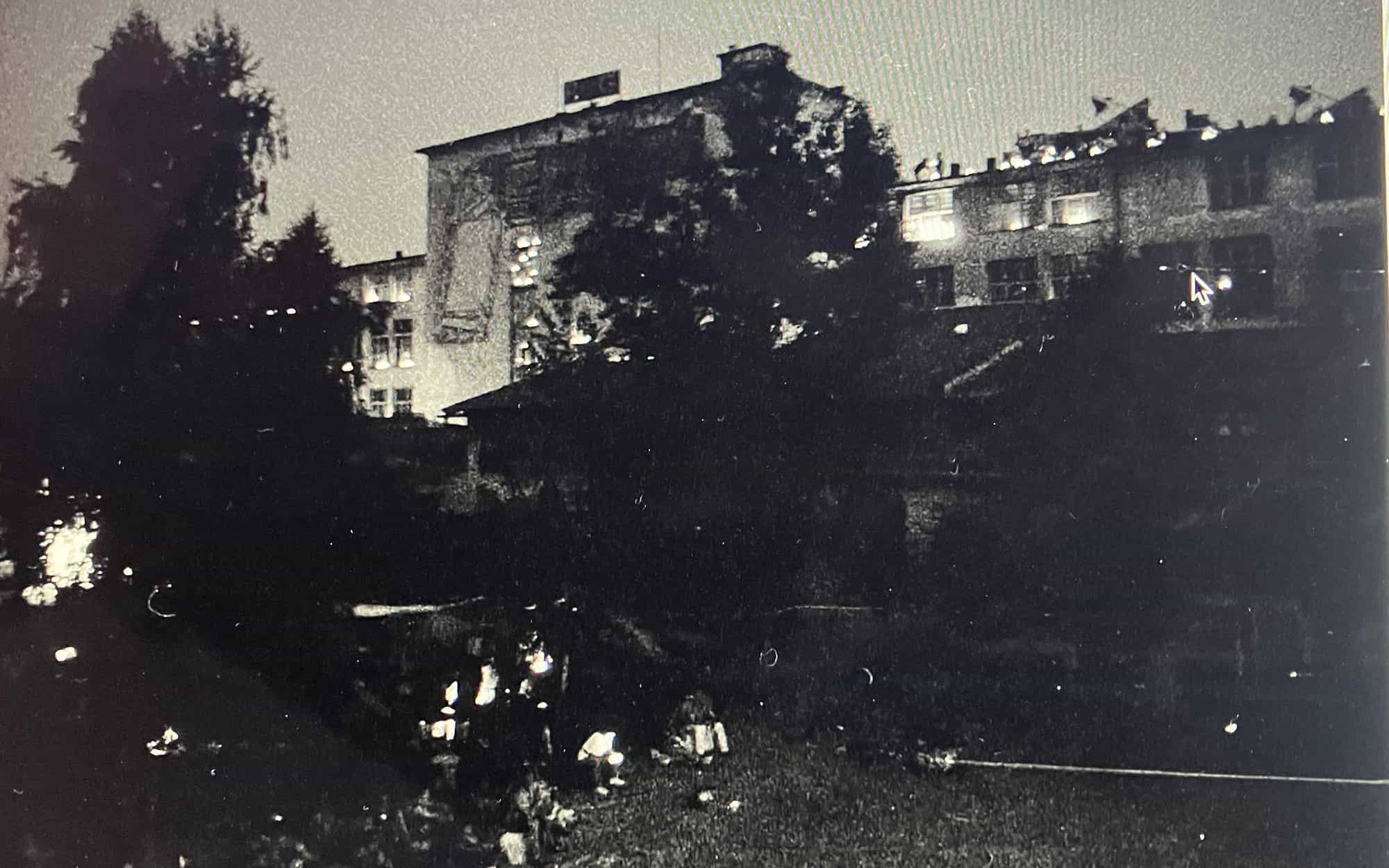
The soundwalk Odjek strela is an artistic research that uses guided listening to open questions of memory, archiving and silence within the urban space. The listening session stems from years of researching the relationship between documentation and forgetting. The walk is based on the layering of sound materials – archival recordings, text fragments, field recordings and contemporary sound interventions – that are intertwined with sounds taken from the immediate surroundings. This establishes a tension between the mediated and the directly experienced, the written and the elusive. The central motif of the soundwalk is the echo of a gunshot – a sound that returns, moves away and comes closer, as a point of orientation and as a disturbance. It refers to the former symbol of the pink gun on the facade of the former Rog factory and opens questions linked to the history of the space: from industrial production to autonomous practices, erasure and transformation. What happens to the story when the gun is not fired? The author treats the lack of the gunshot as silence – an active and meaningful absence. The soundscape shifts between the echoes of live radio transmissions emitted from the roof of the former factory building and low-frequency pulses in its basement, which act almost physically, like a subterranean recording. The path leads through the urban space as through an invisible archive, in which layered histories and repressed memories are revealed. Speculative questions are raised: what would the trees remember if they were still standing, and what traces do the new trees extract from the soil? The conclusion at the former Rog factory, at the monument to the erased, establishes a temporary, invisible monument – a space of reflection on what remains unspoken but persistently present.
The soundwalk Odjek strela is an artistic research that uses guided listening to open questions of memory, archiving and silence within the urban space. The listening session stems from years of researching the relationship between documentation and forgetting. The walk is based on the layering of sound materials – archival recordings, text fragments, field recordings and contemporary sound interventions – that are intertwined with sounds taken from the immediate surroundings. This establishes a tension between the mediated and the directly experienced, the written and the elusive. The central motif of the soundwalk is the echo of a gunshot – a sound that returns, moves away and comes closer, as a point of orientation and as a disturbance. It refers to the former symbol of the pink gun on the facade of the former Rog factory and opens questions linked to the history of the space: from industrial production to autonomous practices, erasure and transformation. What happens to the story when the gun is not fired? The author treats the lack of the gunshot as silence – an active and meaningful absence. The soundscape shifts between the echoes of live radio transmissions emitted from the roof of the former factory building and low-frequency pulses in its basement, which act almost physically, like a subterranean recording. The path leads through the urban space as through an invisible archive, in which layered histories and repressed memories are revealed. Speculative questions are raised: what would the trees remember if they were still standing, and what traces do the new trees extract from the soil? The conclusion at the former Rog factory, at the monument to the erased, establishes a temporary, invisible monument – a space of reflection on what remains unspoken but persistently present.
Sava šumi [Urška Savič]
Intermedia artist and journalist working in the field of culture. In her work, she explores the relationships between documentation, archives and memory, and the tensions between recording and forgetting. Between 2019 and 2025 she led the RADAR platform on Radio Študent, while she currently works as an external collaborator at the Academy of Fine Arts and Design and Radio ARS, and is also active as a member of the photography collective Kela.
Kolofon / Colophon
Artist: Sava šumi [Urška Savič] Artistic Collaborators: David Murko, Maya Al Khaldi, MRŽL, Thierno Dallo, Tisa Neža Herlec Studio Recording: Robbie Hopper Sound post-production: Oliver Wagner Acknowledgements: I would like to thank everyone who contributed to the Neomejen Rog Uporabe archive and whose voices are featured in the sound work, as well as Radio Študent, the RADAR Open Radio (Artistic-Theoretical) Research Platform, Maska Magazine, Cona team, Modri kot, Lora Loran, Ida Hiršenfelder, Nika Grabar, Miha Poredoš, Sašo Puckovski and Jasmina Mustafić. Production: Cona, 2026
The author of the walk was selected through the Open Call for New Sound Walks of the TO)pot Festival in 2025.
The reduced ticket price applies to secondary school students, university students, pensioners, and self-employed professionals in the cultural sector.
Admission is free for children under the age of 12 when accompanied by an adult. The accompanying adult purchases one ticket for themselves and states the number of children accompanying them during the booking process. Children count towards the event’s total capacity. Visitors aged 12 and over require their own paid ticket.
As great as children’s happiness is, children’s sadness is also deep. Full ofquestions. Deep, painful, important.
In the forest amongst moss and dreams, rabbits and ferns have made a bet, which is why they have found themselves in full preparations for a very special Olympics. The sporting event between the squabbling forest creatures who stopped talking to each other, is framed by the story of two best friends, Lara and Igor, who, as all friends sometimes do, fell out one day. Through a series of humorous twists, hurdles and with a strong desire to win, which is overcome by friendship and joy, a space opens up for a range of emotions that accompany the painful clash between a girl and a boy.
The play is designed as a soundwalk for children and their parents. When the children run into the forest together with the actors, the ambiance of the real space and the play start intertwining. By listening, moving around the space, and exploring small art installations, children and parents, together with the actors, immerse themselves in the action, thus becoming part of the story revolving around a very special competition in the forest…
Saška Rakef, Urban Gruden, Lucija Zucchiati, Nina Kokelj, Ingrid Mačus
As great as children’s happiness is, children’s sadness is also deep. Full ofquestions. Deep, painful, important.
In the forest amongst moss and dreams, rabbits and ferns have made a bet, which is why they have found themselves in full preparations for a very special Olympics. The sporting event between the squabbling forest creatures who stopped talking to each other, is framed by the story of two best friends, Lara and Igor, who, as all friends sometimes do, fell out one day. Through a series of humorous twists, hurdles and with a strong desire to win, which is overcome by friendship and joy, a space opens up for a range of emotions that accompany the painful clash between a girl and a boy.
The play is designed as a soundwalk for children and their parents. When the children run into the forest together with the actors, the ambiance of the real space and the play start intertwining. By listening, moving around the space, and exploring small art installations, children and parents, together with the actors, immerse themselves in the action, thus becoming part of the story revolving around a very special competition in the forest…
Saška Rakef
A playwright, director and researcher of experiences triggered by sound. She is employed as a radio director at Radio Slovenia and teaches radio directing at the Academy of Theatre, Radio, Film and Television in Ljubljana.
Urban Gruden
A sound engineer working at Radio Slovenia with a rich opus of radio plays, many of which have been nominated and awarded at international festivals.
Lucija Zucchiati
A designer, illustrator and set designer. She graduated in visual communications from the Academy of Fine Arts and Design, where she is currently studying for a master's degree in painting. Lately she has been mainly involved in theatre set design.
Nina Kokelj
A writer, publicist, screenwriter, an award-winning author of six novels and numerous picture books. A large, valuable part of her work takes place in collaborative tandems and teams. She publishes interviews and reports in a wide range of media.
Ingrid Mačus
A composer and pianist. She explores the space between sound and word in collaboration with poets as well as collaborates with filmmakers. She graduated in composition from the Jacopo Tomadini State Conservatory in Udine.
Kolofon / Colophon
Text: Saška Rakef, Nina Kokelj directed and dramaturgy by: Saška Rakef music: Ingrid Mačus sound design: Urban Gruden set design and illustrations: Lucija Zucchiati drawings and texts recorded for the diary: Leja Šetinc, Ana Tereza Perko, Lucija Zucchiati choreography: Ajda Pirtovšek language advisor: Mateja Juričan expert associate: Katarina Lia Kompan Erzar language editing: Aleš Učakar editor: Alen Jelen. Actors in the play: Ajda Pirtovšek and Daniel Petković. Interpretation of the characters in the radio play: Mojka Končar, Tines Špik, Petra Štibelj, Peter Alojz Marn, Blaž Šef, Uroš Smolej, Ana Tereza Perko, Luka Maslaković, Tibor Bezlaj Milčinski, Mila Koščak, Leja Šetinc, Nace Žerjal. Sound effects and singing: nOrkester 2025, Atelje Sarasvati. The recording was recorded at the Vinko Vodopivec Music School in Ajdovščina. Produced by: ŠKUC Gledališče and Radio Slovenia 3 – Ars Programme. Coproduced by Kolaž institute. Photo: Authors’ archive
The bioacoustic sound sculpture Inaudible – Audible, among the Bats reveals an almost inaudible world of frequency ranges emitted by bats that are usually inaccessible to humans. The project is positioned between sound ecology and bioacoustic music, as it processes the sounds of the night environment and bats from the ultrasonic spectrum and transposes them into the human audible range.
The composition consists of audible night sounds, joined by transposed bat voices and other nocturnal sound sources. The final sound space consists of an inner – castle, distant forest and central space, represented by the external platform surrounding the castle. The composition includes electroacoustic processing of the sound material and is played as a spatial, 3D or 360-degree sound projection.
The bioacoustic sound sculpture Inaudible – Audible, among the Bats reveals an almost inaudible world of frequency ranges emitted by bats that are usually inaccessible to humans. The project is positioned between sound ecology and bioacoustic music, as it processes the sounds of the night environment and bats from the ultrasonic spectrum and transposes them into the human audible range.
The composition consists of audible night sounds, joined by transposed bat voices and other nocturnal sound sources. The final sound space consists of an inner – castle, distant forest and central space, represented by the external platform surrounding the castle. The composition includes electroacoustic processing of the sound material and is played as a spatial, 3D or 360-degree sound projection.
Boštjan Perovšek
A musician, composer and sound space designer who creates experimental and electroacoustic music. He is particularly interested in bioacoustic music, which is based on the sounds of animals, especially insects, and the connection between science and art. He collaborates with the groups SAETA and Jata C and the duo BBtrem, as well as creates music for film, theatre, performances, multimedia installations, museums and galleries. In 2013, he received the honorary Valvasor Award for his work in the field of sound spaces for museum installations.
Kolofon / Colophon
Concept and realisation: Boštjan Perovšek
produced by SAETA – Zavod za kulturne in promocijske aktivnosti Expert associates: dr. Klemen Koselj, expert on the life of bats, Slovenia, and dr. Roland Mühlethaler, expert in the field of bioacoustics and biodiversity, Germany. Photo: Boštjan Perovšek
The project was created for the European Capital of Culture GO! 2025 Nova Gorica – Gorizia and was co-financed within the framework of the GO! 2025 program.
The reduced ticket price applies to secondary school students, university students, pensioners, and self-employed professionals in the cultural sector.
Reverse walking, or rather backwards walking, turns our attention back to front. It slows us down. It relaxes us over time. Not only does the speed of our walk slow down, but also the perception of what we are walking past and what is coming towards us.
As we, through backwards walking, move away from the landscape, the landscape comes closer to us. A space of attention opens, and it is from this reversed position that we surrender to listening.
The artistic practice of backwards walking also reverses the roles in the performance. Mathilde and DISKOlektiv no longer assume the role of performers, instead they adopt the role of spectators. The rest of us join them as the spectators and listeners of the greatest spectacle in the world: life. How does life hear us?
We would like to invite you to a collective backwards walking session under the full moon, at the transition from day to night, in a circle, cyclically, elliptically.
You will need comfortable clothing and footwear to walk backwards. While walking backwards, you will also be able to walk forwards or stomachwards. Walking is suitable for people of all physical abilities.
Reverse walking, or rather backwards walking, turns our attention back to front. It slows us down. It relaxes us over time. Not only does the speed of our walk slow down, but also the perception of what we are walking past and what is coming towards us.
As we, through backwards walking, move away from the landscape, the landscape comes closer to us. A space of attention opens, and it is from this reversed position that we surrender to listening.
The artistic practice of backwards walking also reverses the roles in the performance. Mathilde and DISKOlektiv no longer assume the role of performers, instead they adopt the role of spectators. The rest of us join them as the spectators and listeners of the greatest spectacle in the world: life. How does life hear us?
We would like to invite you to a collective backwards walking session under the full moon, at the transition from day to night, in a circle, cyclically, elliptically.
You will need comfortable clothing and footwear to walk backwards. While walking backwards, you will also be able to walk forwards or stomachwards. Walking is suitable for people of all physical abilities.
Mathilde Vrignaud
A French choreographer and founder of the group LAB//SEM, which was formed in 2014 by a group researching the intersection between music and dance. Her work includes various formats such as performances, walks, situations and scores. In addition to the Backwalk, she also participated in two other events in Slovenia: the Choreographic Turn 10 and she developed a new performance in collaboration with the Krater collective in 2026.
DISKOlektiv
Artistically explores what it is to be a dancer, choreographer, clown, teacher, writer, producer, musician and citizen through formats such as dance, performances, games, meetings, events, laboratory settings, clown acts and concerts. He has been performing TheGame of Names, in which names exchange bodies since 2010.
Kolofon / Colophon
Choreography and production: Mathilde Vrignaud and DISKOlektiv. The development of the Backwalk was significantly aided by the participation in the Along the Walk project. Photo: Mathilde Vrignaud
The reduced ticket price applies to secondary school students, university students, pensioners, and self-employed professionals in the cultural sector.
Voice shapes unique compositions with the complex musical instrument of our bodies every day. A unique composition that follows the individual’s paths is created through the multi-layered structure of predominantly improvised responses to the numerous stimuli to which we are exposed daily and situationally.
The voice, even when not expressed, resides in the inner silence of an individual, thus forming a living entity in which continuous communication between multiple sub-personalities takes place. Only through a conscious decision does it become audible, flexibly transitioning between different roles: communication, warning, messaging, expression of power, creation, social networking, calming or a therapeutic tool.
The GLASnaPOT soundwalk takes us gradually from the loud city streets to inner landscapes – on a journey during which we get to know the musical instrument that we inhabit, inviting us to curiously explore all its hidden corners.
Voice shapes unique compositions with the complex musical instrument of our bodies every day. A unique composition that follows the individual’s paths is created through the multi-layered structure of predominantly improvised responses to the numerous stimuli to which we are exposed daily and situationally.
The voice, even when not expressed, resides in the inner silence of an individual, thus forming a living entity in which continuous communication between multiple sub-personalities takes place. Only through a conscious decision does it become audible, flexibly transitioning between different roles: communication, warning, messaging, expression of power, creation, social networking, calming or a therapeutic tool.
The GLASnaPOT soundwalk takes us gradually from the loud city streets to inner landscapes – on a journey during which we get to know the musical instrument that we inhabit, inviting us to curiously explore all its hidden corners.
Allja Petric
Singer, vocal pedagogue and sound artist working in the field of contemporary, improvised and cross-genre music. Her work consists of independent projects, original music and collaborations in various musical, sound, performative and interdisciplinary productions. In addition to holding concerts, she has also been leading individual and group singing workshops for over ten years.
Kolofon / Colophon
Authorship and performance: Allja Petric Consultation: Brane Zorman, Irena Pivka Language and stylistic review: Mateja Juričan Photography: Matej Tomažin Production: Cona, 2026
The author of the walk was selected through the Open Call for New Sound Walks of the TO)pot Festival in 2025.
The reduced ticket price applies to secondary school students, university students, pensioners, and self-employed professionals in the cultural sector.
Ljubljana is increasingly losing touch with its cultural identity, the essential component of which is also the city’s architecture. It is crucial to keep this component alive, fostering a personal connection between people and their history.
Green Atrium of the City is a sonic exploration of an abandoned space in the middle of the city, where a green landscape is growing. A soundwalk combining art and architecture draws inspiration from a historic building designed by Jože Plečnik, begun in 1925, weaving memories of the past into the present. The Central Stadium in Bežigrad has been closed to the public since 2008. Once a public space, it is now falling into disrepair, its significance increasingly waning. Through sonority and historicization, we want to bring the inhabitants and visitors of Ljubljana closer to the degraded space of the stadium, which has been distorted from different angles by the decay of time. In its silent decay, the stadium is suspended in a timeless void, inviting ideas for its revival. Echoes of falling debris, sticks, branches, and glass scratch the texture of the air, reminding us of a once vibrant place.
The soundwalk acts as a musical intervention, breathing temporary meaning into Plečnik Stadium and reviving its resonant core. It prompts deep reflection on the preservation of cultural heritage and foregrounds the more sensory perception of space. The soundwalk focuses on the complex sound structure and acoustic characteristics of Plečnik Stadium and its environment, which, with its resonant body, acts as an instrument – the stadium not only as a space but as a live sonic entity.
Ljubljana is increasingly losing touch with its cultural identity, the essential component of which is also the city’s architecture. It is crucial to keep this component alive, fostering a personal connection between people and their history.
Green Atrium of the City is a sonic exploration of an abandoned space in the middle of the city, where a green landscape is growing. A soundwalk combining art and architecture draws inspiration from a historic building designed by Jože Plečnik, begun in 1925, weaving memories of the past into the present. The Central Stadium in Bežigrad has been closed to the public since 2008. Once a public space, it is now falling into disrepair, its significance increasingly waning. Through sonority and historicization, we want to bring the inhabitants and visitors of Ljubljana closer to the degraded space of the stadium, which has been distorted from different angles by the decay of time. In its silent decay, the stadium is suspended in a timeless void, inviting ideas for its revival. Echoes of falling debris, sticks, branches, and glass scratch the texture of the air, reminding us of a once vibrant place.
The soundwalk acts as a musical intervention, breathing temporary meaning into Plečnik Stadium and reviving its resonant core. It prompts deep reflection on the preservation of cultural heritage and foregrounds the more sensory perception of space. The soundwalk focuses on the complex sound structure and acoustic characteristics of Plečnik Stadium and its environment, which, with its resonant body, acts as an instrument – the stadium not only as a space but as a live sonic entity.
Nika van Berkel
Graduated from the Faculty of Architecture at the University of Ljubljana in 2015. Shortly after, she moved from Slovenia to the Netherlands, where she works and lives. Her work explores the boundaries between architecture, landscape, sound, and art.
Karmen Ponikvar
A Slovene sound artist and researcher in electronic and electroacoustic music. She is currently studying sound at the Institute of Sonology in The Hague, the Netherlands, where she studies sound's spatiality and texture.
Kolofon / Colophon
Conceptual design, field recording and composition: Nika van Berkel, Karmen Ponikvar Theoretical text: Milos Kosec Accompanying words in the soundwalk: Zala Velkavrh, Karmen Stariha Voice interpretation: Nataša Živkovič Event photo: Matej Tomažin Special thanks: Irena Pivka, Brane Zorman Production: Cona, 2024 Coproduction of premiere event: Museum of Architecture and Design
The bioacoustic sound sculpture Inaudible – Audible, among the Bats reveals an almost inaudible world of frequency ranges emitted by bats that are usually inaccessible to humans. The project is positioned between sound ecology and bioacoustic music, as it processes the sounds of the night environment and bats from the ultrasonic spectrum and transposes them into the human audible range.
The composition consists of audible night sounds, joined by transposed bat voices and other nocturnal sound sources. The final sound space consists of an inner – castle, distant forest and central space, represented by the external platform surrounding the castle. The composition includes electroacoustic processing of the sound material and is played as a spatial, 3D or 360-degree sound projection.
The bioacoustic sound sculpture Inaudible – Audible, among the Bats reveals an almost inaudible world of frequency ranges emitted by bats that are usually inaccessible to humans. The project is positioned between sound ecology and bioacoustic music, as it processes the sounds of the night environment and bats from the ultrasonic spectrum and transposes them into the human audible range.
The composition consists of audible night sounds, joined by transposed bat voices and other nocturnal sound sources. The final sound space consists of an inner – castle, distant forest and central space, represented by the external platform surrounding the castle. The composition includes electroacoustic processing of the sound material and is played as a spatial, 3D or 360-degree sound projection.
Boštjan Perovšek
A musician, composer and sound space designer who creates experimental and electroacoustic music. He is particularly interested in bioacoustic music, which is based on the sounds of animals, especially insects, and the connection between science and art. He collaborates with the groups SAETA and Jata C and the duo BBtrem, as well as creates music for film, theatre, performances, multimedia installations, museums and galleries. In 2013, he received the honorary Valvasor Award for his work in the field of sound spaces for museum installations.
Kolofon / Colophon
Concept and realisation: Boštjan Perovšek
produced by SAETA – Zavod za kulturne in promocijske aktivnosti Expert associates: dr. Klemen Koselj, expert on the life of bats, Slovenia, and dr. Roland Mühlethaler, expert in the field of bioacoustics and biodiversity, Germany. Photo: Boštjan Perovšek
The project was created for the European Capital of Culture GO! 2025 Nova Gorica – Gorizia and was co-financed within the framework of the GO! 2025 program.
The reduced ticket price applies to secondary school students, university students, pensioners, and self-employed professionals in the cultural sector.
The sound walk addresses Ljubljana’s underpasses, largely abandoned areas, reveal the city’s inability to imagine new urban uses and meanings. Neglected underpasses beneath the paving stones of orderly streets and squares are becoming shelters for those unheard on the margins of society.
The author listens closely to the Ajdovščina underpass. Through real-time sound capture and processing, everyday noises, silences, footsteps and echoes are transformed into an immersive sonic experience that opens up a space for what has been left unspoken. It reveals moments of unexpected beauty and places the listener in relation to space as a living, multilayered organism of unheard realities.
The Ajdovščina underpass, built on the site of a former Emona cemetery, carries deeper historical layers. Walking through these underground corridors becomes a movement through the temporalities of the city, where life, death, memory and forgetting intertwine.
Pod(hod) is conceived as a collection of associations from a day in the lives of individuals on the margins of society. The titles of the sound segments, Tunings, Silent Prayers, Gatherings of the Found, Walk of Shame, Lives Before Shop Windows, Lullaby, Morning Again and A Fragile Confrontation with Reality, do not interpret these lives, but create a space of listening in which a sensitive, open relationship to the other and to the world can emerge.
The world holds you, like it or not.
It moves you with fire and wind when it’s hot.
You’re chasing your sleep and wasting your spot —
you better start living.
The world has you turning the dirt, unforgiving,
old gravity is pulling — but love, oh love,
the night that embraced you unraveled the night.
The sound walk addresses Ljubljana’s underpasses, largely abandoned areas, reveal the city’s inability to imagine new urban uses and meanings. Neglected underpasses beneath the paving stones of orderly streets and squares are becoming shelters for those unheard on the margins of society.
The author listens closely to the Ajdovščina underpass. Through real-time sound capture and processing, everyday noises, silences, footsteps and echoes are transformed into an immersive sonic experience that opens up a space for what has been left unspoken. It reveals moments of unexpected beauty and places the listener in relation to space as a living, multilayered organism of unheard realities.
The Ajdovščina underpass, built on the site of a former Emona cemetery, carries deeper historical layers. Walking through these underground corridors becomes a movement through the temporalities of the city, where life, death, memory and forgetting intertwine.
Pod(hod) is conceived as a collection of associations from a day in the lives of individuals on the margins of society. The titles of the sound segments, Tunings, Silent Prayers, Gatherings of the Found, Walk of Shame, Lives Before Shop Windows, Lullaby, Morning Again and A Fragile Confrontation with Reality, do not interpret these lives, but create a space of listening in which a sensitive, open relationship to the other and to the world can emerge.
The world holds you, like it or not.
It moves you with fire and wind when it’s hot.
You’re chasing your sleep and wasting your spot —
you better start living.
The world has you turning the dirt, unforgiving,
old gravity is pulling — but love, oh love,
the night that embraced you unraveled the night.
ACCOMPANYING PROGRAMME
Luka Uršič The Gift of Failure
4. 6.–30. 8. 2026, MGLC Grad Tivoli
On Thursday, June 4, 2026, at 19.30, the exhibition The Gift of Failure by Luka Uršič will open at the International Centre of Graphic Arts (Pod turnom 3, Ljubljana).
Failure as a point of departure for potential future success is today a key part of the artistic process. What might elsewhere be understood as an error or anomaly can become an expressive value and a space of freedom in art. With new works produced this year in the MGLC Print Studio, Luka Uršič explores the potential of his artistic practice as a reparative mechanism.
Through screenprinting interventions on the unsuccessful and discarded Polaroid photographs by others, the artist returns to the source of failure and symbolically takes on the blame and responsibility for failed actions. In this way, he confronts his own and others’ unease, while simultaneously attempting to approach the liberating possibility of redemptive correction and improvement.
Curator of the exhibition: Yasmín Martín Vodopivec
The exhibition will be on view at MGLC Grad Tivoli until 30 August.
INTRODUCTORY TEXT
The Metalka business building in Ljubljana is one of the key examples of Slovenian late modernism and early post-war commercial architecture. Metalka was built in 1963 according to plans by architects Edo Mihevc and Boris Leskovec, and was the first modern business high-rise in Slovenia. It emerged at a time when Ljubljana sought to develop as a modern socialist capital with a clearly articulated business centre.
In the sound walk Pod(hod), however, the artist approaches the exploration of space from another, non-architectural perspective. His interest lies in spontaneous use: in the time after design, construction, planning, and the comprehensive vision of the building and its wider project have run their course. How long, and with what degree of quality, can a space continue to live within a constantly changing environment and society? What, and who, inhabits the space unexpectedly?
The sound walk addresses the underpass, today a largely abandoned area that reveals the difficulty of imagining new urban contents. Neglected underpasses beneath the paving stones of orderly streets and squares become refuges for those unheard at the margins of society. The artist approaches the listening of space in an authorial and intimate way, giving voice to the unseen users of an abandoned space, as well as to the space itself, to its membrane. In doing so, he reflects on shifting, unstable social conditions and on the fragility of the spaces embedded within them.
Through the capture and processing of sound in real time, everyday noises, silences, footsteps, and echoes are transformed into an immersive sonic experience that opens a space for what has remained unspoken. The listener is placed in relation to space as a living, multilayered organism of unheard realities.
Kalu [Luka Uršič]
A visual artist, musician, and performer living and working in Ljubljana. His practice develops at the intersection of image and sound, where, through an intuitive process, he explores relationships between space, materiality, and perception. In his works, he creates suggestive, sensory experiences, while as a music producer he shapes soundscapes for various artistic projects and composes music for his own and collaborative productions.
Kolofon / Colophon
Authorship and performance: Kalu [Luka Uršič] Consulting: Brane Zorman Producer: Alja Petric Text preparation: Martina Valášková, Irena Pivka Photography: Matej Tomažin Partner: Skladišče 172 Production: Cona, 2026
The author of the walk was selected through the Open Call for New Sound Walks of the TO)pot Festival in 2025.
The reduced ticket price applies to secondary school students, university students, pensioners, and self-employed professionals in the cultural sector.
Tu, čisto blizu is an invitation for participants to transform from passive walkers into active co-creators of the urban landscape, leaving behind a more visible imprint, a more visible trace.
On the level of both the individual and the group, the walk explores how we inhabit and move through the city, and what defines the nature of our encounters and interactions. It foregrounds the bodily dimension of experiencing the city and asks how the body might be placed within the predictable dynamics of urban life in a different way. It highlights the power of the moment when individuals step out of individualistic, fleeting observation of their surroundings and become aware of, give meaning to, and perhaps even alter their automated urban routes.
Through different situations and stops in the city, Tu, čisto blizu invites participants to walk through the city in a playful and liberated way, and to actively situate themselves within it.
Tu, čisto blizu is an invitation for participants to transform from passive walkers into active co-creators of the urban landscape, leaving behind a more visible imprint, a more visible trace.
On the level of both the individual and the group, the walk explores how we inhabit and move through the city, and what defines the nature of our encounters and interactions. It foregrounds the bodily dimension of experiencing the city and asks how the body might be placed within the predictable dynamics of urban life in a different way. It highlights the power of the moment when individuals step out of individualistic, fleeting observation of their surroundings and become aware of, give meaning to, and perhaps even alter their automated urban routes.
Through different situations and stops in the city, Tu, čisto blizu invites participants to walk through the city in a playful and liberated way, and to actively situate themselves within it.
Urša Sekirnik
A dancer and creator working in the field of contemporary performing arts. In her projects, audience involvement in both the process and performance is one of her main areas of interest, which is why in recent years she has focused on creating participatory performances.
Aja Zupanec
A dancer, dance pedagogue and choreographer, she moves between these areas of contemporary dance. As an artist, she is most interested in artistic explorations of ideals shaped by society and of the world that exists within our bodies.
Beti Strgar
Musician, music producer and actress who combines various artistic practices in her work. In her projects she explores human identity, sonority and the authenticity of stage expression.
Kolofon / Colophon
Authorship and performance: Aja Zupanec and Urša Sekirnik Music and sound design: Beti Strgar Production and consulting: Irena Pivka and Brane Zorman Photography: Matej Tomažin Partner: KUD NUM Production: CONA, 2026
The authors of the walk were selected through the Open Call for New Sound Walks of the TO)pot Festival in 2025.
V ceni je obrok, ki se plača neposredno No.01Baza.
The TO)pot Festival is not only a space for listening and engaging with the programme, but also a space for meeting, resting, sharing a meal, and informally exploring the themes addressed through the work of Cona and the TO)pot Festival.
This year, we are therefore organising a communal lunch for the festival’s contributors: artists, authors, theorists, and organisers. At the same time, we invite you to join us around the shared table.
At BAZA, we will experience the festival through conversation, food, and informal socialising. We are also preparing a TO)pot Festival library, offering a selection of books on walking, sound, silence, and the mapping of spaces, as well as a listening room.
This is an opportunity to meet the festival participants, ask questions that may not find their way into post-event discussions, exchange impressions, or simply share a meal.
We see REPAST, our communal lunch, as an integral part of the festival programme – a space where the boundary between contributors and visitors becomes blurred. Everyone who would like to experience the festival informally through encounters, conversation, and reading is warmly invited to join us.
The TO)pot Festival is not only a space for listening and engaging with the programme, but also a space for meeting, resting, sharing a meal, and informally exploring the themes addressed through the work of Cona and the TO)pot Festival.
This year, we are therefore organising a communal lunch for the festival’s contributors: artists, authors, theorists, and organisers. At the same time, we invite you to join us around the shared table.
At BAZA, we will experience the festival through conversation, food, and informal socialising. We are also preparing a TO)pot Festival library, offering a selection of books on walking, sound, silence, and the mapping of spaces, as well as a listening room.
This is an opportunity to meet the festival participants, ask questions that may not find their way into post-event discussions, exchange impressions, or simply share a meal.
We see REPAST, our communal lunch, as an integral part of the festival programme – a space where the boundary between contributors and visitors becomes blurred. Everyone who would like to experience the festival informally through encounters, conversation, and reading is warmly invited to join us.
Seven scores for situated listening. Exercises inperception for deep listening.
Nadiža River. Older than Mountain
Eocene. Fossilised Glow
Kipos. Geomagnetic Waves
Panagia Mantala. Tree above River.
Pohorje primeval Forest. Resonant Echoes of Medusa
Vesuvius. In(Out)-Breath
Luna. Almost Audible
Exercises in perception are conceived as a series of poetic scores for whole-body listening. They take as their point of departure seven spaces and their dominant elements, which form the central cores of aural immersion. The performative nature of the poetic instructions foregrounds embodied perception and different modes of sensing, gravitating towards the revelation of deeper fields of perception. The exploration unfolds across three modular clusters: gaze – looking – distance /// cells – skin – hearing /// touch – texture – resonance. Participants will enact the exercises in perception within the dynamic between individual and community.
Participants will be offered poetic instructions for shaping minimal movements and performative formations in space, leading them into processes of expanded perception and attentive listening to particular sonorities. Through heightened sensory receptivity, we become aware of expanded, ecstatic modes of perception and reawaken a sense of different temporalities. The process attunes us to the elements.
Seven scores for situated listening. Exercises inperception for deep listening.
Nadiža River. Older than Mountain
Eocene. Fossilised Glow
Kipos. Geomagnetic Waves
Panagia Mantala. Tree above River.
Pohorje primeval Forest. Resonant Echoes of Medusa
Vesuvius. In(Out)-Breath
Luna. Almost Audible
Exercises in perception are conceived as a series of poetic scores for whole-body listening. They take as their point of departure seven spaces and their dominant elements, which form the central cores of aural immersion. The performative nature of the poetic instructions foregrounds embodied perception and different modes of sensing, gravitating towards the revelation of deeper fields of perception. The exploration unfolds across three modular clusters: gaze – looking – distance /// cells – skin – hearing /// touch – texture – resonance. Participants will enact the exercises in perception within the dynamic between individual and community.
Participants will be offered poetic instructions for shaping minimal movements and performative formations in space, leading them into processes of expanded perception and attentive listening to particular sonorities. Through heightened sensory receptivity, we become aware of expanded, ecstatic modes of perception and reawaken a sense of different temporalities. The process attunes us to the elements.
OR poiesis [Petra Kapš]
An artist, composer and researcher in the fields of bio-, geo- and hydroacoustics. Her work combines experimental music, visual-performative practices, sound sculptures and research into the elements and secrets of the Earth. She is a co-founder of BiomEditions, a founding member of the CENSE association and a member of the bioacoustic group Jata C. She works in performances and installations in Slovenia and beyond.
The bioacoustic sound sculpture Inaudible – Audible, among the Bats reveals an almost inaudible world of frequency ranges emitted by bats that are usually inaccessible to humans. The project is positioned between sound ecology and bioacoustic music, as it processes the sounds of the night environment and bats from the ultrasonic spectrum and transposes them into the human audible range.
The composition consists of audible night sounds, joined by transposed bat voices and other nocturnal sound sources. The final sound space consists of an inner – castle, distant forest and central space, represented by the external platform surrounding the castle. The composition includes electroacoustic processing of the sound material and is played as a spatial, 3D or 360-degree sound projection.
The bioacoustic sound sculpture Inaudible – Audible, among the Bats reveals an almost inaudible world of frequency ranges emitted by bats that are usually inaccessible to humans. The project is positioned between sound ecology and bioacoustic music, as it processes the sounds of the night environment and bats from the ultrasonic spectrum and transposes them into the human audible range.
The composition consists of audible night sounds, joined by transposed bat voices and other nocturnal sound sources. The final sound space consists of an inner – castle, distant forest and central space, represented by the external platform surrounding the castle. The composition includes electroacoustic processing of the sound material and is played as a spatial, 3D or 360-degree sound projection.
Boštjan Perovšek
A musician, composer and sound space designer who creates experimental and electroacoustic music. He is particularly interested in bioacoustic music, which is based on the sounds of animals, especially insects, and the connection between science and art. He collaborates with the groups SAETA and Jata C and the duo BBtrem, as well as creates music for film, theatre, performances, multimedia installations, museums and galleries. In 2013, he received the honorary Valvasor Award for his work in the field of sound spaces for museum installations.
Kolofon / Colophon
Concept and realisation: Boštjan Perovšek
produced by SAETA – Zavod za kulturne in promocijske aktivnosti Expert associates: dr. Klemen Koselj, expert on the life of bats, Slovenia, and dr. Roland Mühlethaler, expert in the field of bioacoustics and biodiversity, Germany. Photo: Boštjan Perovšek
The project was created for the European Capital of Culture GO! 2025 Nova Gorica – Gorizia and was co-financed within the framework of the GO! 2025 program.
Concert for geomantic instruments, sound-bearing stones, archaeological artifacts, field sound recordings, a feedback loop, a sound synthesizer, movement/voice.
The composition is based on the question of how to play space, on sonic autochthonism (; from the earth itself) and on the sonic research of prehistoric spaces and sanctuaries in the Pohorje primeval forest, northern Greece (the Greek island of Samothrace and the Pangaion hills) and Vesuvius. The performative composition synthesizes the sensuality of movement and the archetypal musicality of concrete littoral materiality. It is based on cyclicity, circulation, rubbing, oscillation, the creation of geomantic instruments and sequences of performative field recordings (tied to specific spaces, elemental and archaeological artifacts).
Shrines create, receive, and emit a subtle field that carries profound transformative meaning throughout human culture. The mycelium of the territory is intertwined with natural and manmade shrines, in which the ancient ways of connecting, worshiping, and harmonizing human existence with nature and the transcendent continue resonating even today.
The central parameters of the musical structure are the modalities of movements performed by the artist with geomantic instruments. By circulating the sound signal through the vibration-magnetic circuit of geomantic instruments, microphones and analogue-digital environment, the artist controls the microtonal sound field, elemental melody, fragments of the archetypal rhythm and the axes of asynchronous harmony. The process pursues the psychoacoustics of matter and form.
Littoral matter is not a solitary silent substance, but a networked, crystalline resonance – a musical field full of movement and cosmic connections.
Concert for geomantic instruments, sound-bearing stones, archaeological artifacts, field sound recordings, a feedback loop, a sound synthesizer, movement/voice.
The composition is based on the question of how to play space, on sonic autochthonism (; from the earth itself) and on the sonic research of prehistoric spaces and sanctuaries in the Pohorje primeval forest, northern Greece (the Greek island of Samothrace and the Pangaion hills) and Vesuvius. The performative composition synthesizes the sensuality of movement and the archetypal musicality of concrete littoral materiality. It is based on cyclicity, circulation, rubbing, oscillation, the creation of geomantic instruments and sequences of performative field recordings (tied to specific spaces, elemental and archaeological artifacts).
Shrines create, receive, and emit a subtle field that carries profound transformative meaning throughout human culture. The mycelium of the territory is intertwined with natural and manmade shrines, in which the ancient ways of connecting, worshiping, and harmonizing human existence with nature and the transcendent continue resonating even today.
The central parameters of the musical structure are the modalities of movements performed by the artist with geomantic instruments. By circulating the sound signal through the vibration-magnetic circuit of geomantic instruments, microphones and analogue-digital environment, the artist controls the microtonal sound field, elemental melody, fragments of the archetypal rhythm and the axes of asynchronous harmony. The process pursues the psychoacoustics of matter and form.
Littoral matter is not a solitary silent substance, but a networked, crystalline resonance – a musical field full of movement and cosmic connections.
OR poiesis [Petra Kapš]
An artist, composer and researcher in the fields of bio-, geo- and hydroacoustics. Her work combines experimental music, visual-performative practices, sound sculptures and research into the elements and secrets of the Earth. She is a co-founder of BiomEditions, a founding member of the CENSE association and a member of the bioacoustic group Jata C. She works in performances and installations in Slovenia and beyond.
Kolofon / Colophon
The project was co-financed by the Ministry of Culture of the Republic of Slovenia. Photo: Petra Kapš
The Angstmachine[1] is a series of electroacoustic, quadraphonic compositions for a custom-made friction idiophone of the same name. The sonic material interweaves atmospheric field recordings with friction, oscillations, resonances, and restrained electronic processing. The composition unfolds as a layering of sound, in which performative gestures (strikes, slides, pressures, bowing, spins, and rotations) are transferred into the instrument, generating sensations of unrest, tension, and the foreboding of an approaching collapse. The instrument, tuned to 31EDO, is simultaneously plucked, struck, and played with a bow; it produces pulsations, reverberations, and rhythms, along with unusual sonic landscapes. The electronics act as a quiet extension of the instrument, through decay, modulated feedback loops, spring reverb, and seemingly random movement through the quadraphonic space, with real-time gestures taking the lead role. Through tiny frictions, muffled resonance, and sonic implosions, the artist creates an acoustic metaphor for social anxiety. What begs the question is what kind of poetry can be made during a time of war? The first composition in the series, The Calm Before the Storm, establishes a quiet state of anxiety, ranging from subdued tension to ominous sonic shadows (unease, apprehension, tension, sinister omen, torment). The Angstmachine is a sonic ritual that, through the fissures between the acoustic and the electronic, reveals the unrest of the contemporary world and invites listeners to confront its echo.
[1] Angstmachine is a custom-made instrument that combines elements of the Apprehension Engine, a hybrid acoustic instrument by Canadian film composer Mark Korven, the daxophone, an electroacoustic wooden experimental string instrument invented by Hans Reichel, and Resonant Garden, a modular electroacoustic instrument by Folktek.
The Angstmachine[1] is a series of electroacoustic, quadraphonic compositions for a custom-made friction idiophone of the same name. The sonic material interweaves atmospheric field recordings with friction, oscillations, resonances, and restrained electronic processing. The composition unfolds as a layering of sound, in which performative gestures (strikes, slides, pressures, bowing, spins, and rotations) are transferred into the instrument, generating sensations of unrest, tension, and the foreboding of an approaching collapse. The instrument, tuned to 31EDO, is simultaneously plucked, struck, and played with a bow; it produces pulsations, reverberations, and rhythms, along with unusual sonic landscapes. The electronics act as a quiet extension of the instrument, through decay, modulated feedback loops, spring reverb, and seemingly random movement through the quadraphonic space, with real-time gestures taking the lead role. Through tiny frictions, muffled resonance, and sonic implosions, the artist creates an acoustic metaphor for social anxiety. What begs the question is what kind of poetry can be made during a time of war? The first composition in the series, The Calm Before the Storm, establishes a quiet state of anxiety, ranging from subdued tension to ominous sonic shadows (unease, apprehension, tension, sinister omen, torment). The Angstmachine is a sonic ritual that, through the fissures between the acoustic and the electronic, reveals the unrest of the contemporary world and invites listeners to confront its echo.
[1] Angstmachine is a custom-made instrument that combines elements of the Apprehension Engine, a hybrid acoustic instrument by Canadian film composer Mark Korven, the daxophone, an electroacoustic wooden experimental string instrument invented by Hans Reichel, and Resonant Garden, a modular electroacoustic instrument by Folktek.
beepblip [Ida Hiršenfelder]
A sound artist and archivist who creates immersive psycho-geographical spatial compositions. Her work explores sound ecology, spatialisation, the agency of non-organic others, non-human animal languages and listening to the inaudible. She is a member of the Jata C group for bioacoustics and sound ecologies, the Clockwork Voltage modular synthesis community and the CENSE network.
Kolofon / Colophon
The electronic processing is performed in a VCV Rack 2, an Eurorack modular synthesis simulator and analogue sound synthesisers. Photo: Ida Hiršenfelder
A series of continuous bursts of high-energy sound particles pulsate through frequency and time fields, slicing space into layers. It is no longer a single attack or glitch, but a systematic planning of a series of events and the devastation that follows – a slow, relentless devastation that seeks not a goal, but a state. Orchestrated Attack is a utopian reflection on the echo of informational, financial, social, moral-ethical and personal chaos, the disintegration of civilizational values and rules, in which systems do not collapse in an explosion, but disintegrate in the background, in silence, supported by invisible flows of interests and power. Capital directs the hand, the algorithm seeks the goal and directs the gaze, and the weapon merely completes the sentence that was written long ago.
Pain and loss conjure the morning of searching eyes, not eyes of comfort or hope, but eyes that count losses in absence. They evoke the imperceptible movement through the ruins under drones, where laser-guided metal objects not only extinguish the light, but transform it into eternal darkness.
A series of continuous bursts of high-energy sound particles pulsate through frequency and time fields, slicing space into layers. It is no longer a single attack or glitch, but a systematic planning of a series of events and the devastation that follows – a slow, relentless devastation that seeks not a goal, but a state. Orchestrated Attack is a utopian reflection on the echo of informational, financial, social, moral-ethical and personal chaos, the disintegration of civilizational values and rules, in which systems do not collapse in an explosion, but disintegrate in the background, in silence, supported by invisible flows of interests and power. Capital directs the hand, the algorithm seeks the goal and directs the gaze, and the weapon merely completes the sentence that was written long ago.
Pain and loss conjure the morning of searching eyes, not eyes of comfort or hope, but eyes that count losses in absence. They evoke the imperceptible movement through the ruins under drones, where laser-guided metal objects not only extinguish the light, but transform it into eternal darkness.
Brane Zorman
A composer, bioacoustic, sound and intermedia artist, producer and curator. He creates electroacoustic compositions, spatial sound improvisations and music for performances, theatre, dance and installations. He co-founded the Cona Institute, he co-curates the SO.UND.ING Acousmonium project, organises the interdisciplinary AnimotMUZIK concerts and is a member of the bioacoustic group Jata C and the duo BBtrem. In 2022, he received the EBU Palma Ars Acustica award for his composition The Tree Spirits | Touch.
Kolofon / Colophon
The project uses an excerpt from the song Kudhsinte Kanneer – malajalam. Photo: Darja Štravs Tisu
The reduced ticket price applies to secondary school students, university students, pensioners, and self-employed professionals in the cultural sector.
In a small place where the coast and the sea meet,a woman walks on the warm sand.She walks towards the sea, holding a baby in her arms.In the dark night, the baby’s cry sounds louder.A tear that falls into the sea echoes in the emptiness of the night.Where the sea and the sky meet, infinity begins.
The soundwalk Ad somnum is based on a radio play of the same name. While developing the soundwalk, the creators explored the power of sound contemplation, which leads the listener into an intimate, yet raw grip of postpartum depression experienced by the main protagonist of the story.
The sound is created by intertwining breathing, the rippling of water, and a human voice. Inhalation creates tension, momentum, a moment of introspection, which is released through the wave of exhalation. The deeper the inhalation, the more powerful the wave of songs and words becomes. The motifs taken from the Slovenian folk song A Girl Went to Fetch Water with the principle of loading and removal and the nature of the voice that is created through exhalation, direct the sound flow on which the story sails through three female voices. Factual data penetrates the subtle fabric of the narrative and confession, creating a contrast between subjective experience and objective reality.
In a small place where the coast and the sea meet,a woman walks on the warm sand.She walks towards the sea, holding a baby in her arms.In the dark night, the baby’s cry sounds louder.A tear that falls into the sea echoes in the emptiness of the night.Where the sea and the sky meet, infinity begins.
The soundwalk Ad somnum is based on a radio play of the same name. While developing the soundwalk, the creators explored the power of sound contemplation, which leads the listener into an intimate, yet raw grip of postpartum depression experienced by the main protagonist of the story.
The sound is created by intertwining breathing, the rippling of water, and a human voice. Inhalation creates tension, momentum, a moment of introspection, which is released through the wave of exhalation. The deeper the inhalation, the more powerful the wave of songs and words becomes. The motifs taken from the Slovenian folk song A Girl Went to Fetch Water with the principle of loading and removal and the nature of the voice that is created through exhalation, direct the sound flow on which the story sails through three female voices. Factual data penetrates the subtle fabric of the narrative and confession, creating a contrast between subjective experience and objective reality.
Lucija Trobec
A theatre director who graduated from AGRFT in 2024 with her graduation play Gospa z morja. She directed the puppet plays Desetnica and Učiteljica at the Ljubljana Puppet Theatre and is currently preparing the plays Ivana pred morjem at SNG Drama Ljubljana and Prima Facie at the Ljubljana City Theatre.
Lucija Lorenzutti
A pianist, singer and composer of music for theatre. She graduated from the Academy of Music in Ljubljana, works in chamber ensembles and participates in domestic and international projects in the field of classical and contemporary music.
Luna Pentek
A dramaturg who graduated from the Dramaturgy and Performing Arts department at AGRFT in 2024. She worked as a dramaturg for the following plays: Desetnica (Ljubljana Puppet Theatre), Približno enako (SNG Maribor), Besi (Ljubljana City Theatre) and Učiteljica (Ljubljana Puppet Theatre).
Kolofon / Colophon
Text: Luna Pentek directed by: Lucija Trobec performers: Brina Rakun, Mila Peršin, Špela Lovrec composer: Lucija Lorenzutti sound engineer: Urban Gruden mentor for radio directing: doc. Saška Rakef playwriting mentor: prof. mag. Žanina Mirčevska language and pronunciation mentor: assist. Martin Vrtačnik. Produced by: University of Ljubljana, Academy of Theatre, Radio, Film and Television, 2025/2026. This presentation of the work is realised in partnership with Mladi zmaji BAZA. Photo: Luna Pentek
In this peripatetic lecture, we will encounter intentionality. This is a fundamental characteristic of our ability to think, in which we can only think about something and never about nothing. The same applies to the experience of sound: we can only experience sound and not silence. Just as humans are incapable of not thinking, we are also incapable of experiencing silence.
As a starting point, I will use my old definition of music as non-verbal sound games. It is non-verbal because it reaches into all areas of our experience: pre-symbolic, symbolic (linguistic) and post-symbolic. It is sonorous because music is sound, no matter how much we strive to feel the silence within. And it is a game because it is based on rules even in its freest forms. It is not only playful, but it is a game, it is not merely playing, its essence and core, which dictates its outcome whenever it begins.
I will conduct the peripatetic lecture in improvisation revolving around rhythm. I will explain Lefebvre’s rhythm analysis as a special field of understanding human life, similar to psychoanalysis. The fundamental question of the lecture will be whether Lefebvre discovered a rhythmic equivalent of the unconscious that is in its essence beyond space and time.
Therefore, while walking, we will walk from silence to resonation, from silence to noise, from silence to sound, from silence to tone, from pause to beat, from the measure of silence to rhythm, and finally from silence to space-time. The singular experience of soundsilence here and now will open a moment of eternity. We will end in Hegel’s infinite judgment at the end of dialectics, beyond Aufheben and Aufgehoben.
In this peripatetic lecture, we will encounter intentionality. This is a fundamental characteristic of our ability to think, in which we can only think about something and never about nothing. The same applies to the experience of sound: we can only experience sound and not silence. Just as humans are incapable of not thinking, we are also incapable of experiencing silence.
As a starting point, I will use my old definition of music as non-verbal sound games. It is non-verbal because it reaches into all areas of our experience: pre-symbolic, symbolic (linguistic) and post-symbolic. It is sonorous because music is sound, no matter how much we strive to feel the silence within. And it is a game because it is based on rules even in its freest forms. It is not only playful, but it is a game, it is not merely playing, its essence and core, which dictates its outcome whenever it begins.
I will conduct the peripatetic lecture in improvisation revolving around rhythm. I will explain Lefebvre’s rhythm analysis as a special field of understanding human life, similar to psychoanalysis. The fundamental question of the lecture will be whether Lefebvre discovered a rhythmic equivalent of the unconscious that is in its essence beyond space and time.
Therefore, while walking, we will walk from silence to resonation, from silence to noise, from silence to sound, from silence to tone, from pause to beat, from the measure of silence to rhythm, and finally from silence to space-time. The singular experience of soundsilence here and now will open a moment of eternity. We will end in Hegel’s infinite judgment at the end of dialectics, beyond Aufheben and Aufgehoben.
Rajko Muršič
A full professor at the Department of Ethnology and Cultural Anthropology, Faculty of Arts, University of Ljubljana. He is the author of the monograph Glasbenipojmovnik za mlade (Music Glossary for Youth, 2017) and co-editor of the book Občutki mest:Antropologija, umetnost, čutne transformacije (Senses of Cities: Anthropology, Art, SensoryTransformations, 2022). He teaches basic methodological and theoretical courses, and his professional interests include sensory anthropology, research methodology, theories of science and culture, anthropology of popular music and youth cultures, urban anthropology, anthropology of space, heritage research, digital culture and algorithms.