Katarina Radaljac: Interspecies Sound Communication
–
Cona Zavod za procesiranje sodobne umetnosti Ljubljana
Peripatetic lecture, Education
Schema version: 1.2; generated: ; total events: 326.
–
Cona Zavod za procesiranje sodobne umetnosti Ljubljana
Peripatetic lecture, Education
–
Cona Zavod za procesiranje sodobne umetnosti Ljubljana
Concert, Music
–
Cona Zavod za procesiranje sodobne umetnosti Ljubljana
Concert, Music
–
Cona Zavod za procesiranje sodobne umetnosti Ljubljana
Concert, Music
–
Cona Zavod za procesiranje sodobne umetnosti Ljubljana
Concert, Music
–
Cona Zavod za procesiranje sodobne umetnosti Ljubljana
Concert, Music
–
Cona Zavod za procesiranje sodobne umetnosti Ljubljana
Soundwalk, Performance, Music
The night sound walk takes us on a search of silence and listening to the inaudible, during the time of the night moths yamamayu, which represent the syntropic bonds between distant and nearby territories. The night sound walk takes us into the magical world of nocturnal butterflies, which, as symbionts, represent the syntropic links between nature and culture in Tivoli Park. The series of listening scores aims to intervene in the dominant perceptual agenda and highlight the potentials of aural perception. Hearing is closely related to the capacity for a complex understanding of reality and compassion, the basis for inclusive resonance. How to listen to the invisible? How to perceive beings that do not want to be heard?
Listening to the seemingly inaudible and wandering in night landscapes (which can also be just a reduction of the visual field and listening to the tiny impulses of one’s own body and anima) addresses the sonority of the apparent silence and bioacoustics from the direction of the territory. Japanese silk moths (Antheraea yamamai) inhabit tall deciduous forests, living primarily high in the treetops. These nocturnal butterflies leave behind large light green silk cocoons. Dislocated nocturnal incomers, they managed to flee into the open canopy of the surrounding trees when the locals ventured into silk farming a century ago. Originating in the hills of Japan, they have spread across south-east Europe.
YAMAMAYU Night Wanderings drew on the artist’s ongoing poetic exploration of Japanese silk moths and moths in general, echolocation, the ability of nocturnal moths to absorb sound as protection against predators, silence, the modality of moving/not moving, and the sophistication of the personal aural field in terms of territory.
The night sound walk takes us on a search of silence and listening to the inaudible, during the time of the night moths yamamayu, which represent the syntropic bonds between distant and nearby territories. The night sound walk takes us into the magical world of nocturnal butterflies, which, as symbionts, represent the syntropic links between nature and culture in Tivoli Park. The series of listening scores aims to intervene in the dominant perceptual agenda and highlight the potentials of aural perception. Hearing is closely related to the capacity for a complex understanding of reality and compassion, the basis for inclusive resonance. How to listen to the invisible? How to perceive beings that do not want to be heard?
Listening to the seemingly inaudible and wandering in night landscapes (which can also be just a reduction of the visual field and listening to the tiny impulses of one’s own body and anima) addresses the sonority of the apparent silence and bioacoustics from the direction of the territory. Japanese silk moths (Antheraea yamamai) inhabit tall deciduous forests, living primarily high in the treetops. These nocturnal butterflies leave behind large light green silk cocoons. Dislocated nocturnal incomers, they managed to flee into the open canopy of the surrounding trees when the locals ventured into silk farming a century ago. Originating in the hills of Japan, they have spread across south-east Europe.
YAMAMAYU Night Wanderings drew on the artist’s ongoing poetic exploration of Japanese silk moths and moths in general, echolocation, the ability of nocturnal moths to absorb sound as protection against predators, silence, the modality of moving/not moving, and the sophistication of the personal aural field in terms of territory.
An artist and researcher in the field of bio- and geo-acoustics, hydroacoustics, auditory perception, interactive sound performance in concrete, acoustic space and digitally augmented reality, web transmission and art radio. Her work weaves between the art of sound, radio, space-time poetry, performance and photography. She extends the word, her primary medium, into the sonorous spheres of space-time poetry. She develops a performative practice of field recording, explores and enacts the possibilities of the author's radio space, and focuses on the aurality of spatialized memory and temporal wells. Alongside all digital dimensions, the physical presence of the body is central. Her sound works record _solitudes_. In recent years, she has made a significant contribution to the development of interactive, sonic and performative art practices. Her experimentation and development of location-based media in relation to the auditory sensory system and the development of topographic sound archives, articulating subtle interventions in public space, and exploring memory and remembering, highlighted through sound, sensation and perception, in the dynamic between the ancient and the contemporary, are important. She works in Slovenian and international environments. She is a founding member of CENSE (Central European Network for Sonic Ecologies) and a member of JATA C and the radio.earth collective.
Concept, text, and design: Petra Kapš
Music and sound composition: Petra Kapš
Proofreading and English translation: Melita Silič
Portrait photography: Francesco Rosso
Event photography: Matej Tomažin

–
Cona Zavod za procesiranje sodobne umetnosti Ljubljana
Exhibition, Concert, Music, Visual arts
Ambisonic sound event and multi-channel sound installation
The Tree Spirits| Touch sound work reflects on the life of a tree, speculating on its acoustic component, and explores the interaction of an individual part of a plant with the colony of organisms and the forest biotic community. The sound recordings give voice to the existence of a tree in its annual and life cycles which begin and end in silence. The silence anticipating the springtime resurgence of sap flow, and the silence of destruction caused by climate change, drought, and fires. Brane Zorman is one of the three winners of Palma Ars Acoustica EBU competition 2022. You can read more about the conceptualization of work in the pdf notebook (link here) or buy printed verison of the booklet (here).
The artist zeros in on the touch; touch as an expression of genuine concern and awareness of the coexistence with plants, and a destructive touch of environmental devastation. The sounds of touching a tree trunk, branches rubbing against each other, the crushing of loose bark, the foliage, the rustling of trees in the wind, water drenching the roots – an acoustic journey through the physical existence of a tree. All the way to branch breaking, tree falling and a fire, a warning of the upcoming drought which is always a hard blow to a forest habitat.
Live Sound Event
Brane Zorman performs a live adaptation of Spirit of Trees | Touch, a work that evolved over two years in different phases and intensities. The performance employs spatial ambisonic technology and Silent Disco equipment, consisting of multiple micro FM transmitters and short-range headphones operating on various frequencies. The sound immerses the listener from all directions, creating an intense sonic experience where tones blend, shift, and reshape within a 360° spherical space. The ambisonic system allows the artist to manipulate spatial layers of sound while simultaneously transmitting them through conventional stereo headphones. Listening becomes a multi-dimensional experience, dissolving the boundaries between the audience and the sonic environment.
Art Installation
The installation demonstrates, investigates, and records the changes in the electrical conductivity, which are the result of the intensive drying process of the individual tree cookies (sliced portions of a tree trunk), converting the parameters – through heat, electrical and oscillation sensors, and converters – in the visual and acoustic forms. The cookies dry up and crack. They are colonised by microbes, mould, and fungi, and in the process of decomposition change their forms. Symbolically, these newly formed tree structures confront us with the shortage of water and moisture. The composition with the recorded and processed tree sounds, produced both within the organism as well as when touched by a human or the environment, builds an emotional and dramatic narrative charged with the natural and amplified sounds comingling and entwining. A dynamic 8-channel installation pulls the listener in the very centre of a sound happening.
Ambisonic sound event and multi-channel sound installation
The Tree Spirits| Touch sound work reflects on the life of a tree, speculating on its acoustic component, and explores the interaction of an individual part of a plant with the colony of organisms and the forest biotic community. The sound recordings give voice to the existence of a tree in its annual and life cycles which begin and end in silence. The silence anticipating the springtime resurgence of sap flow, and the silence of destruction caused by climate change, drought, and fires. Brane Zorman is one of the three winners of Palma Ars Acoustica EBU competition 2022. You can read more about the conceptualization of work in the pdf notebook (link here) or buy printed verison of the booklet (here).
The artist zeros in on the touch; touch as an expression of genuine concern and awareness of the coexistence with plants, and a destructive touch of environmental devastation. The sounds of touching a tree trunk, branches rubbing against each other, the crushing of loose bark, the foliage, the rustling of trees in the wind, water drenching the roots – an acoustic journey through the physical existence of a tree. All the way to branch breaking, tree falling and a fire, a warning of the upcoming drought which is always a hard blow to a forest habitat.
Live Sound Event
Brane Zorman performs a live adaptation of Spirit of Trees | Touch, a work that evolved over two years in different phases and intensities. The performance employs spatial ambisonic technology and Silent Disco equipment, consisting of multiple micro FM transmitters and short-range headphones operating on various frequencies. The sound immerses the listener from all directions, creating an intense sonic experience where tones blend, shift, and reshape within a 360° spherical space. The ambisonic system allows the artist to manipulate spatial layers of sound while simultaneously transmitting them through conventional stereo headphones. Listening becomes a multi-dimensional experience, dissolving the boundaries between the audience and the sonic environment.
Art Installation
The installation demonstrates, investigates, and records the changes in the electrical conductivity, which are the result of the intensive drying process of the individual tree cookies (sliced portions of a tree trunk), converting the parameters – through heat, electrical and oscillation sensors, and converters – in the visual and acoustic forms. The cookies dry up and crack. They are colonised by microbes, mould, and fungi, and in the process of decomposition change their forms. Symbolically, these newly formed tree structures confront us with the shortage of water and moisture. The composition with the recorded and processed tree sounds, produced both within the organism as well as when touched by a human or the environment, builds an emotional and dramatic narrative charged with the natural and amplified sounds comingling and entwining. A dynamic 8-channel installation pulls the listener in the very centre of a sound happening.
Composer, sound and intermedia artist, sound manipulator, producer and curator. Besides composing for the theatre, intermedia and dance, he is focused on developing different strategies, techniques, dynamic and interactive models in his work relating to sound and space, recording and reinterpreting soundscapes and creating electronic and acoustic sound sculptures using sophisticated tools.
Artist: Brane Zorman
Consulting: Valentina Cvetkovič, Boris Semenič
Curated by: Irena Pivka
Vibration sensor design: Gregor Krpič
Fieldwork (Trzin): Morales d.o.o., Rok Rudigaj, Boštjan Divjak
Translation and editing: Melita Silič
Cover photo: Brane Zorman, Irena Pivka
Event photo: Sunčan Stone
Organisation: Irena Pivka
Public relations: Matej Tomažin
Production: Cona, zavod za procesiranje sodobne umetnosti, 2021
Locations: Steklenik, galerija za zvok, bioakustiko in umetnost, MGLC, Švicarija, Program Ars, Festival IZIS
Partners: MGLC Švicarija
Thanks: Zavod Kersnikova 4

–
Cona Zavod za procesiranje sodobne umetnosti Ljubljana
Soundwalk, Performance, Exhibition, Music, Visual arts
The Sono-soro[walks] series approaches the diversity of situated experiences of women and LGBTIQ+2 persons walking at night. The project unfolds as a collective night walk experience following a sound score developed through a group workshop.
The primary goal of the project is to connect intersectional feminist agencies engaged in the political acts of collective listening and sounding. Sono-soro[walks] invites women and LGBTIQ+2 individuals to co-create a site-specific augmented reality soundwalk. The route and geolocation are shaped by personal experiences and relationships with the city.
The soundwalk is conceived as a shared night-time experience of walking and listening, created on the Echoes platform.
The Sono-soro[walks] series approaches the diversity of situated experiences of women and LGBTIQ+2 persons walking at night. The project unfolds as a collective night walk experience following a sound score developed through a group workshop.
The primary goal of the project is to connect intersectional feminist agencies engaged in the political acts of collective listening and sounding. Sono-soro[walks] invites women and LGBTIQ+2 individuals to co-create a site-specific augmented reality soundwalk. The route and geolocation are shaped by personal experiences and relationships with the city.
The soundwalk is conceived as a shared night-time experience of walking and listening, created on the Echoes platform.
Her research explores political listening and gender studies through soundwalking practices. Initially trained as a stage designer at the National School of Theater, she completed an MFA in Media and Performance Studies at the School of the Art Institute of Chicago. Her work focuses on investigating everyday aural agencies and collective identities through digital media tools.
Artist: Amanda Gutiérrez
Photography: Matic Pandel, Nada Žgank
Coproduction: City of Women Festival
Financial support: Concordia University

–
Cona Zavod za procesiranje sodobne umetnosti Ljubljana
Soundwalk, Performance, Music
The event engages with the lives of common wild urban birds through a participatory, site-responsive soundwalk. Using written birdsong scores, the walk explores communication with non-human species and considers the urban soundscape as a shared sonic environment shaped by listening, voicing and responding.
Birds are key indicators of the environmental health of ecosystems, yet their populations are declining globally due to the climate emergency, primarily through habitat loss. The soundwalk offers participants an opportunity to listen to birds in their own world and to reflect on the reciprocal act of being heard and observed while walking and listening.
The event engages with the lives of common wild urban birds through a participatory, site-responsive soundwalk. Using written birdsong scores, the walk explores communication with non-human species and considers the urban soundscape as a shared sonic environment shaped by listening, voicing and responding.
Birds are key indicators of the environmental health of ecosystems, yet their populations are declining globally due to the climate emergency, primarily through habitat loss. The soundwalk offers participants an opportunity to listen to birds in their own world and to reflect on the reciprocal act of being heard and observed while walking and listening.
Her multidisciplinary practice addresses communication through sound, language and the interplay between hearing and listening, seeing and reading. Through field recording, digital imaging and spoken and written language, she explores the fluidity, instability and mobility of communication within and across species in everyday contexts.
Artist: Catherine Clover
Photo: Matej Tomažin
Expert partner of the project: BirdLife Slovenia (Društvo za opazovanje in proučevanje ptic Slovenije).
The soundwalk is part of the VITAL project.

–
Cona Zavod za procesiranje sodobne umetnosti Ljubljana
Concert, Music
Sleep Concert is a sound event that explores the relationship between listening, sleep and consciousness. It is conceived as a shared resting space in which the boundaries between active listening and passive perception dissolve.
The sonic structure of the concert encourages participants to enter states of relaxation, drowsiness or sleep, with sound functioning as a soft, repetitive and ambient layer. The work raises questions of time, productivity and collective care, proposing sleep as a form of resistance and regeneration.
Sleep Concert is a sound event that explores the relationship between listening, sleep and consciousness. It is conceived as a shared resting space in which the boundaries between active listening and passive perception dissolve.
The sonic structure of the concert encourages participants to enter states of relaxation, drowsiness or sleep, with sound functioning as a soft, repetitive and ambient layer. The work raises questions of time, productivity and collective care, proposing sleep as a form of resistance and regeneration.
An artist, composer and performer working in the field of sound art, experimental music and performance. Her practice explores slow sonic structures, embodied listening and the relationships between sound, space and consciousness, often employing long-duration formats and states of stillness.
Artist: a l l j a
Photography: Blaž Gutman (Cukrarna)
Technical support: Cukrarna
Acknowledgements: City of Ljubljana, Department for Protection, Rescue and Civil Defence, for providing beds.

–
Cona Zavod za procesiranje sodobne umetnosti Ljubljana
Soundwalk, Performance, Music
The work builds on two phenomena: synesthesia (a sensory experience where perceptual channels intertwine, and sensory information is transmitted from one sense to another) and dissociation (the ability of consciousness to temporarily withdraw from reality by creating distance from immediate physical and emotional experiences). The performance draws from two distinct yet compatible projects: An Eye That Hears (sound exhibition, Ljubljana Castle, 2012) and Corona Nights in Ljubljana (a binaural experience of sonic reality during the Covid pandemic, YouTube, 2020).
The soundwalk unfolds similarly to a cinematic narrative, in which the original sound is replaced by a different or new one, reshaping the perception of visible space. This is not a synchronous replacement of sound, but a multilayered substitution of perception, where time is a crucial component. The sound diverges significantly from the visual experience, as participants predominantly hear daytime sounds.
The effect raises awareness of environmental dissociation, referring to the separation or disruption of the connection between individuals and their natural environment. It manifests as a lack of environmental awareness and the subordination of ecological concerns to economic interests.
The work builds on two phenomena: synesthesia (a sensory experience where perceptual channels intertwine, and sensory information is transmitted from one sense to another) and dissociation (the ability of consciousness to temporarily withdraw from reality by creating distance from immediate physical and emotional experiences). The performance draws from two distinct yet compatible projects: An Eye That Hears (sound exhibition, Ljubljana Castle, 2012) and Corona Nights in Ljubljana (a binaural experience of sonic reality during the Covid pandemic, YouTube, 2020).
The soundwalk unfolds similarly to a cinematic narrative, in which the original sound is replaced by a different or new one, reshaping the perception of visible space. This is not a synchronous replacement of sound, but a multilayered substitution of perception, where time is a crucial component. The sound diverges significantly from the visual experience, as participants predominantly hear daytime sounds.
The effect raises awareness of environmental dissociation, referring to the separation or disruption of the connection between individuals and their natural environment. It manifests as a lack of environmental awareness and the subordination of ecological concerns to economic interests.
A musician, composer and soundscape artist working in experimental, electro-acoustic and bioacoustic music. He performs solo and with various ensembles, including Jata C and SAETA. He is active in sound ecology through the organisation of sound safaris and has released several CDs and the vinyl LP Bio, Industrial Acoustica (green), featuring works from his bioacoustic and urban noise oeuvre.
Author: Boštjan Perovšek
Photo: Jože Suhadolnik (Delo), Matej Tomažin

–
Cona Zavod za procesiranje sodobne umetnosti Ljubljana
Soundwalk, Performance, Music
The soundwalk integrates the poetic dimension of Gloria Anzaldúa’s literature, weaving significant connections with mestizo and Chicana subjectivity articulated through the concepts of transfronterizo and borderlands. These notions are situated within spaces of invisible, unnatural borders and continuous crossings, inhabited by those who challenge or confront the boundaries of normalized binarity.
The work departs from a sound score that addresses otherness as a consequence of migration, queer identity and constant movement across borders, languages and cultures. It reflects site-specific acoustic ecologies alongside the symbolic dimensions of Anzaldúa’s poetry.
The soundwalk integrates the poetic dimension of Gloria Anzaldúa’s literature, weaving significant connections with mestizo and Chicana subjectivity articulated through the concepts of transfronterizo and borderlands. These notions are situated within spaces of invisible, unnatural borders and continuous crossings, inhabited by those who challenge or confront the boundaries of normalized binarity.
The work departs from a sound score that addresses otherness as a consequence of migration, queer identity and constant movement across borders, languages and cultures. It reflects site-specific acoustic ecologies alongside the symbolic dimensions of Anzaldúa’s poetry.
Her research focuses on political listening and gender studies through soundwalking practices. Initially trained as a stage designer at the National School of Theater, she employs a range of digital media tools to investigate everyday aural agencies and collective identities. She completed her MFA in Media and Performance Studies at the School of the Art Institute of Chicago.
Artist: Amanda Gutiérrez
Photo: Alexis Bellavance, Matej Tomažin
Coproduction: City of Women Festival.
Financial support: Concordia University.

–
Cona Zavod za procesiranje sodobne umetnosti Ljubljana
Soundwalk, Performance, Music
The event engages with the lives of common wild urban birds through a participatory, site-responsive soundwalk. Using written birdsong scores, the walk explores communication with non-human species and considers the urban soundscape as a shared sonic environment shaped by listening, voicing and responding.
Birds are key indicators of the environmental health of ecosystems, yet their populations are declining globally due to the climate emergency, primarily through habitat loss. The soundwalk offers participants an opportunity to listen to birds in their own world and to reflect on the reciprocal act of being heard and observed while walking and listening.
The event engages with the lives of common wild urban birds through a participatory, site-responsive soundwalk. Using written birdsong scores, the walk explores communication with non-human species and considers the urban soundscape as a shared sonic environment shaped by listening, voicing and responding.
Birds are key indicators of the environmental health of ecosystems, yet their populations are declining globally due to the climate emergency, primarily through habitat loss. The soundwalk offers participants an opportunity to listen to birds in their own world and to reflect on the reciprocal act of being heard and observed while walking and listening.
Her multidisciplinary practice addresses communication through sound, language and the interplay between hearing and listening, seeing and reading. Through field recording, digital imaging and spoken and written language, she explores the fluidity, instability and mobility of communication within and across species in everyday contexts.
Artist: Catherine Clover
Photo: Matej Tomažin
Expert partner of the project: BirdLife Slovenia (Društvo za opazovanje in proučevanje ptic Slovenije).
The soundwalk is part of the VITAL project.
–
Cona Zavod za procesiranje sodobne umetnosti Ljubljana
Concert, Performance, Music
BesenBallett functions as a social sculpture. Its presence in urban spaces becomes a subject of active discussion through new forms of dialogue between performers and listeners or spectators.
Brooms are everyday objects and global cultural assets. Each type of broom has its own sound and handling. From an artistic perspective, every sweeping movement is a rhythmic and sonic action, simultaneously dance and music. The KEHRPARTITUR (sweeping score) forms the basis of every BesenBallett performance, consisting of various sweeping movements that recur as audible and visible elements. Each performance begins and ends with the score, allowing room in between for variation, improvisation and free sweeping.
Urban ground surfaces are mostly stone or asphalt. The architectural form and surface of action sites – where sweeping takes place – amplify and accentuate the sounds. Urban space is experienced as a dynamic living environment through the combination of sound and action. BesenBallett emerged in 2020 as a new format conceived as a social sculpture.
BesenBallett functions as a social sculpture. Its presence in urban spaces becomes a subject of active discussion through new forms of dialogue between performers and listeners or spectators.
Brooms are everyday objects and global cultural assets. Each type of broom has its own sound and handling. From an artistic perspective, every sweeping movement is a rhythmic and sonic action, simultaneously dance and music. The KEHRPARTITUR (sweeping score) forms the basis of every BesenBallett performance, consisting of various sweeping movements that recur as audible and visible elements. Each performance begins and ends with the score, allowing room in between for variation, improvisation and free sweeping.
Urban ground surfaces are mostly stone or asphalt. The architectural form and surface of action sites – where sweeping takes place – amplify and accentuate the sounds. Urban space is experienced as a dynamic living environment through the combination of sound and action. BesenBallett emerged in 2020 as a new format conceived as a social sculpture.
A composer, sound and performance artist, walker and listener based in Berlin. Since 2004, she has been researching walking in urban environments and related spatial perception. The title go your gait! encompasses her studies, experiments and projects addressing this topic. In 2020, she developed BesenBallett as a new format conceived as a social sculpture.
Artist: katrinem [Katrin Emler]
Photo: Matej Tomažin
Participants: Tea Vidmar and the Ana Monro Theatre (performed by members of Gledališki pevski zbor and Šugla Theatre).

–
Cona Zavod za procesiranje sodobne umetnosti Ljubljana
Soundwalk, Performance, Music
Ambulation is a walking performance that uses listening technologies to harvest diverse sounds from the immediate environment. Drawing on field recording techniques, Tim Shaw records acoustic sounds and electromagnetic waves as he walks. He captures, repeats, processes and mixes these sounds using his own portable equipment, creating an interactive improvisation that intertwines recorded and live sonic events.
Each performance is specific to its geographical and temporal context. The listening technologies and sound processing systems are adapted to the characteristics of each location, meaning that the project is never finished and continues to evolve with every new invitation.
Ambulation is a walking performance that uses listening technologies to harvest diverse sounds from the immediate environment. Drawing on field recording techniques, Tim Shaw records acoustic sounds and electromagnetic waves as he walks. He captures, repeats, processes and mixes these sounds using his own portable equipment, creating an interactive improvisation that intertwines recorded and live sonic events.
Each performance is specific to its geographical and temporal context. The listening technologies and sound processing systems are adapted to the characteristics of each location, meaning that the project is never finished and continues to evolve with every new invitation.
An artist working with sound, light and communication media. Through performances, installations and soundwalks, he explores how environments can be constructed and experienced using a wide range of techniques and technologies. His practice draws on field recordings, electronics, synthesis, sound objects, self-made hardware and DIY software to examine how communication technologies shape our perception of the world.
Artist: Tim Shaw
Photo: Matej Tomažin, François Gendre

–
Cona Zavod za procesiranje sodobne umetnosti Ljubljana
Soundwalk, Performance, Music
The speculative story of the soundwalk performance garden GOround points to the problematic relationship between people and plants, which is geared to mainly benefit people. The colonialism itself and the human-mediated dispersal of plants capitalize on the subjection and exploitation of nature. It is vital to radically change this attitude if we want to deal effectively with the existential threat of ecological crisis and contemplate a brighter scenario for the future. To become more familiar with the world of plants, garden GOroundgoes into the temporal dimension. Through the prism of the journeys of these two utterly different temporalities of humans and plants, seemingly offering no possible point of encounter, it speculates on the development of a future solidarity-based coexistence of humans and plants. Plants, the most populous species on the planet, live at their own pace in their own time, walking the paths we cannot access. garden GOround will take us along the paths of a possible future scenario for our overstressed, noisy planet mirrored through the development of local greenways. Can we learn from plants to build a more solidarity-oriented future?
The audience experiences the soundwalk through specially developed headphones used as a tool to speculate the world and the sonic landscape of the future. The world is getting too loud and harmful for our sensitive ears, which have failed to adapt to aggressive frequencies. To survive outdoors, we will need headphones that will both mute and sharpen the sound image and, at the same time, take us into the acoustic narrative.
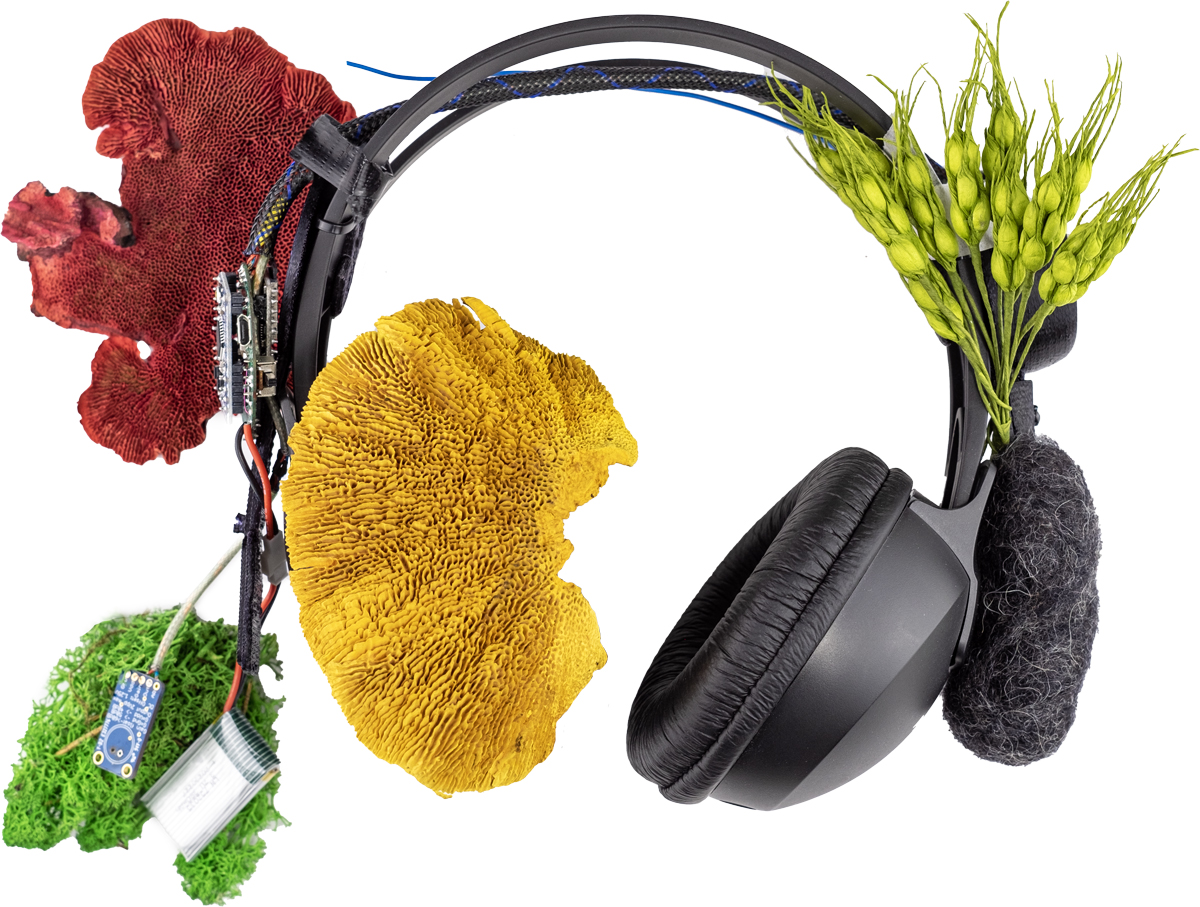
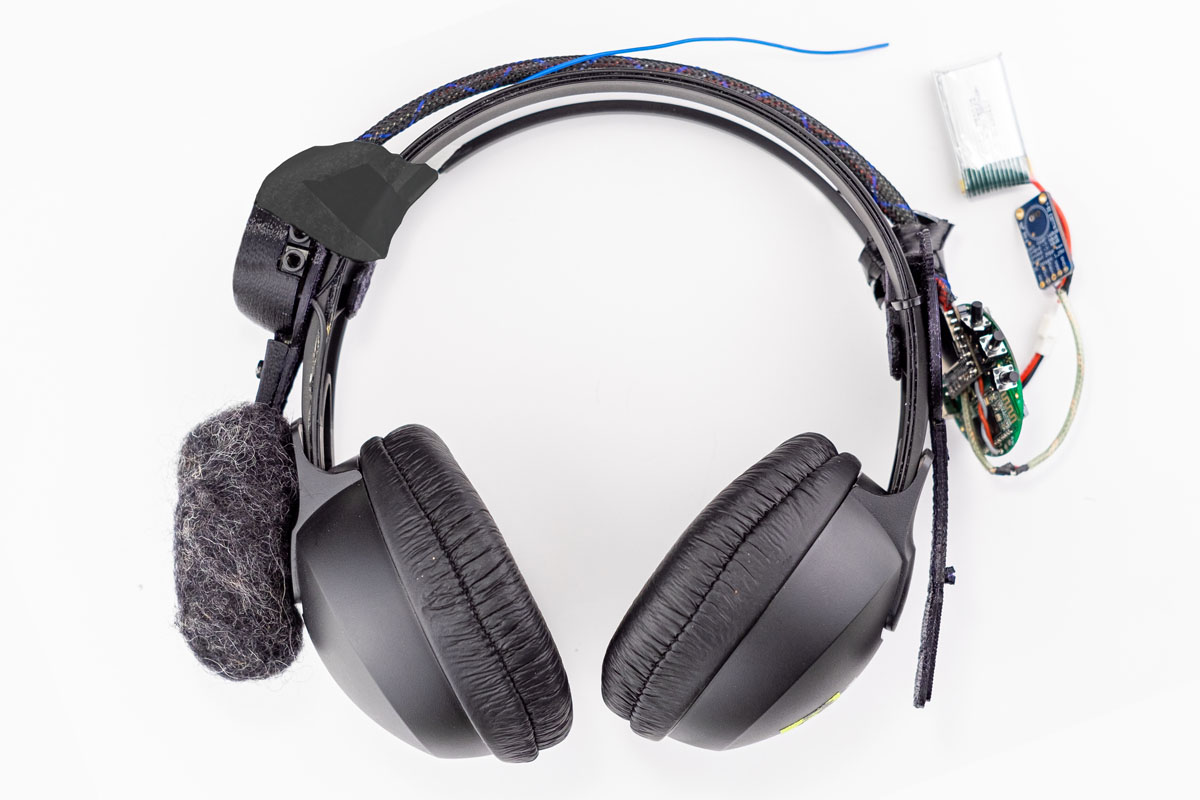
The soundwalk is broadcast on an AR (augmented reality) headset, the result of an innovative in-depth collaboration between the artist and hardware and software developers. The AR headset allows for simultaneous amplified, binaural ambient listening and audio co-composition. They also include an FM receiver module and an EMS sensor input.
The soundwalk path connects the Orangerie Park in Strasbourg and the Tivoli Park in Ljubljana, both designed during the reign of Napoleon. The featured photograph was taken in a disrupted avenue locked today between a road and a railway. It is part of a larger avenue complex in the Tivoli Park, designed by the French at the time of the Illyrian Provinces. The vocalist, dressed in a Slovene folk costume, wears original AR headphones and listens to the landscape.
A testimony form one of the participants of the AR soundwalk:
The speculative story of the soundwalk performance garden GOround points to the problematic relationship between people and plants, which is geared to mainly benefit people. The colonialism itself and the human-mediated dispersal of plants capitalize on the subjection and exploitation of nature. It is vital to radically change this attitude if we want to deal effectively with the existential threat of ecological crisis and contemplate a brighter scenario for the future. To become more familiar with the world of plants, garden GOroundgoes into the temporal dimension. Through the prism of the journeys of these two utterly different temporalities of humans and plants, seemingly offering no possible point of encounter, it speculates on the development of a future solidarity-based coexistence of humans and plants. Plants, the most populous species on the planet, live at their own pace in their own time, walking the paths we cannot access. garden GOround will take us along the paths of a possible future scenario for our overstressed, noisy planet mirrored through the development of local greenways. Can we learn from plants to build a more solidarity-oriented future?
The audience experiences the soundwalk through specially developed headphones used as a tool to speculate the world and the sonic landscape of the future. The world is getting too loud and harmful for our sensitive ears, which have failed to adapt to aggressive frequencies. To survive outdoors, we will need headphones that will both mute and sharpen the sound image and, at the same time, take us into the acoustic narrative.
The soundwalk is broadcast on an AR (augmented reality) headset, the result of an innovative in-depth collaboration between the artist and hardware and software developers. The AR headset allows for simultaneous amplified, binaural ambient listening and audio co-composition. They also include an FM receiver module and an EMS sensor input.
The soundwalk path connects the Orangerie Park in Strasbourg and the Tivoli Park in Ljubljana, both designed during the reign of Napoleon. The featured photograph was taken in a disrupted avenue locked today between a road and a railway. It is part of a larger avenue complex in the Tivoli Park, designed by the French at the time of the Illyrian Provinces. The vocalist, dressed in a Slovene folk costume, wears original AR headphones and listens to the landscape.
A testimony form one of the participants of the AR soundwalk:
The audience experiences the sound work through specially developed author-designed AR headphones, which function as an artistic-technological interface between the listener, the space, and the composition. The headphones are conceived as a speculative tool that reflects on future auditory landscapes and possible modes of orientation within acoustically overloaded environments. They are based on the premise that contemporary sonic space is increasingly shaped by noise, frequency saturation, and aggressive acoustic pressures, as a result of which listening is becoming ever more a matter of perception, protection, and selection.
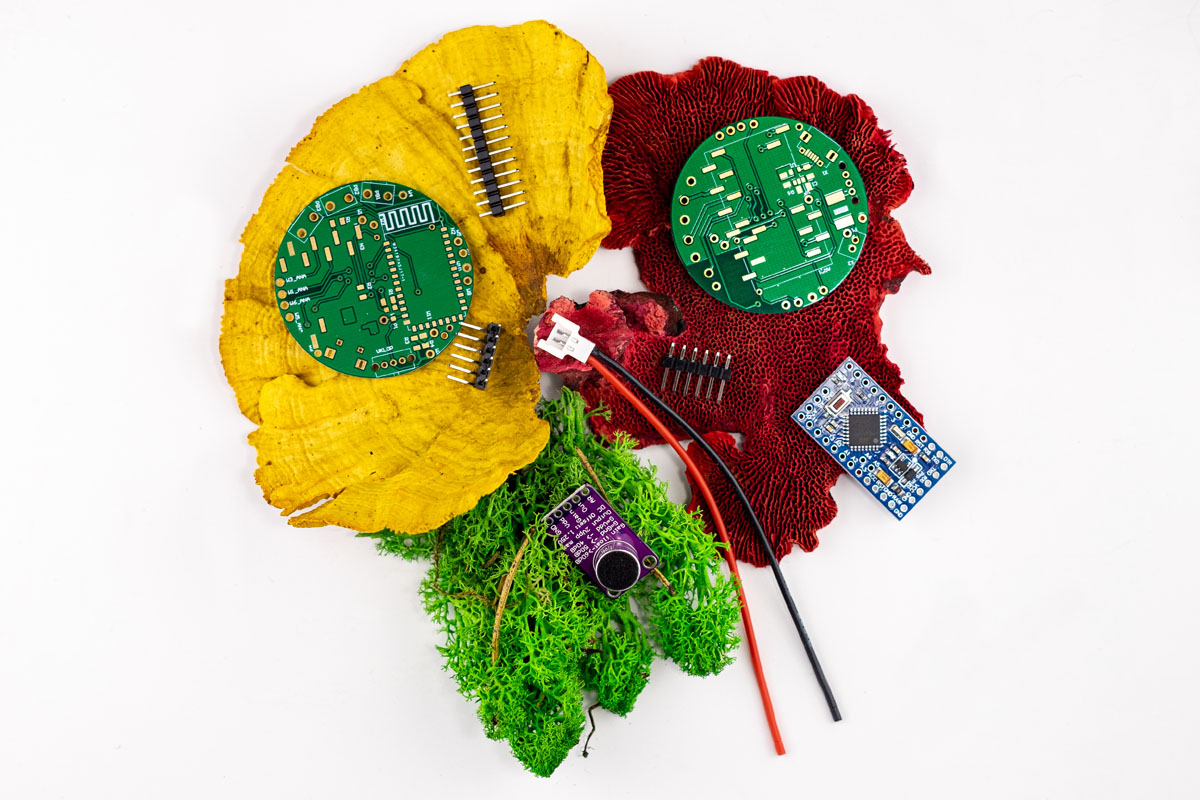
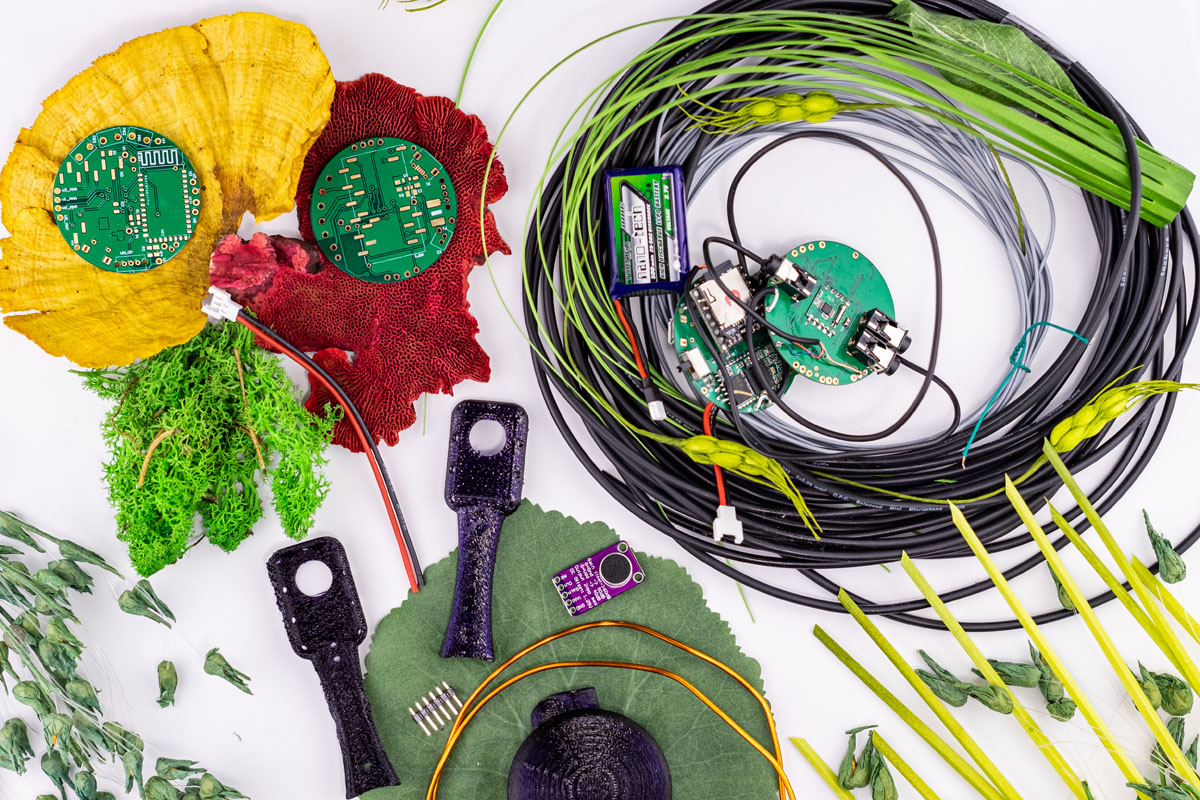
The AR headphones are the result of an in-depth collaboration between the artists and hardware and software developers. Their design enables the simultaneous binaural listening of the immediate surroundings and the playback of a sound composition, thereby creating a layered and dynamic sonic situation in which real acoustic space interweaves with an artificially generated or transmitted sonic narrative. A key feature of the system is that it does not exclude the surrounding environment, but rather acoustically modulates, filters, and accentuates it, so that listening is not separated from space, but remains actively embedded within it.
The headphones include an FM receiver module, which enables the wireless transmission and reception of audio signals, as well as an input for an EMS sensor, through which the system can also be connected to biometric or bodily impulses. The device therefore functions not merely as a playback unit, but as an expanded listening apparatus that combines environmental perception, technological mediation, and compositional layering into a unified listening experience. In this sense, the work addresses not only the future of sound, but also the future of listening as a technologically supported, situated, and selective practice.
An artist and producer. She works in the areas of new media, sound and performance arts. In recent years, she has been focusing her artistic expressions on the preparations of sound-walk performances, co-authored by Brane Zorman, which, by means of transmission tools and sound pictures, through walking and listening establish space anew and reflect social reality.
A composer, sound and radio artist. His work explores the possibilities of processing, presenting, perceiving, understanding, positioning and reinterpreting sound, space and ecology. By employing analogue and digital technologies and techniques, his work traverses the fields of music, multimedia, and visual space, using both sophisticated and simple tools, strategies, methods, and interactive interpretation models, soundscapes, evolving electronic and acoustic sound sculptures.
Concept, text and headphones design: Irena Pivka
Sound composition and editing, sensorial headset concept: Brane Zorman
Vocal: Alja Petric
Voices: Lučka Počkaj, Alja Petric, Toni Cahunek (Slovene)Jana Wilcoxen, Alja Petric, Toni Cahunek (English)Nataša Živkovič, Suzana Koncut, Loup Abramovici (French)
Proofreading, English translation: Melita Silič
English editing and proofreading: Jana Wilcoxen
French translation: Anne-Cécile Lamy-Joswiak
French editing: Suzana KoncutPhotography, design: Matej Tomažin
Illustration: Jovana DjukićHardware and software development and testing, android application: Brane Ždralo
PCB printing, electronics assembling: Zdravko Janšovec
Electronics assembling: Ivan Kvasič
3D printing: Cveto Kunešević, 3Dimension
Headphones assembling: Staš VrenkoProduced by CONA, 2023
VITAL creates an innovative ecosystem that respects the environment and, through art, participates in the fight against global warming and air pollution.
VITAL is co-funded by the Creative Europe programme by the three-year “Strasbourg European Capital” Contract and supported by the Ministry of Public Administration of the Republic of Slovenia and the City of Ljubljana, Departmen of Culture.
Text sources:
Gray, Ros and Sheikh, Shela (ed.). “The Wretched Earth: Botanical Conflicts and Artistic Interventions”. Third Text32(2–3).Kunst, Bojana. “Rastlinsko življenje in prostori umetnosti: o nedostopnem in vzajemnem”. Ana Mizerit (ed.). Zasilni izhod [Exhibition catalogue]. Ljubljana: Moderna galerija, 2022.Thorsen, Line Marie (ed.). Moving Plants. Rønnebæksholm, Næstved: Narayana Press, 2017.Sagan, Dorion. “The Human is More than Human: Interspecies Communities and the New “Facts of Life”.” Theorizing the Contemporary. Fieldsights, 18 Nov 2011.Raja, Vicente. “Moving the Green: Plant Behavior in the Human World“. EuropeNow 45, Nov 2021.Sidebottom, Kay. “Education for a More-Than-Human World”. EuropeNow 45, Nov 2021.Marder, Michael. “Resist Like a Plant! On the Vegetal Life of Political Movements“. Peace Studies Journal 5(1), Jan 2012.Brkič, Vanja. “Mestni park Tivoli: Tivolski drevoredi so bili Ljubljančanom od nekdaj v ponos“. Dnevnik, 10 Oct 2015.Strasbourg Park, https://data.strasbourg.eu/explore/dataset/lieux_arbres-remarquables/table/
More about the work and the authors

–
Cona Zavod za procesiranje sodobne umetnosti Ljubljana
Soundwalk, Performance, Music
The speculative story of the soundwalk performance garden GOround points to the problematic relationship between people and plants, which is geared to mainly benefit people. The colonialism itself and the human-mediated dispersal of plants capitalize on the subjection and exploitation of nature. It is vital to radically change this attitude if we want to deal effectively with the existential threat of ecological crisis and contemplate a brighter scenario for the future. To become more familiar with the world of plants, garden GOroundgoes into the temporal dimension. Through the prism of the journeys of these two utterly different temporalities of humans and plants, seemingly offering no possible point of encounter, it speculates on the development of a future solidarity-based coexistence of humans and plants. Plants, the most populous species on the planet, live at their own pace in their own time, walking the paths we cannot access. garden GOround will take us along the paths of a possible future scenario for our overstressed, noisy planet mirrored through the development of local greenways. Can we learn from plants to build a more solidarity-oriented future?
The audience experiences the soundwalk through specially developed headphones used as a tool to speculate the world and the sonic landscape of the future. The world is getting too loud and harmful for our sensitive ears, which have failed to adapt to aggressive frequencies. To survive outdoors, we will need headphones that will both mute and sharpen the sound image and, at the same time, take us into the acoustic narrative.
The soundwalk is broadcast on an AR (augmented reality) headset, the result of an innovative in-depth collaboration between the artist and hardware and software developers. The AR headset allows for simultaneous amplified, binaural ambient listening and audio co-composition. They also include an FM receiver module and an EMS sensor input.
The soundwalk path connects the Orangerie Park in Strasbourg and the Tivoli Park in Ljubljana, both designed during the reign of Napoleon. The featured photograph was taken in a disrupted avenue locked today between a road and a railway. It is part of a larger avenue complex in the Tivoli Park, designed by the French at the time of the Illyrian Provinces. The vocalist, dressed in a Slovene folk costume, wears original AR headphones and listens to the landscape.
A testimony form one of the participants of the AR soundwalk:
The speculative story of the soundwalk performance garden GOround points to the problematic relationship between people and plants, which is geared to mainly benefit people. The colonialism itself and the human-mediated dispersal of plants capitalize on the subjection and exploitation of nature. It is vital to radically change this attitude if we want to deal effectively with the existential threat of ecological crisis and contemplate a brighter scenario for the future. To become more familiar with the world of plants, garden GOroundgoes into the temporal dimension. Through the prism of the journeys of these two utterly different temporalities of humans and plants, seemingly offering no possible point of encounter, it speculates on the development of a future solidarity-based coexistence of humans and plants. Plants, the most populous species on the planet, live at their own pace in their own time, walking the paths we cannot access. garden GOround will take us along the paths of a possible future scenario for our overstressed, noisy planet mirrored through the development of local greenways. Can we learn from plants to build a more solidarity-oriented future?
The audience experiences the soundwalk through specially developed headphones used as a tool to speculate the world and the sonic landscape of the future. The world is getting too loud and harmful for our sensitive ears, which have failed to adapt to aggressive frequencies. To survive outdoors, we will need headphones that will both mute and sharpen the sound image and, at the same time, take us into the acoustic narrative.
The soundwalk is broadcast on an AR (augmented reality) headset, the result of an innovative in-depth collaboration between the artist and hardware and software developers. The AR headset allows for simultaneous amplified, binaural ambient listening and audio co-composition. They also include an FM receiver module and an EMS sensor input.
The soundwalk path connects the Orangerie Park in Strasbourg and the Tivoli Park in Ljubljana, both designed during the reign of Napoleon. The featured photograph was taken in a disrupted avenue locked today between a road and a railway. It is part of a larger avenue complex in the Tivoli Park, designed by the French at the time of the Illyrian Provinces. The vocalist, dressed in a Slovene folk costume, wears original AR headphones and listens to the landscape.
A testimony form one of the participants of the AR soundwalk:
The audience experiences the sound work through specially developed author-designed AR headphones, which function as an artistic-technological interface between the listener, the space, and the composition. The headphones are conceived as a speculative tool that reflects on future auditory landscapes and possible modes of orientation within acoustically overloaded environments. They are based on the premise that contemporary sonic space is increasingly shaped by noise, frequency saturation, and aggressive acoustic pressures, as a result of which listening is becoming ever more a matter of perception, protection, and selection.
The AR headphones are the result of an in-depth collaboration between the artists and hardware and software developers. Their design enables the simultaneous binaural listening of the immediate surroundings and the playback of a sound composition, thereby creating a layered and dynamic sonic situation in which real acoustic space interweaves with an artificially generated or transmitted sonic narrative. A key feature of the system is that it does not exclude the surrounding environment, but rather acoustically modulates, filters, and accentuates it, so that listening is not separated from space, but remains actively embedded within it.
The headphones include an FM receiver module, which enables the wireless transmission and reception of audio signals, as well as an input for an EMS sensor, through which the system can also be connected to biometric or bodily impulses. The device therefore functions not merely as a playback unit, but as an expanded listening apparatus that combines environmental perception, technological mediation, and compositional layering into a unified listening experience. In this sense, the work addresses not only the future of sound, but also the future of listening as a technologically supported, situated, and selective practice.
An artist and producer. She works in the areas of new media, sound and performance arts. In recent years, she has been focusing her artistic expressions on the preparations of sound-walk performances, co-authored by Brane Zorman, which, by means of transmission tools and sound pictures, through walking and listening establish space anew and reflect social reality.
A composer, sound and radio artist. His work explores the possibilities of processing, presenting, perceiving, understanding, positioning and reinterpreting sound, space and ecology. By employing analogue and digital technologies and techniques, his work traverses the fields of music, multimedia, and visual space, using both sophisticated and simple tools, strategies, methods, and interactive interpretation models, soundscapes, evolving electronic and acoustic sound sculptures.
Concept, text and headphones design: Irena Pivka
Sound composition and editing, sensorial headset concept: Brane Zorman
Vocal: Alja Petric
Voices: Lučka Počkaj, Alja Petric, Toni Cahunek (Slovene)Jana Wilcoxen, Alja Petric, Toni Cahunek (English)Nataša Živkovič, Suzana Koncut, Loup Abramovici (French)
Proofreading, English translation: Melita Silič
English editing and proofreading: Jana Wilcoxen
French translation: Anne-Cécile Lamy-Joswiak
French editing: Suzana KoncutPhotography, design: Matej Tomažin
Illustration: Jovana DjukićHardware and software development and testing, android application: Brane Ždralo
PCB printing, electronics assembling: Zdravko Janšovec
Electronics assembling: Ivan Kvasič
3D printing: Cveto Kunešević, 3Dimension
Headphones assembling: Staš VrenkoProduced by CONA, 2023
VITAL creates an innovative ecosystem that respects the environment and, through art, participates in the fight against global warming and air pollution.
VITAL is co-funded by the Creative Europe programme by the three-year “Strasbourg European Capital” Contract and supported by the Ministry of Public Administration of the Republic of Slovenia and the City of Ljubljana, Departmen of Culture.
Text sources:
Gray, Ros and Sheikh, Shela (ed.). “The Wretched Earth: Botanical Conflicts and Artistic Interventions”. Third Text32(2–3).Kunst, Bojana. “Rastlinsko življenje in prostori umetnosti: o nedostopnem in vzajemnem”. Ana Mizerit (ed.). Zasilni izhod [Exhibition catalogue]. Ljubljana: Moderna galerija, 2022.Thorsen, Line Marie (ed.). Moving Plants. Rønnebæksholm, Næstved: Narayana Press, 2017.Sagan, Dorion. “The Human is More than Human: Interspecies Communities and the New “Facts of Life”.” Theorizing the Contemporary. Fieldsights, 18 Nov 2011.Raja, Vicente. “Moving the Green: Plant Behavior in the Human World“. EuropeNow 45, Nov 2021.Sidebottom, Kay. “Education for a More-Than-Human World”. EuropeNow 45, Nov 2021.Marder, Michael. “Resist Like a Plant! On the Vegetal Life of Political Movements“. Peace Studies Journal 5(1), Jan 2012.Brkič, Vanja. “Mestni park Tivoli: Tivolski drevoredi so bili Ljubljančanom od nekdaj v ponos“. Dnevnik, 10 Oct 2015.Strasbourg Park, https://data.strasbourg.eu/explore/dataset/lieux_arbres-remarquables/table/
More about the work and the authors
–
Cona Zavod za procesiranje sodobne umetnosti Ljubljana
Soundwalk, Performance, Music
Ambulation is a walking performance that uses listening technologies to harvest diverse sounds from the immediate environment. Drawing on field recording techniques, Tim Shaw records acoustic sounds and electromagnetic waves as he walks. He captures, repeats, processes and mixes these sounds using his own portable equipment, creating an interactive improvisation that intertwines recorded and live sonic events.
Each performance is specific to its geographical and temporal context. The listening technologies and sound processing systems are adapted to the characteristics of each location, meaning that the project is never finished and continues to evolve with every new invitation.
Ambulation is a walking performance that uses listening technologies to harvest diverse sounds from the immediate environment. Drawing on field recording techniques, Tim Shaw records acoustic sounds and electromagnetic waves as he walks. He captures, repeats, processes and mixes these sounds using his own portable equipment, creating an interactive improvisation that intertwines recorded and live sonic events.
Each performance is specific to its geographical and temporal context. The listening technologies and sound processing systems are adapted to the characteristics of each location, meaning that the project is never finished and continues to evolve with every new invitation.
An artist working with sound, light and communication media. Through performances, installations and soundwalks, he explores how environments can be constructed and experienced using a wide range of techniques and technologies. His practice draws on field recordings, electronics, synthesis, sound objects, self-made hardware and DIY software to examine how communication technologies shape our perception of the world.
Artist: Tim Shaw
Photo: Matej Tomažin, François Gendre
–
Cona Zavod za procesiranje sodobne umetnosti Ljubljana
Concert, Exhibition, Music, Visual arts
Untangling a Garden combines the imaginations of two parks: one of the first exotic parks in Slovenia, Rafutski Park, and the imaginary park of the Alexandrian women in Alexandria. Both emerged in the first half of the 20th century during a period of intense migration and exchange.
The installation merges sound recordings of Rafutski Park prior to its renovation with a list of exotic and invasive species and criteria defining their uniqueness. This sonic garden is populated with newspaper headlines and quotations addressing attempts to prevent women’s migration to Egypt, as well as fragments of poetry linking the imagination of the Alexandrian women with the Slovenian myth of Lepa Vida.
The work establishes an imaginary garden where plants become co-narrators and the garden itself materializes overgrown narratives and erased histories.
Untangling a Garden combines the imaginations of two parks: one of the first exotic parks in Slovenia, Rafutski Park, and the imaginary park of the Alexandrian women in Alexandria. Both emerged in the first half of the 20th century during a period of intense migration and exchange.
The installation merges sound recordings of Rafutski Park prior to its renovation with a list of exotic and invasive species and criteria defining their uniqueness. This sonic garden is populated with newspaper headlines and quotations addressing attempts to prevent women’s migration to Egypt, as well as fragments of poetry linking the imagination of the Alexandrian women with the Slovenian myth of Lepa Vida.
The work establishes an imaginary garden where plants become co-narrators and the garden itself materializes overgrown narratives and erased histories.
Visual artist, researcher and writer whose interdisciplinary practice combines research with drawing, performance, video and sound. Her work focuses on uncovering overlooked historical narratives and developing performative forms that open new perspectives on the present. She is a co-founder of the Museum of Transitory Art – MoTA and a member of the Nonument Group.
Artist: Neja Tomšič
Photo: Blaž Gutman (MGML)
Special thanks: The garden bed was provided by the Abandoned Plants Sanctuary.

–
Cona Zavod za procesiranje sodobne umetnosti Ljubljana
Discussion, Education
The TO)pot festival opens its discursive programme dedicated to soundwalking and the connections between walking, listening and critical thinking. The programme features presentations by Elena Biserna, Ida Hiršenfelder and Jacek Smolicki, followed by a discussion with invited artists and the audience.
Jacek Smolicki presents his book Soundwalking: Through Time, Space, and Technologies (Routledge, 2023) through a sound-based presentation. The publication brings together contemporary scholars, artists and thinkers and represents one of the first comprehensive studies of soundwalking, addressing environmental, ethical, social and technological concerns.
Elena Biserna proposes an itinerary through her edited volume Going Out. Walking, Listening, Soundmaking (umland, 2022), tracing interdisciplinary experiments at the intersection of walking, listening and soundmaking, and their resonance with contemporary critical spatial thinking.
In her text Exercises in Listening to the Inaudible (Acoustic Commons, Cona, 2022), Ida Hiršenfelder reflects on the notion of location, sonority and the meaning of what is heard, examining artistic approaches to listening through conversations with artists.
The TO)pot festival opens its discursive programme dedicated to soundwalking and the connections between walking, listening and critical thinking. The programme features presentations by Elena Biserna, Ida Hiršenfelder and Jacek Smolicki, followed by a discussion with invited artists and the audience.
Jacek Smolicki presents his book Soundwalking: Through Time, Space, and Technologies (Routledge, 2023) through a sound-based presentation. The publication brings together contemporary scholars, artists and thinkers and represents one of the first comprehensive studies of soundwalking, addressing environmental, ethical, social and technological concerns.
Elena Biserna proposes an itinerary through her edited volume Going Out. Walking, Listening, Soundmaking (umland, 2022), tracing interdisciplinary experiments at the intersection of walking, listening and soundmaking, and their resonance with contemporary critical spatial thinking.
In her text Exercises in Listening to the Inaudible (Acoustic Commons, Cona, 2022), Ida Hiršenfelder reflects on the notion of location, sonority and the meaning of what is heard, examining artistic approaches to listening through conversations with artists.
Independent researcher and curator. She writes, lectures, teaches, facilitates workshops and collective projects, curates and occasionally performs. Her interests focus on listening and situated art practices related to urban dynamics, socio-cultural processes and the public and political sphere.
Sound artist and archivist. Her work explores bioacoustics, experimental music and sound spatialisation, creating immersive soundscapes using analogue electronics, DIY and modular synthesis, field recordings and digital manipulation.
Interdisciplinary artist, researcher, designer and educator. His practice investigates critical, existential and technological dimensions of listening, recording and archiving practices in human and more-than-human contexts.
Authors: Elena Biserna, beepblip [Ida Hiršenfelder], Jacek Smolicki
Photo: Blaž Gutman (MGML)

–
Cona Zavod za procesiranje sodobne umetnosti Ljubljana
Peripatetic lecture, Education
Walking through the city and questioning the meaning, purpose and role of walking as an artistic practice. When Honoré de Balzac published his extraordinary study The Theory of Walking in 1833, he wondered why no one before him had seriously examined the phenomenon of human walking. “Isn’t it curious,” he wrote, “that ever since humans have walked, no one has thought to ask how they walk, whether they walk at all, whether they could walk better, what they do while walking, or whether there might be a better way to reorganize, modify or analyse walking.”
These questions will guide the walk, which focuses on walking as a bodily technique and on walking performances – performative events conceived as walks by performers or audiences who thus become co-performers and participants. Borrowing from the ancient Greek Peripatetic philosophers the idea of developing thought in motion, the project centers on walking as an artistic and critical practice.
Walking through the city and questioning the meaning, purpose and role of walking as an artistic practice. When Honoré de Balzac published his extraordinary study The Theory of Walking in 1833, he wondered why no one before him had seriously examined the phenomenon of human walking. “Isn’t it curious,” he wrote, “that ever since humans have walked, no one has thought to ask how they walk, whether they walk at all, whether they could walk better, what they do while walking, or whether there might be a better way to reorganize, modify or analyse walking.”
These questions will guide the walk, which focuses on walking as a bodily technique and on walking performances – performative events conceived as walks by performers or audiences who thus become co-performers and participants. Borrowing from the ancient Greek Peripatetic philosophers the idea of developing thought in motion, the project centers on walking as an artistic and critical practice.
Professor at the Academy of Theatre, Radio, Film and Television at the University of Ljubljana, where he teaches theatre history. He is the author of Theories of Contemporary Theatre and Performance (2009), Art in the Time of the Rule of Law and Capital (2016), Theatre of Resistance (2021) and 40 Years I Have Worked: Adaptations of Cankar’s The Bailiff Yerney (2022).
Artist: Aldo Milohnić
Photo: Matej Tomažin

–
Cona Zavod za procesiranje sodobne umetnosti Ljubljana
Exhibition, Concert, Music, Visual arts
Untangling a Garden combines the imaginations of two parks: one of the first exotic parks in Slovenia, Rafutski Park, and the imaginary park of the Alexandrian women in Alexandria. Both emerged in the first half of the 20th century during a period of intense migration and exchange.
The installation merges sound recordings of Rafutski Park prior to its renovation with a list of exotic and invasive species and criteria defining their uniqueness. This sonic garden is populated with newspaper headlines and quotations addressing attempts to prevent women’s migration to Egypt, as well as fragments of poetry linking the imagination of the Alexandrian women with the Slovenian myth of Lepa Vida.
The work establishes an imaginary garden where plants become co-narrators and the garden itself materializes overgrown narratives and erased histories.
Untangling a Garden combines the imaginations of two parks: one of the first exotic parks in Slovenia, Rafutski Park, and the imaginary park of the Alexandrian women in Alexandria. Both emerged in the first half of the 20th century during a period of intense migration and exchange.
The installation merges sound recordings of Rafutski Park prior to its renovation with a list of exotic and invasive species and criteria defining their uniqueness. This sonic garden is populated with newspaper headlines and quotations addressing attempts to prevent women’s migration to Egypt, as well as fragments of poetry linking the imagination of the Alexandrian women with the Slovenian myth of Lepa Vida.
The work establishes an imaginary garden where plants become co-narrators and the garden itself materializes overgrown narratives and erased histories.
Visual artist, researcher and writer whose interdisciplinary practice combines research with drawing, performance, video and sound. Her work focuses on uncovering overlooked historical narratives and developing performative forms that open new perspectives on the present. She is a co-founder of the Museum of Transitory Art – MoTA and a member of the Nonument Group.
Artist: Neja Tomšič
Photo: Blaž Gutman (MGML)
Special thanks: The garden bed was provided by the Abandoned Plants Sanctuary.
–
Cona Zavod za procesiranje sodobne umetnosti Ljubljana
Exhibition, Visual arts
Encouragements is a sound exhibition that explores relationships between voice, listening and public space. The work is based on subtle sonic interventions that create intimate situations within everyday environments, inviting visitors to engage in slower and more attentive modes of listening.
The project is not conceived as a various artists format.
Encouragements is a sound exhibition that explores relationships between voice, listening and public space. The work is based on subtle sonic interventions that create intimate situations within everyday environments, inviting visitors to engage in slower and more attentive modes of listening.
The project is not conceived as a various artists format.
Sound artist, performer and researcher whose practice focuses on voice, embodiment and the politics of listening. Her work often unfolds through participatory and site-specific formats situated in public space.
Artist: Anna Raimondo
Photo: Anna Raimondo

–
Cona Zavod za procesiranje sodobne umetnosti Ljubljana
Concert, Exhibition, Music, Visual arts
Chronolith consists of a complex multi-channel sound composition and stone slab installation. In the work, the bioacoustic group Jata C investigates the acoustics and temporal dimensions of stone structures and their sustainability and interdependence with humans.
The artists obtained the sound material for the composition via field recordings of various locations and quarries. The installation serves as a stone instrument, a sensory extension of the human body, with which the composition and the vibrations of the stones are fed back into the materiality of the slabs with the help of transducers, forming a feedback loop. During the production of the work, the artists collaborated with scientists from micropaleontology, geology and physics, and the supporter of the project, the company Marmor Hotavlje.
beepblip [Ida Hiršenfelder], a member of Jata C, wrote about the work:
To think of geological time, the time of the sailing rocks, the time of the lithosphere, and the time of the continents is to think of our insignificance in the big picture, our mortality (dust to dust), and fleeting transience. It is a realisation that might motivate us to stop the insane depletion of the Earth and instead marvel at its mighty delicacy and appreciate the innumerable entities that shaped it in the volatile space and aeons of time. The rocks from the mountains used to be the seabed. The first organic matter in soil was produced by bacteria. Much limestone on the Earth originates from the activity of coccolithophores, unicellular algae covered in calcium carbonate scales. Like us, they are both alive and dead, organic and inorganic. We know too well such distinction is needless; however, it matters what worlds world worlds.[1] It is almost impossible to find a place on the planet not dictated by humans or at least transfigured as the consequences of human interventions. To the world, a different world, ruled by reciprocity and not authority, requires internalising different questions. Jata C asks, “How can we hear a stone and its aeons?”
[1] Donna J. Haraway. Staying with Trouble. Min in the Chthulucene. Durham and London: Duke University Press, 2016, p. 35. “It matters what worlds world worlds. It matters what stories tell stories.“
Multichannel Sound Installation
In the live sound event, Jata C performs Kronolit based on a precomposed score that allows for improvisation. Using a multichannel spatial sound system, sound moves between rocks and walls, resonates through the stone slabs, and evokes a tangible presence of geological time.
Live Sound Event
The installation invites visitors into a stone-based resonant space, where the sound narrative opens up a different experience of time — slow, massive, and all-encompassing. The composition interweaves sounds of cracking, grinding, vibrating, and distant echoes — embedded in a narrative of Earth that does not borrow rhythm from humans but shapes its own across the eons.
Chronolith consists of a complex multi-channel sound composition and stone slab installation. In the work, the bioacoustic group Jata C investigates the acoustics and temporal dimensions of stone structures and their sustainability and interdependence with humans.
The artists obtained the sound material for the composition via field recordings of various locations and quarries. The installation serves as a stone instrument, a sensory extension of the human body, with which the composition and the vibrations of the stones are fed back into the materiality of the slabs with the help of transducers, forming a feedback loop. During the production of the work, the artists collaborated with scientists from micropaleontology, geology and physics, and the supporter of the project, the company Marmor Hotavlje.
beepblip [Ida Hiršenfelder], a member of Jata C, wrote about the work:
To think of geological time, the time of the sailing rocks, the time of the lithosphere, and the time of the continents is to think of our insignificance in the big picture, our mortality (dust to dust), and fleeting transience. It is a realisation that might motivate us to stop the insane depletion of the Earth and instead marvel at its mighty delicacy and appreciate the innumerable entities that shaped it in the volatile space and aeons of time. The rocks from the mountains used to be the seabed. The first organic matter in soil was produced by bacteria. Much limestone on the Earth originates from the activity of coccolithophores, unicellular algae covered in calcium carbonate scales. Like us, they are both alive and dead, organic and inorganic. We know too well such distinction is needless; however, it matters what worlds world worlds.[1] It is almost impossible to find a place on the planet not dictated by humans or at least transfigured as the consequences of human interventions. To the world, a different world, ruled by reciprocity and not authority, requires internalising different questions. Jata C asks, “How can we hear a stone and its aeons?”
[1] Donna J. Haraway. Staying with Trouble. Min in the Chthulucene. Durham and London: Duke University Press, 2016, p. 35. “It matters what worlds world worlds. It matters what stories tell stories.“
Multichannel Sound Installation
In the live sound event, Jata C performs Kronolit based on a precomposed score that allows for improvisation. Using a multichannel spatial sound system, sound moves between rocks and walls, resonates through the stone slabs, and evokes a tangible presence of geological time.
Live Sound Event
The installation invites visitors into a stone-based resonant space, where the sound narrative opens up a different experience of time — slow, massive, and all-encompassing. The composition interweaves sounds of cracking, grinding, vibrating, and distant echoes — embedded in a narrative of Earth that does not borrow rhythm from humans but shapes its own across the eons.
Artistic group whose members share a passion for field recordings, bioacoustics and sound ecology. Their research combines auditory perception with ecological and social issues, expanding them with scientific discourse and original performances of sonic environments. In their compositions, they transform field recordings of their immediate surroundings into speculative projections of the future and delicate perceptions of the present. They employ a vast array of field recording devices to capture the various environmental acoustic phenomena. Their performances follow a general score, leaving enough space for improvisation and live interpretation. The group has presented two other compositions to the public, namely ICEmeltings (2019) and Bibaret JC210120 (2020).
beepblip [Ida Hiršenfelder] is a sound artist and archivist. She makes immersive bleepy psychogeographical soundscapes with analogue electronics, DIY and modular synths, field recordings and computer manipulations. She is interested in bioacoustics, experimental music and sound spatialisation. She was a member of the Theremidi Orchestra (2011–2017) and is currently a member of the Jata C group for bioacoustics and sound ecologies. Her solo albums Noise for Strings, Vol. 1 (2019) and Noise for Strings, Vol. 2 (2020) were published by the Kamizdat label.
Petra Kapš [OR poiesis] is an artist and researcher of sound, sound perception and poetic performance. She extends the word in sonic spheres of time-space poetry. Along with the digital dimensions, her focus is nevertheless the physical presence of the body.
Boštjan Perovšek is an artist, composer and sound designer who composes experimental electro-acoustic music. His special is creating bioacoustic music based on the sounds of animals, particularly insects. In addition, he collaborates with the SAETA group and creates music for film and theatre, performances, multimedia installations and soundscapes for museums and galleries.
Bojana Šaljić Podešva dedicates most of her time as a composer to the research of sound as an entity that affects the listener both physically and in terms of content. Her music spans from complete abstraction to complex semantic narratives. She is the recipient of several awards for her concert compositions, incidental music and film scores.
Brane Zorman is an intermedia artist, composer, sound manipulator, producer and curator. He composes sound works for theatre, intermedia and dance performances. He performs electro-acoustic solo pieces and improvisations with local and foreign artists in surround sound. Working with sound and space, Zorman develops various strategies, techniques, dynamic and interactive modules, records and reinterprets soundscapes, and by way of sophisticated tools, he creates electronic and acoustic sound sculptures.
Sound artists: beepblip, OR poiesis, Boštjan Perovšek, Bojana Šaljić Podešva, Brane Zorman
Production: Cona Institute for Steklenik Gallery, 2022
Produced by: Irena Pivka
Public relations: Matej Tomažin
Translation and proofreading: Melita Silič
Video: Miha Godec, Matej Tomažin
Co-producer of the installation and sound event is the Ljubljana Castle. The installation is supported by the Ministry of Culture of the Republic of Slovenia and the City of Ljubljana, Department for Culture. The project is a part of konS – Platform for Contemporary Investigative Art. We would like to thank the company Marmor Hotavlje for access to their quarry and the sponsorship of the marble slabs for the installation.
