Cona events source

Schema version: 1.2; generated: ; total events: 326.

Jata C: Chronolith

Cona Zavod za procesiranje sodobne umetnosti Ljubljana

Opening, Concert, Exhibition, Music, Visual arts

Event registration

Chronolith consists of a complex multi-channel sound composition and stone slab installation. In the work, the bioacoustic group Jata C investigates the acoustics and temporal dimensions of stone structures and their sustainability and interdependence with humans.

The artists obtained the sound material for the composition via field recordings of various locations and quarries. The installation serves as a stone instrument, a sensory extension of the human body, with which the composition and the vibrations of the stones are fed back into the materiality of the slabs with the help of transducers, forming a feedback loop. During the production of the work, the artists collaborated with scientists from micropaleontology, geology and physics, and the supporter of the project, the company Marmor Hotavlje.

beepblip [Ida Hiršenfelder], a member of Jata C, wrote about the work:
To think of geological time, the time of the sailing rocks, the time of the lithosphere, and the time of the continents is to think of our insignificance in the big picture, our mortality (dust to dust), and fleeting transience. It is a realisation that might motivate us to stop the insane depletion of the Earth and instead marvel at its mighty delicacy and appreciate the innumerable entities that shaped it in the volatile space and aeons of time. The rocks from the mountains used to be the seabed. The first organic matter in soil was produced by bacteria. Much limestone on the Earth originates from the activity of coccolithophores, unicellular algae covered in calcium carbonate scales. Like us, they are both alive and dead, organic and inorganic. We know too well such distinction is needless; however, it matters what worlds world worlds.[1] It is almost impossible to find a place on the planet not dictated by humans or at least transfigured as the consequences of human interventions. To the world, a different world, ruled by reciprocity and not authority, requires internalising different questions. Jata C asks, “How can we hear a stone and its aeons?”

[1] Donna J. Haraway. Staying with Trouble. Min in the Chthulucene. Durham and London: Duke University Press, 2016, p. 35. “It matters what worlds world worlds. It matters what stories tell stories.“

Multichannel Sound Installation

In the live sound event, Jata C performs Kronolit based on a precomposed score that allows for improvisation. Using a multichannel spatial sound system, sound moves between rocks and walls, resonates through the stone slabs, and evokes a tangible presence of geological time.

Live Sound Event

The installation invites visitors into a stone-based resonant space, where the sound narrative opens up a different experience of time — slow, massive, and all-encompassing. The composition interweaves sounds of cracking, grinding, vibrating, and distant echoes — embedded in a narrative of Earth that does not borrow rhythm from humans but shapes its own across the eons.

Cikli / Cycles

Chronolith

Jata C [beepblip, OR poiesis, Boštjan Perovšek, Bojana Šaljić Podešva, Brane Zorman]

Chronolith consists of a complex multi-channel sound composition and stone slab installation. In the work, the bioacoustic group Jata C investigates the acoustics and temporal dimensions of stone structures and their sustainability and interdependence with humans.

The artists obtained the sound material for the composition via field recordings of various locations and quarries. The installation serves as a stone instrument, a sensory extension of the human body, with which the composition and the vibrations of the stones are fed back into the materiality of the slabs with the help of transducers, forming a feedback loop. During the production of the work, the artists collaborated with scientists from micropaleontology, geology and physics, and the supporter of the project, the company Marmor Hotavlje.

beepblip [Ida Hiršenfelder], a member of Jata C, wrote about the work:
To think of geological time, the time of the sailing rocks, the time of the lithosphere, and the time of the continents is to think of our insignificance in the big picture, our mortality (dust to dust), and fleeting transience. It is a realisation that might motivate us to stop the insane depletion of the Earth and instead marvel at its mighty delicacy and appreciate the innumerable entities that shaped it in the volatile space and aeons of time. The rocks from the mountains used to be the seabed. The first organic matter in soil was produced by bacteria. Much limestone on the Earth originates from the activity of coccolithophores, unicellular algae covered in calcium carbonate scales. Like us, they are both alive and dead, organic and inorganic. We know too well such distinction is needless; however, it matters what worlds world worlds.[1] It is almost impossible to find a place on the planet not dictated by humans or at least transfigured as the consequences of human interventions. To the world, a different world, ruled by reciprocity and not authority, requires internalising different questions. Jata C asks, “How can we hear a stone and its aeons?”

[1] Donna J. Haraway. Staying with Trouble. Min in the Chthulucene. Durham and London: Duke University Press, 2016, p. 35. “It matters what worlds world worlds. It matters what stories tell stories.“

Multichannel Sound Installation

In the live sound event, Jata C performs Kronolit based on a precomposed score that allows for improvisation. Using a multichannel spatial sound system, sound moves between rocks and walls, resonates through the stone slabs, and evokes a tangible presence of geological time.

Live Sound Event

The installation invites visitors into a stone-based resonant space, where the sound narrative opens up a different experience of time — slow, massive, and all-encompassing. The composition interweaves sounds of cracking, grinding, vibrating, and distant echoes — embedded in a narrative of Earth that does not borrow rhythm from humans but shapes its own across the eons.

Jata C [beepblip, OR poiesis, Boštjan Perovšek, Bojana Šaljić Podešva, Brane Zorman]

Artistic group whose members share a passion for field recordings, bioacoustics and sound ecology. Their research combines auditory perception with ecological and social issues, expanding them with scientific discourse and original performances of sonic environments. In their compositions, they transform field recordings of their immediate surroundings into speculative projections of the future and delicate perceptions of the present. They employ a vast array of field recording devices to capture the various environmental acoustic phenomena. Their performances follow a general score, leaving enough space for improvisation and live interpretation. The group has presented two other compositions to the public, namely ICEmeltings (2019) and Bibaret JC210120 (2020).

beepblip [Ida Hiršenfelder] is a sound artist and archivist. She makes immersive bleepy psychogeographical soundscapes with analogue electronics, DIY and modular synths, field recordings and computer manipulations. She is interested in bioacoustics, experimental music and sound spatialisation. She was a member of the Theremidi Orchestra (2011–2017) and is currently a member of the Jata C group for bioacoustics and sound ecologies. Her solo albums Noise for Strings, Vol. 1 (2019) and Noise for Strings, Vol. 2 (2020) were published by the Kamizdat label.

Petra Kapš [OR poiesis] is an artist and researcher of sound, sound perception and poetic performance. She extends the word in sonic spheres of time-space poetry. Along with the digital dimensions, her focus is nevertheless the physical presence of the body.

Boštjan Perovšek is an artist, composer and sound designer who composes experimental electro-acoustic music. His special is creating bioacoustic music based on the sounds of animals, particularly insects. In addition, he collaborates with the SAETA group and creates music for film and theatre, performances, multimedia installations and soundscapes for museums and galleries.

Bojana Šaljić Podešva dedicates most of her time as a composer to the research of sound as an entity that affects the listener both physically and in terms of content. Her music spans from complete abstraction to complex semantic narratives. She is the recipient of several awards for her concert compositions, incidental music and film scores.

Brane Zorman is an intermedia artist, composer, sound manipulator, producer and curator. He composes sound works for theatre, intermedia and dance performances. He performs electro-acoustic solo pieces and improvisations with local and foreign artists in surround sound. Working with sound and space, Zorman develops various strategies, techniques, dynamic and interactive modules, records and reinterprets soundscapes, and by way of sophisticated tools, he creates electronic and acoustic sound sculptures.

Kolofon / Colophon

Sound artists: beepblip, OR poiesis, Boštjan Perovšek, Bojana Šaljić Podešva, Brane Zorman
Production: Cona Institute for Steklenik Gallery, 2022
Produced by: Irena Pivka
Public relations: Matej Tomažin
Translation and proofreading: Melita Silič
Video: Miha Godec, Matej Tomažin

Co-producer of the installation and sound event is the Ljubljana Castle. The installation is supported by the Ministry of Culture of the Republic of Slovenia and the City of Ljubljana, Department for Culture. The project is a part of konS – Platform for Contemporary Investigative Art. We would like to thank the company Marmor Hotavlje for access to their quarry and the sponsorship of the marble slabs for the installation.

Fotografija / Image

Foto: Kaja Goljat, Maša Pirc, Matej Tomažin

Marko Pogačnik: Creating Gaia Culture

Cona Zavod za procesiranje sodobne umetnosti Ljubljana

Soundwalk, Performance, Music

Event registration

Since entering the third millennium, we have been witnessing the deterioration of Earth’s ecosystems as well as growing crises within modern civilization. I am convinced that it is not possible to repair the three-dimensional planet Earth as it is fundamentally a creation of the human mind.

The purpose of the project Creating Gaia Culture is to establish direct communication with the consciousness of the Earth – Gaia – and, starting from small groups of dedicated people, to develop a new civilization in cooperation with Gaia and the co-creators of the multidimensional Earthly universe.

The project was published in the book Creating Gaia Culture (Clairview, 2021) and further articulated through the Geocultural Manifesto, written with charcoal on the wall of the Museum of Contemporary Art in Ljubljana as part of the exhibition Emergency Exit (2021–2022).

Through this project, I seek to demonstrate how Gaia culture is already being realized within the urban fabric of Ljubljana, even if its inhabitants are often unaware of it.

Cikli / Cycles

Creating Gaia Culture 2006–2023

Marko Pogačnik

Since entering the third millennium, we have been witnessing the deterioration of Earth’s ecosystems as well as growing crises within modern civilization. I am convinced that it is not possible to repair the three-dimensional planet Earth as it is fundamentally a creation of the human mind.

The purpose of the project Creating Gaia Culture is to establish direct communication with the consciousness of the Earth – Gaia – and, starting from small groups of dedicated people, to develop a new civilization in cooperation with Gaia and the co-creators of the multidimensional Earthly universe.

The project was published in the book Creating Gaia Culture (Clairview, 2021) and further articulated through the Geocultural Manifesto, written with charcoal on the wall of the Museum of Contemporary Art in Ljubljana as part of the exhibition Emergency Exit (2021–2022).

Through this project, I seek to demonstrate how Gaia culture is already being realized within the urban fabric of Ljubljana, even if its inhabitants are often unaware of it.

Marko Pogačnik

Born in 1944 in Kranj, Slovenia, he lives in Šempas in the Vipava Valley. Between 1965 and 1971 he was active in the OHO movement and group, and from 1971 to 1979 in the agricultural-artistic commune in Šempas. He developed lithopuncture, the art of acupuncture of landscapes and cities. He is the author of the Slovenian national coat of arms and served as a UNESCO Artist for Peace between 2016 and 2022.

Kolofon / Colophon

Artist: Marko Pogačnik
Photo: Marko Pogačnik

Production: Maska, 2023, part of Now is here.

Fotografija / Image

Foto: Marko Pogačnik

Jata C: Chronolith

Cona Zavod za procesiranje sodobne umetnosti Ljubljana

Exhibition, Concert, Music, Visual arts

Chronolith consists of a complex multi-channel sound composition and stone slab installation. In the work, the bioacoustic group Jata C investigates the acoustics and temporal dimensions of stone structures and their sustainability and interdependence with humans.

The artists obtained the sound material for the composition via field recordings of various locations and quarries. The installation serves as a stone instrument, a sensory extension of the human body, with which the composition and the vibrations of the stones are fed back into the materiality of the slabs with the help of transducers, forming a feedback loop. During the production of the work, the artists collaborated with scientists from micropaleontology, geology and physics, and the supporter of the project, the company Marmor Hotavlje.

beepblip [Ida Hiršenfelder], a member of Jata C, wrote about the work:
To think of geological time, the time of the sailing rocks, the time of the lithosphere, and the time of the continents is to think of our insignificance in the big picture, our mortality (dust to dust), and fleeting transience. It is a realisation that might motivate us to stop the insane depletion of the Earth and instead marvel at its mighty delicacy and appreciate the innumerable entities that shaped it in the volatile space and aeons of time. The rocks from the mountains used to be the seabed. The first organic matter in soil was produced by bacteria. Much limestone on the Earth originates from the activity of coccolithophores, unicellular algae covered in calcium carbonate scales. Like us, they are both alive and dead, organic and inorganic. We know too well such distinction is needless; however, it matters what worlds world worlds.[1] It is almost impossible to find a place on the planet not dictated by humans or at least transfigured as the consequences of human interventions. To the world, a different world, ruled by reciprocity and not authority, requires internalising different questions. Jata C asks, “How can we hear a stone and its aeons?”

[1] Donna J. Haraway. Staying with Trouble. Min in the Chthulucene. Durham and London: Duke University Press, 2016, p. 35. “It matters what worlds world worlds. It matters what stories tell stories.“

Multichannel Sound Installation

In the live sound event, Jata C performs Kronolit based on a precomposed score that allows for improvisation. Using a multichannel spatial sound system, sound moves between rocks and walls, resonates through the stone slabs, and evokes a tangible presence of geological time.

Live Sound Event

The installation invites visitors into a stone-based resonant space, where the sound narrative opens up a different experience of time — slow, massive, and all-encompassing. The composition interweaves sounds of cracking, grinding, vibrating, and distant echoes — embedded in a narrative of Earth that does not borrow rhythm from humans but shapes its own across the eons.

Chronolith

Jata C [beepblip, OR poiesis, Boštjan Perovšek, Bojana Šaljić Podešva, Brane Zorman]

Chronolith consists of a complex multi-channel sound composition and stone slab installation. In the work, the bioacoustic group Jata C investigates the acoustics and temporal dimensions of stone structures and their sustainability and interdependence with humans.

The artists obtained the sound material for the composition via field recordings of various locations and quarries. The installation serves as a stone instrument, a sensory extension of the human body, with which the composition and the vibrations of the stones are fed back into the materiality of the slabs with the help of transducers, forming a feedback loop. During the production of the work, the artists collaborated with scientists from micropaleontology, geology and physics, and the supporter of the project, the company Marmor Hotavlje.

beepblip [Ida Hiršenfelder], a member of Jata C, wrote about the work:
To think of geological time, the time of the sailing rocks, the time of the lithosphere, and the time of the continents is to think of our insignificance in the big picture, our mortality (dust to dust), and fleeting transience. It is a realisation that might motivate us to stop the insane depletion of the Earth and instead marvel at its mighty delicacy and appreciate the innumerable entities that shaped it in the volatile space and aeons of time. The rocks from the mountains used to be the seabed. The first organic matter in soil was produced by bacteria. Much limestone on the Earth originates from the activity of coccolithophores, unicellular algae covered in calcium carbonate scales. Like us, they are both alive and dead, organic and inorganic. We know too well such distinction is needless; however, it matters what worlds world worlds.[1] It is almost impossible to find a place on the planet not dictated by humans or at least transfigured as the consequences of human interventions. To the world, a different world, ruled by reciprocity and not authority, requires internalising different questions. Jata C asks, “How can we hear a stone and its aeons?”

[1] Donna J. Haraway. Staying with Trouble. Min in the Chthulucene. Durham and London: Duke University Press, 2016, p. 35. “It matters what worlds world worlds. It matters what stories tell stories.“

Multichannel Sound Installation

In the live sound event, Jata C performs Kronolit based on a precomposed score that allows for improvisation. Using a multichannel spatial sound system, sound moves between rocks and walls, resonates through the stone slabs, and evokes a tangible presence of geological time.

Live Sound Event

The installation invites visitors into a stone-based resonant space, where the sound narrative opens up a different experience of time — slow, massive, and all-encompassing. The composition interweaves sounds of cracking, grinding, vibrating, and distant echoes — embedded in a narrative of Earth that does not borrow rhythm from humans but shapes its own across the eons.

Jata C [beepblip, OR poiesis, Boštjan Perovšek, Bojana Šaljić Podešva, Brane Zorman]

Artistic group whose members share a passion for field recordings, bioacoustics and sound ecology. Their research combines auditory perception with ecological and social issues, expanding them with scientific discourse and original performances of sonic environments. In their compositions, they transform field recordings of their immediate surroundings into speculative projections of the future and delicate perceptions of the present. They employ a vast array of field recording devices to capture the various environmental acoustic phenomena. Their performances follow a general score, leaving enough space for improvisation and live interpretation. The group has presented two other compositions to the public, namely ICEmeltings (2019) and Bibaret JC210120 (2020).

beepblip [Ida Hiršenfelder] is a sound artist and archivist. She makes immersive bleepy psychogeographical soundscapes with analogue electronics, DIY and modular synths, field recordings and computer manipulations. She is interested in bioacoustics, experimental music and sound spatialisation. She was a member of the Theremidi Orchestra (2011–2017) and is currently a member of the Jata C group for bioacoustics and sound ecologies. Her solo albums Noise for Strings, Vol. 1 (2019) and Noise for Strings, Vol. 2 (2020) were published by the Kamizdat label.

Petra Kapš [OR poiesis] is an artist and researcher of sound, sound perception and poetic performance. She extends the word in sonic spheres of time-space poetry. Along with the digital dimensions, her focus is nevertheless the physical presence of the body.

Boštjan Perovšek is an artist, composer and sound designer who composes experimental electro-acoustic music. His special is creating bioacoustic music based on the sounds of animals, particularly insects. In addition, he collaborates with the SAETA group and creates music for film and theatre, performances, multimedia installations and soundscapes for museums and galleries.

Bojana Šaljić Podešva dedicates most of her time as a composer to the research of sound as an entity that affects the listener both physically and in terms of content. Her music spans from complete abstraction to complex semantic narratives. She is the recipient of several awards for her concert compositions, incidental music and film scores.

Brane Zorman is an intermedia artist, composer, sound manipulator, producer and curator. He composes sound works for theatre, intermedia and dance performances. He performs electro-acoustic solo pieces and improvisations with local and foreign artists in surround sound. Working with sound and space, Zorman develops various strategies, techniques, dynamic and interactive modules, records and reinterprets soundscapes, and by way of sophisticated tools, he creates electronic and acoustic sound sculptures.

Kolofon / Colophon

Sound artists: beepblip, OR poiesis, Boštjan Perovšek, Bojana Šaljić Podešva, Brane Zorman
Production: Cona Institute for Steklenik Gallery, 2022
Produced by: Irena Pivka
Public relations: Matej Tomažin
Translation and proofreading: Melita Silič
Video: Miha Godec, Matej Tomažin

Co-producer of the installation and sound event is the Ljubljana Castle. The installation is supported by the Ministry of Culture of the Republic of Slovenia and the City of Ljubljana, Department for Culture. The project is a part of konS – Platform for Contemporary Investigative Art. We would like to thank the company Marmor Hotavlje for access to their quarry and the sponsorship of the marble slabs for the installation.

Fotografija / Image

Foto: Kaja Goljat, Maša Pirc, Matej Tomažin

Elena Biserna: Feminist Steps + Amanda Gutiérrez: Sono-soro

Cona Zavod za procesiranje sodobne umetnosti Ljubljana

Workshop, Performance, Music, Arts and cultural education

Event registration

Starting from text scores and protocols contributed by Pauline Oliveros, the Blank Noise collective and Elena Biserna, this collective walk functions as a platform to reflect together on gendered listening experiences in public space and to unlearn behaviours assumed to be appropriate, safe or expected while walking.

Considering urban planning and the social organization of space and time as systems that co-produce power relations, including patriarchal ones, the walk aims to question existing asymmetries, share experiences and collectively imagine practices of attention, care, resonance, solidarity, re-appropriation or refusal that might propose other ways of occupying public space. Feminist Steps is an invitation to listen to our feelings and our relationship to urban otherness, and a call to reclaim public space through the vibration of bodies, presence, steps, voices, words and screams.

The Feminist Steps workshop is intertwined with the Sono-soro workshop, which serves as an introduction to Amanda Gutiérrez’s soundwalk of the same name. The Sono-soro workshop is based on listening and sound recording through a walking score, opening reflections on positionality, intersectionality and collaborative care.

Cikli / Cycles

Feminist Steps | Sono-soro

Elena Biserna, Amanda Gutiérrez

Starting from text scores and protocols contributed by Pauline Oliveros, the Blank Noise collective and Elena Biserna, this collective walk functions as a platform to reflect together on gendered listening experiences in public space and to unlearn behaviours assumed to be appropriate, safe or expected while walking.

Considering urban planning and the social organization of space and time as systems that co-produce power relations, including patriarchal ones, the walk aims to question existing asymmetries, share experiences and collectively imagine practices of attention, care, resonance, solidarity, re-appropriation or refusal that might propose other ways of occupying public space. Feminist Steps is an invitation to listen to our feelings and our relationship to urban otherness, and a call to reclaim public space through the vibration of bodies, presence, steps, voices, words and screams.

The Feminist Steps workshop is intertwined with the Sono-soro workshop, which serves as an introduction to Amanda Gutiérrez’s soundwalk of the same name. The Sono-soro workshop is based on listening and sound recording through a walking score, opening reflections on positionality, intersectionality and collaborative care.

Elena Biserna

An independent researcher and occasional curator based in Marseille, France. She writes, lectures, facilitates workshops and collective projects, curates and sometimes performs. Her interests focus on listening and situated art practices related to urban dynamics, socio-cultural processes and the public and political sphere. Her writings have appeared in numerous international publications and journals.

Amanda Gutiérrez

A researcher focused on political listening and gender studies, with a particular interest in soundwalking practices. She trained in stage design at the National School of Theater and holds an MFA in Media and Performance Studies from the School of the Art Institute of Chicago. Her work explores everyday aural agencies and collective identities through digital media tools.

Kolofon / Colophon

Authors: Elena Biserna, Amanda Gutiérrez
Photo: Nada Žgank

Co-production: City of Women Festival
Financial support: Concordia University, European Union
Co-funded by: Goethe-Institut, Culture Moves Europe programme

The views expressed in this work do not reflect the official opinion of the European Union.

Fotografija / Image

Foto: Nada Žgank

Irena Pivka, Brane Zorman: Globoka hiša

Cona Zavod za procesiranje sodobne umetnosti Ljubljana

Soundwalk, Performance, Music

Event registration

The story opens perspectives on the architecture of Edvard Ravnikar and his collaborators in the construction of Cankarjev dom.

The authors incorporated numerous quotes and reflections by architects, as well as politicians and cultural figures connected with the building of Cankarjev dom. These are interwoven with poetry and drama by selected artists. The subtle and semantically multilayered soundwalk outlines the period of construction and the architecture of the building itself in the context of the present, offering a deeper understanding of its historical and cultural background.

The audio narrative also touches upon Ravnikar’s wider creative oeuvre, from the design of Republic Square as a demanding and long-term spatial intervention to his pedagogical work at the School of Architecture in Ljubljana. In his characteristic understanding of urban space, Ravnikar involved numerous architects and students who, in dialogue with politics and the broader professional field, laid the foundations for high-quality spatial design in a modernist Mediterranean spirit.

Cikli / Cycles

Globoka hiša

Irena Pivka, Brane Zorman

The story opens perspectives on the architecture of Edvard Ravnikar and his collaborators in the construction of Cankarjev dom.

The authors incorporated numerous quotes and reflections by architects, as well as politicians and cultural figures connected with the building of Cankarjev dom. These are interwoven with poetry and drama by selected artists. The subtle and semantically multilayered soundwalk outlines the period of construction and the architecture of the building itself in the context of the present, offering a deeper understanding of its historical and cultural background.

The audio narrative also touches upon Ravnikar’s wider creative oeuvre, from the design of Republic Square as a demanding and long-term spatial intervention to his pedagogical work at the School of Architecture in Ljubljana. In his characteristic understanding of urban space, Ravnikar involved numerous architects and students who, in dialogue with politics and the broader professional field, laid the foundations for high-quality spatial design in a modernist Mediterranean spirit.

Irena Pivka

Curator and author of sound-based works operating at the intersection of art, space and research practices. Her projects frequently take the form of soundwalks and contextual narratives addressing social, architectural and environmental themes.

Brane Zorman

Intermedia artist, composer and sound designer whose work encompasses sound compositions, spatial sound installations and research into the relationship between sound, architecture and listening.

Kolofon / Colophon

Concept and text: Irena Pivka
Concept and sound composition: Brane Zorman
Voice interpretation: Nada Vodušek, Robert Vrtovšek, Toni Cahunek, Jure Longika, Nataša Živkovič
Expert review of the text: dr. Bogo Zupančič, dr. Miloš Kosec
Expert review of technical descriptions: Karmen Klučar
Project manager: Saša Globačnik (Cankarjev dom)
Proofreading: Melita Silič
Design: Edin Alibešter (Cankarjev dom)
Production: Cankarjev dom, September 2023 (on the occasion of the year of Edvard Ravnikar), represented by Uršula Cetinski, General Director

Fotografija / Image

Foto: Kristina Bursać (Cankarjev dom)

OR poiesis: YAMAMAYU Night Wanderings

Cona Zavod za procesiranje sodobne umetnosti Ljubljana

Soundwalk, Performance, Music

Event registration

The night sound walk takes us on a search of silence and listening to the inaudible, during the time of the night moths yamamayu, which represent the syntropic bonds between distant and nearby territories. The night sound walk takes us into the magical world of nocturnal butterflies, which, as symbionts, represent the syntropic links between nature and culture in Tivoli Park. The series of listening scores aims to intervene in the dominant perceptual agenda and highlight the potentials of aural perception. Hearing is closely related to the capacity for a complex understanding of reality and compassion, the basis for inclusive resonance. How to listen to the invisible? How to perceive beings that do not want to be heard?

Listening to the seemingly inaudible and wandering in night landscapes (which can also be just a reduction of the visual field and listening to the tiny impulses of one’s own body and anima) addresses the sonority of the apparent silence and bioacoustics from the direction of the territory. Japanese silk moths (Antheraea yamamai) inhabit tall deciduous forests, living primarily high in the treetops. These nocturnal butterflies leave behind large light green silk cocoons. Dislocated nocturnal incomers, they managed to flee into the open canopy of the surrounding trees when the locals ventured into silk farming a century ago. Originating in the hills of Japan, they have spread across south-east Europe.

YAMAMAYU Night Wanderings drew on the artist’s ongoing poetic exploration of Japanese silk moths and moths in general, echolocation, the ability of nocturnal moths to absorb sound as protection against predators, silence, the modality of moving/not moving, and the sophistication of the personal aural field in terms of territory.

Cikli / Cycles

YAMAMAYU Night Wanderings

OR poiesis [Petra Kapš]

The night sound walk takes us on a search of silence and listening to the inaudible, during the time of the night moths yamamayu, which represent the syntropic bonds between distant and nearby territories. The night sound walk takes us into the magical world of nocturnal butterflies, which, as symbionts, represent the syntropic links between nature and culture in Tivoli Park. The series of listening scores aims to intervene in the dominant perceptual agenda and highlight the potentials of aural perception. Hearing is closely related to the capacity for a complex understanding of reality and compassion, the basis for inclusive resonance. How to listen to the invisible? How to perceive beings that do not want to be heard?

Listening to the seemingly inaudible and wandering in night landscapes (which can also be just a reduction of the visual field and listening to the tiny impulses of one’s own body and anima) addresses the sonority of the apparent silence and bioacoustics from the direction of the territory. Japanese silk moths (Antheraea yamamai) inhabit tall deciduous forests, living primarily high in the treetops. These nocturnal butterflies leave behind large light green silk cocoons. Dislocated nocturnal incomers, they managed to flee into the open canopy of the surrounding trees when the locals ventured into silk farming a century ago. Originating in the hills of Japan, they have spread across south-east Europe.

YAMAMAYU Night Wanderings drew on the artist’s ongoing poetic exploration of Japanese silk moths and moths in general, echolocation, the ability of nocturnal moths to absorb sound as protection against predators, silence, the modality of moving/not moving, and the sophistication of the personal aural field in terms of territory.

OR poiesis [Petra Kapš]

An artist and researcher in the field of bio- and geo-acoustics, hydroacoustics, auditory perception, interactive sound performance in concrete, acoustic space and digitally augmented reality, web transmission and art radio. Her work weaves between the art of sound, radio, space-time poetry, performance and photography. She extends the word, her primary medium, into the sonorous spheres of space-time poetry. She develops a performative practice of field recording, explores and enacts the possibilities of the author's radio space, and focuses on the aurality of spatialized memory and temporal wells. Alongside all digital dimensions, the physical presence of the body is central. Her sound works record _solitudes_. In recent years, she has made a significant contribution to the development of interactive, sonic and performative art practices. Her experimentation and development of location-based media in relation to the auditory sensory system and the development of topographic sound archives, articulating subtle interventions in public space, and exploring memory and remembering, highlighted through sound, sensation and perception, in the dynamic between the ancient and the contemporary, are important. She works in Slovenian and international environments. She is a founding member of CENSE (Central European Network for Sonic Ecologies) and a member of JATA C and the radio.earth collective.

Kolofon / Colophon

Concept, text, and design: Petra Kapš
Music and sound composition: Petra Kapš
Proofreading and English translation: Melita Silič
Portrait photography: Francesco Rosso
Event photography: Matej Tomažin

Fotografija / Image

Foto: Petra Kapš, Matej Tomažin

Irena Pivka, Brane Zorman: Globoka hiša

Cona Zavod za procesiranje sodobne umetnosti Ljubljana

Soundwalk, Performance, Music

Event registration

The story opens perspectives on the architecture of Edvard Ravnikar and his collaborators in the construction of Cankarjev dom.

The authors incorporated numerous quotes and reflections by architects, as well as politicians and cultural figures connected with the building of Cankarjev dom. These are interwoven with poetry and drama by selected artists. The subtle and semantically multilayered soundwalk outlines the period of construction and the architecture of the building itself in the context of the present, offering a deeper understanding of its historical and cultural background.

The audio narrative also touches upon Ravnikar’s wider creative oeuvre, from the design of Republic Square as a demanding and long-term spatial intervention to his pedagogical work at the School of Architecture in Ljubljana. In his characteristic understanding of urban space, Ravnikar involved numerous architects and students who, in dialogue with politics and the broader professional field, laid the foundations for high-quality spatial design in a modernist Mediterranean spirit.

Globoka hiša

Irena Pivka, Brane Zorman

The story opens perspectives on the architecture of Edvard Ravnikar and his collaborators in the construction of Cankarjev dom.

The authors incorporated numerous quotes and reflections by architects, as well as politicians and cultural figures connected with the building of Cankarjev dom. These are interwoven with poetry and drama by selected artists. The subtle and semantically multilayered soundwalk outlines the period of construction and the architecture of the building itself in the context of the present, offering a deeper understanding of its historical and cultural background.

The audio narrative also touches upon Ravnikar’s wider creative oeuvre, from the design of Republic Square as a demanding and long-term spatial intervention to his pedagogical work at the School of Architecture in Ljubljana. In his characteristic understanding of urban space, Ravnikar involved numerous architects and students who, in dialogue with politics and the broader professional field, laid the foundations for high-quality spatial design in a modernist Mediterranean spirit.

Irena Pivka

Curator and author of sound-based works operating at the intersection of art, space and research practices. Her projects frequently take the form of soundwalks and contextual narratives addressing social, architectural and environmental themes.

Brane Zorman

Intermedia artist, composer and sound designer whose work encompasses sound compositions, spatial sound installations and research into the relationship between sound, architecture and listening.

Kolofon / Colophon

Concept and text: Irena Pivka
Concept and sound composition: Brane Zorman
Voice interpretation: Nada Vodušek, Robert Vrtovšek, Toni Cahunek, Jure Longika, Nataša Živkovič
Expert review of the text: dr. Bogo Zupančič, dr. Miloš Kosec
Expert review of technical descriptions: Karmen Klučar
Project manager: Saša Globačnik (Cankarjev dom)
Proofreading: Melita Silič
Design: Edin Alibešter (Cankarjev dom)
Production: Cankarjev dom, September 2023 (on the occasion of the year of Edvard Ravnikar), represented by Uršula Cetinski, General Director

Fotografija / Image

Foto: Kristina Bursać (Cankarjev dom)

Irena Pivka, Brane Zorman: Globoka hiša

Cona Zavod za procesiranje sodobne umetnosti Ljubljana

Soundwalk, Performance, Music

Event registration

The story opens perspectives on the architecture of Edvard Ravnikar and his collaborators in the construction of Cankarjev dom.

The authors incorporated numerous quotes and reflections by architects, as well as politicians and cultural figures connected with the building of Cankarjev dom. These are interwoven with poetry and drama by selected artists. The subtle and semantically multilayered soundwalk outlines the period of construction and the architecture of the building itself in the context of the present, offering a deeper understanding of its historical and cultural background.

The audio narrative also touches upon Ravnikar’s wider creative oeuvre, from the design of Republic Square as a demanding and long-term spatial intervention to his pedagogical work at the School of Architecture in Ljubljana. In his characteristic understanding of urban space, Ravnikar involved numerous architects and students who, in dialogue with politics and the broader professional field, laid the foundations for high-quality spatial design in a modernist Mediterranean spirit.

Globoka hiša

Irena Pivka, Brane Zorman

The story opens perspectives on the architecture of Edvard Ravnikar and his collaborators in the construction of Cankarjev dom.

The authors incorporated numerous quotes and reflections by architects, as well as politicians and cultural figures connected with the building of Cankarjev dom. These are interwoven with poetry and drama by selected artists. The subtle and semantically multilayered soundwalk outlines the period of construction and the architecture of the building itself in the context of the present, offering a deeper understanding of its historical and cultural background.

The audio narrative also touches upon Ravnikar’s wider creative oeuvre, from the design of Republic Square as a demanding and long-term spatial intervention to his pedagogical work at the School of Architecture in Ljubljana. In his characteristic understanding of urban space, Ravnikar involved numerous architects and students who, in dialogue with politics and the broader professional field, laid the foundations for high-quality spatial design in a modernist Mediterranean spirit.

Irena Pivka

Curator and author of sound-based works operating at the intersection of art, space and research practices. Her projects frequently take the form of soundwalks and contextual narratives addressing social, architectural and environmental themes.

Brane Zorman

Intermedia artist, composer and sound designer whose work encompasses sound compositions, spatial sound installations and research into the relationship between sound, architecture and listening.

Kolofon / Colophon

Concept and text: Irena Pivka
Concept and sound composition: Brane Zorman
Voice interpretation: Nada Vodušek, Robert Vrtovšek, Toni Cahunek, Jure Longika, Nataša Živkovič
Expert review of the text: dr. Bogo Zupančič, dr. Miloš Kosec
Expert review of technical descriptions: Karmen Klučar
Project manager: Saša Globačnik (Cankarjev dom)
Proofreading: Melita Silič
Design: Edin Alibešter (Cankarjev dom)
Production: Cankarjev dom, September 2023 (on the occasion of the year of Edvard Ravnikar), represented by Uršula Cetinski, General Director

Fotografija / Image

Foto: Kristina Bursać (Cankarjev dom)

Irena Pivka, Brane Zorman: Globoka hiša

Cona Zavod za procesiranje sodobne umetnosti Ljubljana

Soundwalk, Performance, Music

Event registration

The story opens perspectives on the architecture of Edvard Ravnikar and his collaborators in the construction of Cankarjev dom.

The authors incorporated numerous quotes and reflections by architects, as well as politicians and cultural figures connected with the building of Cankarjev dom. These are interwoven with poetry and drama by selected artists. The subtle and semantically multilayered soundwalk outlines the period of construction and the architecture of the building itself in the context of the present, offering a deeper understanding of its historical and cultural background.

The audio narrative also touches upon Ravnikar’s wider creative oeuvre, from the design of Republic Square as a demanding and long-term spatial intervention to his pedagogical work at the School of Architecture in Ljubljana. In his characteristic understanding of urban space, Ravnikar involved numerous architects and students who, in dialogue with politics and the broader professional field, laid the foundations for high-quality spatial design in a modernist Mediterranean spirit.

Globoka hiša

Irena Pivka, Brane Zorman

The story opens perspectives on the architecture of Edvard Ravnikar and his collaborators in the construction of Cankarjev dom.

The authors incorporated numerous quotes and reflections by architects, as well as politicians and cultural figures connected with the building of Cankarjev dom. These are interwoven with poetry and drama by selected artists. The subtle and semantically multilayered soundwalk outlines the period of construction and the architecture of the building itself in the context of the present, offering a deeper understanding of its historical and cultural background.

The audio narrative also touches upon Ravnikar’s wider creative oeuvre, from the design of Republic Square as a demanding and long-term spatial intervention to his pedagogical work at the School of Architecture in Ljubljana. In his characteristic understanding of urban space, Ravnikar involved numerous architects and students who, in dialogue with politics and the broader professional field, laid the foundations for high-quality spatial design in a modernist Mediterranean spirit.

Irena Pivka

Curator and author of sound-based works operating at the intersection of art, space and research practices. Her projects frequently take the form of soundwalks and contextual narratives addressing social, architectural and environmental themes.

Brane Zorman

Intermedia artist, composer and sound designer whose work encompasses sound compositions, spatial sound installations and research into the relationship between sound, architecture and listening.

Kolofon / Colophon

Concept and text: Irena Pivka
Concept and sound composition: Brane Zorman
Voice interpretation: Nada Vodušek, Robert Vrtovšek, Toni Cahunek, Jure Longika, Nataša Živkovič
Expert review of the text: dr. Bogo Zupančič, dr. Miloš Kosec
Expert review of technical descriptions: Karmen Klučar
Project manager: Saša Globačnik (Cankarjev dom)
Proofreading: Melita Silič
Design: Edin Alibešter (Cankarjev dom)
Production: Cankarjev dom, September 2023 (on the occasion of the year of Edvard Ravnikar), represented by Uršula Cetinski, General Director

Fotografija / Image

Foto: Kristina Bursać (Cankarjev dom)

Irena Pivka in Brane Zorman: garden GOround

Cona Zavod za procesiranje sodobne umetnosti Ljubljana

Soundwalk, Performance, Music

The speculative story of the soundwalk performance garden GOround points to the problematic relationship between people and plants, which is geared to mainly benefit people. The colonialism itself and the human-mediated dispersal of plants capitalize on the subjection and exploitation of nature. It is vital to radically change this attitude if we want to deal effectively with the existential threat of ecological crisis and contemplate a brighter scenario for the future. To become more familiar with the world of plants, garden GOroundgoes into the temporal dimension. Through the prism of the journeys of these two utterly different temporalities of humans and plants, seemingly offering no possible point of encounter, it speculates on the development of a future solidarity-based coexistence of humans and plants. Plants, the most populous species on the planet, live at their own pace in their own time, walking the paths we cannot access. garden GOround will take us along the paths of a possible future scenario for our overstressed, noisy planet mirrored through the development of local greenways. Can we learn from plants to build a more solidarity-oriented future?

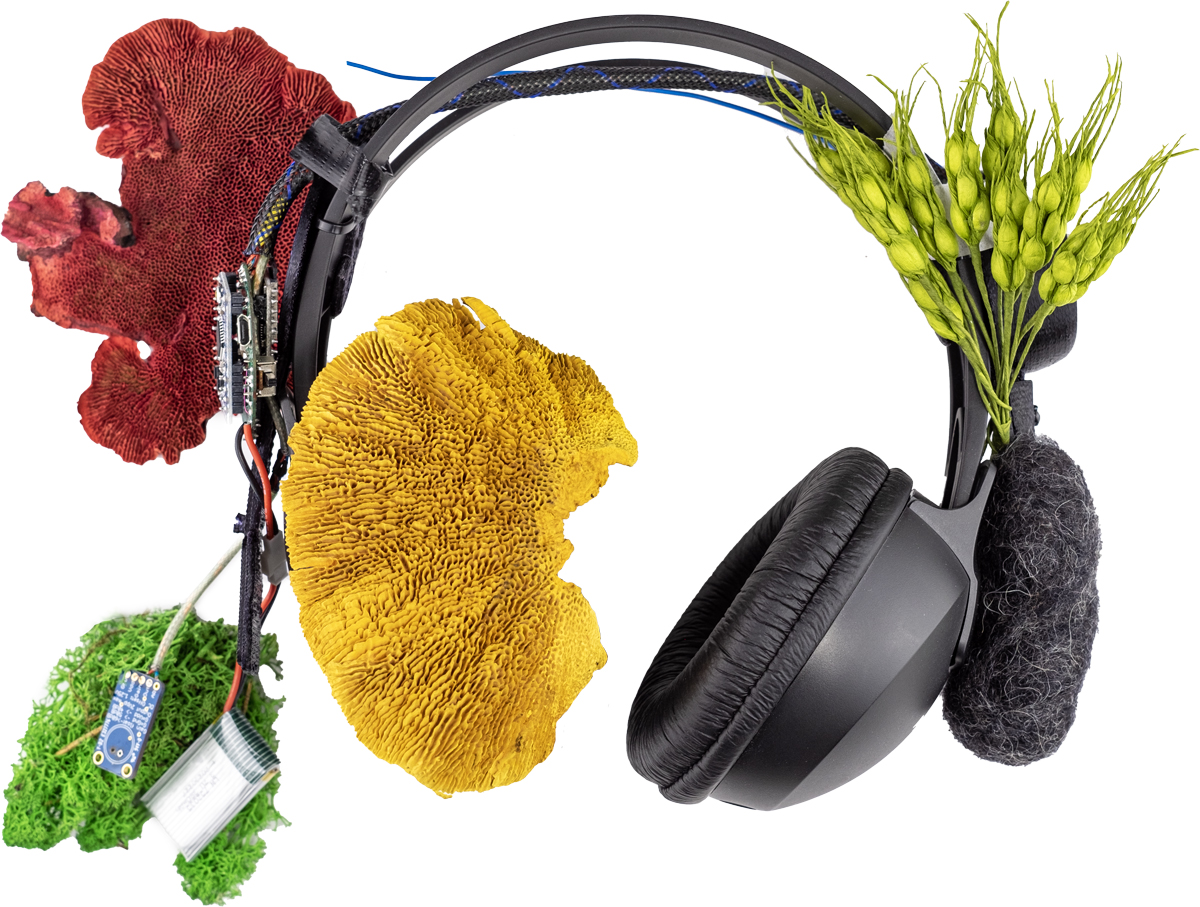
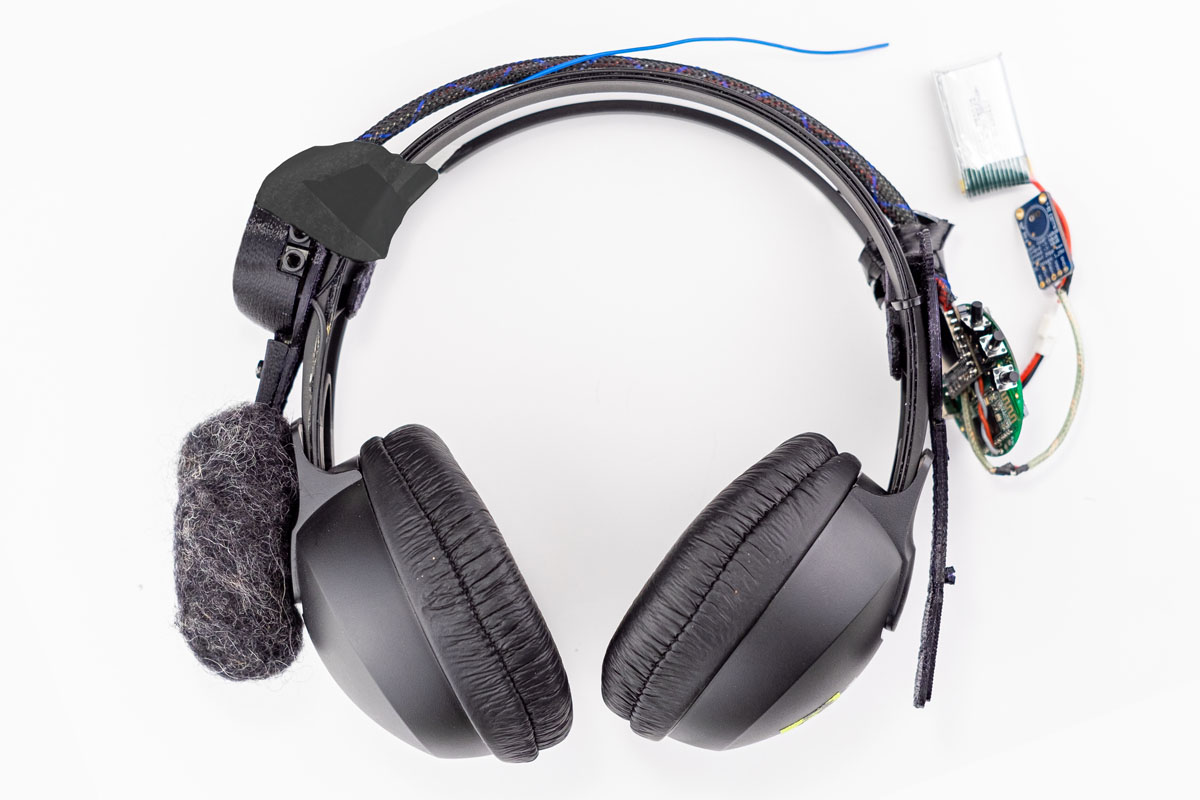
The audience experiences the soundwalk through specially developed headphones used as a tool to speculate the world and the sonic landscape of the future. The world is getting too loud and harmful for our sensitive ears, which have failed to adapt to aggressive frequencies. To survive outdoors, we will need headphones that will both mute and sharpen the sound image and, at the same time, take us into the acoustic narrative.

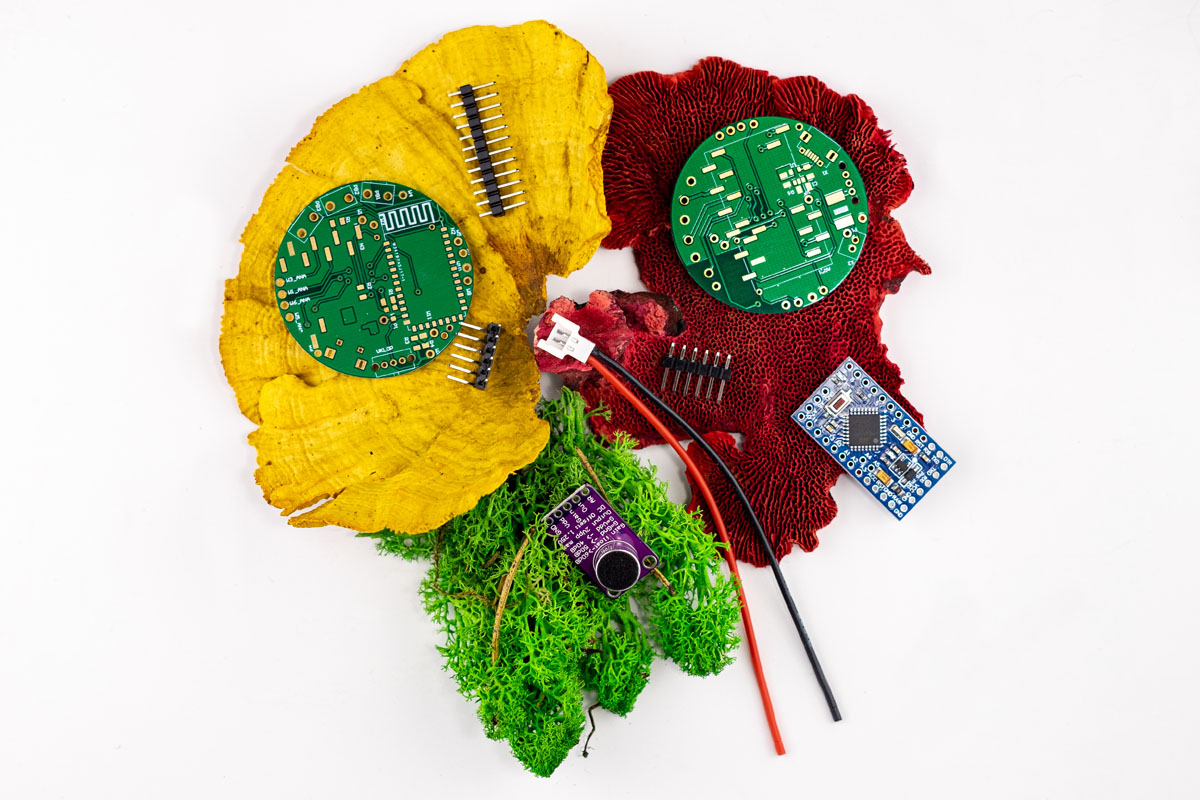
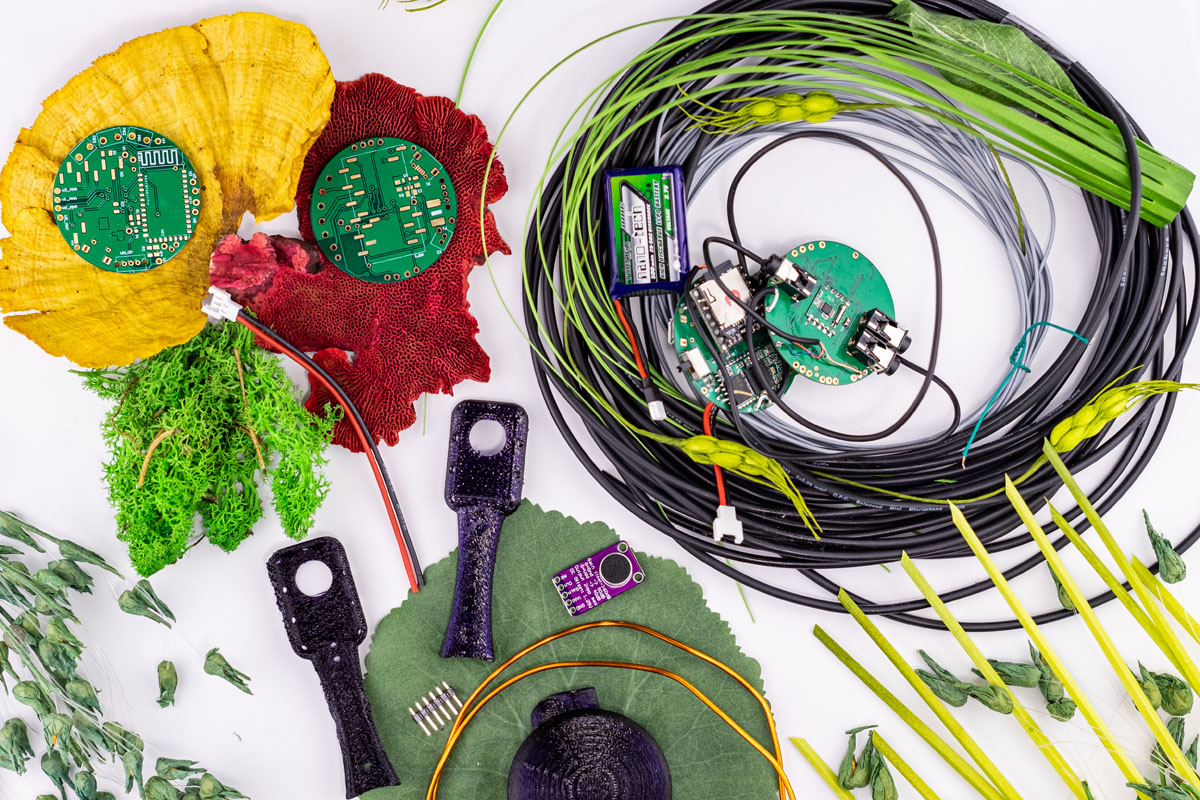
The soundwalk is broadcast on an AR (augmented reality) headset, the result of an innovative  in-depth collaboration between the artist and hardware and software developers. The AR headset allows for simultaneous amplified, binaural ambient listening and audio co-composition. They also include an FM receiver module and an EMS sensor input.

The soundwalk path connects the Orangerie Park in Strasbourg and the Tivoli Park in Ljubljana, both designed during the reign of Napoleon. The featured photograph was taken in a disrupted avenue locked today between a road and a railway. It is part of a larger avenue complex in the Tivoli Park, designed by the French at the time of the Illyrian Provinces. The vocalist, dressed in a Slovene folk costume, wears original AR headphones and listens to the landscape.

A testimony form one of the participants of the AR soundwalk:

“Many thanks to the artists and the Apollonia team for this very inspiring “Sound Walk” in the Parc de l’Orangerie, so beautiful in this early spring. It was like being a little weightless. 45 minutes, with the boundaries between reality and fiction seemingly blurred.”

garden GOround

Irena Pivka, Brane Zorman

The speculative story of the soundwalk performance garden GOround points to the problematic relationship between people and plants, which is geared to mainly benefit people. The colonialism itself and the human-mediated dispersal of plants capitalize on the subjection and exploitation of nature. It is vital to radically change this attitude if we want to deal effectively with the existential threat of ecological crisis and contemplate a brighter scenario for the future. To become more familiar with the world of plants, garden GOroundgoes into the temporal dimension. Through the prism of the journeys of these two utterly different temporalities of humans and plants, seemingly offering no possible point of encounter, it speculates on the development of a future solidarity-based coexistence of humans and plants. Plants, the most populous species on the planet, live at their own pace in their own time, walking the paths we cannot access. garden GOround will take us along the paths of a possible future scenario for our overstressed, noisy planet mirrored through the development of local greenways. Can we learn from plants to build a more solidarity-oriented future?

The audience experiences the soundwalk through specially developed headphones used as a tool to speculate the world and the sonic landscape of the future. The world is getting too loud and harmful for our sensitive ears, which have failed to adapt to aggressive frequencies. To survive outdoors, we will need headphones that will both mute and sharpen the sound image and, at the same time, take us into the acoustic narrative.

The soundwalk is broadcast on an AR (augmented reality) headset, the result of an innovative  in-depth collaboration between the artist and hardware and software developers. The AR headset allows for simultaneous amplified, binaural ambient listening and audio co-composition. They also include an FM receiver module and an EMS sensor input.

The soundwalk path connects the Orangerie Park in Strasbourg and the Tivoli Park in Ljubljana, both designed during the reign of Napoleon. The featured photograph was taken in a disrupted avenue locked today between a road and a railway. It is part of a larger avenue complex in the Tivoli Park, designed by the French at the time of the Illyrian Provinces. The vocalist, dressed in a Slovene folk costume, wears original AR headphones and listens to the landscape.

A testimony form one of the participants of the AR soundwalk:

“Many thanks to the artists and the Apollonia team for this very inspiring “Sound Walk” in the Parc de l’Orangerie, so beautiful in this early spring. It was like being a little weightless. 45 minutes, with the boundaries between reality and fiction seemingly blurred.”

AUTHOR-DESIGNED AR TECHNOLOGY

The audience experiences the sound work through specially developed author-designed AR headphones, which function as an artistic-technological interface between the listener, the space, and the composition. The headphones are conceived as a speculative tool that reflects on future auditory landscapes and possible modes of orientation within acoustically overloaded environments. They are based on the premise that contemporary sonic space is increasingly shaped by noise, frequency saturation, and aggressive acoustic pressures, as a result of which listening is becoming ever more a matter of perception, protection, and selection.

The AR headphones are the result of an in-depth collaboration between the artists and hardware and software developers. Their design enables the simultaneous binaural listening of the immediate surroundings and the playback of a sound composition, thereby creating a layered and dynamic sonic situation in which real acoustic space interweaves with an artificially generated or transmitted sonic narrative. A key feature of the system is that it does not exclude the surrounding environment, but rather acoustically modulates, filters, and accentuates it, so that listening is not separated from space, but remains actively embedded within it.

The headphones include an FM receiver module, which enables the wireless transmission and reception of audio signals, as well as an input for an EMS sensor, through which the system can also be connected to biometric or bodily impulses. The device therefore functions not merely as a playback unit, but as an expanded listening apparatus that combines environmental perception, technological mediation, and compositional layering into a unified listening experience. In this sense, the work addresses not only the future of sound, but also the future of listening as a technologically supported, situated, and selective practice.

Irena Pivka

An artist and producer. She works in the areas of new media, sound and performance arts. In recent years, she has been focusing her artistic expressions on the preparations of sound-walk performances, co-authored by Brane Zorman, which, by means of transmission tools and sound pictures, through walking and listening establish space anew and reflect social reality.

Brane Zorman

A composer, sound and radio artist. His work explores the possibilities of processing, presenting, perceiving, understanding, positioning and reinterpreting sound, space and ecology. By employing analogue and digital technologies and techniques, his work traverses the fields of music, multimedia, and visual space, using both sophisticated and simple tools, strategies, methods, and interactive interpretation models, soundscapes, evolving electronic and acoustic sound sculptures.

Kolofon / Colophon

Concept, text and headphones design: Irena Pivka
Sound composition and editing, sensorial headset concept: Brane Zorman
Vocal: Alja Petric
Voices: Lučka Počkaj, Alja Petric, Toni Cahunek (Slovene)Jana Wilcoxen, Alja Petric, Toni Cahunek (English)Nataša Živkovič, Suzana Koncut, Loup Abramovici (French)
Proofreading, English translation: Melita Silič
English editing and proofreading: Jana Wilcoxen
French translation: Anne-Cécile Lamy-Joswiak
French editing: Suzana KoncutPhotography, design: Matej Tomažin
Illustration: Jovana DjukićHardware and software development and testing, android application: Brane Ždralo
PCB printing, electronics assembling: Zdravko Janšovec
Electronics assembling: Ivan Kvasič
3D printing: Cveto Kunešević, 3Dimension
Headphones assembling: Staš VrenkoProduced by CONA, 2023

VITAL creates an innovative ecosystem that respects the environment and, through art, participates in the fight against global warming and air pollution.

VITAL is co-funded by the Creative Europe programme by the three-year “Strasbourg European Capital” Contract and supported by the Ministry of Public Administration of the Republic of Slovenia and the City of Ljubljana, Departmen of Culture.

Text sources:

Gray, Ros and Sheikh, Shela (ed.). “The Wretched Earth: Botanical Conflicts and Artistic Interventions”. Third Text32(2–3).Kunst, Bojana. “Rastlinsko življenje in prostori umetnosti: o nedostopnem in vzajemnem”. Ana Mizerit (ed.). Zasilni izhod [Exhibition catalogue]. Ljubljana: Moderna galerija, 2022.Thorsen, Line Marie (ed.). Moving Plants. Rønnebæksholm, Næstved: Narayana Press, 2017.Sagan, Dorion. “The Human is More than Human: Interspecies Communities and the New “Facts of Life”.” Theorizing the Contemporary. Fieldsights, 18 Nov 2011.Raja, Vicente. “Moving the Green: Plant Behavior in the Human World“. EuropeNow 45, Nov 2021.Sidebottom, Kay. “Education for a More-Than-Human World”. EuropeNow 45, Nov 2021.Marder, Michael. “Resist Like a Plant! On the Vegetal Life of Political Movements“. Peace Studies Journal 5(1), Jan 2012.Brkič, Vanja. “Mestni park Tivoli: Tivolski drevoredi so bili Ljubljančanom od nekdaj v ponos“. Dnevnik, 10 Oct 2015.Strasbourg Park, https://data.strasbourg.eu/explore/dataset/lieux_arbres-remarquables/table/

More about the work and the authors

Fotografija / Image

Foto: Nada Žgank, Matej Tomažin

Irena Pivka in Brane Zorman: garden GOround

Cona Zavod za procesiranje sodobne umetnosti Ljubljana

Soundwalk, Performance, Music

The speculative story of the soundwalk performance garden GOround points to the problematic relationship between people and plants, which is geared to mainly benefit people. The colonialism itself and the human-mediated dispersal of plants capitalize on the subjection and exploitation of nature. It is vital to radically change this attitude if we want to deal effectively with the existential threat of ecological crisis and contemplate a brighter scenario for the future. To become more familiar with the world of plants, garden GOroundgoes into the temporal dimension. Through the prism of the journeys of these two utterly different temporalities of humans and plants, seemingly offering no possible point of encounter, it speculates on the development of a future solidarity-based coexistence of humans and plants. Plants, the most populous species on the planet, live at their own pace in their own time, walking the paths we cannot access. garden GOround will take us along the paths of a possible future scenario for our overstressed, noisy planet mirrored through the development of local greenways. Can we learn from plants to build a more solidarity-oriented future?

The audience experiences the soundwalk through specially developed headphones used as a tool to speculate the world and the sonic landscape of the future. The world is getting too loud and harmful for our sensitive ears, which have failed to adapt to aggressive frequencies. To survive outdoors, we will need headphones that will both mute and sharpen the sound image and, at the same time, take us into the acoustic narrative.

The soundwalk is broadcast on an AR (augmented reality) headset, the result of an innovative  in-depth collaboration between the artist and hardware and software developers. The AR headset allows for simultaneous amplified, binaural ambient listening and audio co-composition. They also include an FM receiver module and an EMS sensor input.

The soundwalk path connects the Orangerie Park in Strasbourg and the Tivoli Park in Ljubljana, both designed during the reign of Napoleon. The featured photograph was taken in a disrupted avenue locked today between a road and a railway. It is part of a larger avenue complex in the Tivoli Park, designed by the French at the time of the Illyrian Provinces. The vocalist, dressed in a Slovene folk costume, wears original AR headphones and listens to the landscape.

A testimony form one of the participants of the AR soundwalk:

“Many thanks to the artists and the Apollonia team for this very inspiring “Sound Walk” in the Parc de l’Orangerie, so beautiful in this early spring. It was like being a little weightless. 45 minutes, with the boundaries between reality and fiction seemingly blurred.”

garden GOround

Irena Pivka, Brane Zorman

The speculative story of the soundwalk performance garden GOround points to the problematic relationship between people and plants, which is geared to mainly benefit people. The colonialism itself and the human-mediated dispersal of plants capitalize on the subjection and exploitation of nature. It is vital to radically change this attitude if we want to deal effectively with the existential threat of ecological crisis and contemplate a brighter scenario for the future. To become more familiar with the world of plants, garden GOroundgoes into the temporal dimension. Through the prism of the journeys of these two utterly different temporalities of humans and plants, seemingly offering no possible point of encounter, it speculates on the development of a future solidarity-based coexistence of humans and plants. Plants, the most populous species on the planet, live at their own pace in their own time, walking the paths we cannot access. garden GOround will take us along the paths of a possible future scenario for our overstressed, noisy planet mirrored through the development of local greenways. Can we learn from plants to build a more solidarity-oriented future?

The audience experiences the soundwalk through specially developed headphones used as a tool to speculate the world and the sonic landscape of the future. The world is getting too loud and harmful for our sensitive ears, which have failed to adapt to aggressive frequencies. To survive outdoors, we will need headphones that will both mute and sharpen the sound image and, at the same time, take us into the acoustic narrative.

The soundwalk is broadcast on an AR (augmented reality) headset, the result of an innovative  in-depth collaboration between the artist and hardware and software developers. The AR headset allows for simultaneous amplified, binaural ambient listening and audio co-composition. They also include an FM receiver module and an EMS sensor input.

The soundwalk path connects the Orangerie Park in Strasbourg and the Tivoli Park in Ljubljana, both designed during the reign of Napoleon. The featured photograph was taken in a disrupted avenue locked today between a road and a railway. It is part of a larger avenue complex in the Tivoli Park, designed by the French at the time of the Illyrian Provinces. The vocalist, dressed in a Slovene folk costume, wears original AR headphones and listens to the landscape.

A testimony form one of the participants of the AR soundwalk:

“Many thanks to the artists and the Apollonia team for this very inspiring “Sound Walk” in the Parc de l’Orangerie, so beautiful in this early spring. It was like being a little weightless. 45 minutes, with the boundaries between reality and fiction seemingly blurred.”

AUTHOR-DESIGNED AR TECHNOLOGY

The audience experiences the sound work through specially developed author-designed AR headphones, which function as an artistic-technological interface between the listener, the space, and the composition. The headphones are conceived as a speculative tool that reflects on future auditory landscapes and possible modes of orientation within acoustically overloaded environments. They are based on the premise that contemporary sonic space is increasingly shaped by noise, frequency saturation, and aggressive acoustic pressures, as a result of which listening is becoming ever more a matter of perception, protection, and selection.

The AR headphones are the result of an in-depth collaboration between the artists and hardware and software developers. Their design enables the simultaneous binaural listening of the immediate surroundings and the playback of a sound composition, thereby creating a layered and dynamic sonic situation in which real acoustic space interweaves with an artificially generated or transmitted sonic narrative. A key feature of the system is that it does not exclude the surrounding environment, but rather acoustically modulates, filters, and accentuates it, so that listening is not separated from space, but remains actively embedded within it.

The headphones include an FM receiver module, which enables the wireless transmission and reception of audio signals, as well as an input for an EMS sensor, through which the system can also be connected to biometric or bodily impulses. The device therefore functions not merely as a playback unit, but as an expanded listening apparatus that combines environmental perception, technological mediation, and compositional layering into a unified listening experience. In this sense, the work addresses not only the future of sound, but also the future of listening as a technologically supported, situated, and selective practice.

Irena Pivka

An artist and producer. She works in the areas of new media, sound and performance arts. In recent years, she has been focusing her artistic expressions on the preparations of sound-walk performances, co-authored by Brane Zorman, which, by means of transmission tools and sound pictures, through walking and listening establish space anew and reflect social reality.

Brane Zorman

A composer, sound and radio artist. His work explores the possibilities of processing, presenting, perceiving, understanding, positioning and reinterpreting sound, space and ecology. By employing analogue and digital technologies and techniques, his work traverses the fields of music, multimedia, and visual space, using both sophisticated and simple tools, strategies, methods, and interactive interpretation models, soundscapes, evolving electronic and acoustic sound sculptures.

Kolofon / Colophon

Concept, text and headphones design: Irena Pivka
Sound composition and editing, sensorial headset concept: Brane Zorman
Vocal: Alja Petric
Voices: Lučka Počkaj, Alja Petric, Toni Cahunek (Slovene)Jana Wilcoxen, Alja Petric, Toni Cahunek (English)Nataša Živkovič, Suzana Koncut, Loup Abramovici (French)
Proofreading, English translation: Melita Silič
English editing and proofreading: Jana Wilcoxen
French translation: Anne-Cécile Lamy-Joswiak
French editing: Suzana KoncutPhotography, design: Matej Tomažin
Illustration: Jovana DjukićHardware and software development and testing, android application: Brane Ždralo
PCB printing, electronics assembling: Zdravko Janšovec
Electronics assembling: Ivan Kvasič
3D printing: Cveto Kunešević, 3Dimension
Headphones assembling: Staš VrenkoProduced by CONA, 2023

VITAL creates an innovative ecosystem that respects the environment and, through art, participates in the fight against global warming and air pollution.

VITAL is co-funded by the Creative Europe programme by the three-year “Strasbourg European Capital” Contract and supported by the Ministry of Public Administration of the Republic of Slovenia and the City of Ljubljana, Departmen of Culture.

Text sources:

Gray, Ros and Sheikh, Shela (ed.). “The Wretched Earth: Botanical Conflicts and Artistic Interventions”. Third Text32(2–3).Kunst, Bojana. “Rastlinsko življenje in prostori umetnosti: o nedostopnem in vzajemnem”. Ana Mizerit (ed.). Zasilni izhod [Exhibition catalogue]. Ljubljana: Moderna galerija, 2022.Thorsen, Line Marie (ed.). Moving Plants. Rønnebæksholm, Næstved: Narayana Press, 2017.Sagan, Dorion. “The Human is More than Human: Interspecies Communities and the New “Facts of Life”.” Theorizing the Contemporary. Fieldsights, 18 Nov 2011.Raja, Vicente. “Moving the Green: Plant Behavior in the Human World“. EuropeNow 45, Nov 2021.Sidebottom, Kay. “Education for a More-Than-Human World”. EuropeNow 45, Nov 2021.Marder, Michael. “Resist Like a Plant! On the Vegetal Life of Political Movements“. Peace Studies Journal 5(1), Jan 2012.Brkič, Vanja. “Mestni park Tivoli: Tivolski drevoredi so bili Ljubljančanom od nekdaj v ponos“. Dnevnik, 10 Oct 2015.Strasbourg Park, https://data.strasbourg.eu/explore/dataset/lieux_arbres-remarquables/table/

More about the work and the authors

Fotografija / Image

Foto: Nada Žgank, Matej Tomažin

Irena Pivka in Brane Zorman: garden GOround

Cona Zavod za procesiranje sodobne umetnosti Ljubljana

Soundwalk, Performance, Music

The speculative story of the soundwalk performance garden GOround points to the problematic relationship between people and plants, which is geared to mainly benefit people. The colonialism itself and the human-mediated dispersal of plants capitalize on the subjection and exploitation of nature. It is vital to radically change this attitude if we want to deal effectively with the existential threat of ecological crisis and contemplate a brighter scenario for the future. To become more familiar with the world of plants, garden GOroundgoes into the temporal dimension. Through the prism of the journeys of these two utterly different temporalities of humans and plants, seemingly offering no possible point of encounter, it speculates on the development of a future solidarity-based coexistence of humans and plants. Plants, the most populous species on the planet, live at their own pace in their own time, walking the paths we cannot access. garden GOround will take us along the paths of a possible future scenario for our overstressed, noisy planet mirrored through the development of local greenways. Can we learn from plants to build a more solidarity-oriented future?

The audience experiences the soundwalk through specially developed headphones used as a tool to speculate the world and the sonic landscape of the future. The world is getting too loud and harmful for our sensitive ears, which have failed to adapt to aggressive frequencies. To survive outdoors, we will need headphones that will both mute and sharpen the sound image and, at the same time, take us into the acoustic narrative.

The soundwalk is broadcast on an AR (augmented reality) headset, the result of an innovative  in-depth collaboration between the artist and hardware and software developers. The AR headset allows for simultaneous amplified, binaural ambient listening and audio co-composition. They also include an FM receiver module and an EMS sensor input.

The soundwalk path connects the Orangerie Park in Strasbourg and the Tivoli Park in Ljubljana, both designed during the reign of Napoleon. The featured photograph was taken in a disrupted avenue locked today between a road and a railway. It is part of a larger avenue complex in the Tivoli Park, designed by the French at the time of the Illyrian Provinces. The vocalist, dressed in a Slovene folk costume, wears original AR headphones and listens to the landscape.

A testimony form one of the participants of the AR soundwalk:

“Many thanks to the artists and the Apollonia team for this very inspiring “Sound Walk” in the Parc de l’Orangerie, so beautiful in this early spring. It was like being a little weightless. 45 minutes, with the boundaries between reality and fiction seemingly blurred.”

garden GOround

Irena Pivka, Brane Zorman

The speculative story of the soundwalk performance garden GOround points to the problematic relationship between people and plants, which is geared to mainly benefit people. The colonialism itself and the human-mediated dispersal of plants capitalize on the subjection and exploitation of nature. It is vital to radically change this attitude if we want to deal effectively with the existential threat of ecological crisis and contemplate a brighter scenario for the future. To become more familiar with the world of plants, garden GOroundgoes into the temporal dimension. Through the prism of the journeys of these two utterly different temporalities of humans and plants, seemingly offering no possible point of encounter, it speculates on the development of a future solidarity-based coexistence of humans and plants. Plants, the most populous species on the planet, live at their own pace in their own time, walking the paths we cannot access. garden GOround will take us along the paths of a possible future scenario for our overstressed, noisy planet mirrored through the development of local greenways. Can we learn from plants to build a more solidarity-oriented future?

The audience experiences the soundwalk through specially developed headphones used as a tool to speculate the world and the sonic landscape of the future. The world is getting too loud and harmful for our sensitive ears, which have failed to adapt to aggressive frequencies. To survive outdoors, we will need headphones that will both mute and sharpen the sound image and, at the same time, take us into the acoustic narrative.

The soundwalk is broadcast on an AR (augmented reality) headset, the result of an innovative  in-depth collaboration between the artist and hardware and software developers. The AR headset allows for simultaneous amplified, binaural ambient listening and audio co-composition. They also include an FM receiver module and an EMS sensor input.

The soundwalk path connects the Orangerie Park in Strasbourg and the Tivoli Park in Ljubljana, both designed during the reign of Napoleon. The featured photograph was taken in a disrupted avenue locked today between a road and a railway. It is part of a larger avenue complex in the Tivoli Park, designed by the French at the time of the Illyrian Provinces. The vocalist, dressed in a Slovene folk costume, wears original AR headphones and listens to the landscape.

A testimony form one of the participants of the AR soundwalk:

“Many thanks to the artists and the Apollonia team for this very inspiring “Sound Walk” in the Parc de l’Orangerie, so beautiful in this early spring. It was like being a little weightless. 45 minutes, with the boundaries between reality and fiction seemingly blurred.”

AUTHOR-DESIGNED AR TECHNOLOGY

The audience experiences the sound work through specially developed author-designed AR headphones, which function as an artistic-technological interface between the listener, the space, and the composition. The headphones are conceived as a speculative tool that reflects on future auditory landscapes and possible modes of orientation within acoustically overloaded environments. They are based on the premise that contemporary sonic space is increasingly shaped by noise, frequency saturation, and aggressive acoustic pressures, as a result of which listening is becoming ever more a matter of perception, protection, and selection.

The AR headphones are the result of an in-depth collaboration between the artists and hardware and software developers. Their design enables the simultaneous binaural listening of the immediate surroundings and the playback of a sound composition, thereby creating a layered and dynamic sonic situation in which real acoustic space interweaves with an artificially generated or transmitted sonic narrative. A key feature of the system is that it does not exclude the surrounding environment, but rather acoustically modulates, filters, and accentuates it, so that listening is not separated from space, but remains actively embedded within it.

The headphones include an FM receiver module, which enables the wireless transmission and reception of audio signals, as well as an input for an EMS sensor, through which the system can also be connected to biometric or bodily impulses. The device therefore functions not merely as a playback unit, but as an expanded listening apparatus that combines environmental perception, technological mediation, and compositional layering into a unified listening experience. In this sense, the work addresses not only the future of sound, but also the future of listening as a technologically supported, situated, and selective practice.

Irena Pivka

An artist and producer. She works in the areas of new media, sound and performance arts. In recent years, she has been focusing her artistic expressions on the preparations of sound-walk performances, co-authored by Brane Zorman, which, by means of transmission tools and sound pictures, through walking and listening establish space anew and reflect social reality.

Brane Zorman

A composer, sound and radio artist. His work explores the possibilities of processing, presenting, perceiving, understanding, positioning and reinterpreting sound, space and ecology. By employing analogue and digital technologies and techniques, his work traverses the fields of music, multimedia, and visual space, using both sophisticated and simple tools, strategies, methods, and interactive interpretation models, soundscapes, evolving electronic and acoustic sound sculptures.

Kolofon / Colophon

Concept, text and headphones design: Irena Pivka
Sound composition and editing, sensorial headset concept: Brane Zorman
Vocal: Alja Petric
Voices: Lučka Počkaj, Alja Petric, Toni Cahunek (Slovene)Jana Wilcoxen, Alja Petric, Toni Cahunek (English)Nataša Živkovič, Suzana Koncut, Loup Abramovici (French)
Proofreading, English translation: Melita Silič
English editing and proofreading: Jana Wilcoxen
French translation: Anne-Cécile Lamy-Joswiak
French editing: Suzana KoncutPhotography, design: Matej Tomažin
Illustration: Jovana DjukićHardware and software development and testing, android application: Brane Ždralo
PCB printing, electronics assembling: Zdravko Janšovec
Electronics assembling: Ivan Kvasič
3D printing: Cveto Kunešević, 3Dimension
Headphones assembling: Staš VrenkoProduced by CONA, 2023

VITAL creates an innovative ecosystem that respects the environment and, through art, participates in the fight against global warming and air pollution.

VITAL is co-funded by the Creative Europe programme by the three-year “Strasbourg European Capital” Contract and supported by the Ministry of Public Administration of the Republic of Slovenia and the City of Ljubljana, Departmen of Culture.

Text sources:

Gray, Ros and Sheikh, Shela (ed.). “The Wretched Earth: Botanical Conflicts and Artistic Interventions”. Third Text32(2–3).Kunst, Bojana. “Rastlinsko življenje in prostori umetnosti: o nedostopnem in vzajemnem”. Ana Mizerit (ed.). Zasilni izhod [Exhibition catalogue]. Ljubljana: Moderna galerija, 2022.Thorsen, Line Marie (ed.). Moving Plants. Rønnebæksholm, Næstved: Narayana Press, 2017.Sagan, Dorion. “The Human is More than Human: Interspecies Communities and the New “Facts of Life”.” Theorizing the Contemporary. Fieldsights, 18 Nov 2011.Raja, Vicente. “Moving the Green: Plant Behavior in the Human World“. EuropeNow 45, Nov 2021.Sidebottom, Kay. “Education for a More-Than-Human World”. EuropeNow 45, Nov 2021.Marder, Michael. “Resist Like a Plant! On the Vegetal Life of Political Movements“. Peace Studies Journal 5(1), Jan 2012.Brkič, Vanja. “Mestni park Tivoli: Tivolski drevoredi so bili Ljubljančanom od nekdaj v ponos“. Dnevnik, 10 Oct 2015.Strasbourg Park, https://data.strasbourg.eu/explore/dataset/lieux_arbres-remarquables/table/

More about the work and the authors

Fotografija / Image

Foto: Nada Žgank, Matej Tomažin

Irena Pivka in Brane Zorman: garden GOround

Cona Zavod za procesiranje sodobne umetnosti Ljubljana

Soundwalk, Performance, Music

The speculative story of the soundwalk performance garden GOround points to the problematic relationship between people and plants, which is geared to mainly benefit people. The colonialism itself and the human-mediated dispersal of plants capitalize on the subjection and exploitation of nature. It is vital to radically change this attitude if we want to deal effectively with the existential threat of ecological crisis and contemplate a brighter scenario for the future. To become more familiar with the world of plants, garden GOroundgoes into the temporal dimension. Through the prism of the journeys of these two utterly different temporalities of humans and plants, seemingly offering no possible point of encounter, it speculates on the development of a future solidarity-based coexistence of humans and plants. Plants, the most populous species on the planet, live at their own pace in their own time, walking the paths we cannot access. garden GOround will take us along the paths of a possible future scenario for our overstressed, noisy planet mirrored through the development of local greenways. Can we learn from plants to build a more solidarity-oriented future?

The audience experiences the soundwalk through specially developed headphones used as a tool to speculate the world and the sonic landscape of the future. The world is getting too loud and harmful for our sensitive ears, which have failed to adapt to aggressive frequencies. To survive outdoors, we will need headphones that will both mute and sharpen the sound image and, at the same time, take us into the acoustic narrative.

The soundwalk is broadcast on an AR (augmented reality) headset, the result of an innovative  in-depth collaboration between the artist and hardware and software developers. The AR headset allows for simultaneous amplified, binaural ambient listening and audio co-composition. They also include an FM receiver module and an EMS sensor input.

The soundwalk path connects the Orangerie Park in Strasbourg and the Tivoli Park in Ljubljana, both designed during the reign of Napoleon. The featured photograph was taken in a disrupted avenue locked today between a road and a railway. It is part of a larger avenue complex in the Tivoli Park, designed by the French at the time of the Illyrian Provinces. The vocalist, dressed in a Slovene folk costume, wears original AR headphones and listens to the landscape.

A testimony form one of the participants of the AR soundwalk:

“Many thanks to the artists and the Apollonia team for this very inspiring “Sound Walk” in the Parc de l’Orangerie, so beautiful in this early spring. It was like being a little weightless. 45 minutes, with the boundaries between reality and fiction seemingly blurred.”

garden GOround

Irena Pivka, Brane Zorman

The speculative story of the soundwalk performance garden GOround points to the problematic relationship between people and plants, which is geared to mainly benefit people. The colonialism itself and the human-mediated dispersal of plants capitalize on the subjection and exploitation of nature. It is vital to radically change this attitude if we want to deal effectively with the existential threat of ecological crisis and contemplate a brighter scenario for the future. To become more familiar with the world of plants, garden GOroundgoes into the temporal dimension. Through the prism of the journeys of these two utterly different temporalities of humans and plants, seemingly offering no possible point of encounter, it speculates on the development of a future solidarity-based coexistence of humans and plants. Plants, the most populous species on the planet, live at their own pace in their own time, walking the paths we cannot access. garden GOround will take us along the paths of a possible future scenario for our overstressed, noisy planet mirrored through the development of local greenways. Can we learn from plants to build a more solidarity-oriented future?

The audience experiences the soundwalk through specially developed headphones used as a tool to speculate the world and the sonic landscape of the future. The world is getting too loud and harmful for our sensitive ears, which have failed to adapt to aggressive frequencies. To survive outdoors, we will need headphones that will both mute and sharpen the sound image and, at the same time, take us into the acoustic narrative.

The soundwalk is broadcast on an AR (augmented reality) headset, the result of an innovative  in-depth collaboration between the artist and hardware and software developers. The AR headset allows for simultaneous amplified, binaural ambient listening and audio co-composition. They also include an FM receiver module and an EMS sensor input.

The soundwalk path connects the Orangerie Park in Strasbourg and the Tivoli Park in Ljubljana, both designed during the reign of Napoleon. The featured photograph was taken in a disrupted avenue locked today between a road and a railway. It is part of a larger avenue complex in the Tivoli Park, designed by the French at the time of the Illyrian Provinces. The vocalist, dressed in a Slovene folk costume, wears original AR headphones and listens to the landscape.

A testimony form one of the participants of the AR soundwalk:

“Many thanks to the artists and the Apollonia team for this very inspiring “Sound Walk” in the Parc de l’Orangerie, so beautiful in this early spring. It was like being a little weightless. 45 minutes, with the boundaries between reality and fiction seemingly blurred.”

AUTHOR-DESIGNED AR TECHNOLOGY

The audience experiences the sound work through specially developed author-designed AR headphones, which function as an artistic-technological interface between the listener, the space, and the composition. The headphones are conceived as a speculative tool that reflects on future auditory landscapes and possible modes of orientation within acoustically overloaded environments. They are based on the premise that contemporary sonic space is increasingly shaped by noise, frequency saturation, and aggressive acoustic pressures, as a result of which listening is becoming ever more a matter of perception, protection, and selection.

The AR headphones are the result of an in-depth collaboration between the artists and hardware and software developers. Their design enables the simultaneous binaural listening of the immediate surroundings and the playback of a sound composition, thereby creating a layered and dynamic sonic situation in which real acoustic space interweaves with an artificially generated or transmitted sonic narrative. A key feature of the system is that it does not exclude the surrounding environment, but rather acoustically modulates, filters, and accentuates it, so that listening is not separated from space, but remains actively embedded within it.

The headphones include an FM receiver module, which enables the wireless transmission and reception of audio signals, as well as an input for an EMS sensor, through which the system can also be connected to biometric or bodily impulses. The device therefore functions not merely as a playback unit, but as an expanded listening apparatus that combines environmental perception, technological mediation, and compositional layering into a unified listening experience. In this sense, the work addresses not only the future of sound, but also the future of listening as a technologically supported, situated, and selective practice.

Irena Pivka

An artist and producer. She works in the areas of new media, sound and performance arts. In recent years, she has been focusing her artistic expressions on the preparations of sound-walk performances, co-authored by Brane Zorman, which, by means of transmission tools and sound pictures, through walking and listening establish space anew and reflect social reality.

Brane Zorman

A composer, sound and radio artist. His work explores the possibilities of processing, presenting, perceiving, understanding, positioning and reinterpreting sound, space and ecology. By employing analogue and digital technologies and techniques, his work traverses the fields of music, multimedia, and visual space, using both sophisticated and simple tools, strategies, methods, and interactive interpretation models, soundscapes, evolving electronic and acoustic sound sculptures.

Kolofon / Colophon

Concept, text and headphones design: Irena Pivka
Sound composition and editing, sensorial headset concept: Brane Zorman
Vocal: Alja Petric
Voices: Lučka Počkaj, Alja Petric, Toni Cahunek (Slovene)Jana Wilcoxen, Alja Petric, Toni Cahunek (English)Nataša Živkovič, Suzana Koncut, Loup Abramovici (French)
Proofreading, English translation: Melita Silič
English editing and proofreading: Jana Wilcoxen
French translation: Anne-Cécile Lamy-Joswiak
French editing: Suzana KoncutPhotography, design: Matej Tomažin
Illustration: Jovana DjukićHardware and software development and testing, android application: Brane Ždralo
PCB printing, electronics assembling: Zdravko Janšovec
Electronics assembling: Ivan Kvasič
3D printing: Cveto Kunešević, 3Dimension
Headphones assembling: Staš VrenkoProduced by CONA, 2023

VITAL creates an innovative ecosystem that respects the environment and, through art, participates in the fight against global warming and air pollution.

VITAL is co-funded by the Creative Europe programme by the three-year “Strasbourg European Capital” Contract and supported by the Ministry of Public Administration of the Republic of Slovenia and the City of Ljubljana, Departmen of Culture.

Text sources:

Gray, Ros and Sheikh, Shela (ed.). “The Wretched Earth: Botanical Conflicts and Artistic Interventions”. Third Text32(2–3).Kunst, Bojana. “Rastlinsko življenje in prostori umetnosti: o nedostopnem in vzajemnem”. Ana Mizerit (ed.). Zasilni izhod [Exhibition catalogue]. Ljubljana: Moderna galerija, 2022.Thorsen, Line Marie (ed.). Moving Plants. Rønnebæksholm, Næstved: Narayana Press, 2017.Sagan, Dorion. “The Human is More than Human: Interspecies Communities and the New “Facts of Life”.” Theorizing the Contemporary. Fieldsights, 18 Nov 2011.Raja, Vicente. “Moving the Green: Plant Behavior in the Human World“. EuropeNow 45, Nov 2021.Sidebottom, Kay. “Education for a More-Than-Human World”. EuropeNow 45, Nov 2021.Marder, Michael. “Resist Like a Plant! On the Vegetal Life of Political Movements“. Peace Studies Journal 5(1), Jan 2012.Brkič, Vanja. “Mestni park Tivoli: Tivolski drevoredi so bili Ljubljančanom od nekdaj v ponos“. Dnevnik, 10 Oct 2015.Strasbourg Park, https://data.strasbourg.eu/explore/dataset/lieux_arbres-remarquables/table/

More about the work and the authors

Fotografija / Image

Foto: Nada Žgank, Matej Tomažin

Irena Pivka in Brane Zorman: garden GOround

Cona Zavod za procesiranje sodobne umetnosti Ljubljana

Soundwalk, Performance, Music

The speculative story of the soundwalk performance garden GOround points to the problematic relationship between people and plants, which is geared to mainly benefit people. The colonialism itself and the human-mediated dispersal of plants capitalize on the subjection and exploitation of nature. It is vital to radically change this attitude if we want to deal effectively with the existential threat of ecological crisis and contemplate a brighter scenario for the future. To become more familiar with the world of plants, garden GOroundgoes into the temporal dimension. Through the prism of the journeys of these two utterly different temporalities of humans and plants, seemingly offering no possible point of encounter, it speculates on the development of a future solidarity-based coexistence of humans and plants. Plants, the most populous species on the planet, live at their own pace in their own time, walking the paths we cannot access. garden GOround will take us along the paths of a possible future scenario for our overstressed, noisy planet mirrored through the development of local greenways. Can we learn from plants to build a more solidarity-oriented future?

The audience experiences the soundwalk through specially developed headphones used as a tool to speculate the world and the sonic landscape of the future. The world is getting too loud and harmful for our sensitive ears, which have failed to adapt to aggressive frequencies. To survive outdoors, we will need headphones that will both mute and sharpen the sound image and, at the same time, take us into the acoustic narrative.

The soundwalk is broadcast on an AR (augmented reality) headset, the result of an innovative  in-depth collaboration between the artist and hardware and software developers. The AR headset allows for simultaneous amplified, binaural ambient listening and audio co-composition. They also include an FM receiver module and an EMS sensor input.

The soundwalk path connects the Orangerie Park in Strasbourg and the Tivoli Park in Ljubljana, both designed during the reign of Napoleon. The featured photograph was taken in a disrupted avenue locked today between a road and a railway. It is part of a larger avenue complex in the Tivoli Park, designed by the French at the time of the Illyrian Provinces. The vocalist, dressed in a Slovene folk costume, wears original AR headphones and listens to the landscape.

A testimony form one of the participants of the AR soundwalk:

“Many thanks to the artists and the Apollonia team for this very inspiring “Sound Walk” in the Parc de l’Orangerie, so beautiful in this early spring. It was like being a little weightless. 45 minutes, with the boundaries between reality and fiction seemingly blurred.”

garden GOround

Irena Pivka, Brane Zorman

The speculative story of the soundwalk performance garden GOround points to the problematic relationship between people and plants, which is geared to mainly benefit people. The colonialism itself and the human-mediated dispersal of plants capitalize on the subjection and exploitation of nature. It is vital to radically change this attitude if we want to deal effectively with the existential threat of ecological crisis and contemplate a brighter scenario for the future. To become more familiar with the world of plants, garden GOroundgoes into the temporal dimension. Through the prism of the journeys of these two utterly different temporalities of humans and plants, seemingly offering no possible point of encounter, it speculates on the development of a future solidarity-based coexistence of humans and plants. Plants, the most populous species on the planet, live at their own pace in their own time, walking the paths we cannot access. garden GOround will take us along the paths of a possible future scenario for our overstressed, noisy planet mirrored through the development of local greenways. Can we learn from plants to build a more solidarity-oriented future?

The audience experiences the soundwalk through specially developed headphones used as a tool to speculate the world and the sonic landscape of the future. The world is getting too loud and harmful for our sensitive ears, which have failed to adapt to aggressive frequencies. To survive outdoors, we will need headphones that will both mute and sharpen the sound image and, at the same time, take us into the acoustic narrative.

The soundwalk is broadcast on an AR (augmented reality) headset, the result of an innovative  in-depth collaboration between the artist and hardware and software developers. The AR headset allows for simultaneous amplified, binaural ambient listening and audio co-composition. They also include an FM receiver module and an EMS sensor input.

The soundwalk path connects the Orangerie Park in Strasbourg and the Tivoli Park in Ljubljana, both designed during the reign of Napoleon. The featured photograph was taken in a disrupted avenue locked today between a road and a railway. It is part of a larger avenue complex in the Tivoli Park, designed by the French at the time of the Illyrian Provinces. The vocalist, dressed in a Slovene folk costume, wears original AR headphones and listens to the landscape.

A testimony form one of the participants of the AR soundwalk:

“Many thanks to the artists and the Apollonia team for this very inspiring “Sound Walk” in the Parc de l’Orangerie, so beautiful in this early spring. It was like being a little weightless. 45 minutes, with the boundaries between reality and fiction seemingly blurred.”

AUTHOR-DESIGNED AR TECHNOLOGY

The audience experiences the sound work through specially developed author-designed AR headphones, which function as an artistic-technological interface between the listener, the space, and the composition. The headphones are conceived as a speculative tool that reflects on future auditory landscapes and possible modes of orientation within acoustically overloaded environments. They are based on the premise that contemporary sonic space is increasingly shaped by noise, frequency saturation, and aggressive acoustic pressures, as a result of which listening is becoming ever more a matter of perception, protection, and selection.

The AR headphones are the result of an in-depth collaboration between the artists and hardware and software developers. Their design enables the simultaneous binaural listening of the immediate surroundings and the playback of a sound composition, thereby creating a layered and dynamic sonic situation in which real acoustic space interweaves with an artificially generated or transmitted sonic narrative. A key feature of the system is that it does not exclude the surrounding environment, but rather acoustically modulates, filters, and accentuates it, so that listening is not separated from space, but remains actively embedded within it.

The headphones include an FM receiver module, which enables the wireless transmission and reception of audio signals, as well as an input for an EMS sensor, through which the system can also be connected to biometric or bodily impulses. The device therefore functions not merely as a playback unit, but as an expanded listening apparatus that combines environmental perception, technological mediation, and compositional layering into a unified listening experience. In this sense, the work addresses not only the future of sound, but also the future of listening as a technologically supported, situated, and selective practice.

Irena Pivka

An artist and producer. She works in the areas of new media, sound and performance arts. In recent years, she has been focusing her artistic expressions on the preparations of sound-walk performances, co-authored by Brane Zorman, which, by means of transmission tools and sound pictures, through walking and listening establish space anew and reflect social reality.

Brane Zorman

A composer, sound and radio artist. His work explores the possibilities of processing, presenting, perceiving, understanding, positioning and reinterpreting sound, space and ecology. By employing analogue and digital technologies and techniques, his work traverses the fields of music, multimedia, and visual space, using both sophisticated and simple tools, strategies, methods, and interactive interpretation models, soundscapes, evolving electronic and acoustic sound sculptures.

Kolofon / Colophon

Concept, text and headphones design: Irena Pivka
Sound composition and editing, sensorial headset concept: Brane Zorman
Vocal: Alja Petric
Voices: Lučka Počkaj, Alja Petric, Toni Cahunek (Slovene)Jana Wilcoxen, Alja Petric, Toni Cahunek (English)Nataša Živkovič, Suzana Koncut, Loup Abramovici (French)
Proofreading, English translation: Melita Silič
English editing and proofreading: Jana Wilcoxen
French translation: Anne-Cécile Lamy-Joswiak
French editing: Suzana KoncutPhotography, design: Matej Tomažin
Illustration: Jovana DjukićHardware and software development and testing, android application: Brane Ždralo
PCB printing, electronics assembling: Zdravko Janšovec
Electronics assembling: Ivan Kvasič
3D printing: Cveto Kunešević, 3Dimension
Headphones assembling: Staš VrenkoProduced by CONA, 2023

VITAL creates an innovative ecosystem that respects the environment and, through art, participates in the fight against global warming and air pollution.

VITAL is co-funded by the Creative Europe programme by the three-year “Strasbourg European Capital” Contract and supported by the Ministry of Public Administration of the Republic of Slovenia and the City of Ljubljana, Departmen of Culture.

Text sources:

Gray, Ros and Sheikh, Shela (ed.). “The Wretched Earth: Botanical Conflicts and Artistic Interventions”. Third Text32(2–3).Kunst, Bojana. “Rastlinsko življenje in prostori umetnosti: o nedostopnem in vzajemnem”. Ana Mizerit (ed.). Zasilni izhod [Exhibition catalogue]. Ljubljana: Moderna galerija, 2022.Thorsen, Line Marie (ed.). Moving Plants. Rønnebæksholm, Næstved: Narayana Press, 2017.Sagan, Dorion. “The Human is More than Human: Interspecies Communities and the New “Facts of Life”.” Theorizing the Contemporary. Fieldsights, 18 Nov 2011.Raja, Vicente. “Moving the Green: Plant Behavior in the Human World“. EuropeNow 45, Nov 2021.Sidebottom, Kay. “Education for a More-Than-Human World”. EuropeNow 45, Nov 2021.Marder, Michael. “Resist Like a Plant! On the Vegetal Life of Political Movements“. Peace Studies Journal 5(1), Jan 2012.Brkič, Vanja. “Mestni park Tivoli: Tivolski drevoredi so bili Ljubljančanom od nekdaj v ponos“. Dnevnik, 10 Oct 2015.Strasbourg Park, https://data.strasbourg.eu/explore/dataset/lieux_arbres-remarquables/table/

More about the work and the authors

Fotografija / Image

Foto: Nada Žgank, Matej Tomažin

Irena Pivka in Brane Zorman: garden GOround

Cona Zavod za procesiranje sodobne umetnosti Ljubljana

Soundwalk, Performance, Music

The speculative story of the soundwalk performance garden GOround points to the problematic relationship between people and plants, which is geared to mainly benefit people. The colonialism itself and the human-mediated dispersal of plants capitalize on the subjection and exploitation of nature. It is vital to radically change this attitude if we want to deal effectively with the existential threat of ecological crisis and contemplate a brighter scenario for the future. To become more familiar with the world of plants, garden GOroundgoes into the temporal dimension. Through the prism of the journeys of these two utterly different temporalities of humans and plants, seemingly offering no possible point of encounter, it speculates on the development of a future solidarity-based coexistence of humans and plants. Plants, the most populous species on the planet, live at their own pace in their own time, walking the paths we cannot access. garden GOround will take us along the paths of a possible future scenario for our overstressed, noisy planet mirrored through the development of local greenways. Can we learn from plants to build a more solidarity-oriented future?

The audience experiences the soundwalk through specially developed headphones used as a tool to speculate the world and the sonic landscape of the future. The world is getting too loud and harmful for our sensitive ears, which have failed to adapt to aggressive frequencies. To survive outdoors, we will need headphones that will both mute and sharpen the sound image and, at the same time, take us into the acoustic narrative.

The soundwalk is broadcast on an AR (augmented reality) headset, the result of an innovative  in-depth collaboration between the artist and hardware and software developers. The AR headset allows for simultaneous amplified, binaural ambient listening and audio co-composition. They also include an FM receiver module and an EMS sensor input.

The soundwalk path connects the Orangerie Park in Strasbourg and the Tivoli Park in Ljubljana, both designed during the reign of Napoleon. The featured photograph was taken in a disrupted avenue locked today between a road and a railway. It is part of a larger avenue complex in the Tivoli Park, designed by the French at the time of the Illyrian Provinces. The vocalist, dressed in a Slovene folk costume, wears original AR headphones and listens to the landscape.

A testimony form one of the participants of the AR soundwalk:

“Many thanks to the artists and the Apollonia team for this very inspiring “Sound Walk” in the Parc de l’Orangerie, so beautiful in this early spring. It was like being a little weightless. 45 minutes, with the boundaries between reality and fiction seemingly blurred.”

garden GOround

Irena Pivka, Brane Zorman

The speculative story of the soundwalk performance garden GOround points to the problematic relationship between people and plants, which is geared to mainly benefit people. The colonialism itself and the human-mediated dispersal of plants capitalize on the subjection and exploitation of nature. It is vital to radically change this attitude if we want to deal effectively with the existential threat of ecological crisis and contemplate a brighter scenario for the future. To become more familiar with the world of plants, garden GOroundgoes into the temporal dimension. Through the prism of the journeys of these two utterly different temporalities of humans and plants, seemingly offering no possible point of encounter, it speculates on the development of a future solidarity-based coexistence of humans and plants. Plants, the most populous species on the planet, live at their own pace in their own time, walking the paths we cannot access. garden GOround will take us along the paths of a possible future scenario for our overstressed, noisy planet mirrored through the development of local greenways. Can we learn from plants to build a more solidarity-oriented future?

The audience experiences the soundwalk through specially developed headphones used as a tool to speculate the world and the sonic landscape of the future. The world is getting too loud and harmful for our sensitive ears, which have failed to adapt to aggressive frequencies. To survive outdoors, we will need headphones that will both mute and sharpen the sound image and, at the same time, take us into the acoustic narrative.

The soundwalk is broadcast on an AR (augmented reality) headset, the result of an innovative  in-depth collaboration between the artist and hardware and software developers. The AR headset allows for simultaneous amplified, binaural ambient listening and audio co-composition. They also include an FM receiver module and an EMS sensor input.

The soundwalk path connects the Orangerie Park in Strasbourg and the Tivoli Park in Ljubljana, both designed during the reign of Napoleon. The featured photograph was taken in a disrupted avenue locked today between a road and a railway. It is part of a larger avenue complex in the Tivoli Park, designed by the French at the time of the Illyrian Provinces. The vocalist, dressed in a Slovene folk costume, wears original AR headphones and listens to the landscape.

A testimony form one of the participants of the AR soundwalk:

“Many thanks to the artists and the Apollonia team for this very inspiring “Sound Walk” in the Parc de l’Orangerie, so beautiful in this early spring. It was like being a little weightless. 45 minutes, with the boundaries between reality and fiction seemingly blurred.”

AUTHOR-DESIGNED AR TECHNOLOGY

The audience experiences the sound work through specially developed author-designed AR headphones, which function as an artistic-technological interface between the listener, the space, and the composition. The headphones are conceived as a speculative tool that reflects on future auditory landscapes and possible modes of orientation within acoustically overloaded environments. They are based on the premise that contemporary sonic space is increasingly shaped by noise, frequency saturation, and aggressive acoustic pressures, as a result of which listening is becoming ever more a matter of perception, protection, and selection.

The AR headphones are the result of an in-depth collaboration between the artists and hardware and software developers. Their design enables the simultaneous binaural listening of the immediate surroundings and the playback of a sound composition, thereby creating a layered and dynamic sonic situation in which real acoustic space interweaves with an artificially generated or transmitted sonic narrative. A key feature of the system is that it does not exclude the surrounding environment, but rather acoustically modulates, filters, and accentuates it, so that listening is not separated from space, but remains actively embedded within it.

The headphones include an FM receiver module, which enables the wireless transmission and reception of audio signals, as well as an input for an EMS sensor, through which the system can also be connected to biometric or bodily impulses. The device therefore functions not merely as a playback unit, but as an expanded listening apparatus that combines environmental perception, technological mediation, and compositional layering into a unified listening experience. In this sense, the work addresses not only the future of sound, but also the future of listening as a technologically supported, situated, and selective practice.

Irena Pivka

An artist and producer. She works in the areas of new media, sound and performance arts. In recent years, she has been focusing her artistic expressions on the preparations of sound-walk performances, co-authored by Brane Zorman, which, by means of transmission tools and sound pictures, through walking and listening establish space anew and reflect social reality.

Brane Zorman

A composer, sound and radio artist. His work explores the possibilities of processing, presenting, perceiving, understanding, positioning and reinterpreting sound, space and ecology. By employing analogue and digital technologies and techniques, his work traverses the fields of music, multimedia, and visual space, using both sophisticated and simple tools, strategies, methods, and interactive interpretation models, soundscapes, evolving electronic and acoustic sound sculptures.

Kolofon / Colophon

Concept, text and headphones design: Irena Pivka
Sound composition and editing, sensorial headset concept: Brane Zorman
Vocal: Alja Petric
Voices: Lučka Počkaj, Alja Petric, Toni Cahunek (Slovene)Jana Wilcoxen, Alja Petric, Toni Cahunek (English)Nataša Živkovič, Suzana Koncut, Loup Abramovici (French)
Proofreading, English translation: Melita Silič
English editing and proofreading: Jana Wilcoxen
French translation: Anne-Cécile Lamy-Joswiak
French editing: Suzana KoncutPhotography, design: Matej Tomažin
Illustration: Jovana DjukićHardware and software development and testing, android application: Brane Ždralo
PCB printing, electronics assembling: Zdravko Janšovec
Electronics assembling: Ivan Kvasič
3D printing: Cveto Kunešević, 3Dimension
Headphones assembling: Staš VrenkoProduced by CONA, 2023

VITAL creates an innovative ecosystem that respects the environment and, through art, participates in the fight against global warming and air pollution.

VITAL is co-funded by the Creative Europe programme by the three-year “Strasbourg European Capital” Contract and supported by the Ministry of Public Administration of the Republic of Slovenia and the City of Ljubljana, Departmen of Culture.

Text sources:

Gray, Ros and Sheikh, Shela (ed.). “The Wretched Earth: Botanical Conflicts and Artistic Interventions”. Third Text32(2–3).Kunst, Bojana. “Rastlinsko življenje in prostori umetnosti: o nedostopnem in vzajemnem”. Ana Mizerit (ed.). Zasilni izhod [Exhibition catalogue]. Ljubljana: Moderna galerija, 2022.Thorsen, Line Marie (ed.). Moving Plants. Rønnebæksholm, Næstved: Narayana Press, 2017.Sagan, Dorion. “The Human is More than Human: Interspecies Communities and the New “Facts of Life”.” Theorizing the Contemporary. Fieldsights, 18 Nov 2011.Raja, Vicente. “Moving the Green: Plant Behavior in the Human World“. EuropeNow 45, Nov 2021.Sidebottom, Kay. “Education for a More-Than-Human World”. EuropeNow 45, Nov 2021.Marder, Michael. “Resist Like a Plant! On the Vegetal Life of Political Movements“. Peace Studies Journal 5(1), Jan 2012.Brkič, Vanja. “Mestni park Tivoli: Tivolski drevoredi so bili Ljubljančanom od nekdaj v ponos“. Dnevnik, 10 Oct 2015.Strasbourg Park, https://data.strasbourg.eu/explore/dataset/lieux_arbres-remarquables/table/

More about the work and the authors

Fotografija / Image

Foto: Nada Žgank, Matej Tomažin

Irena Pivka in Brane Zorman: garden GOround

Cona Zavod za procesiranje sodobne umetnosti Ljubljana

Soundwalk, Performance, Music

The speculative story of the soundwalk performance garden GOround points to the problematic relationship between people and plants, which is geared to mainly benefit people. The colonialism itself and the human-mediated dispersal of plants capitalize on the subjection and exploitation of nature. It is vital to radically change this attitude if we want to deal effectively with the existential threat of ecological crisis and contemplate a brighter scenario for the future. To become more familiar with the world of plants, garden GOroundgoes into the temporal dimension. Through the prism of the journeys of these two utterly different temporalities of humans and plants, seemingly offering no possible point of encounter, it speculates on the development of a future solidarity-based coexistence of humans and plants. Plants, the most populous species on the planet, live at their own pace in their own time, walking the paths we cannot access. garden GOround will take us along the paths of a possible future scenario for our overstressed, noisy planet mirrored through the development of local greenways. Can we learn from plants to build a more solidarity-oriented future?

The audience experiences the soundwalk through specially developed headphones used as a tool to speculate the world and the sonic landscape of the future. The world is getting too loud and harmful for our sensitive ears, which have failed to adapt to aggressive frequencies. To survive outdoors, we will need headphones that will both mute and sharpen the sound image and, at the same time, take us into the acoustic narrative.

The soundwalk is broadcast on an AR (augmented reality) headset, the result of an innovative  in-depth collaboration between the artist and hardware and software developers. The AR headset allows for simultaneous amplified, binaural ambient listening and audio co-composition. They also include an FM receiver module and an EMS sensor input.

The soundwalk path connects the Orangerie Park in Strasbourg and the Tivoli Park in Ljubljana, both designed during the reign of Napoleon. The featured photograph was taken in a disrupted avenue locked today between a road and a railway. It is part of a larger avenue complex in the Tivoli Park, designed by the French at the time of the Illyrian Provinces. The vocalist, dressed in a Slovene folk costume, wears original AR headphones and listens to the landscape.

A testimony form one of the participants of the AR soundwalk:

“Many thanks to the artists and the Apollonia team for this very inspiring “Sound Walk” in the Parc de l’Orangerie, so beautiful in this early spring. It was like being a little weightless. 45 minutes, with the boundaries between reality and fiction seemingly blurred.”

garden GOround

Irena Pivka, Brane Zorman

The speculative story of the soundwalk performance garden GOround points to the problematic relationship between people and plants, which is geared to mainly benefit people. The colonialism itself and the human-mediated dispersal of plants capitalize on the subjection and exploitation of nature. It is vital to radically change this attitude if we want to deal effectively with the existential threat of ecological crisis and contemplate a brighter scenario for the future. To become more familiar with the world of plants, garden GOroundgoes into the temporal dimension. Through the prism of the journeys of these two utterly different temporalities of humans and plants, seemingly offering no possible point of encounter, it speculates on the development of a future solidarity-based coexistence of humans and plants. Plants, the most populous species on the planet, live at their own pace in their own time, walking the paths we cannot access. garden GOround will take us along the paths of a possible future scenario for our overstressed, noisy planet mirrored through the development of local greenways. Can we learn from plants to build a more solidarity-oriented future?

The audience experiences the soundwalk through specially developed headphones used as a tool to speculate the world and the sonic landscape of the future. The world is getting too loud and harmful for our sensitive ears, which have failed to adapt to aggressive frequencies. To survive outdoors, we will need headphones that will both mute and sharpen the sound image and, at the same time, take us into the acoustic narrative.

The soundwalk is broadcast on an AR (augmented reality) headset, the result of an innovative  in-depth collaboration between the artist and hardware and software developers. The AR headset allows for simultaneous amplified, binaural ambient listening and audio co-composition. They also include an FM receiver module and an EMS sensor input.

The soundwalk path connects the Orangerie Park in Strasbourg and the Tivoli Park in Ljubljana, both designed during the reign of Napoleon. The featured photograph was taken in a disrupted avenue locked today between a road and a railway. It is part of a larger avenue complex in the Tivoli Park, designed by the French at the time of the Illyrian Provinces. The vocalist, dressed in a Slovene folk costume, wears original AR headphones and listens to the landscape.

A testimony form one of the participants of the AR soundwalk:

“Many thanks to the artists and the Apollonia team for this very inspiring “Sound Walk” in the Parc de l’Orangerie, so beautiful in this early spring. It was like being a little weightless. 45 minutes, with the boundaries between reality and fiction seemingly blurred.”

AUTHOR-DESIGNED AR TECHNOLOGY

The audience experiences the sound work through specially developed author-designed AR headphones, which function as an artistic-technological interface between the listener, the space, and the composition. The headphones are conceived as a speculative tool that reflects on future auditory landscapes and possible modes of orientation within acoustically overloaded environments. They are based on the premise that contemporary sonic space is increasingly shaped by noise, frequency saturation, and aggressive acoustic pressures, as a result of which listening is becoming ever more a matter of perception, protection, and selection.

The AR headphones are the result of an in-depth collaboration between the artists and hardware and software developers. Their design enables the simultaneous binaural listening of the immediate surroundings and the playback of a sound composition, thereby creating a layered and dynamic sonic situation in which real acoustic space interweaves with an artificially generated or transmitted sonic narrative. A key feature of the system is that it does not exclude the surrounding environment, but rather acoustically modulates, filters, and accentuates it, so that listening is not separated from space, but remains actively embedded within it.

The headphones include an FM receiver module, which enables the wireless transmission and reception of audio signals, as well as an input for an EMS sensor, through which the system can also be connected to biometric or bodily impulses. The device therefore functions not merely as a playback unit, but as an expanded listening apparatus that combines environmental perception, technological mediation, and compositional layering into a unified listening experience. In this sense, the work addresses not only the future of sound, but also the future of listening as a technologically supported, situated, and selective practice.

Irena Pivka

An artist and producer. She works in the areas of new media, sound and performance arts. In recent years, she has been focusing her artistic expressions on the preparations of sound-walk performances, co-authored by Brane Zorman, which, by means of transmission tools and sound pictures, through walking and listening establish space anew and reflect social reality.

Brane Zorman

A composer, sound and radio artist. His work explores the possibilities of processing, presenting, perceiving, understanding, positioning and reinterpreting sound, space and ecology. By employing analogue and digital technologies and techniques, his work traverses the fields of music, multimedia, and visual space, using both sophisticated and simple tools, strategies, methods, and interactive interpretation models, soundscapes, evolving electronic and acoustic sound sculptures.

Kolofon / Colophon

Concept, text and headphones design: Irena Pivka
Sound composition and editing, sensorial headset concept: Brane Zorman
Vocal: Alja Petric
Voices: Lučka Počkaj, Alja Petric, Toni Cahunek (Slovene)Jana Wilcoxen, Alja Petric, Toni Cahunek (English)Nataša Živkovič, Suzana Koncut, Loup Abramovici (French)
Proofreading, English translation: Melita Silič
English editing and proofreading: Jana Wilcoxen
French translation: Anne-Cécile Lamy-Joswiak
French editing: Suzana KoncutPhotography, design: Matej Tomažin
Illustration: Jovana DjukićHardware and software development and testing, android application: Brane Ždralo
PCB printing, electronics assembling: Zdravko Janšovec
Electronics assembling: Ivan Kvasič
3D printing: Cveto Kunešević, 3Dimension
Headphones assembling: Staš VrenkoProduced by CONA, 2023

VITAL creates an innovative ecosystem that respects the environment and, through art, participates in the fight against global warming and air pollution.

VITAL is co-funded by the Creative Europe programme by the three-year “Strasbourg European Capital” Contract and supported by the Ministry of Public Administration of the Republic of Slovenia and the City of Ljubljana, Departmen of Culture.

Text sources:

Gray, Ros and Sheikh, Shela (ed.). “The Wretched Earth: Botanical Conflicts and Artistic Interventions”. Third Text32(2–3).Kunst, Bojana. “Rastlinsko življenje in prostori umetnosti: o nedostopnem in vzajemnem”. Ana Mizerit (ed.). Zasilni izhod [Exhibition catalogue]. Ljubljana: Moderna galerija, 2022.Thorsen, Line Marie (ed.). Moving Plants. Rønnebæksholm, Næstved: Narayana Press, 2017.Sagan, Dorion. “The Human is More than Human: Interspecies Communities and the New “Facts of Life”.” Theorizing the Contemporary. Fieldsights, 18 Nov 2011.Raja, Vicente. “Moving the Green: Plant Behavior in the Human World“. EuropeNow 45, Nov 2021.Sidebottom, Kay. “Education for a More-Than-Human World”. EuropeNow 45, Nov 2021.Marder, Michael. “Resist Like a Plant! On the Vegetal Life of Political Movements“. Peace Studies Journal 5(1), Jan 2012.Brkič, Vanja. “Mestni park Tivoli: Tivolski drevoredi so bili Ljubljančanom od nekdaj v ponos“. Dnevnik, 10 Oct 2015.Strasbourg Park, https://data.strasbourg.eu/explore/dataset/lieux_arbres-remarquables/table/

More about the work and the authors

Fotografija / Image

Foto: Nada Žgank, Matej Tomažin

Irena Pivka in Brane Zorman: garden GOround

Cona Zavod za procesiranje sodobne umetnosti Ljubljana

Soundwalk, Performance, Music

The speculative story of the soundwalk performance garden GOround points to the problematic relationship between people and plants, which is geared to mainly benefit people. The colonialism itself and the human-mediated dispersal of plants capitalize on the subjection and exploitation of nature. It is vital to radically change this attitude if we want to deal effectively with the existential threat of ecological crisis and contemplate a brighter scenario for the future. To become more familiar with the world of plants, garden GOroundgoes into the temporal dimension. Through the prism of the journeys of these two utterly different temporalities of humans and plants, seemingly offering no possible point of encounter, it speculates on the development of a future solidarity-based coexistence of humans and plants. Plants, the most populous species on the planet, live at their own pace in their own time, walking the paths we cannot access. garden GOround will take us along the paths of a possible future scenario for our overstressed, noisy planet mirrored through the development of local greenways. Can we learn from plants to build a more solidarity-oriented future?

The audience experiences the soundwalk through specially developed headphones used as a tool to speculate the world and the sonic landscape of the future. The world is getting too loud and harmful for our sensitive ears, which have failed to adapt to aggressive frequencies. To survive outdoors, we will need headphones that will both mute and sharpen the sound image and, at the same time, take us into the acoustic narrative.

The soundwalk is broadcast on an AR (augmented reality) headset, the result of an innovative  in-depth collaboration between the artist and hardware and software developers. The AR headset allows for simultaneous amplified, binaural ambient listening and audio co-composition. They also include an FM receiver module and an EMS sensor input.

The soundwalk path connects the Orangerie Park in Strasbourg and the Tivoli Park in Ljubljana, both designed during the reign of Napoleon. The featured photograph was taken in a disrupted avenue locked today between a road and a railway. It is part of a larger avenue complex in the Tivoli Park, designed by the French at the time of the Illyrian Provinces. The vocalist, dressed in a Slovene folk costume, wears original AR headphones and listens to the landscape.

A testimony form one of the participants of the AR soundwalk:

“Many thanks to the artists and the Apollonia team for this very inspiring “Sound Walk” in the Parc de l’Orangerie, so beautiful in this early spring. It was like being a little weightless. 45 minutes, with the boundaries between reality and fiction seemingly blurred.”

garden GOround

Irena Pivka, Brane Zorman

The speculative story of the soundwalk performance garden GOround points to the problematic relationship between people and plants, which is geared to mainly benefit people. The colonialism itself and the human-mediated dispersal of plants capitalize on the subjection and exploitation of nature. It is vital to radically change this attitude if we want to deal effectively with the existential threat of ecological crisis and contemplate a brighter scenario for the future. To become more familiar with the world of plants, garden GOroundgoes into the temporal dimension. Through the prism of the journeys of these two utterly different temporalities of humans and plants, seemingly offering no possible point of encounter, it speculates on the development of a future solidarity-based coexistence of humans and plants. Plants, the most populous species on the planet, live at their own pace in their own time, walking the paths we cannot access. garden GOround will take us along the paths of a possible future scenario for our overstressed, noisy planet mirrored through the development of local greenways. Can we learn from plants to build a more solidarity-oriented future?

The audience experiences the soundwalk through specially developed headphones used as a tool to speculate the world and the sonic landscape of the future. The world is getting too loud and harmful for our sensitive ears, which have failed to adapt to aggressive frequencies. To survive outdoors, we will need headphones that will both mute and sharpen the sound image and, at the same time, take us into the acoustic narrative.

The soundwalk is broadcast on an AR (augmented reality) headset, the result of an innovative  in-depth collaboration between the artist and hardware and software developers. The AR headset allows for simultaneous amplified, binaural ambient listening and audio co-composition. They also include an FM receiver module and an EMS sensor input.

The soundwalk path connects the Orangerie Park in Strasbourg and the Tivoli Park in Ljubljana, both designed during the reign of Napoleon. The featured photograph was taken in a disrupted avenue locked today between a road and a railway. It is part of a larger avenue complex in the Tivoli Park, designed by the French at the time of the Illyrian Provinces. The vocalist, dressed in a Slovene folk costume, wears original AR headphones and listens to the landscape.

A testimony form one of the participants of the AR soundwalk:

“Many thanks to the artists and the Apollonia team for this very inspiring “Sound Walk” in the Parc de l’Orangerie, so beautiful in this early spring. It was like being a little weightless. 45 minutes, with the boundaries between reality and fiction seemingly blurred.”

AUTHOR-DESIGNED AR TECHNOLOGY

The audience experiences the sound work through specially developed author-designed AR headphones, which function as an artistic-technological interface between the listener, the space, and the composition. The headphones are conceived as a speculative tool that reflects on future auditory landscapes and possible modes of orientation within acoustically overloaded environments. They are based on the premise that contemporary sonic space is increasingly shaped by noise, frequency saturation, and aggressive acoustic pressures, as a result of which listening is becoming ever more a matter of perception, protection, and selection.

The AR headphones are the result of an in-depth collaboration between the artists and hardware and software developers. Their design enables the simultaneous binaural listening of the immediate surroundings and the playback of a sound composition, thereby creating a layered and dynamic sonic situation in which real acoustic space interweaves with an artificially generated or transmitted sonic narrative. A key feature of the system is that it does not exclude the surrounding environment, but rather acoustically modulates, filters, and accentuates it, so that listening is not separated from space, but remains actively embedded within it.

The headphones include an FM receiver module, which enables the wireless transmission and reception of audio signals, as well as an input for an EMS sensor, through which the system can also be connected to biometric or bodily impulses. The device therefore functions not merely as a playback unit, but as an expanded listening apparatus that combines environmental perception, technological mediation, and compositional layering into a unified listening experience. In this sense, the work addresses not only the future of sound, but also the future of listening as a technologically supported, situated, and selective practice.

Irena Pivka

An artist and producer. She works in the areas of new media, sound and performance arts. In recent years, she has been focusing her artistic expressions on the preparations of sound-walk performances, co-authored by Brane Zorman, which, by means of transmission tools and sound pictures, through walking and listening establish space anew and reflect social reality.

Brane Zorman

A composer, sound and radio artist. His work explores the possibilities of processing, presenting, perceiving, understanding, positioning and reinterpreting sound, space and ecology. By employing analogue and digital technologies and techniques, his work traverses the fields of music, multimedia, and visual space, using both sophisticated and simple tools, strategies, methods, and interactive interpretation models, soundscapes, evolving electronic and acoustic sound sculptures.

Kolofon / Colophon

Concept, text and headphones design: Irena Pivka
Sound composition and editing, sensorial headset concept: Brane Zorman
Vocal: Alja Petric
Voices: Lučka Počkaj, Alja Petric, Toni Cahunek (Slovene)Jana Wilcoxen, Alja Petric, Toni Cahunek (English)Nataša Živkovič, Suzana Koncut, Loup Abramovici (French)
Proofreading, English translation: Melita Silič
English editing and proofreading: Jana Wilcoxen
French translation: Anne-Cécile Lamy-Joswiak
French editing: Suzana KoncutPhotography, design: Matej Tomažin
Illustration: Jovana DjukićHardware and software development and testing, android application: Brane Ždralo
PCB printing, electronics assembling: Zdravko Janšovec
Electronics assembling: Ivan Kvasič
3D printing: Cveto Kunešević, 3Dimension
Headphones assembling: Staš VrenkoProduced by CONA, 2023

VITAL creates an innovative ecosystem that respects the environment and, through art, participates in the fight against global warming and air pollution.

VITAL is co-funded by the Creative Europe programme by the three-year “Strasbourg European Capital” Contract and supported by the Ministry of Public Administration of the Republic of Slovenia and the City of Ljubljana, Departmen of Culture.

Text sources:

Gray, Ros and Sheikh, Shela (ed.). “The Wretched Earth: Botanical Conflicts and Artistic Interventions”. Third Text32(2–3).Kunst, Bojana. “Rastlinsko življenje in prostori umetnosti: o nedostopnem in vzajemnem”. Ana Mizerit (ed.). Zasilni izhod [Exhibition catalogue]. Ljubljana: Moderna galerija, 2022.Thorsen, Line Marie (ed.). Moving Plants. Rønnebæksholm, Næstved: Narayana Press, 2017.Sagan, Dorion. “The Human is More than Human: Interspecies Communities and the New “Facts of Life”.” Theorizing the Contemporary. Fieldsights, 18 Nov 2011.Raja, Vicente. “Moving the Green: Plant Behavior in the Human World“. EuropeNow 45, Nov 2021.Sidebottom, Kay. “Education for a More-Than-Human World”. EuropeNow 45, Nov 2021.Marder, Michael. “Resist Like a Plant! On the Vegetal Life of Political Movements“. Peace Studies Journal 5(1), Jan 2012.Brkič, Vanja. “Mestni park Tivoli: Tivolski drevoredi so bili Ljubljančanom od nekdaj v ponos“. Dnevnik, 10 Oct 2015.Strasbourg Park, https://data.strasbourg.eu/explore/dataset/lieux_arbres-remarquables/table/

More about the work and the authors

Fotografija / Image

Foto: Nada Žgank, Matej Tomažin

Irena Pivka in Brane Zorman: garden GOround

Cona Zavod za procesiranje sodobne umetnosti Ljubljana

Soundwalk, Performance, Music

The speculative story of the soundwalk performance garden GOround points to the problematic relationship between people and plants, which is geared to mainly benefit people. The colonialism itself and the human-mediated dispersal of plants capitalize on the subjection and exploitation of nature. It is vital to radically change this attitude if we want to deal effectively with the existential threat of ecological crisis and contemplate a brighter scenario for the future. To become more familiar with the world of plants, garden GOroundgoes into the temporal dimension. Through the prism of the journeys of these two utterly different temporalities of humans and plants, seemingly offering no possible point of encounter, it speculates on the development of a future solidarity-based coexistence of humans and plants. Plants, the most populous species on the planet, live at their own pace in their own time, walking the paths we cannot access. garden GOround will take us along the paths of a possible future scenario for our overstressed, noisy planet mirrored through the development of local greenways. Can we learn from plants to build a more solidarity-oriented future?

The audience experiences the soundwalk through specially developed headphones used as a tool to speculate the world and the sonic landscape of the future. The world is getting too loud and harmful for our sensitive ears, which have failed to adapt to aggressive frequencies. To survive outdoors, we will need headphones that will both mute and sharpen the sound image and, at the same time, take us into the acoustic narrative.

The soundwalk is broadcast on an AR (augmented reality) headset, the result of an innovative  in-depth collaboration between the artist and hardware and software developers. The AR headset allows for simultaneous amplified, binaural ambient listening and audio co-composition. They also include an FM receiver module and an EMS sensor input.

The soundwalk path connects the Orangerie Park in Strasbourg and the Tivoli Park in Ljubljana, both designed during the reign of Napoleon. The featured photograph was taken in a disrupted avenue locked today between a road and a railway. It is part of a larger avenue complex in the Tivoli Park, designed by the French at the time of the Illyrian Provinces. The vocalist, dressed in a Slovene folk costume, wears original AR headphones and listens to the landscape.

A testimony form one of the participants of the AR soundwalk:

“Many thanks to the artists and the Apollonia team for this very inspiring “Sound Walk” in the Parc de l’Orangerie, so beautiful in this early spring. It was like being a little weightless. 45 minutes, with the boundaries between reality and fiction seemingly blurred.”

garden GOround

Irena Pivka, Brane Zorman

The speculative story of the soundwalk performance garden GOround points to the problematic relationship between people and plants, which is geared to mainly benefit people. The colonialism itself and the human-mediated dispersal of plants capitalize on the subjection and exploitation of nature. It is vital to radically change this attitude if we want to deal effectively with the existential threat of ecological crisis and contemplate a brighter scenario for the future. To become more familiar with the world of plants, garden GOroundgoes into the temporal dimension. Through the prism of the journeys of these two utterly different temporalities of humans and plants, seemingly offering no possible point of encounter, it speculates on the development of a future solidarity-based coexistence of humans and plants. Plants, the most populous species on the planet, live at their own pace in their own time, walking the paths we cannot access. garden GOround will take us along the paths of a possible future scenario for our overstressed, noisy planet mirrored through the development of local greenways. Can we learn from plants to build a more solidarity-oriented future?

The audience experiences the soundwalk through specially developed headphones used as a tool to speculate the world and the sonic landscape of the future. The world is getting too loud and harmful for our sensitive ears, which have failed to adapt to aggressive frequencies. To survive outdoors, we will need headphones that will both mute and sharpen the sound image and, at the same time, take us into the acoustic narrative.

The soundwalk is broadcast on an AR (augmented reality) headset, the result of an innovative  in-depth collaboration between the artist and hardware and software developers. The AR headset allows for simultaneous amplified, binaural ambient listening and audio co-composition. They also include an FM receiver module and an EMS sensor input.

The soundwalk path connects the Orangerie Park in Strasbourg and the Tivoli Park in Ljubljana, both designed during the reign of Napoleon. The featured photograph was taken in a disrupted avenue locked today between a road and a railway. It is part of a larger avenue complex in the Tivoli Park, designed by the French at the time of the Illyrian Provinces. The vocalist, dressed in a Slovene folk costume, wears original AR headphones and listens to the landscape.

A testimony form one of the participants of the AR soundwalk:

“Many thanks to the artists and the Apollonia team for this very inspiring “Sound Walk” in the Parc de l’Orangerie, so beautiful in this early spring. It was like being a little weightless. 45 minutes, with the boundaries between reality and fiction seemingly blurred.”

AUTHOR-DESIGNED AR TECHNOLOGY

The audience experiences the sound work through specially developed author-designed AR headphones, which function as an artistic-technological interface between the listener, the space, and the composition. The headphones are conceived as a speculative tool that reflects on future auditory landscapes and possible modes of orientation within acoustically overloaded environments. They are based on the premise that contemporary sonic space is increasingly shaped by noise, frequency saturation, and aggressive acoustic pressures, as a result of which listening is becoming ever more a matter of perception, protection, and selection.

The AR headphones are the result of an in-depth collaboration between the artists and hardware and software developers. Their design enables the simultaneous binaural listening of the immediate surroundings and the playback of a sound composition, thereby creating a layered and dynamic sonic situation in which real acoustic space interweaves with an artificially generated or transmitted sonic narrative. A key feature of the system is that it does not exclude the surrounding environment, but rather acoustically modulates, filters, and accentuates it, so that listening is not separated from space, but remains actively embedded within it.

The headphones include an FM receiver module, which enables the wireless transmission and reception of audio signals, as well as an input for an EMS sensor, through which the system can also be connected to biometric or bodily impulses. The device therefore functions not merely as a playback unit, but as an expanded listening apparatus that combines environmental perception, technological mediation, and compositional layering into a unified listening experience. In this sense, the work addresses not only the future of sound, but also the future of listening as a technologically supported, situated, and selective practice.

Irena Pivka

An artist and producer. She works in the areas of new media, sound and performance arts. In recent years, she has been focusing her artistic expressions on the preparations of sound-walk performances, co-authored by Brane Zorman, which, by means of transmission tools and sound pictures, through walking and listening establish space anew and reflect social reality.

Brane Zorman

A composer, sound and radio artist. His work explores the possibilities of processing, presenting, perceiving, understanding, positioning and reinterpreting sound, space and ecology. By employing analogue and digital technologies and techniques, his work traverses the fields of music, multimedia, and visual space, using both sophisticated and simple tools, strategies, methods, and interactive interpretation models, soundscapes, evolving electronic and acoustic sound sculptures.

Kolofon / Colophon

Concept, text and headphones design: Irena Pivka
Sound composition and editing, sensorial headset concept: Brane Zorman
Vocal: Alja Petric
Voices: Lučka Počkaj, Alja Petric, Toni Cahunek (Slovene)Jana Wilcoxen, Alja Petric, Toni Cahunek (English)Nataša Živkovič, Suzana Koncut, Loup Abramovici (French)
Proofreading, English translation: Melita Silič
English editing and proofreading: Jana Wilcoxen
French translation: Anne-Cécile Lamy-Joswiak
French editing: Suzana KoncutPhotography, design: Matej Tomažin
Illustration: Jovana DjukićHardware and software development and testing, android application: Brane Ždralo
PCB printing, electronics assembling: Zdravko Janšovec
Electronics assembling: Ivan Kvasič
3D printing: Cveto Kunešević, 3Dimension
Headphones assembling: Staš VrenkoProduced by CONA, 2023

VITAL creates an innovative ecosystem that respects the environment and, through art, participates in the fight against global warming and air pollution.

VITAL is co-funded by the Creative Europe programme by the three-year “Strasbourg European Capital” Contract and supported by the Ministry of Public Administration of the Republic of Slovenia and the City of Ljubljana, Departmen of Culture.

Text sources:

Gray, Ros and Sheikh, Shela (ed.). “The Wretched Earth: Botanical Conflicts and Artistic Interventions”. Third Text32(2–3).Kunst, Bojana. “Rastlinsko življenje in prostori umetnosti: o nedostopnem in vzajemnem”. Ana Mizerit (ed.). Zasilni izhod [Exhibition catalogue]. Ljubljana: Moderna galerija, 2022.Thorsen, Line Marie (ed.). Moving Plants. Rønnebæksholm, Næstved: Narayana Press, 2017.Sagan, Dorion. “The Human is More than Human: Interspecies Communities and the New “Facts of Life”.” Theorizing the Contemporary. Fieldsights, 18 Nov 2011.Raja, Vicente. “Moving the Green: Plant Behavior in the Human World“. EuropeNow 45, Nov 2021.Sidebottom, Kay. “Education for a More-Than-Human World”. EuropeNow 45, Nov 2021.Marder, Michael. “Resist Like a Plant! On the Vegetal Life of Political Movements“. Peace Studies Journal 5(1), Jan 2012.Brkič, Vanja. “Mestni park Tivoli: Tivolski drevoredi so bili Ljubljančanom od nekdaj v ponos“. Dnevnik, 10 Oct 2015.Strasbourg Park, https://data.strasbourg.eu/explore/dataset/lieux_arbres-remarquables/table/

More about the work and the authors

Fotografija / Image

Foto: Nada Žgank, Matej Tomažin

Irena Pivka, Brane Zorman: Sing pillow sing

Cona Zavod za procesiranje sodobne umetnosti Ljubljana

Cultural education, Exhibition, Education, Arts and cultural education, Visual arts

The sound of an uncut, wild meadow, the rustling of the wind from the nearby canopy, the singing of birds in the bushes and the chirping of the swallows of the neighboring house are interspersed with the evening call of murres and the hum of a sleepy bumblebee… between the pillows. Like a wide, soft bosom, where the sound of the evening, summer meadow intertwines with the breathing and heartbeat of a loved one. The day lounge, arranged as a space with soft, sound cushions, encourages participants to listen quietly and actively. The musical composition, played on a multi-channel two-level sound system, is complemented by sound cushions and allows babies, toddlers and their caregivers to rest.

Sing pillow sing

Irena Pivka, Brane Zorman

The sound of an uncut, wild meadow, the rustling of the wind from the nearby canopy, the singing of birds in the bushes and the chirping of the swallows of the neighboring house are interspersed with the evening call of murres and the hum of a sleepy bumblebee… between the pillows. Like a wide, soft bosom, where the sound of the evening, summer meadow intertwines with the breathing and heartbeat of a loved one. The day lounge, arranged as a space with soft, sound cushions, encourages participants to listen quietly and actively. The musical composition, played on a multi-channel two-level sound system, is complemented by sound cushions and allows babies, toddlers and their caregivers to rest.

Irena Pivka

An artist and producer. She works in the areas of new media, sound and performance arts. In recent years, she has been focusing her artistic expressions on the preparations of sound-walk performances, co-authored by Brane Zorman, which, by means of transmission tools and sound pictures, through walking and listening establish space anew and reflect social reality.

Brane Zorman

A composer, sound and radio artist. His work explores the possibilities of processing, presenting, perceiving, understanding, positioning and reinterpreting sound, space and ecology. By employing analogue and digital technologies and techniques, his work traverses the fields of music, multimedia, and visual space, using both sophisticated and simple tools, strategies, methods, and interactive interpretation models, soundscapes, evolving electronic and acoustic sound sculptures.

Kolofon / Colophon

Authors: Irena Pivka, Brane Zorman

Part of the project “B-AIR: Sound Art for Babies, Toddlers and Vulnerable Groups”, financially supported by the European Union’s Creative Europe programme. The European Union’s Creative Europe programme was not involved in the preparation of the project and is not responsible for the information and views presented within the project.

Fotografija / Image

Foto: Matej Tomažin

Jata C: Chronolith

Cona Zavod za procesiranje sodobne umetnosti Ljubljana

Exhibition, Concert, Music, Visual arts

Event registration

Chronolith consists of a complex multi-channel sound composition and stone slab installation. In the work, the bioacoustic group Jata C investigates the acoustics and temporal dimensions of stone structures and their sustainability and interdependence with humans.

The artists obtained the sound material for the composition via field recordings of various locations and quarries. The installation serves as a stone instrument, a sensory extension of the human body, with which the composition and the vibrations of the stones are fed back into the materiality of the slabs with the help of transducers, forming a feedback loop. During the production of the work, the artists collaborated with scientists from micropaleontology, geology and physics, and the supporter of the project, the company Marmor Hotavlje.

beepblip [Ida Hiršenfelder], a member of Jata C, wrote about the work:
To think of geological time, the time of the sailing rocks, the time of the lithosphere, and the time of the continents is to think of our insignificance in the big picture, our mortality (dust to dust), and fleeting transience. It is a realisation that might motivate us to stop the insane depletion of the Earth and instead marvel at its mighty delicacy and appreciate the innumerable entities that shaped it in the volatile space and aeons of time. The rocks from the mountains used to be the seabed. The first organic matter in soil was produced by bacteria. Much limestone on the Earth originates from the activity of coccolithophores, unicellular algae covered in calcium carbonate scales. Like us, they are both alive and dead, organic and inorganic. We know too well such distinction is needless; however, it matters what worlds world worlds.[1] It is almost impossible to find a place on the planet not dictated by humans or at least transfigured as the consequences of human interventions. To the world, a different world, ruled by reciprocity and not authority, requires internalising different questions. Jata C asks, “How can we hear a stone and its aeons?”

[1] Donna J. Haraway. Staying with Trouble. Min in the Chthulucene. Durham and London: Duke University Press, 2016, p. 35. “It matters what worlds world worlds. It matters what stories tell stories.“

Multichannel Sound Installation

In the live sound event, Jata C performs Kronolit based on a precomposed score that allows for improvisation. Using a multichannel spatial sound system, sound moves between rocks and walls, resonates through the stone slabs, and evokes a tangible presence of geological time.

Live Sound Event

The installation invites visitors into a stone-based resonant space, where the sound narrative opens up a different experience of time — slow, massive, and all-encompassing. The composition interweaves sounds of cracking, grinding, vibrating, and distant echoes — embedded in a narrative of Earth that does not borrow rhythm from humans but shapes its own across the eons.

Chronolith

Jata C [beepblip, OR poiesis, Boštjan Perovšek, Bojana Šaljić Podešva, Brane Zorman]

Chronolith consists of a complex multi-channel sound composition and stone slab installation. In the work, the bioacoustic group Jata C investigates the acoustics and temporal dimensions of stone structures and their sustainability and interdependence with humans.

The artists obtained the sound material for the composition via field recordings of various locations and quarries. The installation serves as a stone instrument, a sensory extension of the human body, with which the composition and the vibrations of the stones are fed back into the materiality of the slabs with the help of transducers, forming a feedback loop. During the production of the work, the artists collaborated with scientists from micropaleontology, geology and physics, and the supporter of the project, the company Marmor Hotavlje.

beepblip [Ida Hiršenfelder], a member of Jata C, wrote about the work:
To think of geological time, the time of the sailing rocks, the time of the lithosphere, and the time of the continents is to think of our insignificance in the big picture, our mortality (dust to dust), and fleeting transience. It is a realisation that might motivate us to stop the insane depletion of the Earth and instead marvel at its mighty delicacy and appreciate the innumerable entities that shaped it in the volatile space and aeons of time. The rocks from the mountains used to be the seabed. The first organic matter in soil was produced by bacteria. Much limestone on the Earth originates from the activity of coccolithophores, unicellular algae covered in calcium carbonate scales. Like us, they are both alive and dead, organic and inorganic. We know too well such distinction is needless; however, it matters what worlds world worlds.[1] It is almost impossible to find a place on the planet not dictated by humans or at least transfigured as the consequences of human interventions. To the world, a different world, ruled by reciprocity and not authority, requires internalising different questions. Jata C asks, “How can we hear a stone and its aeons?”

[1] Donna J. Haraway. Staying with Trouble. Min in the Chthulucene. Durham and London: Duke University Press, 2016, p. 35. “It matters what worlds world worlds. It matters what stories tell stories.“

Multichannel Sound Installation

In the live sound event, Jata C performs Kronolit based on a precomposed score that allows for improvisation. Using a multichannel spatial sound system, sound moves between rocks and walls, resonates through the stone slabs, and evokes a tangible presence of geological time.

Live Sound Event

The installation invites visitors into a stone-based resonant space, where the sound narrative opens up a different experience of time — slow, massive, and all-encompassing. The composition interweaves sounds of cracking, grinding, vibrating, and distant echoes — embedded in a narrative of Earth that does not borrow rhythm from humans but shapes its own across the eons.

Jata C [beepblip, OR poiesis, Boštjan Perovšek, Bojana Šaljić Podešva, Brane Zorman]

Artistic group whose members share a passion for field recordings, bioacoustics and sound ecology. Their research combines auditory perception with ecological and social issues, expanding them with scientific discourse and original performances of sonic environments. In their compositions, they transform field recordings of their immediate surroundings into speculative projections of the future and delicate perceptions of the present. They employ a vast array of field recording devices to capture the various environmental acoustic phenomena. Their performances follow a general score, leaving enough space for improvisation and live interpretation. The group has presented two other compositions to the public, namely ICEmeltings (2019) and Bibaret JC210120 (2020).

beepblip [Ida Hiršenfelder] is a sound artist and archivist. She makes immersive bleepy psychogeographical soundscapes with analogue electronics, DIY and modular synths, field recordings and computer manipulations. She is interested in bioacoustics, experimental music and sound spatialisation. She was a member of the Theremidi Orchestra (2011–2017) and is currently a member of the Jata C group for bioacoustics and sound ecologies. Her solo albums Noise for Strings, Vol. 1 (2019) and Noise for Strings, Vol. 2 (2020) were published by the Kamizdat label.

Petra Kapš [OR poiesis] is an artist and researcher of sound, sound perception and poetic performance. She extends the word in sonic spheres of time-space poetry. Along with the digital dimensions, her focus is nevertheless the physical presence of the body.

Boštjan Perovšek is an artist, composer and sound designer who composes experimental electro-acoustic music. His special is creating bioacoustic music based on the sounds of animals, particularly insects. In addition, he collaborates with the SAETA group and creates music for film and theatre, performances, multimedia installations and soundscapes for museums and galleries.

Bojana Šaljić Podešva dedicates most of her time as a composer to the research of sound as an entity that affects the listener both physically and in terms of content. Her music spans from complete abstraction to complex semantic narratives. She is the recipient of several awards for her concert compositions, incidental music and film scores.

Brane Zorman is an intermedia artist, composer, sound manipulator, producer and curator. He composes sound works for theatre, intermedia and dance performances. He performs electro-acoustic solo pieces and improvisations with local and foreign artists in surround sound. Working with sound and space, Zorman develops various strategies, techniques, dynamic and interactive modules, records and reinterprets soundscapes, and by way of sophisticated tools, he creates electronic and acoustic sound sculptures.

Kolofon / Colophon

Sound artists: beepblip, OR poiesis, Boštjan Perovšek, Bojana Šaljić Podešva, Brane Zorman
Production: Cona Institute for Steklenik Gallery, 2022
Produced by: Irena Pivka
Public relations: Matej Tomažin
Translation and proofreading: Melita Silič
Video: Miha Godec, Matej Tomažin

Co-producer of the installation and sound event is the Ljubljana Castle. The installation is supported by the Ministry of Culture of the Republic of Slovenia and the City of Ljubljana, Department for Culture. The project is a part of konS – Platform for Contemporary Investigative Art. We would like to thank the company Marmor Hotavlje for access to their quarry and the sponsorship of the marble slabs for the installation.

Fotografija / Image

Foto: Kaja Goljat, Maša Pirc, Matej Tomažin

Robertina Šebjanič: Line | +1233m –1233m

Cona Zavod za procesiranje sodobne umetnosti Ljubljana

Concert, Exhibition, Music, Visual arts

The work of Robertina Šebjanič explores the sonority of the sea in a vertical strip deep below and above the surface. With its evocative title, the artist refers to one of the deepest points in the southern Adriatic, conveying a message of empathy and solidarity in coexistence with more-than-human beings and ecosystems. The poetic audiovisual work invites an immersive exhibition experience and encourages reflection on humanity’s impact on oceans.

Line | +1233m –1233m is a poetic audiovisual work that examines the sonority of the sea across vertical layers to inspire reflection on new ecological realities of the Anthropocene. Vertical migration between ocean layers represents one of the largest daily and seasonal migration routes in the marine world, undertaken by millions of animals across all oceans and seas. In this project, the artist symbolically addresses such movement by referencing one of the deepest points in the southern Adriatic (–1233m).

At the core of this intermedia work lies the concept of empathy and solidarity in coexistence with more-than-human entities. As a counterpoint, the artist highlights the importance of awareness of the shared environment and encourages critical reflection on its ecological vulnerability.

The work is based on datasets of temperature, salinity and water hardness in the southern Adriatic over the past 30 years, as well as measurements conducted by the artist between 2021 and 2022. These were analysed in collaboration with the Institute for Marine and Coastal Research at the University of Dubrovnik and artificial intelligence expert Tanja Minarik. Through sonification of biogeochemical datasets and the use of original sound recordings made above and below the water surface, the artist reveals previously unexplored sonorous environments of marine depths, placing them in dialogue with the airiness of the landscape above.

Line | +1233m –1233m

Robertina Šebjanič, Lena Ortega Atristain [Leena Lee]

The work of Robertina Šebjanič explores the sonority of the sea in a vertical strip deep below and above the surface. With its evocative title, the artist refers to one of the deepest points in the southern Adriatic, conveying a message of empathy and solidarity in coexistence with more-than-human beings and ecosystems. The poetic audiovisual work invites an immersive exhibition experience and encourages reflection on humanity’s impact on oceans.

Line | +1233m –1233m is a poetic audiovisual work that examines the sonority of the sea across vertical layers to inspire reflection on new ecological realities of the Anthropocene. Vertical migration between ocean layers represents one of the largest daily and seasonal migration routes in the marine world, undertaken by millions of animals across all oceans and seas. In this project, the artist symbolically addresses such movement by referencing one of the deepest points in the southern Adriatic (–1233m).

At the core of this intermedia work lies the concept of empathy and solidarity in coexistence with more-than-human entities. As a counterpoint, the artist highlights the importance of awareness of the shared environment and encourages critical reflection on its ecological vulnerability.

The work is based on datasets of temperature, salinity and water hardness in the southern Adriatic over the past 30 years, as well as measurements conducted by the artist between 2021 and 2022. These were analysed in collaboration with the Institute for Marine and Coastal Research at the University of Dubrovnik and artificial intelligence expert Tanja Minarik. Through sonification of biogeochemical datasets and the use of original sound recordings made above and below the water surface, the artist reveals previously unexplored sonorous environments of marine depths, placing them in dialogue with the airiness of the landscape above.

Robertina Šebjanič

An intermedia artist whose practice merges art, technology and science. Her projects explore the biological, geopolitical and cultural realities of aquatic environments and the impact of humanity on other organisms. Her works often involve interdisciplinary collaboration and have received awards and nominations at Prix Ars Electronica, Starts Prize and Falling Walls.

Lena Ortega Atristain [Leena Lee]

A sound artist, researcher, designer and educator with a Master’s degree in Visual Arts and a PhD in Art History. Her research focuses on contemporary art engaging with natural phenomena as a medium, approached through atmosphere and embodied experience. She has over a decade of experience in practice-based research at the intersection of art, science and humanities.

Kolofon / Colophon

Artist (video, sound, execution): Robertina Šebjanič
AI video and sound programming: Tanja Minarik
Object manufacturing: David Drolc, Miha Godec
Audio mastering: Mauricio Valdes
8-channel audio composition support: HEKA/Pina Koper
Text: Robertina Šebjanič, Maja Lozić
Expert advisors: dr. Alenka Malej, dr. Matjaž Ličer, Gjino Šutić (UR Institute), dr. Marijana Hure, dr. Valter Kozul (Institute for Marine and Coastal Research, University of Dubrovnik)
Public relations: Matej Tomažin
Producer: Irena Pivka
Partner for the display in Kresija Gallery: Museum of Contemporary Art Metelkova, Zavod Sektor
Production: Cona, part of the Steklenik gallery exhibition programme 2023

The exhibition featured in the project has been supported by the Ministry of Culture of the Republic of Slovenia and the City of Ljubljana, Department of Culture.

Fotografija / Image

Foto: Mojca Čerpenjak (Kino Šiška)

Robertina Šebjanič: Line | +1233m –1233m

Cona Zavod za procesiranje sodobne umetnosti Ljubljana

Guided tour, Concert, Exhibition, Music, Visual arts

The work of Robertina Šebjanič explores the sonority of the sea in a vertical strip deep below and above the surface. With its evocative title, the artist refers to one of the deepest points in the southern Adriatic, conveying a message of empathy and solidarity in coexistence with more-than-human beings and ecosystems. The poetic audiovisual work invites an immersive exhibition experience and encourages reflection on humanity’s impact on oceans.

Line | +1233m –1233m is a poetic audiovisual work that examines the sonority of the sea across vertical layers to inspire reflection on new ecological realities of the Anthropocene. Vertical migration between ocean layers represents one of the largest daily and seasonal migration routes in the marine world, undertaken by millions of animals across all oceans and seas. In this project, the artist symbolically addresses such movement by referencing one of the deepest points in the southern Adriatic (–1233m).

At the core of this intermedia work lies the concept of empathy and solidarity in coexistence with more-than-human entities. As a counterpoint, the artist highlights the importance of awareness of the shared environment and encourages critical reflection on its ecological vulnerability.

The work is based on datasets of temperature, salinity and water hardness in the southern Adriatic over the past 30 years, as well as measurements conducted by the artist between 2021 and 2022. These were analysed in collaboration with the Institute for Marine and Coastal Research at the University of Dubrovnik and artificial intelligence expert Tanja Minarik. Through sonification of biogeochemical datasets and the use of original sound recordings made above and below the water surface, the artist reveals previously unexplored sonorous environments of marine depths, placing them in dialogue with the airiness of the landscape above.

Line | +1233m –1233m

Robertina Šebjanič, Lena Ortega Atristain [Leena Lee]

The work of Robertina Šebjanič explores the sonority of the sea in a vertical strip deep below and above the surface. With its evocative title, the artist refers to one of the deepest points in the southern Adriatic, conveying a message of empathy and solidarity in coexistence with more-than-human beings and ecosystems. The poetic audiovisual work invites an immersive exhibition experience and encourages reflection on humanity’s impact on oceans.

Line | +1233m –1233m is a poetic audiovisual work that examines the sonority of the sea across vertical layers to inspire reflection on new ecological realities of the Anthropocene. Vertical migration between ocean layers represents one of the largest daily and seasonal migration routes in the marine world, undertaken by millions of animals across all oceans and seas. In this project, the artist symbolically addresses such movement by referencing one of the deepest points in the southern Adriatic (–1233m).

At the core of this intermedia work lies the concept of empathy and solidarity in coexistence with more-than-human entities. As a counterpoint, the artist highlights the importance of awareness of the shared environment and encourages critical reflection on its ecological vulnerability.

The work is based on datasets of temperature, salinity and water hardness in the southern Adriatic over the past 30 years, as well as measurements conducted by the artist between 2021 and 2022. These were analysed in collaboration with the Institute for Marine and Coastal Research at the University of Dubrovnik and artificial intelligence expert Tanja Minarik. Through sonification of biogeochemical datasets and the use of original sound recordings made above and below the water surface, the artist reveals previously unexplored sonorous environments of marine depths, placing them in dialogue with the airiness of the landscape above.

Robertina Šebjanič

An intermedia artist whose practice merges art, technology and science. Her projects explore the biological, geopolitical and cultural realities of aquatic environments and the impact of humanity on other organisms. Her works often involve interdisciplinary collaboration and have received awards and nominations at Prix Ars Electronica, Starts Prize and Falling Walls.

Lena Ortega Atristain [Leena Lee]

A sound artist, researcher, designer and educator with a Master’s degree in Visual Arts and a PhD in Art History. Her research focuses on contemporary art engaging with natural phenomena as a medium, approached through atmosphere and embodied experience. She has over a decade of experience in practice-based research at the intersection of art, science and humanities.

Kolofon / Colophon

Artist (video, sound, execution): Robertina Šebjanič
AI video and sound programming: Tanja Minarik
Object manufacturing: David Drolc, Miha Godec
Audio mastering: Mauricio Valdes
8-channel audio composition support: HEKA/Pina Koper
Text: Robertina Šebjanič, Maja Lozić
Expert advisors: dr. Alenka Malej, dr. Matjaž Ličer, Gjino Šutić (UR Institute), dr. Marijana Hure, dr. Valter Kozul (Institute for Marine and Coastal Research, University of Dubrovnik)
Public relations: Matej Tomažin
Producer: Irena Pivka
Partner for the display in Kresija Gallery: Museum of Contemporary Art Metelkova, Zavod Sektor
Production: Cona, part of the Steklenik gallery exhibition programme 2023

The exhibition featured in the project has been supported by the Ministry of Culture of the Republic of Slovenia and the City of Ljubljana, Department of Culture.

Fotografija / Image

Foto: Mojca Čerpenjak (Kino Šiška)

Eduardo Raon, David Rothenberg and Tea Vidmar: Interspecies sound event

Cona Zavod za procesiranje sodobne umetnosti Ljubljana

Concert, Music

Event registration

Cikli / Cycles

Eduardo Raon, David Rothenberg and Tea Vidmar: Interspecies sound event

Cona Zavod za procesiranje sodobne umetnosti Ljubljana

Concert, Music

Cikli / Cycles

Katarina Radaljac: Lecture on interspecies sound communication

Cona Zavod za procesiranje sodobne umetnosti Ljubljana

Peripatetic lecture, Education

Cikli / Cycles

JSON · SL