By addressing the propaganda of progress, consumption and self-referentiality, Jasmina Založnik engages in a conversation about the performativity of walking in the context of art.
She approaches the sound walk as a form that evades the spectacularity of art products, foregrounding difference and play with unpredictability and chance, the slowing down of everyday rhythms, experientiality and embodiment, the relationship between the external and the internal, and the shift from a monological to a dialogical form as a possible platform for inclusivity and ethics.
By addressing the propaganda of progress, consumption and self-referentiality, Jasmina Založnik engages in a conversation about the performativity of walking in the context of art.
She approaches the sound walk as a form that evades the spectacularity of art products, foregrounding difference and play with unpredictability and chance, the slowing down of everyday rhythms, experientiality and embodiment, the relationship between the external and the internal, and the shift from a monological to a dialogical form as a possible platform for inclusivity and ethics.
Jasmina Založnik
Dramaturge, publicist and producer primarily engaged in the field of contemporary dance. In recent years, she has focused on genealogies of contemporary performing arts and choreography and their multiple relations to everyday life. She is interested in strategies of social politicization and emancipation. She holds a PhD in film and visual culture from the University of Aberdeen.
Kolofon / Colophon
Artist: Jasmina Založnik Photo: Matjaž Rušt
Main speaker: Jasmina Založnik Moderator: Geert Vermeire Organization: Irena Pivka, Katarina Radaljac Translation and editing: Melita Silič Cover photo: Matjaž Rušt Production: walk · listen · create In collaboration: Cona, Institute for Contemporary Arts Processing Part of the festival: Sound Walk City · prelude
Sound Walk City · prelude was initiated by the walk · listen · create platform in collaboration with the Cona Institute. The Ljubljana edition is produced by the Cona Institute, Steklenik Gallery.
Cultural education, Workshop, Education, Arts and cultural education
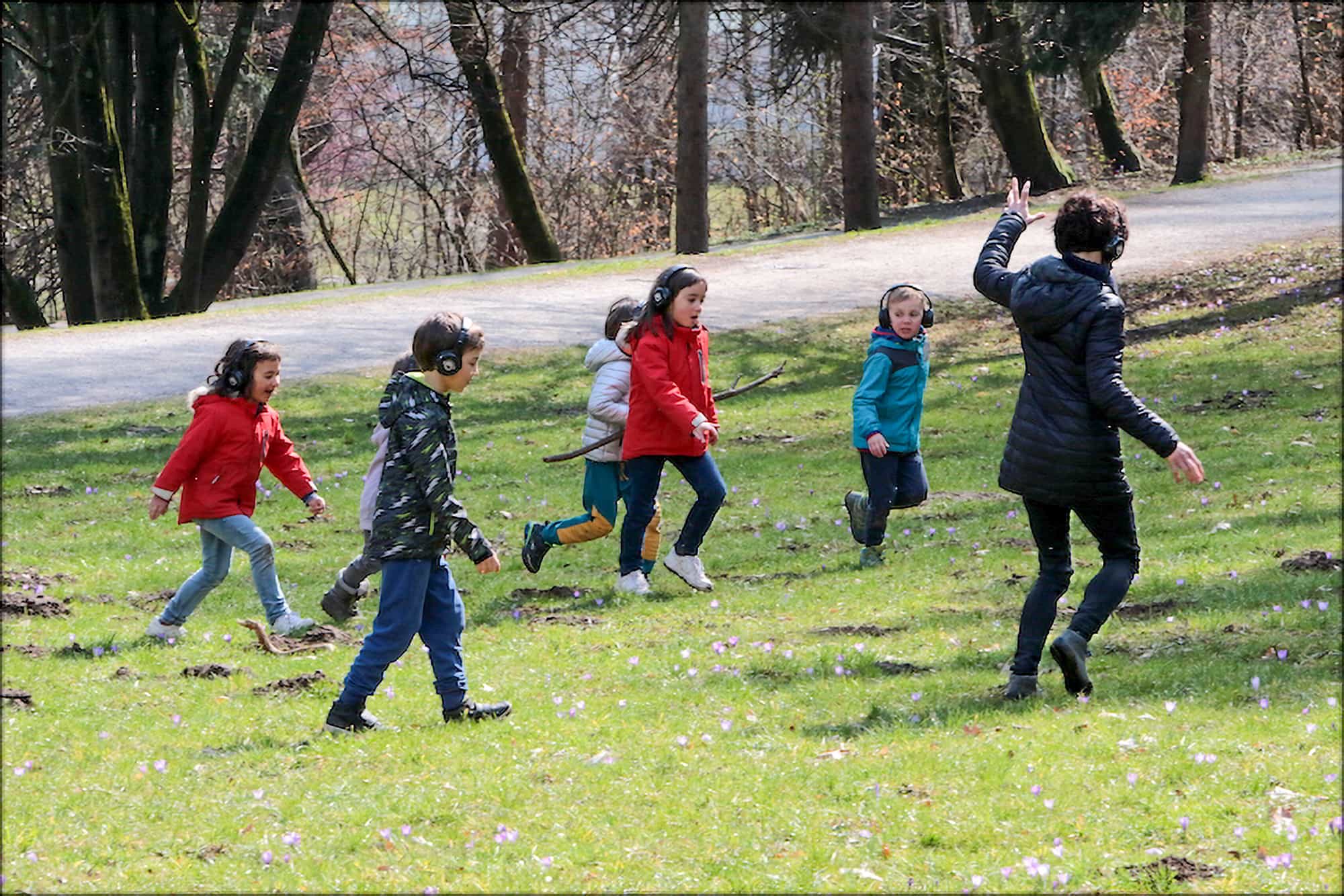
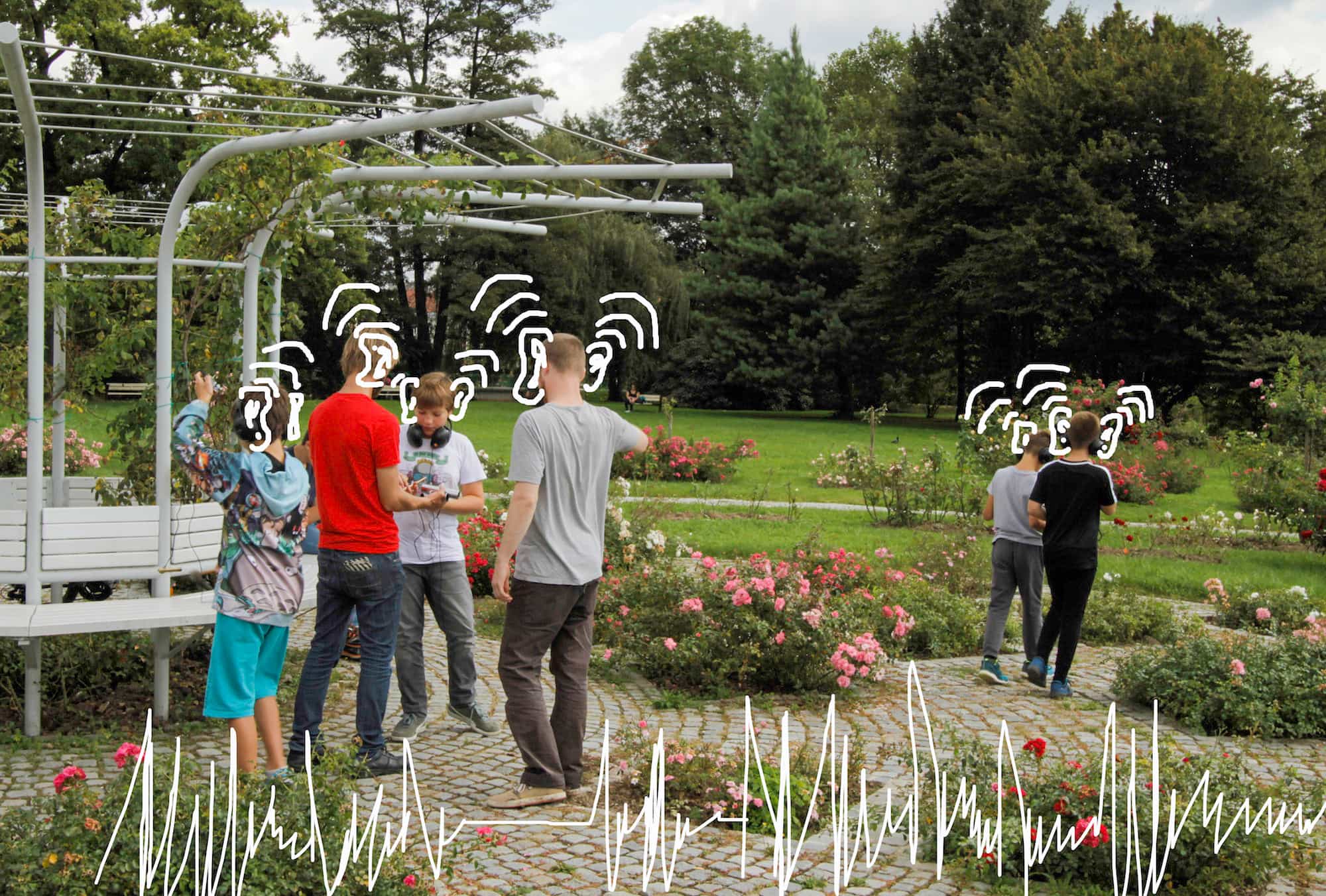
parkParty is an outdoor workshop where participants discover how contemporary artists observe and interpret nature through listening and guided movement in space. The workshop encourages community building, spatial awareness, and focused perception of sound.
The format uses a silent disco system: participants follow sound guidance through headphones while the mentor leads tasks and reflection through live microphone communication. Selected examples of sound artworks support the practical exploration process.
parkParty is an outdoor workshop where participants discover how contemporary artists observe and interpret nature through listening and guided movement in space. The workshop encourages community building, spatial awareness, and focused perception of sound.
The format uses a silent disco system: participants follow sound guidance through headphones while the mentor leads tasks and reflection through live microphone communication. Selected examples of sound artworks support the practical exploration process.
Tadeja Pungerčar
A sociologist and producer active in theatre, performative arts, and cultural-art education. As a long-time programme lead of the Bobri festival, she develops projects for children and young audiences across multiple art fields.
Barbara Kapelj
An independent cultural practitioner working as a set designer for film and theatre, and as an author of original projects and texts in the independent performing arts scene.
Kolofon / Colophon
Workshop creators and mentors: Tadeja Pungerčar, Barbara Kapelj Educational content coordinator: Irena Pivka Technical director: Brane Zorman Illustration: Nea Likar Photos: Sunčan Stone Production: Cona, Institute for Processing Contemporary Art, 2021
Part of the konS – Platform for Contemporary Research-based Art project. The investment is co-financed by the Republic of Slovenia and the European Union through the European Regional Development Fund.
In May and June 1968, France was struck by extensive civil unrest. With the Situationists as major protagonists, citizens revolted against the control exerted over public space by state power and capitalist structures. Public space was increasingly transformed into a spectacle dictating behaviour, consumption and perception.
To counter this, the Situationists introduced psychogeography and dérive as tools for reclaiming individual agency in navigating public space. Psychogeography refers to the emotional and behavioural impact of place, while dérive is a method of drifting through space guided by a series of small tasks that encourage observation, reflection and action.
The workshop combines historical and theoretical perspectives on Situationist practices with contemporary critiques of digital environments. Through the use of the award-winning Dérive app, participants collaboratively develop new task cards, expanding the application and making them available for global use.
In May and June 1968, France was struck by extensive civil unrest. With the Situationists as major protagonists, citizens revolted against the control exerted over public space by state power and capitalist structures. Public space was increasingly transformed into a spectacle dictating behaviour, consumption and perception.
To counter this, the Situationists introduced psychogeography and dérive as tools for reclaiming individual agency in navigating public space. Psychogeography refers to the emotional and behavioural impact of place, while dérive is a method of drifting through space guided by a series of small tasks that encourage observation, reflection and action.
The workshop combines historical and theoretical perspectives on Situationist practices with contemporary critiques of digital environments. Through the use of the award-winning Dérive app, participants collaboratively develop new task cards, expanding the application and making them available for global use.
Babak Fakhamzadeh
A developer, researcher and lecturer working at the intersection of technology, urban space and critical practice. His work focuses on creating digital tools that enable reflection on, and subversion of, dominant modes of navigating public and digital environments. He is the creator of the Dérive app.
Workshop and Dérive app development: Babak Fakhamzadeh Moderator: Babak Fakhamzadeh Speakers: John Wild, Cecilia Quiles, Michael Kwet, Anja Podreka Organization: Irena Pivka, Katarina Radaljac, Babak Fakhamzadeh Translation and editing: Melita Silič Cover photo: Babak Fakhamzadeh Production: walk · listen · create In collaboration with: Cona, Institute for Contemporary Arts Processing Part of the festival: Sound Walk City · prelude
Sound Walk City · prelude was initiated by the walk · listen · create platform, in collaboration with the Cona Institute. The Ljubljana edition is produced by the Cona Institute, Steklenik Gallery.
Cultural education, Workshop, Education, Arts and cultural education
parkParty is an outdoor workshop where participants discover how contemporary artists observe and interpret nature through listening and guided movement in space. The workshop encourages community building, spatial awareness, and focused perception of sound.
The format uses a silent disco system: participants follow sound guidance through headphones while the mentor leads tasks and reflection through live microphone communication. Selected examples of sound artworks support the practical exploration process.
parkParty is an outdoor workshop where participants discover how contemporary artists observe and interpret nature through listening and guided movement in space. The workshop encourages community building, spatial awareness, and focused perception of sound.
The format uses a silent disco system: participants follow sound guidance through headphones while the mentor leads tasks and reflection through live microphone communication. Selected examples of sound artworks support the practical exploration process.
Tadeja Pungerčar
A sociologist and producer active in theatre, performative arts, and cultural-art education. As a long-time programme lead of the Bobri festival, she develops projects for children and young audiences across multiple art fields.
Barbara Kapelj
An independent cultural practitioner working as a set designer for film and theatre, and as an author of original projects and texts in the independent performing arts scene.
Kolofon / Colophon
Workshop creators and mentors: Tadeja Pungerčar, Barbara Kapelj Educational content coordinator: Irena Pivka Technical director: Brane Zorman Illustration: Nea Likar Photos: Sunčan Stone Production: Cona, Institute for Processing Contemporary Art, 2021
Part of the konS – Platform for Contemporary Research-based Art project. The investment is co-financed by the Republic of Slovenia and the European Union through the European Regional Development Fund.
The work was created during the time of the epidemic when all public life had come to a standstill. As a result, the thick layer of the all-encompassing and constant noise disappeared, the existence of which we only really became aware of once it was gone. The authors captured this period, marked by weeks of silence and the gradual return of noise, with their recording equipment, walked paths and by discovering local microspaces. The result of their research is the existent locative performance, which, through the absence of noise, tells a tale of a future space. By using geolocation tools, the performance reflects on an experiential experience of landscape and sound and, in these complicated times, brings forth thoughts about the potential of a degraded space from the perspective of a society incapable of dialogue. The latter is using its last atoms of strength to depict dominance over the planet, while plants on the other side are blossoming, intertwining and even consoling, soothing, silencing and covering the all-pervasive species. The rhythm of walking, listening-in to the transitional space, a path that leads away from the overburdened city, and of listening to the degraded, waiting spaces, which are being taken back by nature, form the stance of this period of time … before it ends.
The work was created during the time of the epidemic when all public life had come to a standstill. As a result, the thick layer of the all-encompassing and constant noise disappeared, the existence of which we only really became aware of once it was gone. The authors captured this period, marked by weeks of silence and the gradual return of noise, with their recording equipment, walked paths and by discovering local microspaces. The result of their research is the existent locative performance, which, through the absence of noise, tells a tale of a future space. By using geolocation tools, the performance reflects on an experiential experience of landscape and sound and, in these complicated times, brings forth thoughts about the potential of a degraded space from the perspective of a society incapable of dialogue. The latter is using its last atoms of strength to depict dominance over the planet, while plants on the other side are blossoming, intertwining and even consoling, soothing, silencing and covering the all-pervasive species. The rhythm of walking, listening-in to the transitional space, a path that leads away from the overburdened city, and of listening to the degraded, waiting spaces, which are being taken back by nature, form the stance of this period of time … before it ends.
Irena Pivka
An artist, producer, architect and scenographer. In recent years she has primarily focused on artworks that shed light on the connection between place, sound, map and digital tools. Her evolving artistic expression is centered on sound-geolocation performances, which, with the help of location tools and created sound images, combine walking and listening.
Brane Zorman
A composer, sound and intermedia artist, sound manipulator, producer and curator. Besides composing for the theatre, intermedia and dance, he is focused on developing different strategies, techniques, dynamic and interactive models in his work on sound and space, recording and reinterpreting soundscapes and creating electronic and acoustic sound sculptures using sophisticated tools.
Kolofon / Colophon
Artists: Irena Pivka, Brane Zorman Translation and editing: Melita Silič Cover photo: Matjaž Rušt Production: Ljudmila, festival Is it working? In collaboration: Cona, Institute for Contemporary Arts Processing Part of the festival: Sound Walk City · prelude Part of the project: Acoustic Commons
Sound Walk City · prelude was initiated by the walk · listen · create platform, in collaboration with the Cona Institute. The Ljubljana edition is produced by the Cona Institute, Steklenik Gallery.
Cultural education, Workshop, Education, Arts and cultural education
The workshop introduces participants to animal sound worlds and encourages reflection on the differences between sonic communication and sonic creativity across species. It combines artistic and research perspectives while promoting active listening, curiosity, and critical thinking.
The format is an outdoor listening session using a silent disco system. Through headphones and live microphone guidance, participants follow structured listening tasks and collaborative exercises that support focused perception and discussion.
The workshop introduces participants to animal sound worlds and encourages reflection on the differences between sonic communication and sonic creativity across species. It combines artistic and research perspectives while promoting active listening, curiosity, and critical thinking.
The format is an outdoor listening session using a silent disco system. Through headphones and live microphone guidance, participants follow structured listening tasks and collaborative exercises that support focused perception and discussion.
Katarina Radaljac
A musicologist and researcher focused on the music of non-human animals and interspecies interaction. Her work bridges zoomusicology, applied ethnomusicology, interspecies art, human-animal studies, and animal ethics.
Uršek Slivšek
A psychologist with experience in research, pedagogy, and activism. He has worked with youth and academic organisations and led workshops for children with special needs and children from socially vulnerable backgrounds.
Kolofon / Colophon
Workshop creators and mentors: Katarina Radaljac, Uršek Slivšek Educational content coordinator: Irena Pivka Technical director: Brane Zorman Illustration: Nea Likar Photos: Sunčan Stone Cover photo: A. t Photography Production: Cona, Institute for Processing Contemporary Art, 2021
Within the konS – Platform for Contemporary Research-based Art project. The investment is co-financed by the Republic of Slovenia and the European Union through the European Regional Development Fund.
The urban sound walk along the Ljubljanica River takes the listener to the places of the river’s origin. The artist brings the resonant sound of karst water caves into the city centre – the sound of silence occasionally interrupted by drops percolating through limestone.
The Dark Drops project (2017–2021) gives voice to a place unfamiliar to the human ear. The artist visited several karst caves, and the sound recordings used in her 8-channel composition are mainly drawn from the Zelše Caves and Planina Cave, where the rivers Pivka, Rak and Unica form the Ljubljanica further downstream.
Resonating drops in the darkness of caves represent a condensed image of a complex and extreme environment still charged with mystery and unique beauty, where geological and biological time unfold at a different pace. The persistent sound of dripping water acts as a transmitter of information about living conditions in forests, fields, cities and grasslands, while also serving as nourishment for biological life and material for geological formations.
The sound walk was created during the process of developing a homonymous 8-channel sound installation for Steklenik Gallery.
The urban sound walk along the Ljubljanica River takes the listener to the places of the river’s origin. The artist brings the resonant sound of karst water caves into the city centre – the sound of silence occasionally interrupted by drops percolating through limestone.
The Dark Drops project (2017–2021) gives voice to a place unfamiliar to the human ear. The artist visited several karst caves, and the sound recordings used in her 8-channel composition are mainly drawn from the Zelše Caves and Planina Cave, where the rivers Pivka, Rak and Unica form the Ljubljanica further downstream.
Resonating drops in the darkness of caves represent a condensed image of a complex and extreme environment still charged with mystery and unique beauty, where geological and biological time unfold at a different pace. The persistent sound of dripping water acts as a transmitter of information about living conditions in forests, fields, cities and grasslands, while also serving as nourishment for biological life and material for geological formations.
The sound walk was created during the process of developing a homonymous 8-channel sound installation for Steklenik Gallery.
Robertina Šebjanič
An internationally acclaimed and award-winning intermedia artist whose work addresses philosophical questions at the intersection of art, technology and science. Her practice explores the cultural, biopolitical and ecological realities of aquatic environments and examines humanity’s impact on other species and the rights of non-human entities. In her analysis of the Anthropocene, she introduces the terms aquatocene and aquaforming.
Kolofon / Colophon
Artist: Robertina Šebjanič Photo: Miha Godec
Artist: Robertina Šebjanič Translation and editing: Melita Silič Cover photo: Miha Godec Production: Cona, Institute for Contemporary Arts Processing, 2021 Part of the festival: Sound Walk City · prelude
Sound Walk City · prelude was initiated by the walk · listen · create platform in collaboration with the Cona Institute. The Ljubljana edition is produced by the Cona Institute, Steklenik Gallery.
Cultural education, Workshop, Education, Arts and cultural education
The workshop introduces participants to animal sound worlds and encourages reflection on the differences between sonic communication and sonic creativity across species. It combines artistic and research perspectives while promoting active listening, curiosity, and critical thinking.
The format is an outdoor listening session using a silent disco system. Through headphones and live microphone guidance, participants follow structured listening tasks and collaborative exercises that support focused perception and discussion.
The workshop introduces participants to animal sound worlds and encourages reflection on the differences between sonic communication and sonic creativity across species. It combines artistic and research perspectives while promoting active listening, curiosity, and critical thinking.
The format is an outdoor listening session using a silent disco system. Through headphones and live microphone guidance, participants follow structured listening tasks and collaborative exercises that support focused perception and discussion.
Katarina Radaljac
A musicologist and researcher focused on the music of non-human animals and interspecies interaction. Her work bridges zoomusicology, applied ethnomusicology, interspecies art, human-animal studies, and animal ethics.
Uršek Slivšek
A psychologist with experience in research, pedagogy, and activism. He has worked with youth and academic organisations and led workshops for children with special needs and children from socially vulnerable backgrounds.
Kolofon / Colophon
Workshop creators and mentors: Katarina Radaljac, Uršek Slivšek Educational content coordinator: Irena Pivka Technical director: Brane Zorman Illustration: Nea Likar Photos: Sunčan Stone Cover photo: A. t Photography Production: Cona, Institute for Processing Contemporary Art, 2021
Within the konS – Platform for Contemporary Research-based Art project. The investment is co-financed by the Republic of Slovenia and the European Union through the European Regional Development Fund.
The 8-channel sound composition (dis)solutions II reflects on proximity between bodies through water. Our bodies are a myriad of things, composed of equal amounts of human cells and microorganisms, with 70% being water in constant exchange. Our cells change according to our surroundings, and in the quantum world we may even exist in several places at once. We are not stable.
The sound piece opens with a quote by Astrida Neimanis: “Everyone both lives in and is a drain.” In her work Bodies of Water, Neimanis writes: “As bodies of water, we leak and seethe, our borders always vulnerable to rupture and renegotiation,” connecting human bodies with worlds beyond the human.
Sound, omnipresent and ephemeral, physical yet intangible, powerfully represents this complex mesh of relations. It undulates through us and ricochets off our skin. We are in constant negotiation with other bodies, also through sound waves. The composition guides the listener through these encounters, from planetary to watery and microscopic scales.
The composition includes field recordings, hydrophone, electromagnetic and ultrasound recordings, as well as sounds of deep-sea hydrothermal vents, electromagnetic waves, rowing, underground sewer systems, rain, rivers and wind.
The 8-channel sound composition (dis)solutions II reflects on proximity between bodies through water. Our bodies are a myriad of things, composed of equal amounts of human cells and microorganisms, with 70% being water in constant exchange. Our cells change according to our surroundings, and in the quantum world we may even exist in several places at once. We are not stable.
The sound piece opens with a quote by Astrida Neimanis: “Everyone both lives in and is a drain.” In her work Bodies of Water, Neimanis writes: “As bodies of water, we leak and seethe, our borders always vulnerable to rupture and renegotiation,” connecting human bodies with worlds beyond the human.
Sound, omnipresent and ephemeral, physical yet intangible, powerfully represents this complex mesh of relations. It undulates through us and ricochets off our skin. We are in constant negotiation with other bodies, also through sound waves. The composition guides the listener through these encounters, from planetary to watery and microscopic scales.
The composition includes field recordings, hydrophone, electromagnetic and ultrasound recordings, as well as sounds of deep-sea hydrothermal vents, electromagnetic waves, rowing, underground sewer systems, rain, rivers and wind.
Anne Cecilie Lie
Artist and scenographer based in Oslo, Norway. Her practice spans sound, sculpture, bio-art, installations, video and text. She often develops projects in collaboration with other artists and through scientific research, working with educational institutions and local communities. In 2019, she received the first prize at the Sound Walk September festival.
Kolofon / Colophon
Artist: Anne Cecilie Lie Photo: Anne Cecilie Lie
Artist: Anne Cecilie Lie Organization: Irena Pivka, Katarina Radaljac Curator: Brane Zorman Public relations: Katarina Radaljac Translation and editing: Melita Silič Cover photo: Anne Cecilie Lie Production: Cona, Institute for Contemporary Arts Processing, 2021 Venues: Steklenik, Gallery for Sound, Bioacoustics and Art, Tivoli Park Partner: Studio Notam
The exhibition is part of the project Acoustic Commons, co-funded by the Creative Europe Programme of the European Union.
Earthling Gaia is a performance which through sound, walking and the inclusion of space aims at the sensibilization of young people and the promotion of outdoor activities. In addition to experiencing and reflecting on the ecology, it prompts the development of mindfulness.
From an indoor site, such as a theatre, cinema or gallery, the performance invites us outdoors, in the nature. A forest as a stage, and the audience trading comfortable chairs for walking shoes and heading off to the performance.
Some locations along the way are natural venues – natural auditoriums complete with architecturally superb observations posts, offering magnificent views of the landscape which intoxicates with its beauty and triggers imagination by constantly changing. We can imagine looking into the future, exploring possible scenarios for the days to come.
A dystopian story of Earthling Gaia recounts a possible future of the Lake Cerknica area. We experience the sound performance while walking a selected part of the Drvošec trail. We stop at the observation posts, observe the lake, experience the forest and, above all, listen. Earthling Gaia, a girl as a metaphor and the main character of the performance, will speculate on a potential scenario of the future of our overstrained planet which indisputably dictates the development of the local landscape.
Earthling Gaia is a performance which through sound, walking and the inclusion of space aims at the sensibilization of young people and the promotion of outdoor activities. In addition to experiencing and reflecting on the ecology, it prompts the development of mindfulness.
From an indoor site, such as a theatre, cinema or gallery, the performance invites us outdoors, in the nature. A forest as a stage, and the audience trading comfortable chairs for walking shoes and heading off to the performance.
Some locations along the way are natural venues – natural auditoriums complete with architecturally superb observations posts, offering magnificent views of the landscape which intoxicates with its beauty and triggers imagination by constantly changing. We can imagine looking into the future, exploring possible scenarios for the days to come.
A dystopian story of Earthling Gaia recounts a possible future of the Lake Cerknica area. We experience the sound performance while walking a selected part of the Drvošec trail. We stop at the observation posts, observe the lake, experience the forest and, above all, listen. Earthling Gaia, a girl as a metaphor and the main character of the performance, will speculate on a potential scenario of the future of our overstrained planet which indisputably dictates the development of the local landscape.
Irena Pivka
An artist, producer, architect and scenographer. In recent years she has primarily focused on artworks that shed light on the connection between place, sound, map and digital tools. Her evolving artistic expression is centered on sound-geolocation performances, which, with the help of location tools and created sound images, combine walking and listening.
Brane Zorman
A composer, sound and intermedia artist, sound manipulator, producer and curator. Besides composing for the theatre, intermedia and dance, he is focused on developing different strategies, techniques, dynamic and interactive models in his work on sound and space, recording and reinterpreting soundscapes and creating electronic and acoustic sound sculptures using sophisticated tools.
Kolofon / Colophon
Artists: Irena Pivka, Brane Zorman Text: Irena Pivka Musical composition: Brane Zorman Voice: Nada Vodušek, Anu Pivka Translation and proofreading: Melita Silič Photography: Irena Pivka Illustration: Jovana Dukić Headphone equipment: Tina Žen Production: KD Cerknica, 2021 and Notranjska Regional Park In collaboration with: Cona – Institute for Processing Contemporary Art, within the festival: Sound Walk City · prelude
The initiator of Sound Walk City · prelude is the platform walk · listen · create in collaboration with the Cona Institute. The producer of the festival in Ljubljana is the Cona Institute, Steklenik Gallery.
Sound artist Anne Cecilie Lie invites a discussion around sound walking in the Anthropocene. She raises questions about global technology and ecology and how they affect artistic practices working with locative technologies and smartphones. She is interested in the importance of other, non-human perspectives and senses of scale, as well as in avoiding the over-aestheticization of a “serene nature” as opposed to the chaotic, dark and grey nature of ecology of which humans and more-than-human beings alike are a part.
The discussion also addresses her 8-channel sound composition (dis)solutions II, created for Steklenik Gallery.
Sound artist Anne Cecilie Lie invites a discussion around sound walking in the Anthropocene. She raises questions about global technology and ecology and how they affect artistic practices working with locative technologies and smartphones. She is interested in the importance of other, non-human perspectives and senses of scale, as well as in avoiding the over-aestheticization of a “serene nature” as opposed to the chaotic, dark and grey nature of ecology of which humans and more-than-human beings alike are a part.
The discussion also addresses her 8-channel sound composition (dis)solutions II, created for Steklenik Gallery.
Anne Cecilie Lie
Artist and scenographer based in Oslo, Norway. Her practice spans sound, sculpture, bio-art, installations, video and text. She frequently develops projects in collaboration with other artists and through scientific research, working with educational institutions and local communities. In 2019, she received the first prize at the Sound Walk September festival.
Kolofon / Colophon
Artist: Anne Cecilie Lie Photo: Claudia Lucacel
Main speaker: Anne Cecilie Lie Moderator: Geert Vermeire Organization: Irena Pivka, Katarina Radaljac Cover photo: Claudia Lucacel Production: walk · listen · create In collaboration: Cona, Institute for Contemporary Arts Processing Part of the festival: Sound Walk City · prelude
Sound Walk City · prelude was initiated by the walk · listen · create platform in collaboration with the Cona Institute. The Ljubljana edition is produced by the Cona Institute, Steklenik Gallery.
Cultural education, Workshop, Education, Arts and cultural education
The workshop introduces participants to animal sound worlds and encourages reflection on the differences between sonic communication and sonic creativity across species. It combines artistic and research perspectives while promoting active listening, curiosity, and critical thinking.
The format is an outdoor listening session using a silent disco system. Through headphones and live microphone guidance, participants follow structured listening tasks and collaborative exercises that support focused perception and discussion.
The workshop introduces participants to animal sound worlds and encourages reflection on the differences between sonic communication and sonic creativity across species. It combines artistic and research perspectives while promoting active listening, curiosity, and critical thinking.
The format is an outdoor listening session using a silent disco system. Through headphones and live microphone guidance, participants follow structured listening tasks and collaborative exercises that support focused perception and discussion.
Katarina Radaljac
A musicologist and researcher focused on the music of non-human animals and interspecies interaction. Her work bridges zoomusicology, applied ethnomusicology, interspecies art, human-animal studies, and animal ethics.
Uršek Slivšek
A psychologist with experience in research, pedagogy, and activism. He has worked with youth and academic organisations and led workshops for children with special needs and children from socially vulnerable backgrounds.
Kolofon / Colophon
Workshop creators and mentors: Katarina Radaljac, Uršek Slivšek Educational content coordinator: Irena Pivka Technical director: Brane Zorman Illustration: Nea Likar Photos: Sunčan Stone Cover photo: A. t Photography Production: Cona, Institute for Processing Contemporary Art, 2021
Within the konS – Platform for Contemporary Research-based Art project. The investment is co-financed by the Republic of Slovenia and the European Union through the European Regional Development Fund.
Cultural education, Workshop, Education, Arts and cultural education
The workshop introduces participants to animal sound worlds and encourages reflection on the differences between sonic communication and sonic creativity across species. It combines artistic and research perspectives while promoting active listening, curiosity, and critical thinking.
The format is an outdoor listening session using a silent disco system. Through headphones and live microphone guidance, participants follow structured listening tasks and collaborative exercises that support focused perception and discussion.
The workshop introduces participants to animal sound worlds and encourages reflection on the differences between sonic communication and sonic creativity across species. It combines artistic and research perspectives while promoting active listening, curiosity, and critical thinking.
The format is an outdoor listening session using a silent disco system. Through headphones and live microphone guidance, participants follow structured listening tasks and collaborative exercises that support focused perception and discussion.
Katarina Radaljac
A musicologist and researcher focused on the music of non-human animals and interspecies interaction. Her work bridges zoomusicology, applied ethnomusicology, interspecies art, human-animal studies, and animal ethics.
Uršek Slivšek
A psychologist with experience in research, pedagogy, and activism. He has worked with youth and academic organisations and led workshops for children with special needs and children from socially vulnerable backgrounds.
Kolofon / Colophon
Workshop creators and mentors: Katarina Radaljac, Uršek Slivšek Educational content coordinator: Irena Pivka Technical director: Brane Zorman Illustration: Nea Likar Photos: Sunčan Stone Cover photo: A. t Photography Production: Cona, Institute for Processing Contemporary Art, 2021
Within the konS – Platform for Contemporary Research-based Art project. The investment is co-financed by the Republic of Slovenia and the European Union through the European Regional Development Fund.
Cultural education, Workshop, Education, Arts and cultural education
The workshop introduces participants to animal sound worlds and encourages reflection on the differences between sonic communication and sonic creativity across species. It combines artistic and research perspectives while promoting active listening, curiosity, and critical thinking.
The format is an outdoor listening session using a silent disco system. Through headphones and live microphone guidance, participants follow structured listening tasks and collaborative exercises that support focused perception and discussion.
The workshop introduces participants to animal sound worlds and encourages reflection on the differences between sonic communication and sonic creativity across species. It combines artistic and research perspectives while promoting active listening, curiosity, and critical thinking.
The format is an outdoor listening session using a silent disco system. Through headphones and live microphone guidance, participants follow structured listening tasks and collaborative exercises that support focused perception and discussion.
Katarina Radaljac
A musicologist and researcher focused on the music of non-human animals and interspecies interaction. Her work bridges zoomusicology, applied ethnomusicology, interspecies art, human-animal studies, and animal ethics.
Uršek Slivšek
A psychologist with experience in research, pedagogy, and activism. He has worked with youth and academic organisations and led workshops for children with special needs and children from socially vulnerable backgrounds.
Kolofon / Colophon
Workshop creators and mentors: Katarina Radaljac, Uršek Slivšek Educational content coordinator: Irena Pivka Technical director: Brane Zorman Illustration: Nea Likar Photos: Sunčan Stone Cover photo: A. t Photography Production: Cona, Institute for Processing Contemporary Art, 2021
Within the konS – Platform for Contemporary Research-based Art project. The investment is co-financed by the Republic of Slovenia and the European Union through the European Regional Development Fund.
Cultural education, Workshop, Education, Arts and cultural education
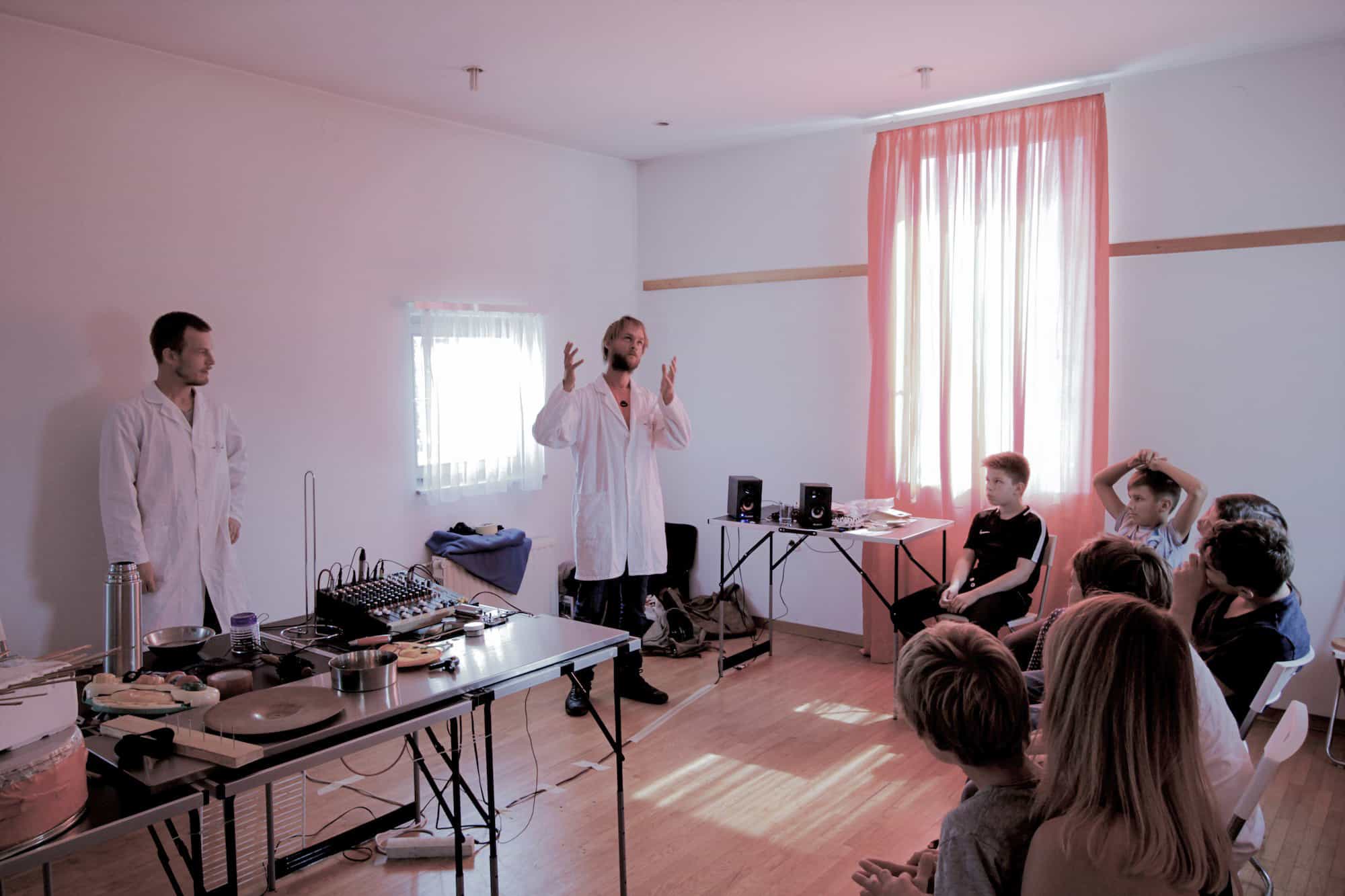
The Sound Microscope workshop is designed for children who want to explore sounds that usually remain unheard. Participants first learn basic principles of sound transmission and then test them through practical listening exercises and collaborative activities.
The mentors introduce both mechanical and digital versions of the sound microscope and demonstrate how contact microphones work. Participants build a simple mechanical device for amplifying quiet sounds and use it to discover hidden sonic details in their surroundings.
The Sound Microscope workshop is designed for children who want to explore sounds that usually remain unheard. Participants first learn basic principles of sound transmission and then test them through practical listening exercises and collaborative activities.
The mentors introduce both mechanical and digital versions of the sound microscope and demonstrate how contact microphones work. Participants build a simple mechanical device for amplifying quiet sounds and use it to discover hidden sonic details in their surroundings.
Andrej Fon
A Slovenian musician, multi-instrumentalist, author, and pedagogue. His practice spans improvised, experimental, folk, and authorial music, and includes educational workshop work with different age groups.
Staš Vrenko
A media artist, musician, and designer of electronic instruments. His artistic practice connects sound research, technology, kinetics, and performativity across solo and collaborative projects.
Kolofon / Colophon
Workshop creators and mentors: Andrej Fon, Staš Vrenko Educational content coordinator: Irena Pivka Technical director: Brane Zorman Technical support: RogLab (laser cutter) Production: Cona, 2019
The workshop is part of KONS: A Platform for Contemporary Research-based Art. The investment is co-financed by the Republic of Slovenia and the European Union through the European Regional Development Fund.
Ambisonic sound event and multi-channel sound installation
The Tree Spirits| Touch sound work reflects on the life of a tree, speculating on its acoustic component, and explores the interaction of an individual part of a plant with the colony of organisms and the forest biotic community. The sound recordings give voice to the existence of a tree in its annual and life cycles which begin and end in silence. The silence anticipating the springtime resurgence of sap flow, and the silence of destruction caused by climate change, drought, and fires. Brane Zorman is one of the three winners of Palma Ars Acoustica EBU competition 2022. You can read more about the conceptualization of work in the pdf notebook (link here) or buy printed verison of the booklet (here).
The artist zeros in on the touch; touch as an expression of genuine concern and awareness of the coexistence with plants, and a destructive touch of environmental devastation. The sounds of touching a tree trunk, branches rubbing against each other, the crushing of loose bark, the foliage, the rustling of trees in the wind, water drenching the roots – an acoustic journey through the physical existence of a tree. All the way to branch breaking, tree falling and a fire, a warning of the upcoming drought which is always a hard blow to a forest habitat.
Live Sound Event
Brane Zorman performs a live adaptation of Spirit of Trees | Touch, a work that evolved over two years in different phases and intensities. The performance employs spatial ambisonic technology and Silent Disco equipment, consisting of multiple micro FM transmitters and short-range headphones operating on various frequencies. The sound immerses the listener from all directions, creating an intense sonic experience where tones blend, shift, and reshape within a 360° spherical space. The ambisonic system allows the artist to manipulate spatial layers of sound while simultaneously transmitting them through conventional stereo headphones. Listening becomes a multi-dimensional experience, dissolving the boundaries between the audience and the sonic environment.
Art Installation
The installation demonstrates, investigates, and records the changes in the electrical conductivity, which are the result of the intensive drying process of the individual tree cookies (sliced portions of a tree trunk), converting the parameters – through heat, electrical and oscillation sensors, and converters – in the visual and acoustic forms. The cookies dry up and crack. They are colonised by microbes, mould, and fungi, and in the process of decomposition change their forms. Symbolically, these newly formed tree structures confront us with the shortage of water and moisture. The composition with the recorded and processed tree sounds, produced both within the organism as well as when touched by a human or the environment, builds an emotional and dramatic narrative charged with the natural and amplified sounds comingling and entwining. A dynamic 8-channel installation pulls the listener in the very centre of a sound happening.
Ambisonic sound event and multi-channel sound installation
The Tree Spirits| Touch sound work reflects on the life of a tree, speculating on its acoustic component, and explores the interaction of an individual part of a plant with the colony of organisms and the forest biotic community. The sound recordings give voice to the existence of a tree in its annual and life cycles which begin and end in silence. The silence anticipating the springtime resurgence of sap flow, and the silence of destruction caused by climate change, drought, and fires. Brane Zorman is one of the three winners of Palma Ars Acoustica EBU competition 2022. You can read more about the conceptualization of work in the pdf notebook (link here) or buy printed verison of the booklet (here).
The artist zeros in on the touch; touch as an expression of genuine concern and awareness of the coexistence with plants, and a destructive touch of environmental devastation. The sounds of touching a tree trunk, branches rubbing against each other, the crushing of loose bark, the foliage, the rustling of trees in the wind, water drenching the roots – an acoustic journey through the physical existence of a tree. All the way to branch breaking, tree falling and a fire, a warning of the upcoming drought which is always a hard blow to a forest habitat.
Live Sound Event
Brane Zorman performs a live adaptation of Spirit of Trees | Touch, a work that evolved over two years in different phases and intensities. The performance employs spatial ambisonic technology and Silent Disco equipment, consisting of multiple micro FM transmitters and short-range headphones operating on various frequencies. The sound immerses the listener from all directions, creating an intense sonic experience where tones blend, shift, and reshape within a 360° spherical space. The ambisonic system allows the artist to manipulate spatial layers of sound while simultaneously transmitting them through conventional stereo headphones. Listening becomes a multi-dimensional experience, dissolving the boundaries between the audience and the sonic environment.
Art Installation
The installation demonstrates, investigates, and records the changes in the electrical conductivity, which are the result of the intensive drying process of the individual tree cookies (sliced portions of a tree trunk), converting the parameters – through heat, electrical and oscillation sensors, and converters – in the visual and acoustic forms. The cookies dry up and crack. They are colonised by microbes, mould, and fungi, and in the process of decomposition change their forms. Symbolically, these newly formed tree structures confront us with the shortage of water and moisture. The composition with the recorded and processed tree sounds, produced both within the organism as well as when touched by a human or the environment, builds an emotional and dramatic narrative charged with the natural and amplified sounds comingling and entwining. A dynamic 8-channel installation pulls the listener in the very centre of a sound happening.
Brane Zorman
Composer, sound and intermedia artist, sound manipulator, producer and curator. Besides composing for the theatre, intermedia and dance, he is focused on developing different strategies, techniques, dynamic and interactive models in his work relating to sound and space, recording and reinterpreting soundscapes and creating electronic and acoustic sound sculptures using sophisticated tools.
Kolofon / Colophon
Artist: Brane Zorman Consulting: Valentina Cvetkovič, Boris Semenič Curated by: Irena Pivka Vibration sensor design: Gregor Krpič Fieldwork (Trzin): Morales d.o.o., Rok Rudigaj, Boštjan Divjak Translation and editing: Melita Silič Cover photo: Brane Zorman, Irena Pivka Event photo: Sunčan Stone Organisation: Irena Pivka Public relations: Matej Tomažin Production: Cona, zavod za procesiranje sodobne umetnosti, 2021 Locations: Steklenik, galerija za zvok, bioakustiko in umetnost, MGLC, Švicarija, Program Ars, Festival IZIS Partners: MGLC Švicarija Thanks: Zavod Kersnikova 4
Ambisonic sound event and multi-channel sound installation
The Tree Spirits| Touch sound work reflects on the life of a tree, speculating on its acoustic component, and explores the interaction of an individual part of a plant with the colony of organisms and the forest biotic community. The sound recordings give voice to the existence of a tree in its annual and life cycles which begin and end in silence. The silence anticipating the springtime resurgence of sap flow, and the silence of destruction caused by climate change, drought, and fires. Brane Zorman is one of the three winners of Palma Ars Acoustica EBU competition 2022. You can read more about the conceptualization of work in the pdf notebook (link here) or buy printed verison of the booklet (here).
The artist zeros in on the touch; touch as an expression of genuine concern and awareness of the coexistence with plants, and a destructive touch of environmental devastation. The sounds of touching a tree trunk, branches rubbing against each other, the crushing of loose bark, the foliage, the rustling of trees in the wind, water drenching the roots – an acoustic journey through the physical existence of a tree. All the way to branch breaking, tree falling and a fire, a warning of the upcoming drought which is always a hard blow to a forest habitat.
Live Sound Event
Brane Zorman performs a live adaptation of Spirit of Trees | Touch, a work that evolved over two years in different phases and intensities. The performance employs spatial ambisonic technology and Silent Disco equipment, consisting of multiple micro FM transmitters and short-range headphones operating on various frequencies. The sound immerses the listener from all directions, creating an intense sonic experience where tones blend, shift, and reshape within a 360° spherical space. The ambisonic system allows the artist to manipulate spatial layers of sound while simultaneously transmitting them through conventional stereo headphones. Listening becomes a multi-dimensional experience, dissolving the boundaries between the audience and the sonic environment.
Art Installation
The installation demonstrates, investigates, and records the changes in the electrical conductivity, which are the result of the intensive drying process of the individual tree cookies (sliced portions of a tree trunk), converting the parameters – through heat, electrical and oscillation sensors, and converters – in the visual and acoustic forms. The cookies dry up and crack. They are colonised by microbes, mould, and fungi, and in the process of decomposition change their forms. Symbolically, these newly formed tree structures confront us with the shortage of water and moisture. The composition with the recorded and processed tree sounds, produced both within the organism as well as when touched by a human or the environment, builds an emotional and dramatic narrative charged with the natural and amplified sounds comingling and entwining. A dynamic 8-channel installation pulls the listener in the very centre of a sound happening.
Ambisonic sound event and multi-channel sound installation
The Tree Spirits| Touch sound work reflects on the life of a tree, speculating on its acoustic component, and explores the interaction of an individual part of a plant with the colony of organisms and the forest biotic community. The sound recordings give voice to the existence of a tree in its annual and life cycles which begin and end in silence. The silence anticipating the springtime resurgence of sap flow, and the silence of destruction caused by climate change, drought, and fires. Brane Zorman is one of the three winners of Palma Ars Acoustica EBU competition 2022. You can read more about the conceptualization of work in the pdf notebook (link here) or buy printed verison of the booklet (here).
The artist zeros in on the touch; touch as an expression of genuine concern and awareness of the coexistence with plants, and a destructive touch of environmental devastation. The sounds of touching a tree trunk, branches rubbing against each other, the crushing of loose bark, the foliage, the rustling of trees in the wind, water drenching the roots – an acoustic journey through the physical existence of a tree. All the way to branch breaking, tree falling and a fire, a warning of the upcoming drought which is always a hard blow to a forest habitat.
Live Sound Event
Brane Zorman performs a live adaptation of Spirit of Trees | Touch, a work that evolved over two years in different phases and intensities. The performance employs spatial ambisonic technology and Silent Disco equipment, consisting of multiple micro FM transmitters and short-range headphones operating on various frequencies. The sound immerses the listener from all directions, creating an intense sonic experience where tones blend, shift, and reshape within a 360° spherical space. The ambisonic system allows the artist to manipulate spatial layers of sound while simultaneously transmitting them through conventional stereo headphones. Listening becomes a multi-dimensional experience, dissolving the boundaries between the audience and the sonic environment.
Art Installation
The installation demonstrates, investigates, and records the changes in the electrical conductivity, which are the result of the intensive drying process of the individual tree cookies (sliced portions of a tree trunk), converting the parameters – through heat, electrical and oscillation sensors, and converters – in the visual and acoustic forms. The cookies dry up and crack. They are colonised by microbes, mould, and fungi, and in the process of decomposition change their forms. Symbolically, these newly formed tree structures confront us with the shortage of water and moisture. The composition with the recorded and processed tree sounds, produced both within the organism as well as when touched by a human or the environment, builds an emotional and dramatic narrative charged with the natural and amplified sounds comingling and entwining. A dynamic 8-channel installation pulls the listener in the very centre of a sound happening.
Brane Zorman
Composer, sound and intermedia artist, sound manipulator, producer and curator. Besides composing for the theatre, intermedia and dance, he is focused on developing different strategies, techniques, dynamic and interactive models in his work relating to sound and space, recording and reinterpreting soundscapes and creating electronic and acoustic sound sculptures using sophisticated tools.
Kolofon / Colophon
Artist: Brane Zorman Consulting: Valentina Cvetkovič, Boris Semenič Curated by: Irena Pivka Vibration sensor design: Gregor Krpič Fieldwork (Trzin): Morales d.o.o., Rok Rudigaj, Boštjan Divjak Translation and editing: Melita Silič Cover photo: Brane Zorman, Irena Pivka Event photo: Sunčan Stone Organisation: Irena Pivka Public relations: Matej Tomažin Production: Cona, zavod za procesiranje sodobne umetnosti, 2021 Locations: Steklenik, galerija za zvok, bioakustiko in umetnost, MGLC, Švicarija, Program Ars, Festival IZIS Partners: MGLC Švicarija Thanks: Zavod Kersnikova 4
Cultural education, Workshop, Education, Arts and cultural education
parkParty is an outdoor workshop where participants discover how contemporary artists observe and interpret nature through listening and guided movement in space. The workshop encourages community building, spatial awareness, and focused perception of sound.
The format uses a silent disco system: participants follow sound guidance through headphones while the mentor leads tasks and reflection through live microphone communication. Selected examples of sound artworks support the practical exploration process.
parkParty is an outdoor workshop where participants discover how contemporary artists observe and interpret nature through listening and guided movement in space. The workshop encourages community building, spatial awareness, and focused perception of sound.
The format uses a silent disco system: participants follow sound guidance through headphones while the mentor leads tasks and reflection through live microphone communication. Selected examples of sound artworks support the practical exploration process.
Tadeja Pungerčar
A sociologist and producer active in theatre, performative arts, and cultural-art education. As a long-time programme lead of the Bobri festival, she develops projects for children and young audiences across multiple art fields.
Barbara Kapelj
An independent cultural practitioner working as a set designer for film and theatre, and as an author of original projects and texts in the independent performing arts scene.
Kolofon / Colophon
Workshop creators and mentors: Tadeja Pungerčar, Barbara Kapelj Educational content coordinator: Irena Pivka Technical director: Brane Zorman Illustration: Nea Likar Photos: Sunčan Stone Production: Cona, Institute for Processing Contemporary Art, 2021
Part of the konS – Platform for Contemporary Research-based Art project. The investment is co-financed by the Republic of Slovenia and the European Union through the European Regional Development Fund.
Interweaving Soundscapes is situated at the crossroads of science and art. Scientific research into animal vibrational signals, known as biotremology, is artistically compelling due to its sonic manifestation of animal activity, which through specific organisation of sound mass can also extend into the field of interspecies communication.
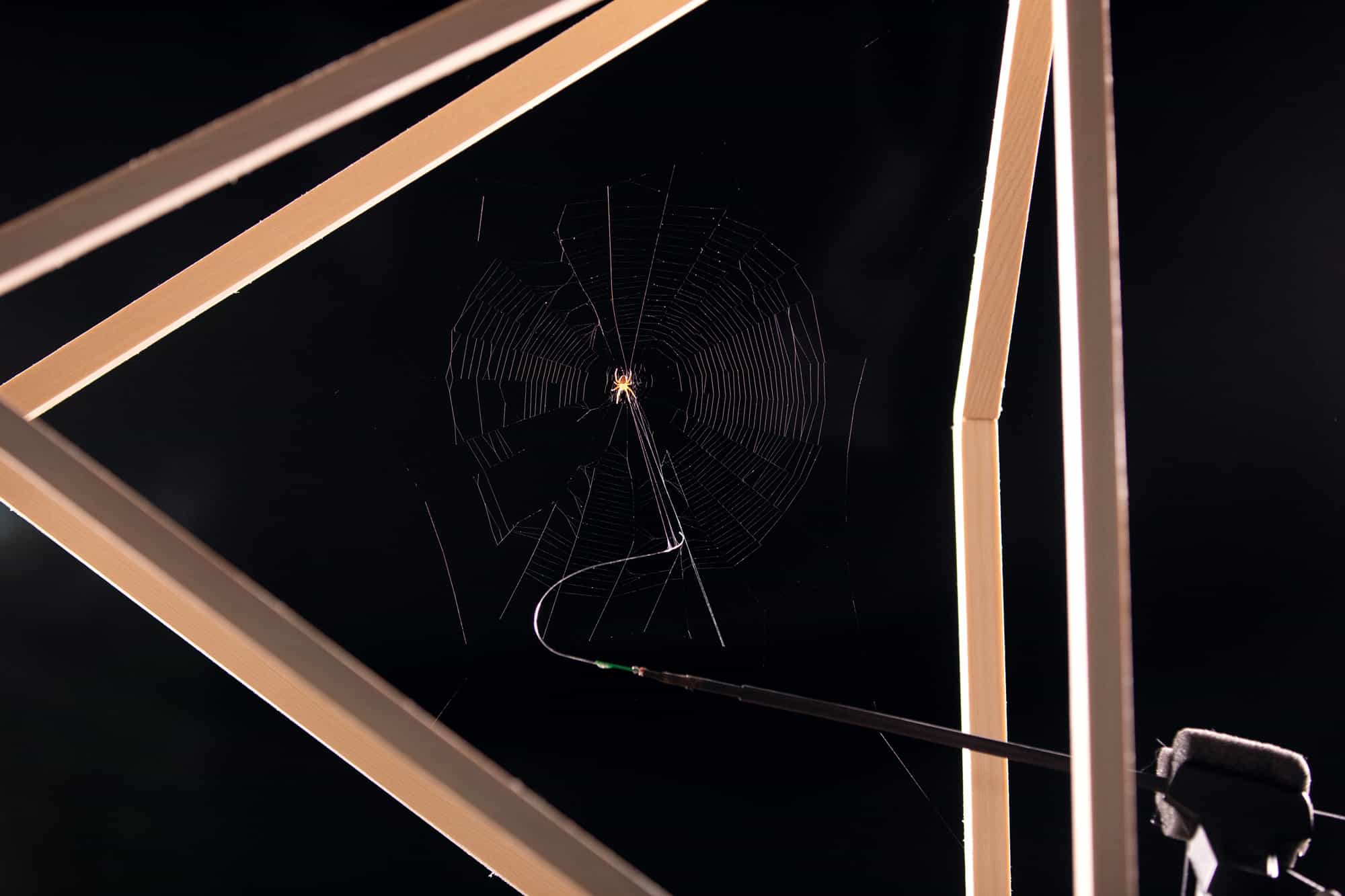
The exhibition presents two spiders of the species Araneus diadematus placed on a specially designed structure that forms the core of the installation. Spider webs function not only as traps but also as extensions of the spiders’ sensory systems. Vibrations transmitted through the web are inaudible to the human ear, yet the installation reveals this hidden sonic world.
The composition consists of raw recordings of insect and spider activity, later electronically processed. Most recordings were made in the studios of the Cona Institute and Boštjan Perovšek using custom-made piezo sensors. Selected recordings were produced at Tomás Saraceno’s studio and from Roland Mühlethaler’s private sound archive.
Interweaving Soundscapes is situated at the crossroads of science and art. Scientific research into animal vibrational signals, known as biotremology, is artistically compelling due to its sonic manifestation of animal activity, which through specific organisation of sound mass can also extend into the field of interspecies communication.
The exhibition presents two spiders of the species Araneus diadematus placed on a specially designed structure that forms the core of the installation. Spider webs function not only as traps but also as extensions of the spiders’ sensory systems. Vibrations transmitted through the web are inaudible to the human ear, yet the installation reveals this hidden sonic world.
The composition consists of raw recordings of insect and spider activity, later electronically processed. Most recordings were made in the studios of the Cona Institute and Boštjan Perovšek using custom-made piezo sensors. Selected recordings were produced at Tomás Saraceno’s studio and from Roland Mühlethaler’s private sound archive.
Boštjan Perovšek
Musician, composer and sound designer working in the field of experimental electroacoustic and bioacoustic music. His practice focuses on animal sounds, particularly insects, and extends to film, theatre, performance, multimedia installations and soundscapes for museums and galleries.
Roland Mühlethaler
An expert in vibrational communication of insects and spiders. His research centres on biotremology and the study of imperceptible communication systems in natural and urban environments.
Kolofon / Colophon
Artist: Boštjan Perovšek Scientist: Roland Mühlethaler PhD Spiders present at the exhibition: Araneus diadematus Artistic design of installation: Irena Pivka Video and photos: Miha Godec Curation and organisation: Irena Pivka, Brane Zorman Translation and editing: Katja Kosi Public relations: Katarina Radaljac Production: Cona, Institute for Contemporary Arts Processing, 2020 Venue: Steklenik, Gallery for Sound, Bioacoustics and Art
The installation was created within the project konS – Platform for Contemporary Investigative Art. The project was selected within the public call Network of Investigative Art and Culture Centres. The investment is co-financed by the Republic of Slovenia and the European Union through the European Regional Development Fund.
Soundwalk, Concert, Performance, Exhibition, Music, Visual arts
Interweaving Soundscapes is situated at the crossroads of science and art. Scientific research into animal vibrational signals, known as biotremology, is artistically compelling due to its sonic manifestation of animal activity, which through specific organisation of sound mass can also extend into the field of interspecies communication.
The exhibition presents two spiders of the species Araneus diadematus placed on a specially designed structure that forms the core of the installation. Spider webs function not only as traps but also as extensions of the spiders’ sensory systems. Vibrations transmitted through the web are inaudible to the human ear, yet the installation reveals this hidden sonic world.
The composition consists of raw recordings of insect and spider activity, later electronically processed. Most recordings were made in the studios of the Cona Institute and Boštjan Perovšek using custom-made piezo sensors. Selected recordings were produced at Tomás Saraceno’s studio and from Roland Mühlethaler’s private sound archive.
Interweaving Soundscapes is situated at the crossroads of science and art. Scientific research into animal vibrational signals, known as biotremology, is artistically compelling due to its sonic manifestation of animal activity, which through specific organisation of sound mass can also extend into the field of interspecies communication.
The exhibition presents two spiders of the species Araneus diadematus placed on a specially designed structure that forms the core of the installation. Spider webs function not only as traps but also as extensions of the spiders’ sensory systems. Vibrations transmitted through the web are inaudible to the human ear, yet the installation reveals this hidden sonic world.
The composition consists of raw recordings of insect and spider activity, later electronically processed. Most recordings were made in the studios of the Cona Institute and Boštjan Perovšek using custom-made piezo sensors. Selected recordings were produced at Tomás Saraceno’s studio and from Roland Mühlethaler’s private sound archive.
Boštjan Perovšek
Musician, composer and sound designer working in the field of experimental electroacoustic and bioacoustic music. His practice focuses on animal sounds, particularly insects, and extends to film, theatre, performance, multimedia installations and soundscapes for museums and galleries.
Roland Mühlethaler
An expert in vibrational communication of insects and spiders. His research centres on biotremology and the study of imperceptible communication systems in natural and urban environments.
Kolofon / Colophon
Artist: Boštjan Perovšek Scientist: Roland Mühlethaler PhD Spiders present at the exhibition: Araneus diadematus Artistic design of installation: Irena Pivka Video and photos: Miha Godec Curation and organisation: Irena Pivka, Brane Zorman Translation and editing: Katja Kosi Public relations: Katarina Radaljac Production: Cona, Institute for Contemporary Arts Processing, 2020 Venue: Steklenik, Gallery for Sound, Bioacoustics and Art
The installation was created within the project konS – Platform for Contemporary Investigative Art. The project was selected within the public call Network of Investigative Art and Culture Centres. The investment is co-financed by the Republic of Slovenia and the European Union through the European Regional Development Fund.
Guided tour, Concert, Exhibition, Music, Visual arts
Interweaving Soundscapes is situated at the crossroads of science and art. Scientific research into animal vibrational signals, known as biotremology, is artistically compelling due to its sonic manifestation of animal activity, which through specific organisation of sound mass can also extend into the field of interspecies communication.
The exhibition presents two spiders of the species Araneus diadematus placed on a specially designed structure that forms the core of the installation. Spider webs function not only as traps but also as extensions of the spiders’ sensory systems. Vibrations transmitted through the web are inaudible to the human ear, yet the installation reveals this hidden sonic world.
The composition consists of raw recordings of insect and spider activity, later electronically processed. Most recordings were made in the studios of the Cona Institute and Boštjan Perovšek using custom-made piezo sensors. Selected recordings were produced at Tomás Saraceno’s studio and from Roland Mühlethaler’s private sound archive.
Interweaving Soundscapes is situated at the crossroads of science and art. Scientific research into animal vibrational signals, known as biotremology, is artistically compelling due to its sonic manifestation of animal activity, which through specific organisation of sound mass can also extend into the field of interspecies communication.
The exhibition presents two spiders of the species Araneus diadematus placed on a specially designed structure that forms the core of the installation. Spider webs function not only as traps but also as extensions of the spiders’ sensory systems. Vibrations transmitted through the web are inaudible to the human ear, yet the installation reveals this hidden sonic world.
The composition consists of raw recordings of insect and spider activity, later electronically processed. Most recordings were made in the studios of the Cona Institute and Boštjan Perovšek using custom-made piezo sensors. Selected recordings were produced at Tomás Saraceno’s studio and from Roland Mühlethaler’s private sound archive.
Boštjan Perovšek
Musician, composer and sound designer working in the field of experimental electroacoustic and bioacoustic music. His practice focuses on animal sounds, particularly insects, and extends to film, theatre, performance, multimedia installations and soundscapes for museums and galleries.
Roland Mühlethaler
An expert in vibrational communication of insects and spiders. His research centres on biotremology and the study of imperceptible communication systems in natural and urban environments.
Kolofon / Colophon
Artist: Boštjan Perovšek Scientist: Roland Mühlethaler PhD Spiders present at the exhibition: Araneus diadematus Artistic design of installation: Irena Pivka Video and photos: Miha Godec Curation and organisation: Irena Pivka, Brane Zorman Translation and editing: Katja Kosi Public relations: Katarina Radaljac Production: Cona, Institute for Contemporary Arts Processing, 2020 Venue: Steklenik, Gallery for Sound, Bioacoustics and Art
The installation was created within the project konS – Platform for Contemporary Investigative Art. The project was selected within the public call Network of Investigative Art and Culture Centres. The investment is co-financed by the Republic of Slovenia and the European Union through the European Regional Development Fund.
Cultural education, Guided tour, Education, Arts and cultural education
Exploring Sounds is a children’s guided format focused on curiosity, active listening, and shared investigation of natural sound environments. Through guided questions and observation, participants become more attentive to sonic details that often go unnoticed.
The programme continues with a guided visit to Boštjan Perovšek’s sound exhibition Sound Intertwinings, combining experiential learning with contemporary sound art in a gallery context.
Exploring Sounds is a children’s guided format focused on curiosity, active listening, and shared investigation of natural sound environments. Through guided questions and observation, participants become more attentive to sonic details that often go unnoticed.
The programme continues with a guided visit to Boštjan Perovšek’s sound exhibition Sound Intertwinings, combining experiential learning with contemporary sound art in a gallery context.
Tadeja Pungerčar
Author and facilitator of children’s guided programmes at Steklenik and programme lead of the Bobri festival. Her practice connects cultural-art education, performative approaches, and work with young audiences.
Boštjan Perovšek
An artist, composer, and sound designer working in experimental electroacoustic and bioacoustic music. He creates work for film, theatre, installations, and sound-based exhibition formats.
Interweaving Soundscapes is situated at the crossroads of science and art. Scientific research into animal vibrational signals, known as biotremology, is artistically compelling due to its sonic manifestation of animal activity, which through specific organisation of sound mass can also extend into the field of interspecies communication.
The exhibition presents two spiders of the species Araneus diadematus placed on a specially designed structure that forms the core of the installation. Spider webs function not only as traps but also as extensions of the spiders’ sensory systems. Vibrations transmitted through the web are inaudible to the human ear, yet the installation reveals this hidden sonic world.
The composition consists of raw recordings of insect and spider activity, later electronically processed. Most recordings were made in the studios of the Cona Institute and Boštjan Perovšek using custom-made piezo sensors. Selected recordings were produced at Tomás Saraceno’s studio and from Roland Mühlethaler’s private sound archive.
Interweaving Soundscapes is situated at the crossroads of science and art. Scientific research into animal vibrational signals, known as biotremology, is artistically compelling due to its sonic manifestation of animal activity, which through specific organisation of sound mass can also extend into the field of interspecies communication.
The exhibition presents two spiders of the species Araneus diadematus placed on a specially designed structure that forms the core of the installation. Spider webs function not only as traps but also as extensions of the spiders’ sensory systems. Vibrations transmitted through the web are inaudible to the human ear, yet the installation reveals this hidden sonic world.
The composition consists of raw recordings of insect and spider activity, later electronically processed. Most recordings were made in the studios of the Cona Institute and Boštjan Perovšek using custom-made piezo sensors. Selected recordings were produced at Tomás Saraceno’s studio and from Roland Mühlethaler’s private sound archive.
Boštjan Perovšek
Musician, composer and sound designer working in the field of experimental electroacoustic and bioacoustic music. His practice focuses on animal sounds, particularly insects, and extends to film, theatre, performance, multimedia installations and soundscapes for museums and galleries.
Roland Mühlethaler
An expert in vibrational communication of insects and spiders. His research centres on biotremology and the study of imperceptible communication systems in natural and urban environments.
Kolofon / Colophon
Artist: Boštjan Perovšek Scientist: Roland Mühlethaler PhD Spiders present at the exhibition: Araneus diadematus Artistic design of installation: Irena Pivka Video and photos: Miha Godec Curation and organisation: Irena Pivka, Brane Zorman Translation and editing: Katja Kosi Public relations: Katarina Radaljac Production: Cona, Institute for Contemporary Arts Processing, 2020 Venue: Steklenik, Gallery for Sound, Bioacoustics and Art
The installation was created within the project konS – Platform for Contemporary Investigative Art. The project was selected within the public call Network of Investigative Art and Culture Centres. The investment is co-financed by the Republic of Slovenia and the European Union through the European Regional Development Fund.
Cultural education, Guided tour, Education, Arts and cultural education
The programme combines environmental listening with an introduction to electromagnetic sonorities accessed through simple technology-assisted exercises. Participants learn about differences between acoustic and electromagnetic wave phenomena through guided tasks, observation, and discussion.
The session continues with a guided tour of Luka Prinčič’s sound exhibition Rhizosphere. The format supports listening as a creative practice and introduces children to contemporary sound art.
The programme combines environmental listening with an introduction to electromagnetic sonorities accessed through simple technology-assisted exercises. Participants learn about differences between acoustic and electromagnetic wave phenomena through guided tasks, observation, and discussion.
The session continues with a guided tour of Luka Prinčič’s sound exhibition Rhizosphere. The format supports listening as a creative practice and introduces children to contemporary sound art.
Tadeja Pungerčar
Author and facilitator of children’s guided programmes at Steklenik and programme lead of the Bobri festival. Her work connects cultural-art education, performative methods, and audience development for young participants.
Luka Prinčič
A musician, performer, and media artist specialising in computer-based electronic and experimental music, immersive soundscapes, and artistic research in digital media.
Kolofon / Colophon
Guided programme concept and facilitation: Tadeja Pungerčar Exhibition: Luka Prinčič, Rhizosphere Supporting workshop methodology: Andrej Fon, Staš Vrenko Educational content coordinator: Irena Pivka Technical director: Brane Zorman Production: Cona, 2020
Within KONS: A Platform for Contemporary Research-based Art. The investment is co-financed by the Republic of Slovenia and the European Union through the European Regional Development Fund.
Cultural education, Workshop, Education, Arts and cultural education
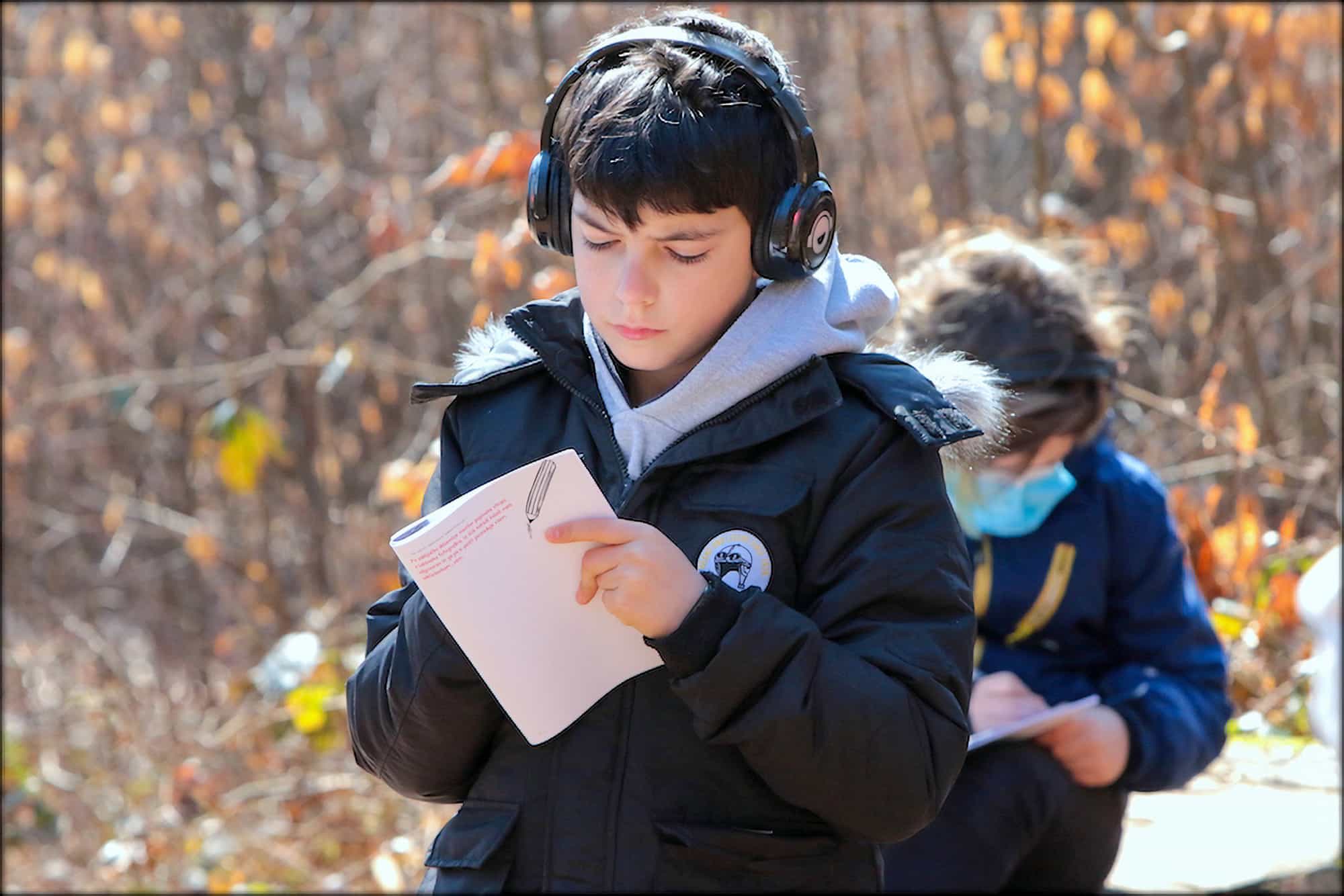
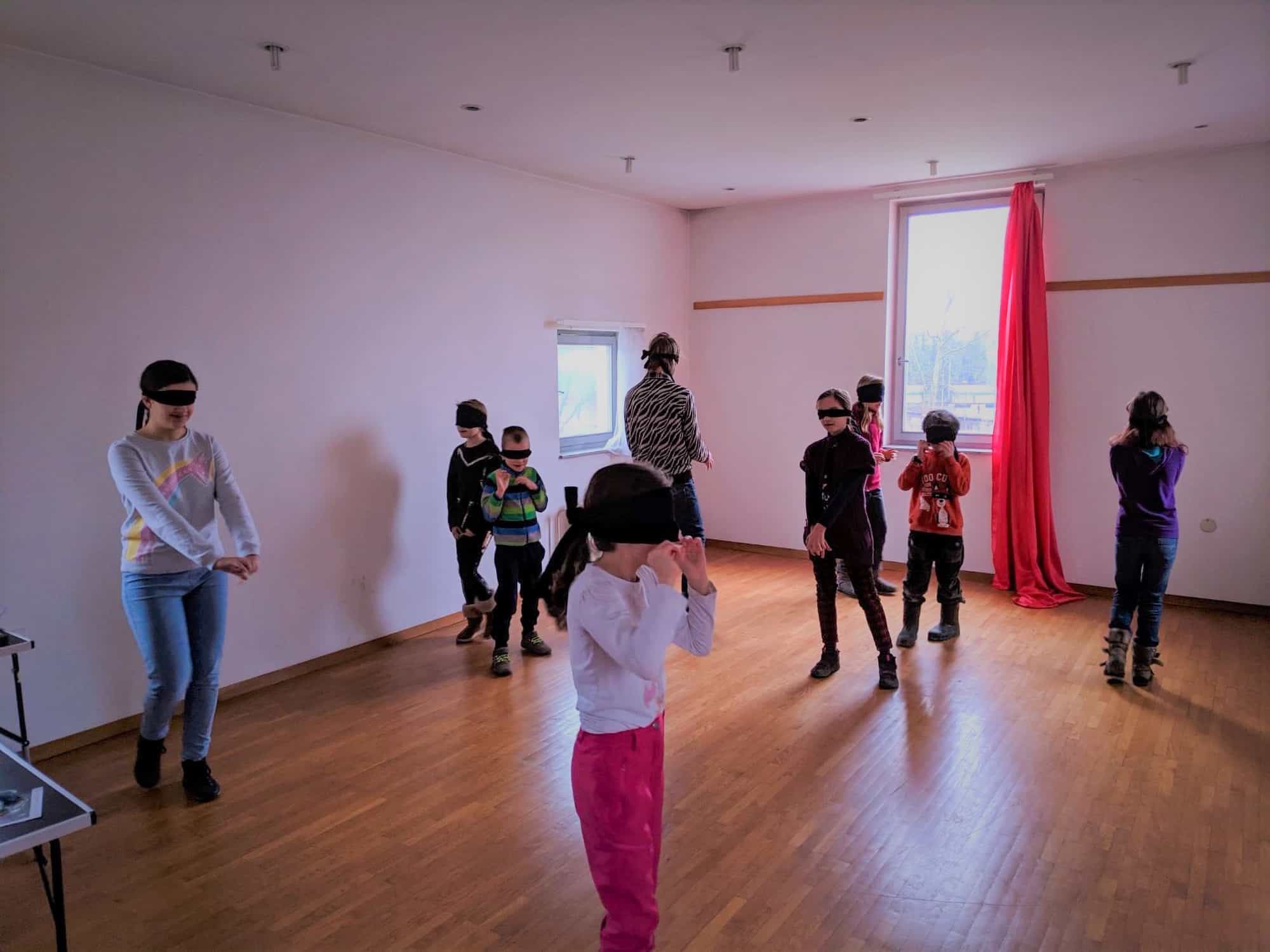
The Sound Walk workshop encourages children to listen attentively while moving through urban and natural environments. Participants are introduced to soundwalk practice and to practical aspects of echolocation used by certain animals and people.
Using binaural microphones and headphones, children perform tasks in pairs and small groups, test different microphone positions, and compare what they hear. The workshop also includes short improvised sonic actions in diverse acoustic spaces.
The Sound Walk workshop encourages children to listen attentively while moving through urban and natural environments. Participants are introduced to soundwalk practice and to practical aspects of echolocation used by certain animals and people.
Using binaural microphones and headphones, children perform tasks in pairs and small groups, test different microphone positions, and compare what they hear. The workshop also includes short improvised sonic actions in diverse acoustic spaces.
Andrej Fon
A Slovenian musician, multi-instrumentalist, author, and pedagogue. His work spans improvised, experimental, folk, and authorial music, and includes educational workshop practice.
Staš Vrenko
A media artist, musician, and electronic instrument designer whose practice connects sound research, electronic media, and performative formats.
Kolofon / Colophon
Workshop creators and mentors: Andrej Fon, Staš Vrenko Educational content coordinator: Irena Pivka Technical director: Brane Zorman Producer: Jasmina Založnik Photos: Sunčan Stone Production: Cona, 2020
The workshop was presented within the Bobri festival and alongside the opening of the exhibition Jata C: Bibaret JC210120.