How do we tune into the city? How do we recognise that the everyday soundscape of the city, enveloping us as we open a window or step onto the street, is in fact the longest and most enduring musical composition? How can we understand artistic practices of acoustic ecology and psychogeography that require active auditory awareness? How do we read and listen to such works, and how do we participate in them?
The educational programme unfolds alongside the TO)pot festival of radical soundwalks as a dedicated strand aimed at educating young people in auditory sensitisation and critical-poetic reflection. Participants listen to and document the festival programme, developing attentiveness and reflective awareness of the surrounding environment. The collective sound work produced by the participants is broadcast on Radio Študent.
Lectures within the workshop are given by Irena Pivka, Saška Rakef and Marta Medvešek.
How do we tune into the city? How do we recognise that the everyday soundscape of the city, enveloping us as we open a window or step onto the street, is in fact the longest and most enduring musical composition? How can we understand artistic practices of acoustic ecology and psychogeography that require active auditory awareness? How do we read and listen to such works, and how do we participate in them?
The educational programme unfolds alongside the TO)pot festival of radical soundwalks as a dedicated strand aimed at educating young people in auditory sensitisation and critical-poetic reflection. Participants listen to and document the festival programme, developing attentiveness and reflective awareness of the surrounding environment. The collective sound work produced by the participants is broadcast on Radio Študent.
Lectures within the workshop are given by Irena Pivka, Saška Rakef and Marta Medvešek.
Audio works by workshop participants:
Lucka Zajc: Dovolj_1
Filip Jelovšek: Topotornotopot
Naomi Uma Zorman: mal zadihi
Tadej Grum: Terapija za ušesa
Ana Lorger: Pasivistka
Veronika Rakovec: js pa ti feminist
Lara Slekovec: Restart
Sava šumi [Urška Savič]
A critic and journalist active in the field of cultural politics, also working as a photographer and radio artist. She completed her BA in Photography at FAMU Prague in 2014 and obtained her MA at the Department of Sculpture at the Academy of Fine Arts and Design, University of Ljubljana. As a self-employed cultural worker, she contributes to various publications, co-creates multimedia projects, is part of the editorial board of Fotografija magazine and teaches at the ALUO Photography Department. Between 2015 and 2019, she was an active user of the Autonomous Rog Factory.
Kolofon / Colophon
Author and workshop mentor: Urška Savič Lecturers: Irena Pivka, Saška Rakef, Marta Medvešek Photo: Matej Tomažin Workshop partner: Radio Študent
Have you ever been to the woods? I imagine you smiling slightly now, with a hint of sarcasm. “Of course,” you tell yourself. “What kind of question is that?!” But have you really? Have you been to a real forest? The kind you pay to enter?
Walking is never innocent. Walking shapes the landscape. It indulges the gaze. Walking is political. It creates realities depending on where we go, with whom, when, the weather, clothing, thoughts, feelings, health conditions, terrains, forms, plants, types of soil, moisture, and every other element you can think of.
Have you ever been to the woods? I imagine you smiling slightly now, with a hint of sarcasm. “Of course,” you tell yourself. “What kind of question is that?!” But have you really? Have you been to a real forest? The kind you pay to enter?
Walking is never innocent. Walking shapes the landscape. It indulges the gaze. Walking is political. It creates realities depending on where we go, with whom, when, the weather, clothing, thoughts, feelings, health conditions, terrains, forms, plants, types of soil, moisture, and every other element you can think of.
I lost myself in the woods. Come walk through me!
Tery Žeželj
She studied Dramaturgy and Performing Arts in Ljubljana and completed a master’s degree in Contemporary Theatre, Dance and Dramaturgy at Utrecht University. Her research interests lie at the intersection of feminism, ecology and performing arts. She is currently employed as an assistant researcher at the University of Nova Gorica.
Maria Magdalena Kozłowska
Singer, writer and theatre maker. Her performances and videos portray singing women and sonic utopias. She frequently collaborates with classical musicians and opera singers. Her research focuses on the entanglement of voice and landscape through temporary stages in nature and public spaces.
Kolofon / Colophon
Artists: Tery Žeželj, Maria Magdalena Kozłowska
Photo: Matej Tomažin
Sound design and music: Blaž Pavlica Producer: Maja Vižin Production: Bunker, Ljubljana, 2022
Supported by: Ministry of Culture of the Republic of Slovenia, ACT – Art, Climate, Transition, European Union – Creative Europe programme: Culture
If Trees Would Cry, We Would Cry Too is a soundwalk, a site-sensitive walking activation that recalibrates the mind and body and makes them receptive to perceiving agents that have not been mourned or are impossible to mourn. The walk honours the life of Pika, the artist’s family dog companion who passed away in May 2023. It is framed by an audio recording of a walk the artist and Pika first took together in April 2008.
The artist grieves. By repeatedly walking the route, she allows memories to surface.
In seeking answers to questions of what is considered worthy of mourning in our society, how we collectively confront ecological grief, and how we can mourn other bodies, the walk includes reflections shared by Lea Leskovec, a forester, who considers experiences of death in forest environments.
If Trees Would Cry, We Would Cry Too is a soundwalk, a site-sensitive walking activation that recalibrates the mind and body and makes them receptive to perceiving agents that have not been mourned or are impossible to mourn. The walk honours the life of Pika, the artist’s family dog companion who passed away in May 2023. It is framed by an audio recording of a walk the artist and Pika first took together in April 2008.
The artist grieves. By repeatedly walking the route, she allows memories to surface.
In seeking answers to questions of what is considered worthy of mourning in our society, how we collectively confront ecological grief, and how we can mourn other bodies, the walk includes reflections shared by Lea Leskovec, a forester, who considers experiences of death in forest environments.
Tery Žeželj
She studied Dramaturgy and Performing Arts in Ljubljana and Contemporary Theatre, Dance and Dramaturgy at Utrecht University. Her research interests lie at the intersection of feminism, ecology and performing arts. She is currently employed as an assistant researcher at the University of Nova Gorica.
Kolofon / Colophon
Artist: Tery Žeželj
Photo: Matej Tomažin
Soundwalk realised in collaboration with: Lea Leskovec Sound and technical support: Blaž Pavlica Producer: Maja Vižin Production: Bunker, Ljubljana, 2023
Supported by: Ministry of Culture RS, ACT – Art, Climate, Transition, EU – Creative Europe programme: Culture
The speculative story of the soundwalk performance garden GOround points to the problematic relationship between people and plants, which is geared to mainly benefit people. The colonialism itself and the human-mediated dispersal of plants capitalize on the subjection and exploitation of nature. It is vital to radically change this attitude if we want to deal effectively with the existential threat of ecological crisis and contemplate a brighter scenario for the future. To become more familiar with the world of plants, garden GOroundgoes into the temporal dimension. Through the prism of the journeys of these two utterly different temporalities of humans and plants, seemingly offering no possible point of encounter, it speculates on the development of a future solidarity-based coexistence of humans and plants. Plants, the most populous species on the planet, live at their own pace in their own time, walking the paths we cannot access. garden GOround will take us along the paths of a possible future scenario for our overstressed, noisy planet mirrored through the development of local greenways. Can we learn from plants to build a more solidarity-oriented future?
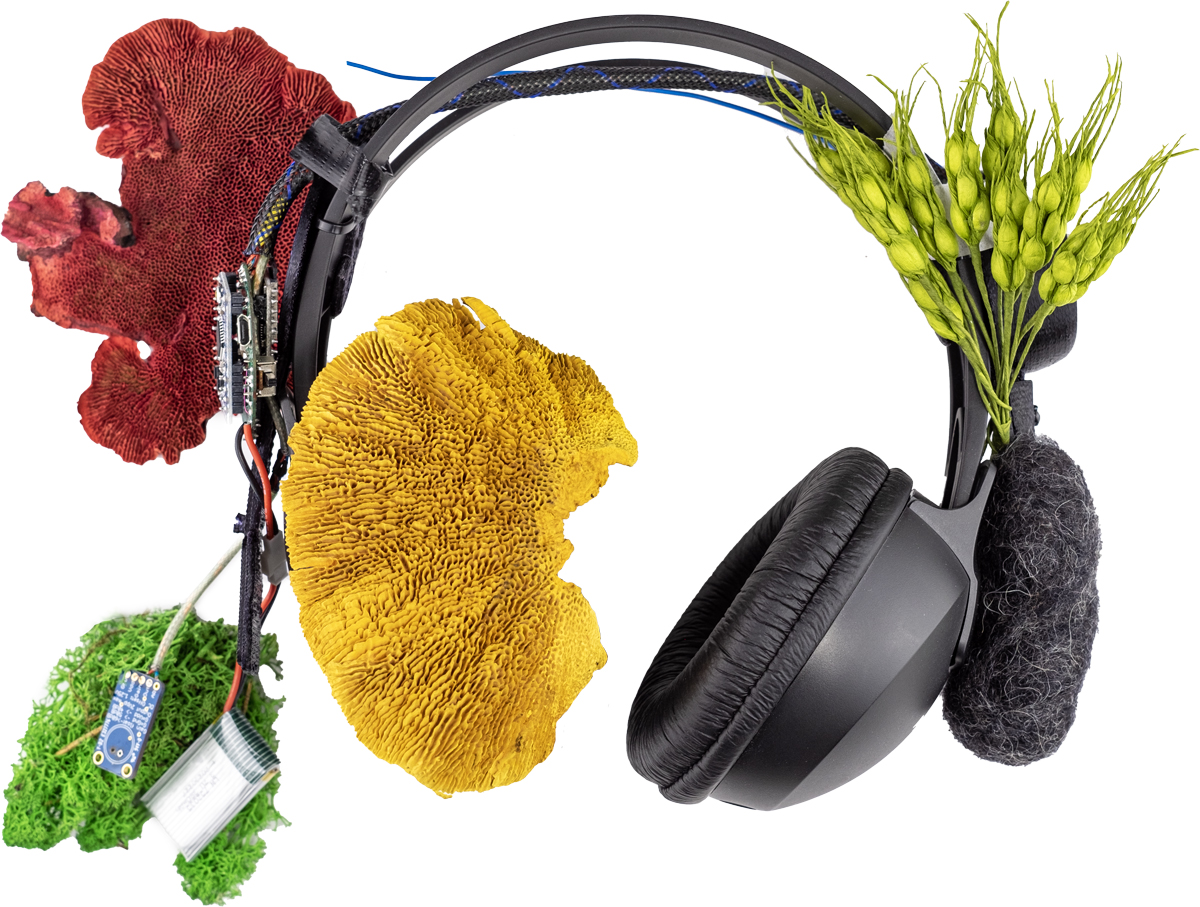
The audience experiences the soundwalk through specially developed headphones used as a tool to speculate the world and the sonic landscape of the future. The world is getting too loud and harmful for our sensitive ears, which have failed to adapt to aggressive frequencies. To survive outdoors, we will need headphones that will both mute and sharpen the sound image and, at the same time, take us into the acoustic narrative.
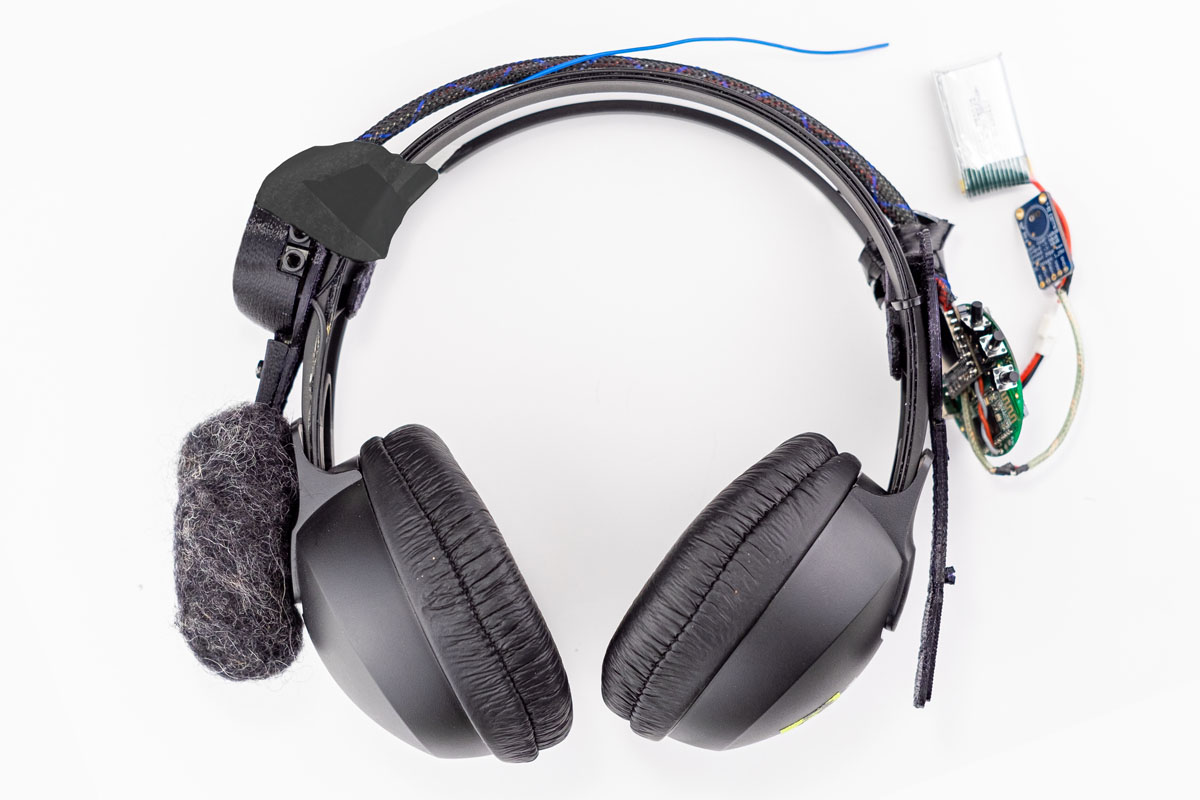
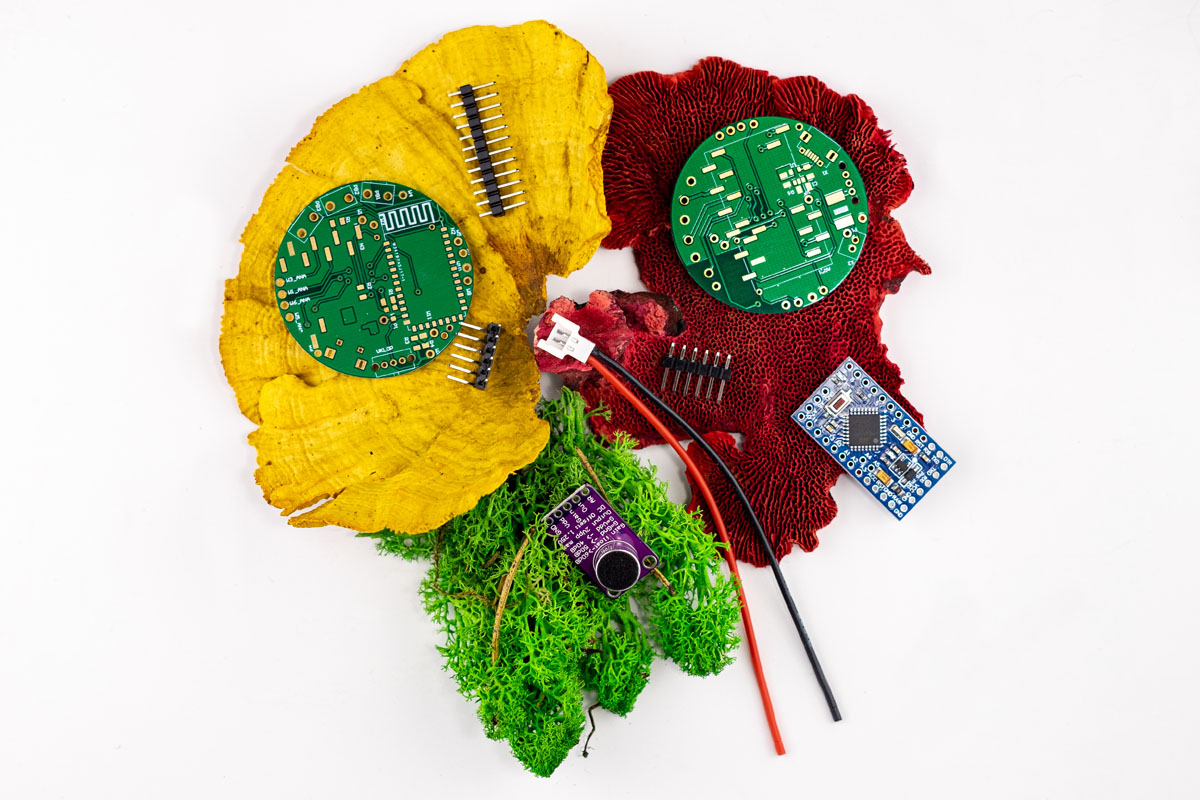
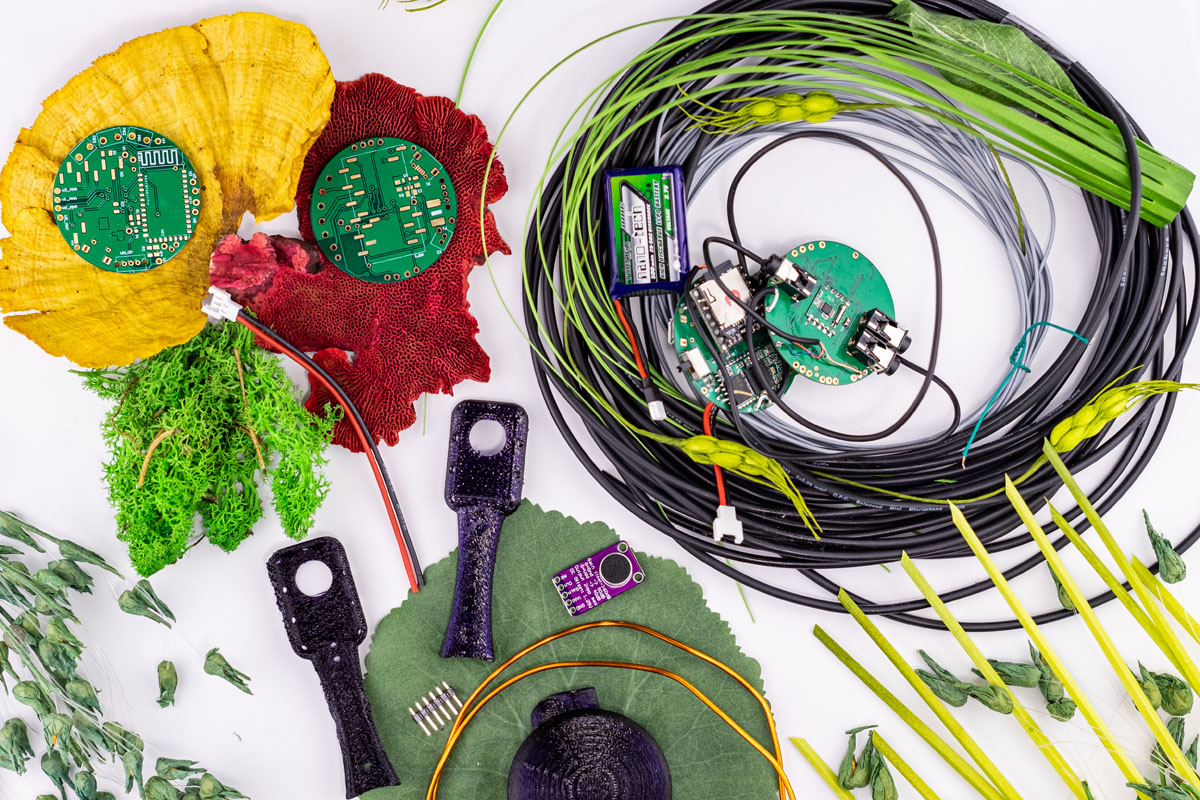
The soundwalk is broadcast on an AR (augmented reality) headset, the result of an innovativein-depth collaboration between the artist and hardware and software developers. The AR headset allows for simultaneous amplified, binaural ambient listening and audio co-composition. They also include an FM receiver module and an EMS sensor input.
The soundwalk path connects the Orangerie Park in Strasbourg and the Tivoli Park in Ljubljana, both designed during the reign of Napoleon. The featured photograph was taken in a disrupted avenue locked today between a road and a railway. It is part of a larger avenue complex in the Tivoli Park, designed by the French at the time of the Illyrian Provinces. The vocalist, dressed in a Slovene folk costume, wears original AR headphones and listens to the landscape.
A testimony form one of the participants of the AR soundwalk:
“Many thanks to the artists and the Apollonia team for this very inspiring “Sound Walk” in the Parc de l’Orangerie, so beautiful in this early spring. It was like being a little weightless. 45 minutes, with the boundaries between reality and fiction seemingly blurred.”
The speculative story of the soundwalk performance garden GOround points to the problematic relationship between people and plants, which is geared to mainly benefit people. The colonialism itself and the human-mediated dispersal of plants capitalize on the subjection and exploitation of nature. It is vital to radically change this attitude if we want to deal effectively with the existential threat of ecological crisis and contemplate a brighter scenario for the future. To become more familiar with the world of plants, garden GOroundgoes into the temporal dimension. Through the prism of the journeys of these two utterly different temporalities of humans and plants, seemingly offering no possible point of encounter, it speculates on the development of a future solidarity-based coexistence of humans and plants. Plants, the most populous species on the planet, live at their own pace in their own time, walking the paths we cannot access. garden GOround will take us along the paths of a possible future scenario for our overstressed, noisy planet mirrored through the development of local greenways. Can we learn from plants to build a more solidarity-oriented future?
The audience experiences the soundwalk through specially developed headphones used as a tool to speculate the world and the sonic landscape of the future. The world is getting too loud and harmful for our sensitive ears, which have failed to adapt to aggressive frequencies. To survive outdoors, we will need headphones that will both mute and sharpen the sound image and, at the same time, take us into the acoustic narrative.
The soundwalk is broadcast on an AR (augmented reality) headset, the result of an innovativein-depth collaboration between the artist and hardware and software developers. The AR headset allows for simultaneous amplified, binaural ambient listening and audio co-composition. They also include an FM receiver module and an EMS sensor input.
The soundwalk path connects the Orangerie Park in Strasbourg and the Tivoli Park in Ljubljana, both designed during the reign of Napoleon. The featured photograph was taken in a disrupted avenue locked today between a road and a railway. It is part of a larger avenue complex in the Tivoli Park, designed by the French at the time of the Illyrian Provinces. The vocalist, dressed in a Slovene folk costume, wears original AR headphones and listens to the landscape.
A testimony form one of the participants of the AR soundwalk:
“Many thanks to the artists and the Apollonia team for this very inspiring “Sound Walk” in the Parc de l’Orangerie, so beautiful in this early spring. It was like being a little weightless. 45 minutes, with the boundaries between reality and fiction seemingly blurred.”
AUTHOR-DESIGNED AR TECHNOLOGY
The audience experiences the sound work through specially developed author-designed AR headphones, which function as an artistic-technological interface between the listener, the space, and the composition. The headphones are conceived as a speculative tool that reflects on future auditory landscapes and possible modes of orientation within acoustically overloaded environments. They are based on the premise that contemporary sonic space is increasingly shaped by noise, frequency saturation, and aggressive acoustic pressures, as a result of which listening is becoming ever more a matter of perception, protection, and selection.
The AR headphones are the result of an in-depth collaboration between the artists and hardware and software developers. Their design enables the simultaneous binaural listening of the immediate surroundings and the playback of a sound composition, thereby creating a layered and dynamic sonic situation in which real acoustic space interweaves with an artificially generated or transmitted sonic narrative. A key feature of the system is that it does not exclude the surrounding environment, but rather acoustically modulates, filters, and accentuates it, so that listening is not separated from space, but remains actively embedded within it.
The headphones include an FM receiver module, which enables the wireless transmission and reception of audio signals, as well as an input for an EMS sensor, through which the system can also be connected to biometric or bodily impulses. The device therefore functions not merely as a playback unit, but as an expanded listening apparatus that combines environmental perception, technological mediation, and compositional layering into a unified listening experience. In this sense, the work addresses not only the future of sound, but also the future of listening as a technologically supported, situated, and selective practice.
Irena Pivka
An artist and producer. She works in the areas of new media, sound and performance arts. In recent years, she has been focusing her artistic expressions on the preparations of sound-walk performances, co-authored by Brane Zorman, which, by means of transmission tools and sound pictures, through walking and listening establish space anew and reflect social reality.
Brane Zorman
A composer, sound and radio artist. His work explores the possibilities of processing, presenting, perceiving, understanding, positioning and reinterpreting sound, space and ecology. By employing analogue and digital technologies and techniques, his work traverses the fields of music, multimedia, and visual space, using both sophisticated and simple tools, strategies, methods, and interactive interpretation models, soundscapes, evolving electronic and acoustic sound sculptures.
Kolofon / Colophon
Concept, text and headphones design: Irena Pivka Sound composition and editing, sensorial headset concept: Brane Zorman Vocal: Alja Petric Voices: Lučka Počkaj, Alja Petric, Toni Cahunek (Slovene)Jana Wilcoxen, Alja Petric, Toni Cahunek (English)Nataša Živkovič, Suzana Koncut, Loup Abramovici (French) Proofreading, English translation: Melita Silič English editing and proofreading: Jana Wilcoxen French translation: Anne-Cécile Lamy-Joswiak French editing: Suzana KoncutPhotography, design: Matej Tomažin Illustration: Jovana DjukićHardware and software development and testing, android application: Brane Ždralo PCB printing, electronics assembling: Zdravko Janšovec Electronics assembling: Ivan Kvasič 3D printing: Cveto Kunešević, 3Dimension Headphones assembling: Staš VrenkoProduced by CONA, 2023
VITAL creates an innovative ecosystem that respects the environment and, through art, participates in the fight against global warming and air pollution.
VITAL is co-funded by the Creative Europe programme by the three-year “Strasbourg European Capital” Contract and supported by the Ministry of Public Administration of the Republic of Slovenia and the City of Ljubljana, Departmen of Culture.
Text sources:
Gray, Ros and Sheikh, Shela (ed.). “The Wretched Earth: Botanical Conflicts and Artistic Interventions”. Third Text32(2–3).Kunst, Bojana. “Rastlinsko življenje in prostori umetnosti: o nedostopnem in vzajemnem”. Ana Mizerit (ed.). Zasilni izhod [Exhibition catalogue]. Ljubljana: Moderna galerija, 2022.Thorsen, Line Marie (ed.). Moving Plants. Rønnebæksholm, Næstved: Narayana Press, 2017.Sagan, Dorion. “The Human is More than Human: Interspecies Communities and the New “Facts of Life”.” Theorizing the Contemporary. Fieldsights, 18 Nov 2011.Raja, Vicente. “Moving the Green: Plant Behavior in the Human World“. EuropeNow 45, Nov 2021.Sidebottom, Kay. “Education for a More-Than-Human World”. EuropeNow 45, Nov 2021.Marder, Michael. “Resist Like a Plant! On the Vegetal Life of Political Movements“. Peace Studies Journal 5(1), Jan 2012.Brkič, Vanja. “Mestni park Tivoli: Tivolski drevoredi so bili Ljubljančanom od nekdaj v ponos“. Dnevnik, 10 Oct 2015.Strasbourg Park, https://data.strasbourg.eu/explore/dataset/lieux_arbres-remarquables/table/
The speculative story of the soundwalk performance garden GOround points to the problematic relationship between people and plants, which is geared to mainly benefit people. The colonialism itself and the human-mediated dispersal of plants capitalize on the subjection and exploitation of nature. It is vital to radically change this attitude if we want to deal effectively with the existential threat of ecological crisis and contemplate a brighter scenario for the future. To become more familiar with the world of plants, garden GOroundgoes into the temporal dimension. Through the prism of the journeys of these two utterly different temporalities of humans and plants, seemingly offering no possible point of encounter, it speculates on the development of a future solidarity-based coexistence of humans and plants. Plants, the most populous species on the planet, live at their own pace in their own time, walking the paths we cannot access. garden GOround will take us along the paths of a possible future scenario for our overstressed, noisy planet mirrored through the development of local greenways. Can we learn from plants to build a more solidarity-oriented future?
The audience experiences the soundwalk through specially developed headphones used as a tool to speculate the world and the sonic landscape of the future. The world is getting too loud and harmful for our sensitive ears, which have failed to adapt to aggressive frequencies. To survive outdoors, we will need headphones that will both mute and sharpen the sound image and, at the same time, take us into the acoustic narrative.
The soundwalk is broadcast on an AR (augmented reality) headset, the result of an innovativein-depth collaboration between the artist and hardware and software developers. The AR headset allows for simultaneous amplified, binaural ambient listening and audio co-composition. They also include an FM receiver module and an EMS sensor input.
The soundwalk path connects the Orangerie Park in Strasbourg and the Tivoli Park in Ljubljana, both designed during the reign of Napoleon. The featured photograph was taken in a disrupted avenue locked today between a road and a railway. It is part of a larger avenue complex in the Tivoli Park, designed by the French at the time of the Illyrian Provinces. The vocalist, dressed in a Slovene folk costume, wears original AR headphones and listens to the landscape.
A testimony form one of the participants of the AR soundwalk:
“Many thanks to the artists and the Apollonia team for this very inspiring “Sound Walk” in the Parc de l’Orangerie, so beautiful in this early spring. It was like being a little weightless. 45 minutes, with the boundaries between reality and fiction seemingly blurred.”
The speculative story of the soundwalk performance garden GOround points to the problematic relationship between people and plants, which is geared to mainly benefit people. The colonialism itself and the human-mediated dispersal of plants capitalize on the subjection and exploitation of nature. It is vital to radically change this attitude if we want to deal effectively with the existential threat of ecological crisis and contemplate a brighter scenario for the future. To become more familiar with the world of plants, garden GOroundgoes into the temporal dimension. Through the prism of the journeys of these two utterly different temporalities of humans and plants, seemingly offering no possible point of encounter, it speculates on the development of a future solidarity-based coexistence of humans and plants. Plants, the most populous species on the planet, live at their own pace in their own time, walking the paths we cannot access. garden GOround will take us along the paths of a possible future scenario for our overstressed, noisy planet mirrored through the development of local greenways. Can we learn from plants to build a more solidarity-oriented future?
The audience experiences the soundwalk through specially developed headphones used as a tool to speculate the world and the sonic landscape of the future. The world is getting too loud and harmful for our sensitive ears, which have failed to adapt to aggressive frequencies. To survive outdoors, we will need headphones that will both mute and sharpen the sound image and, at the same time, take us into the acoustic narrative.
The soundwalk is broadcast on an AR (augmented reality) headset, the result of an innovativein-depth collaboration between the artist and hardware and software developers. The AR headset allows for simultaneous amplified, binaural ambient listening and audio co-composition. They also include an FM receiver module and an EMS sensor input.
The soundwalk path connects the Orangerie Park in Strasbourg and the Tivoli Park in Ljubljana, both designed during the reign of Napoleon. The featured photograph was taken in a disrupted avenue locked today between a road and a railway. It is part of a larger avenue complex in the Tivoli Park, designed by the French at the time of the Illyrian Provinces. The vocalist, dressed in a Slovene folk costume, wears original AR headphones and listens to the landscape.
A testimony form one of the participants of the AR soundwalk:
“Many thanks to the artists and the Apollonia team for this very inspiring “Sound Walk” in the Parc de l’Orangerie, so beautiful in this early spring. It was like being a little weightless. 45 minutes, with the boundaries between reality and fiction seemingly blurred.”
AUTHOR-DESIGNED AR TECHNOLOGY
The audience experiences the sound work through specially developed author-designed AR headphones, which function as an artistic-technological interface between the listener, the space, and the composition. The headphones are conceived as a speculative tool that reflects on future auditory landscapes and possible modes of orientation within acoustically overloaded environments. They are based on the premise that contemporary sonic space is increasingly shaped by noise, frequency saturation, and aggressive acoustic pressures, as a result of which listening is becoming ever more a matter of perception, protection, and selection.
The AR headphones are the result of an in-depth collaboration between the artists and hardware and software developers. Their design enables the simultaneous binaural listening of the immediate surroundings and the playback of a sound composition, thereby creating a layered and dynamic sonic situation in which real acoustic space interweaves with an artificially generated or transmitted sonic narrative. A key feature of the system is that it does not exclude the surrounding environment, but rather acoustically modulates, filters, and accentuates it, so that listening is not separated from space, but remains actively embedded within it.
The headphones include an FM receiver module, which enables the wireless transmission and reception of audio signals, as well as an input for an EMS sensor, through which the system can also be connected to biometric or bodily impulses. The device therefore functions not merely as a playback unit, but as an expanded listening apparatus that combines environmental perception, technological mediation, and compositional layering into a unified listening experience. In this sense, the work addresses not only the future of sound, but also the future of listening as a technologically supported, situated, and selective practice.
Irena Pivka
An artist and producer. She works in the areas of new media, sound and performance arts. In recent years, she has been focusing her artistic expressions on the preparations of sound-walk performances, co-authored by Brane Zorman, which, by means of transmission tools and sound pictures, through walking and listening establish space anew and reflect social reality.
Brane Zorman
A composer, sound and radio artist. His work explores the possibilities of processing, presenting, perceiving, understanding, positioning and reinterpreting sound, space and ecology. By employing analogue and digital technologies and techniques, his work traverses the fields of music, multimedia, and visual space, using both sophisticated and simple tools, strategies, methods, and interactive interpretation models, soundscapes, evolving electronic and acoustic sound sculptures.
Kolofon / Colophon
Concept, text and headphones design: Irena Pivka Sound composition and editing, sensorial headset concept: Brane Zorman Vocal: Alja Petric Voices: Lučka Počkaj, Alja Petric, Toni Cahunek (Slovene)Jana Wilcoxen, Alja Petric, Toni Cahunek (English)Nataša Živkovič, Suzana Koncut, Loup Abramovici (French) Proofreading, English translation: Melita Silič English editing and proofreading: Jana Wilcoxen French translation: Anne-Cécile Lamy-Joswiak French editing: Suzana KoncutPhotography, design: Matej Tomažin Illustration: Jovana DjukićHardware and software development and testing, android application: Brane Ždralo PCB printing, electronics assembling: Zdravko Janšovec Electronics assembling: Ivan Kvasič 3D printing: Cveto Kunešević, 3Dimension Headphones assembling: Staš VrenkoProduced by CONA, 2023
VITAL creates an innovative ecosystem that respects the environment and, through art, participates in the fight against global warming and air pollution.
VITAL is co-funded by the Creative Europe programme by the three-year “Strasbourg European Capital” Contract and supported by the Ministry of Public Administration of the Republic of Slovenia and the City of Ljubljana, Departmen of Culture.
Text sources:
Gray, Ros and Sheikh, Shela (ed.). “The Wretched Earth: Botanical Conflicts and Artistic Interventions”. Third Text32(2–3).Kunst, Bojana. “Rastlinsko življenje in prostori umetnosti: o nedostopnem in vzajemnem”. Ana Mizerit (ed.). Zasilni izhod [Exhibition catalogue]. Ljubljana: Moderna galerija, 2022.Thorsen, Line Marie (ed.). Moving Plants. Rønnebæksholm, Næstved: Narayana Press, 2017.Sagan, Dorion. “The Human is More than Human: Interspecies Communities and the New “Facts of Life”.” Theorizing the Contemporary. Fieldsights, 18 Nov 2011.Raja, Vicente. “Moving the Green: Plant Behavior in the Human World“. EuropeNow 45, Nov 2021.Sidebottom, Kay. “Education for a More-Than-Human World”. EuropeNow 45, Nov 2021.Marder, Michael. “Resist Like a Plant! On the Vegetal Life of Political Movements“. Peace Studies Journal 5(1), Jan 2012.Brkič, Vanja. “Mestni park Tivoli: Tivolski drevoredi so bili Ljubljančanom od nekdaj v ponos“. Dnevnik, 10 Oct 2015.Strasbourg Park, https://data.strasbourg.eu/explore/dataset/lieux_arbres-remarquables/table/
The Memodrom soundwalk is a compost of memories of the most beautiful city in the world. It unexpectedly guides you through a spiral of memory in which the city by the river becomes a labyrinth, and sound triggers situations that surface from oblivion.
Memodrom creates a parallel experience of the city in which public infrastructure does not serve as functional space. It merely exists only as a backdrop for the actions within the sound space. Instead of an immersive experience, we create an emersive experience. Memodrom idolises your right to forget.
In less than an hour, it exposes you to the sonic memories of generations who have experienced Ljubljana through older sound carriers. Using the “file” reproduction method, we will collectively revive these memories – from evergreen music hits to public figures overlooked by history to the city’s supposedly most invasive inhabitants.
Would you like to set aside one of your memories, too? Memodrom awaits your call.
The Memodrom soundwalk is a compost of memories of the most beautiful city in the world. It unexpectedly guides you through a spiral of memory in which the city by the river becomes a labyrinth, and sound triggers situations that surface from oblivion.
Memodrom creates a parallel experience of the city in which public infrastructure does not serve as functional space. It merely exists only as a backdrop for the actions within the sound space. Instead of an immersive experience, we create an emersive experience. Memodrom idolises your right to forget.
In less than an hour, it exposes you to the sonic memories of generations who have experienced Ljubljana through older sound carriers. Using the “file” reproduction method, we will collectively revive these memories – from evergreen music hits to public figures overlooked by history to the city’s supposedly most invasive inhabitants.
Would you like to set aside one of your memories, too? Memodrom awaits your call.
Augenmas [Dare Pejič]
A non-professional author, lyricist, and producer. Action+drama, his first original work, was selected as the best radio play on Radio Študent. With occasional forays into sound experimentation (as a member of the sound collective Theremidi Orchestra) and a short career as a music selector, he has remained faithful to the medium of text in various genres. His interest in soundwalks draws from media archaeology.
beepblip [Ida Hiršenfelder]
A sound artist and archivist. She makes immersive bleepy psychogeographical soundscapes with analogue electronics, DIY and modular synths, field recordings and computer manipulations. She is interested in bioacoustics, experimental music and sound spatialisation. She was a member of the Theremidi Orchestra (2011–2017) and is currently a member of the Jata C group for bioacoustics and sound ecologies. She studied Sonology at the Royal Conservatory in The Hague.
Kolofon / Colophon
Concept: Augenmas Screenplay and direction: Augenmas & beepblip Composition and field recording: beepblipDramaturgy: Jasmina Založnik Text review: Primož Jesenko Vocal interpretation: Lina Akif and Blaž Šef
Original music used: Avgust Danilov, Moj mili kraj (1918); Jani Golob, Moja dežela (1986); Brane Zorman, Don’t Take Our Freedom To Us! (2020), and for the purpose of satire, the arrangement of the music Majde Sepe, Šuštarski most(1969), Mešani Pevski Zbor Don Bosko Celje, Slovenska zemlja, Jakob Aljaž (2017) and Magnifico, Ko enkrat bom umrl(1995). We also used sound samples from the Freesound.org portal of the following creators with different CC licenses: joedeshon, bruno.auzet, Harris85, soundslikewillem, tjandrasounds, cabled_mess, OGsoundFX, Nox_Sound, CyrileneRossouw, Robinhood76, hugobeaumont, Bertrof, thgurdy, 13FPanská_Tolar_David, PierrotDu25, Osiruswaltz.
Inspired by Italo Calvino’s Invisible Cities, Inaudible Cities explores suburban areas through a series of spontaneously generated soundscapes that highlight often overlooked sonorities of urban environments.
Inaudible Cities #3 invites participants to a hybrid walk where normally inaudible flows and movements of earth, air, fire and water within urban infrastructure open gateways to temporally and geographically distant sonic environments and memories.
The project represents the third iteration in a series of soundwalking initiatives exploring urban peripheries, shifting attention from the visual to the sonic and from the extraordinary to the infra-ordinary.
Inspired by Italo Calvino’s Invisible Cities, Inaudible Cities explores suburban areas through a series of spontaneously generated soundscapes that highlight often overlooked sonorities of urban environments.
Inaudible Cities #3 invites participants to a hybrid walk where normally inaudible flows and movements of earth, air, fire and water within urban infrastructure open gateways to temporally and geographically distant sonic environments and memories.
The project represents the third iteration in a series of soundwalking initiatives exploring urban peripheries, shifting attention from the visual to the sonic and from the extraordinary to the infra-ordinary.
Jacek Smolicki
An interdisciplinary artist, researcher, designer and educator. His work explores temporal, existential and technological dimensions of listening, recording and archiving practices in human and more-than-human realms. His practice manifests through soundwalks, soundscape compositions, experimental archives, installations and writing. He holds a PhD from Malmö University and has been a postdoctoral researcher at Linköping University and Simon Fraser University, as well as a Fulbright visiting scholar at Harvard. He co-founded the Walking Festival of Sound.
O, WHAT A WORLD of unseen visions and heard silences, this insubstantial country of the mind! What ineffable essences, these touchless remembering’s and unshowable reveries! And the privacy of it all! A secret theater of speechless monologue and prevenient counsel, an invisible mansion of all moods, musings, and mysteries, an infinite resort of disappointments and discoveries. A whole kingdom. where each of us reigns reclusively alone, questioning what we will, commanding what we can. A hidden hermitage where we may study out the troubled book of what we have done and yet may do. An introcosm that is more myself than anything I can find in a mirror. This consciousness that is myself of selves, that is everything, and yet nothing at all — what is it?
And where did it come from?
And why? [1]
In The Origin of Consciousness in the Breakdown of the Bicameral Mind, Julian Jaynes introduces us to a poetic series of questions about invisible visions and audible silences that explore consciousness. His introduction served as inspiration for the original performance on the staircase of Cukrarna – a building rich in history, where the walls have absorbed the sonorities of the fates of Slovene modernist writers.
The work is now presented in a new location, in Navje Park in Ljubljana. The sound performance transforms into an immersion into echoes of the past, as participants create a sonic landscape through walking, evoking stored visions from the park itself. In this way, all the surfaces of the park become instruments of the visitors, amplifying the silences. The work raises more questions than it answers, reflecting Jaynes’s idea of consciousness as an intangible realm of the mind.
The technical core of the performance involves a sound sensor, a software algorithm, and a digitised database of modernist poetry. Together, these elements create a complex sonic tapestry composed of layered sounds and the inner voices of the literati.
[1] The origin of consciousness in the breakdown of the bicameral mind, Julian Jaynes, Penguin books, 1990.
O, WHAT A WORLD of unseen visions and heard silences, this insubstantial country of the mind! What ineffable essences, these touchless remembering’s and unshowable reveries! And the privacy of it all! A secret theater of speechless monologue and prevenient counsel, an invisible mansion of all moods, musings, and mysteries, an infinite resort of disappointments and discoveries. A whole kingdom. where each of us reigns reclusively alone, questioning what we will, commanding what we can. A hidden hermitage where we may study out the troubled book of what we have done and yet may do. An introcosm that is more myself than anything I can find in a mirror. This consciousness that is myself of selves, that is everything, and yet nothing at all — what is it?
And where did it come from?
And why? [1]
In The Origin of Consciousness in the Breakdown of the Bicameral Mind, Julian Jaynes introduces us to a poetic series of questions about invisible visions and audible silences that explore consciousness. His introduction served as inspiration for the original performance on the staircase of Cukrarna – a building rich in history, where the walls have absorbed the sonorities of the fates of Slovene modernist writers.
The work is now presented in a new location, in Navje Park in Ljubljana. The sound performance transforms into an immersion into echoes of the past, as participants create a sonic landscape through walking, evoking stored visions from the park itself. In this way, all the surfaces of the park become instruments of the visitors, amplifying the silences. The work raises more questions than it answers, reflecting Jaynes’s idea of consciousness as an intangible realm of the mind.
The technical core of the performance involves a sound sensor, a software algorithm, and a digitised database of modernist poetry. Together, these elements create a complex sonic tapestry composed of layered sounds and the inner voices of the literati.
[1] The origin of consciousness in the breakdown of the bicameral mind, Julian Jaynes, Penguin books, 1990.
Spiro Mason [Dušan Zidar]
[Dušan Zidar] graduated from the Academy of Fine Arts in Ljubljana, Department of Sculpture, where he also completed his postgraduate studies. In his works, he uses different media: sculpture, drawing, noise, and intermedia art. He has held several solo and group exhibitions in Slovenia and abroad. Since 2000, he has been a professor at the University of Maribor, Faculty of Education, Department of Fine Arts.
Rene Markovič
PhD, is employed at the Faculty of Natural Sciences and Mathematics and the Faculty of Electrical Engineering, Computer Science, and Informatics at the University of Maribor. He also teaches at the Faculty of Medicine and the Faculty of Education at the University of Maribor. He holds a Ph.D. in physics and is actively involved in research in various fields, such as energy, biophysics, text analysis, mathematical modeling, and data mining. Additionally, he is engaged in machine learning and data analytics.
Kolofon / Colophon
Concept and realisation: Spiro Mason Programme algorithm: Rene Markovič, PhDUse of the eBralec speech synthesizer, eBralec team (Amebis, Alpineon, IJS).
The reduced ticket price applies to secondary school students, university students, pensioners, and self-employed professionals in the cultural sector.
Ljubljana is increasingly losing touch with its cultural identity, the essential component of which is also the city’s architecture. It is crucial to keep this component alive, fostering a personal connection between people and their history.
Green Atrium of the City is a sonic exploration of an abandoned space in the middle of the city, where a green landscape is growing. A soundwalk combining art and architecture draws inspiration from a historic building designed by Jože Plečnik, begun in 1925, weaving memories of the past into the present. The Central Stadium in Bežigrad has been closed to the public since 2008. Once a public space, it is now falling into disrepair, its significance increasingly waning. Through sonority and historicization, we want to bring the inhabitants and visitors of Ljubljana closer to the degraded space of the stadium, which has been distorted from different angles by the decay of time. In its silent decay, the stadium is suspended in a timeless void, inviting ideas for its revival. Echoes of falling debris, sticks, branches, and glass scratch the texture of the air, reminding us of a once vibrant place.
The soundwalk acts as a musical intervention, breathing temporary meaning into Plečnik Stadium and reviving its resonant core. It prompts deep reflection on the preservation of cultural heritage and foregrounds the more sensory perception of space. The soundwalk focuses on the complex sound structure and acoustic characteristics of Plečnik Stadium and its environment, which, with its resonant body, acts as an instrument – the stadium not only as a space but as a live sonic entity.
Ljubljana is increasingly losing touch with its cultural identity, the essential component of which is also the city’s architecture. It is crucial to keep this component alive, fostering a personal connection between people and their history.
Green Atrium of the City is a sonic exploration of an abandoned space in the middle of the city, where a green landscape is growing. A soundwalk combining art and architecture draws inspiration from a historic building designed by Jože Plečnik, begun in 1925, weaving memories of the past into the present. The Central Stadium in Bežigrad has been closed to the public since 2008. Once a public space, it is now falling into disrepair, its significance increasingly waning. Through sonority and historicization, we want to bring the inhabitants and visitors of Ljubljana closer to the degraded space of the stadium, which has been distorted from different angles by the decay of time. In its silent decay, the stadium is suspended in a timeless void, inviting ideas for its revival. Echoes of falling debris, sticks, branches, and glass scratch the texture of the air, reminding us of a once vibrant place.
The soundwalk acts as a musical intervention, breathing temporary meaning into Plečnik Stadium and reviving its resonant core. It prompts deep reflection on the preservation of cultural heritage and foregrounds the more sensory perception of space. The soundwalk focuses on the complex sound structure and acoustic characteristics of Plečnik Stadium and its environment, which, with its resonant body, acts as an instrument – the stadium not only as a space but as a live sonic entity.
Nika van Berkel
Graduated from the Faculty of Architecture at the University of Ljubljana in 2015. Shortly after, she moved from Slovenia to the Netherlands, where she works and lives. Her work explores the boundaries between architecture, landscape, sound, and art.
Karmen Ponikvar
A Slovene sound artist and researcher in electronic and electroacoustic music. She is currently studying sound at the Institute of Sonology in The Hague, the Netherlands, where she studies sound's spatiality and texture.
Kolofon / Colophon
Conceptual design, field recording and composition: Nika van Berkel, Karmen Ponikvar Theoretical text: Milos Kosec Accompanying words in the soundwalk: Zala Velkavrh, Karmen Stariha Voice interpretation: Nataša Živkovič Event photo: Matej Tomažin Special thanks: Irena Pivka, Brane Zorman Production: Cona, 2024 Coproduction of premiere event: Museum of Architecture and Design
How do we tune into the city? How do we recognise that the everyday soundscape of the city, enveloping us as we open a window or step onto the street, is in fact the longest and most enduring musical composition? How can we understand artistic practices of acoustic ecology and psychogeography that require active auditory awareness? How do we read and listen to such works, and how do we participate in them?
The educational programme unfolds alongside the TO)pot festival of radical soundwalks as a dedicated strand aimed at educating young people in auditory sensitisation and critical-poetic reflection. Participants listen to and document the festival programme, developing attentiveness and reflective awareness of the surrounding environment. The collective sound work produced by the participants is broadcast on Radio Študent.
Lectures within the workshop are given by Irena Pivka, Saška Rakef and Marta Medvešek.
How do we tune into the city? How do we recognise that the everyday soundscape of the city, enveloping us as we open a window or step onto the street, is in fact the longest and most enduring musical composition? How can we understand artistic practices of acoustic ecology and psychogeography that require active auditory awareness? How do we read and listen to such works, and how do we participate in them?
The educational programme unfolds alongside the TO)pot festival of radical soundwalks as a dedicated strand aimed at educating young people in auditory sensitisation and critical-poetic reflection. Participants listen to and document the festival programme, developing attentiveness and reflective awareness of the surrounding environment. The collective sound work produced by the participants is broadcast on Radio Študent.
Lectures within the workshop are given by Irena Pivka, Saška Rakef and Marta Medvešek.
Audio works by workshop participants:
Lucka Zajc: Dovolj_1
Filip Jelovšek: Topotornotopot
Naomi Uma Zorman: mal zadihi
Tadej Grum: Terapija za ušesa
Ana Lorger: Pasivistka
Veronika Rakovec: js pa ti feminist
Lara Slekovec: Restart
Sava šumi [Urška Savič]
A critic and journalist active in the field of cultural politics, also working as a photographer and radio artist. She completed her BA in Photography at FAMU Prague in 2014 and obtained her MA at the Department of Sculpture at the Academy of Fine Arts and Design, University of Ljubljana. As a self-employed cultural worker, she contributes to various publications, co-creates multimedia projects, is part of the editorial board of Fotografija magazine and teaches at the ALUO Photography Department. Between 2015 and 2019, she was an active user of the Autonomous Rog Factory.
Kolofon / Colophon
Author and workshop mentor: Urška Savič Lecturers: Irena Pivka, Saška Rakef, Marta Medvešek Photo: Matej Tomažin Workshop partner: Radio Študent
If Trees Would Cry, We Would Cry Too is a soundwalk, a site-sensitive walking activation that recalibrates the mind and body and makes them receptive to perceiving agents that have not been mourned or are impossible to mourn. The walk honours the life of Pika, the artist’s family dog companion who passed away in May 2023. It is framed by an audio recording of a walk the artist and Pika first took together in April 2008.
The artist grieves. By repeatedly walking the route, she allows memories to surface.
In seeking answers to questions of what is considered worthy of mourning in our society, how we collectively confront ecological grief, and how we can mourn other bodies, the walk includes reflections shared by Lea Leskovec, a forester, who considers experiences of death in forest environments.
If Trees Would Cry, We Would Cry Too is a soundwalk, a site-sensitive walking activation that recalibrates the mind and body and makes them receptive to perceiving agents that have not been mourned or are impossible to mourn. The walk honours the life of Pika, the artist’s family dog companion who passed away in May 2023. It is framed by an audio recording of a walk the artist and Pika first took together in April 2008.
The artist grieves. By repeatedly walking the route, she allows memories to surface.
In seeking answers to questions of what is considered worthy of mourning in our society, how we collectively confront ecological grief, and how we can mourn other bodies, the walk includes reflections shared by Lea Leskovec, a forester, who considers experiences of death in forest environments.
Tery Žeželj
She studied Dramaturgy and Performing Arts in Ljubljana and Contemporary Theatre, Dance and Dramaturgy at Utrecht University. Her research interests lie at the intersection of feminism, ecology and performing arts. She is currently employed as an assistant researcher at the University of Nova Gorica.
Kolofon / Colophon
Artist: Tery Žeželj
Photo: Matej Tomažin
Soundwalk realised in collaboration with: Lea Leskovec Sound and technical support: Blaž Pavlica Producer: Maja Vižin Production: Bunker, Ljubljana, 2023
Supported by: Ministry of Culture RS, ACT – Art, Climate, Transition, EU – Creative Europe programme: Culture
The reduced ticket price applies to secondary school students, university students, pensioners, and self-employed professionals in the cultural sector.
Ljubljana is increasingly losing touch with its cultural identity, the essential component of which is also the city’s architecture. It is crucial to keep this component alive, fostering a personal connection between people and their history.
Green Atrium of the City is a sonic exploration of an abandoned space in the middle of the city, where a green landscape is growing. A soundwalk combining art and architecture draws inspiration from a historic building designed by Jože Plečnik, begun in 1925, weaving memories of the past into the present. The Central Stadium in Bežigrad has been closed to the public since 2008. Once a public space, it is now falling into disrepair, its significance increasingly waning. Through sonority and historicization, we want to bring the inhabitants and visitors of Ljubljana closer to the degraded space of the stadium, which has been distorted from different angles by the decay of time. In its silent decay, the stadium is suspended in a timeless void, inviting ideas for its revival. Echoes of falling debris, sticks, branches, and glass scratch the texture of the air, reminding us of a once vibrant place.
The soundwalk acts as a musical intervention, breathing temporary meaning into Plečnik Stadium and reviving its resonant core. It prompts deep reflection on the preservation of cultural heritage and foregrounds the more sensory perception of space. The soundwalk focuses on the complex sound structure and acoustic characteristics of Plečnik Stadium and its environment, which, with its resonant body, acts as an instrument – the stadium not only as a space but as a live sonic entity.
Ljubljana is increasingly losing touch with its cultural identity, the essential component of which is also the city’s architecture. It is crucial to keep this component alive, fostering a personal connection between people and their history.
Green Atrium of the City is a sonic exploration of an abandoned space in the middle of the city, where a green landscape is growing. A soundwalk combining art and architecture draws inspiration from a historic building designed by Jože Plečnik, begun in 1925, weaving memories of the past into the present. The Central Stadium in Bežigrad has been closed to the public since 2008. Once a public space, it is now falling into disrepair, its significance increasingly waning. Through sonority and historicization, we want to bring the inhabitants and visitors of Ljubljana closer to the degraded space of the stadium, which has been distorted from different angles by the decay of time. In its silent decay, the stadium is suspended in a timeless void, inviting ideas for its revival. Echoes of falling debris, sticks, branches, and glass scratch the texture of the air, reminding us of a once vibrant place.
The soundwalk acts as a musical intervention, breathing temporary meaning into Plečnik Stadium and reviving its resonant core. It prompts deep reflection on the preservation of cultural heritage and foregrounds the more sensory perception of space. The soundwalk focuses on the complex sound structure and acoustic characteristics of Plečnik Stadium and its environment, which, with its resonant body, acts as an instrument – the stadium not only as a space but as a live sonic entity.
Nika van Berkel
Graduated from the Faculty of Architecture at the University of Ljubljana in 2015. Shortly after, she moved from Slovenia to the Netherlands, where she works and lives. Her work explores the boundaries between architecture, landscape, sound, and art.
Karmen Ponikvar
A Slovene sound artist and researcher in electronic and electroacoustic music. She is currently studying sound at the Institute of Sonology in The Hague, the Netherlands, where she studies sound's spatiality and texture.
Kolofon / Colophon
Conceptual design, field recording and composition: Nika van Berkel, Karmen Ponikvar Theoretical text: Milos Kosec Accompanying words in the soundwalk: Zala Velkavrh, Karmen Stariha Voice interpretation: Nataša Živkovič Event photo: Matej Tomažin Special thanks: Irena Pivka, Brane Zorman Production: Cona, 2024 Coproduction of premiere event: Museum of Architecture and Design
Inspired by Italo Calvino’s Invisible Cities, Inaudible Cities explores suburban areas through a series of spontaneously generated soundscapes that highlight often overlooked sonorities of urban environments.
Inaudible Cities #3 invites participants to a hybrid walk where normally inaudible flows and movements of earth, air, fire and water within urban infrastructure open gateways to temporally and geographically distant sonic environments and memories.
The project represents the third iteration in a series of soundwalking initiatives exploring urban peripheries, shifting attention from the visual to the sonic and from the extraordinary to the infra-ordinary.
Inspired by Italo Calvino’s Invisible Cities, Inaudible Cities explores suburban areas through a series of spontaneously generated soundscapes that highlight often overlooked sonorities of urban environments.
Inaudible Cities #3 invites participants to a hybrid walk where normally inaudible flows and movements of earth, air, fire and water within urban infrastructure open gateways to temporally and geographically distant sonic environments and memories.
The project represents the third iteration in a series of soundwalking initiatives exploring urban peripheries, shifting attention from the visual to the sonic and from the extraordinary to the infra-ordinary.
Jacek Smolicki
An interdisciplinary artist, researcher, designer and educator. His work explores temporal, existential and technological dimensions of listening, recording and archiving practices in human and more-than-human realms. His practice manifests through soundwalks, soundscape compositions, experimental archives, installations and writing. He holds a PhD from Malmö University and has been a postdoctoral researcher at Linköping University and Simon Fraser University, as well as a Fulbright visiting scholar at Harvard. He co-founded the Walking Festival of Sound.
O, WHAT A WORLD of unseen visions and heard silences, this insubstantial country of the mind! What ineffable essences, these touchless remembering’s and unshowable reveries! And the privacy of it all! A secret theater of speechless monologue and prevenient counsel, an invisible mansion of all moods, musings, and mysteries, an infinite resort of disappointments and discoveries. A whole kingdom. where each of us reigns reclusively alone, questioning what we will, commanding what we can. A hidden hermitage where we may study out the troubled book of what we have done and yet may do. An introcosm that is more myself than anything I can find in a mirror. This consciousness that is myself of selves, that is everything, and yet nothing at all — what is it?
And where did it come from?
And why? [1]
In The Origin of Consciousness in the Breakdown of the Bicameral Mind, Julian Jaynes introduces us to a poetic series of questions about invisible visions and audible silences that explore consciousness. His introduction served as inspiration for the original performance on the staircase of Cukrarna – a building rich in history, where the walls have absorbed the sonorities of the fates of Slovene modernist writers.
The work is now presented in a new location, in Navje Park in Ljubljana. The sound performance transforms into an immersion into echoes of the past, as participants create a sonic landscape through walking, evoking stored visions from the park itself. In this way, all the surfaces of the park become instruments of the visitors, amplifying the silences. The work raises more questions than it answers, reflecting Jaynes’s idea of consciousness as an intangible realm of the mind.
The technical core of the performance involves a sound sensor, a software algorithm, and a digitised database of modernist poetry. Together, these elements create a complex sonic tapestry composed of layered sounds and the inner voices of the literati.
[1] The origin of consciousness in the breakdown of the bicameral mind, Julian Jaynes, Penguin books, 1990.
O, WHAT A WORLD of unseen visions and heard silences, this insubstantial country of the mind! What ineffable essences, these touchless remembering’s and unshowable reveries! And the privacy of it all! A secret theater of speechless monologue and prevenient counsel, an invisible mansion of all moods, musings, and mysteries, an infinite resort of disappointments and discoveries. A whole kingdom. where each of us reigns reclusively alone, questioning what we will, commanding what we can. A hidden hermitage where we may study out the troubled book of what we have done and yet may do. An introcosm that is more myself than anything I can find in a mirror. This consciousness that is myself of selves, that is everything, and yet nothing at all — what is it?
And where did it come from?
And why? [1]
In The Origin of Consciousness in the Breakdown of the Bicameral Mind, Julian Jaynes introduces us to a poetic series of questions about invisible visions and audible silences that explore consciousness. His introduction served as inspiration for the original performance on the staircase of Cukrarna – a building rich in history, where the walls have absorbed the sonorities of the fates of Slovene modernist writers.
The work is now presented in a new location, in Navje Park in Ljubljana. The sound performance transforms into an immersion into echoes of the past, as participants create a sonic landscape through walking, evoking stored visions from the park itself. In this way, all the surfaces of the park become instruments of the visitors, amplifying the silences. The work raises more questions than it answers, reflecting Jaynes’s idea of consciousness as an intangible realm of the mind.
The technical core of the performance involves a sound sensor, a software algorithm, and a digitised database of modernist poetry. Together, these elements create a complex sonic tapestry composed of layered sounds and the inner voices of the literati.
[1] The origin of consciousness in the breakdown of the bicameral mind, Julian Jaynes, Penguin books, 1990.
Spiro Mason [Dušan Zidar]
[Dušan Zidar] graduated from the Academy of Fine Arts in Ljubljana, Department of Sculpture, where he also completed his postgraduate studies. In his works, he uses different media: sculpture, drawing, noise, and intermedia art. He has held several solo and group exhibitions in Slovenia and abroad. Since 2000, he has been a professor at the University of Maribor, Faculty of Education, Department of Fine Arts.
Rene Markovič
PhD, is employed at the Faculty of Natural Sciences and Mathematics and the Faculty of Electrical Engineering, Computer Science, and Informatics at the University of Maribor. He also teaches at the Faculty of Medicine and the Faculty of Education at the University of Maribor. He holds a Ph.D. in physics and is actively involved in research in various fields, such as energy, biophysics, text analysis, mathematical modeling, and data mining. Additionally, he is engaged in machine learning and data analytics.
Kolofon / Colophon
Concept and realisation: Spiro Mason Programme algorithm: Rene Markovič, PhDUse of the eBralec speech synthesizer, eBralec team (Amebis, Alpineon, IJS).
In the Soundwalk As Art Therapy workshop, Colin Black invites participants to tune into their acoustic environment and focus on deepening their sense of self and connection with their surroundings, place, space and wider community.
Participants explore the creation of their own psychogeographic sound maps, with an emphasis on the emotional impact of place at the intersection of psychological and sonic-geographical perspectives. The workshop encourages reflection on how soundwalks can be understood as a form of art therapy and a self-expressive practice that supports personal well-being.
In the Soundwalk As Art Therapy workshop, Colin Black invites participants to tune into their acoustic environment and focus on deepening their sense of self and connection with their surroundings, place, space and wider community.
Participants explore the creation of their own psychogeographic sound maps, with an emphasis on the emotional impact of place at the intersection of psychological and sonic-geographical perspectives. The workshop encourages reflection on how soundwalks can be understood as a form of art therapy and a self-expressive practice that supports personal well-being.
Colin Black
An internationally acclaimed sound artist and recipient of the Prix Phonurgia Nova Awards (2023), New York Festivals Awards (2015), and Prix Italia Award (2003). He has created works for installation, performance and broadcast across Australia, the USA and Europe. He completed his PhD at the University of Sydney and currently works as an Adjunct Lecturer at Southern Cross University and a Visiting Research Fellow at the University of Nova Gorica.
How do we tune into the city? How do we recognise that the everyday soundscape of the city, enveloping us as we open a window or step onto the street, is in fact the longest and most enduring musical composition? How can we understand artistic practices of acoustic ecology and psychogeography that require active auditory awareness? How do we read and listen to such works, and how do we participate in them?
The educational programme unfolds alongside the TO)pot festival of radical soundwalks as a dedicated strand aimed at educating young people in auditory sensitisation and critical-poetic reflection. Participants listen to and document the festival programme, developing attentiveness and reflective awareness of the surrounding environment. The collective sound work produced by the participants is broadcast on Radio Študent.
Lectures within the workshop are given by Irena Pivka, Saška Rakef and Marta Medvešek.
How do we tune into the city? How do we recognise that the everyday soundscape of the city, enveloping us as we open a window or step onto the street, is in fact the longest and most enduring musical composition? How can we understand artistic practices of acoustic ecology and psychogeography that require active auditory awareness? How do we read and listen to such works, and how do we participate in them?
The educational programme unfolds alongside the TO)pot festival of radical soundwalks as a dedicated strand aimed at educating young people in auditory sensitisation and critical-poetic reflection. Participants listen to and document the festival programme, developing attentiveness and reflective awareness of the surrounding environment. The collective sound work produced by the participants is broadcast on Radio Študent.
Lectures within the workshop are given by Irena Pivka, Saška Rakef and Marta Medvešek.
Audio works by workshop participants:
Lucka Zajc: Dovolj_1
Filip Jelovšek: Topotornotopot
Naomi Uma Zorman: mal zadihi
Tadej Grum: Terapija za ušesa
Ana Lorger: Pasivistka
Veronika Rakovec: js pa ti feminist
Lara Slekovec: Restart
Sava šumi [Urška Savič]
A critic and journalist active in the field of cultural politics, also working as a photographer and radio artist. She completed her BA in Photography at FAMU Prague in 2014 and obtained her MA at the Department of Sculpture at the Academy of Fine Arts and Design, University of Ljubljana. As a self-employed cultural worker, she contributes to various publications, co-creates multimedia projects, is part of the editorial board of Fotografija magazine and teaches at the ALUO Photography Department. Between 2015 and 2019, she was an active user of the Autonomous Rog Factory.
Kolofon / Colophon
Author and workshop mentor: Urška Savič Lecturers: Irena Pivka, Saška Rakef, Marta Medvešek Photo: Matej Tomažin Workshop partner: Radio Študent
If Trees Would Cry, We Would Cry Too is a soundwalk, a site-sensitive walking activation that recalibrates the mind and body and makes them receptive to perceiving agents that have not been mourned or are impossible to mourn. The walk honours the life of Pika, the artist’s family dog companion who passed away in May 2023. It is framed by an audio recording of a walk the artist and Pika first took together in April 2008.
The artist grieves. By repeatedly walking the route, she allows memories to surface.
In seeking answers to questions of what is considered worthy of mourning in our society, how we collectively confront ecological grief, and how we can mourn other bodies, the walk includes reflections shared by Lea Leskovec, a forester, who considers experiences of death in forest environments.
If Trees Would Cry, We Would Cry Too is a soundwalk, a site-sensitive walking activation that recalibrates the mind and body and makes them receptive to perceiving agents that have not been mourned or are impossible to mourn. The walk honours the life of Pika, the artist’s family dog companion who passed away in May 2023. It is framed by an audio recording of a walk the artist and Pika first took together in April 2008.
The artist grieves. By repeatedly walking the route, she allows memories to surface.
In seeking answers to questions of what is considered worthy of mourning in our society, how we collectively confront ecological grief, and how we can mourn other bodies, the walk includes reflections shared by Lea Leskovec, a forester, who considers experiences of death in forest environments.
Tery Žeželj
She studied Dramaturgy and Performing Arts in Ljubljana and Contemporary Theatre, Dance and Dramaturgy at Utrecht University. Her research interests lie at the intersection of feminism, ecology and performing arts. She is currently employed as an assistant researcher at the University of Nova Gorica.
Kolofon / Colophon
Artist: Tery Žeželj
Photo: Matej Tomažin
Soundwalk realised in collaboration with: Lea Leskovec Sound and technical support: Blaž Pavlica Producer: Maja Vižin Production: Bunker, Ljubljana, 2023
Supported by: Ministry of Culture RS, ACT – Art, Climate, Transition, EU – Creative Europe programme: Culture
Nikola Tesla was a brilliant engineer and eccentric renowned as the inventor of radio and alternating current. However, his greatest love was not technology, but a pigeon. Avian Love is a sound artwork inspired by Tesla’s deep affection for his beloved pigeon, charged with electricity and pulsing with emotion. Tesla once stated: “There was one, a beautiful bird… I loved that pigeon as a man loves a woman, and she loved me. As long as I had her, there was a purpose to my life.”
Originally commissioned by Deutschlandradio Kultur, in this live adaptation of Avian Love Colin Black electrifies the atmosphere, ignites the imagination, and guides the listener through an intimate sonic adventure. The work, which received the Audience Award at the 2023 Prix Phonurgia Nova Awards, weaves sonic elements into a tribute to one of the most electrifying love stories of the twentieth century.
Nikola Tesla was a brilliant engineer and eccentric renowned as the inventor of radio and alternating current. However, his greatest love was not technology, but a pigeon. Avian Love is a sound artwork inspired by Tesla’s deep affection for his beloved pigeon, charged with electricity and pulsing with emotion. Tesla once stated: “There was one, a beautiful bird… I loved that pigeon as a man loves a woman, and she loved me. As long as I had her, there was a purpose to my life.”
Originally commissioned by Deutschlandradio Kultur, in this live adaptation of Avian Love Colin Black electrifies the atmosphere, ignites the imagination, and guides the listener through an intimate sonic adventure. The work, which received the Audience Award at the 2023 Prix Phonurgia Nova Awards, weaves sonic elements into a tribute to one of the most electrifying love stories of the twentieth century.
Colin Black
An internationally acclaimed sound artist, recipient of the Prix Phonurgia Nova Awards (2023), New York Festivals Awards (2015), and Prix Italia Award (2003). He has received numerous national and international commissions for large-scale works for installation, performance, and broadcast across Australia, the USA, and Europe. He completed his PhD at the University of Sydney and currently works as an Adjunct Lecturer at Southern Cross University and a Visiting Research Fellow at the University of Nova Gorica.
Irreversible Loop explores bodies in relation to extremely distant others, unknown microbiomes, and glacial bodies in elemental environments. The artist actively immerses herself in cosmic impulses, seeking ways to loosen the anthropocentric orientation of contemporary civilisation. In August 2023, she ascended Triglav and Skuta, using microphones to eavesdrop on the ancient sonorities of vanishing glaciers. The Triglav Glacier and the Skuta Glacier, Slovenia’s last remnants of glaciers, faced accelerated melting in September 2023. By the autumn of the same year, extreme temperature and precipitation fluctuations had almost completely eradicated them.
“As I sat with the glaciers on Skuta and Triglav, shivering with cold and expanded consciousness, I listened to the sacred breath of the mountains and the complex language of the ancient waters accumulated in the glacial body. A powerful intuition emerged: the icy waters high in the mountains were bodies of cosmic transmission – receivers of cosmic particles and transmitters of their own mysterious sonority, glaciers as cosmic radio. Up there, you feel it deeply through your body, akin to the inspired meteorologists and practitioners of ancient Greek oracle traditions, who used their resonant bodies and breath to listen to the earth and the cosmos. The transition of ice into liquid water is instantaneous; in that moment, it reveals ancient and unknown mysteries. When the glaciers disappear, silence remains.”
Performative field recordings of glaciers included sonic studies using vibration, electromagnetic, tectonic, surface, and underwater microphones. The collected (post)glacial textural and structural patterns form the foundation of the acousmatic composition. In the performance, glacial sonority is expanded into the field of extended radio sonority in collaboration with Nikos Sotirelis.
Irreversible Loop explores bodies in relation to extremely distant others, unknown microbiomes, and glacial bodies in elemental environments. The artist actively immerses herself in cosmic impulses, seeking ways to loosen the anthropocentric orientation of contemporary civilisation. In August 2023, she ascended Triglav and Skuta, using microphones to eavesdrop on the ancient sonorities of vanishing glaciers. The Triglav Glacier and the Skuta Glacier, Slovenia’s last remnants of glaciers, faced accelerated melting in September 2023. By the autumn of the same year, extreme temperature and precipitation fluctuations had almost completely eradicated them.
“As I sat with the glaciers on Skuta and Triglav, shivering with cold and expanded consciousness, I listened to the sacred breath of the mountains and the complex language of the ancient waters accumulated in the glacial body. A powerful intuition emerged: the icy waters high in the mountains were bodies of cosmic transmission – receivers of cosmic particles and transmitters of their own mysterious sonority, glaciers as cosmic radio. Up there, you feel it deeply through your body, akin to the inspired meteorologists and practitioners of ancient Greek oracle traditions, who used their resonant bodies and breath to listen to the earth and the cosmos. The transition of ice into liquid water is instantaneous; in that moment, it reveals ancient and unknown mysteries. When the glaciers disappear, silence remains.”
Performative field recordings of glaciers included sonic studies using vibration, electromagnetic, tectonic, surface, and underwater microphones. The collected (post)glacial textural and structural patterns form the foundation of the acousmatic composition. In the performance, glacial sonority is expanded into the field of extended radio sonority in collaboration with Nikos Sotirelis.
OR poiesis [Petra Kapš]
Artist, composer, and researcher working in the fields of bio-, geo-, and hydro-acoustics. She merges elemental life and the secrets of the Earth with Arte Sonora, experimental music, and visual-performative practices. She is a co-curator of BIOM micro-editions, a founding member of CENSE, and a member of the JATA C group and the radio.earth collective.
Kolofon / Colophon
Artist: OR poiesis [Petra Kapš] Photo: Matej Tomažin
Acknowledgment: Mag. Miha Pavšek, Anton Melik Geographical Institute ZRC SAZU, Gregor Gošnjak Support: Ministry of Culture, Municipality of Maribor
The Memodrom soundwalk is a compost of memories of the most beautiful city in the world. It unexpectedly guides you through a spiral of memory in which the city by the river becomes a labyrinth, and sound triggers situations that surface from oblivion.
Memodrom creates a parallel experience of the city in which public infrastructure does not serve as functional space. It merely exists only as a backdrop for the actions within the sound space. Instead of an immersive experience, we create an emersive experience. Memodrom idolises your right to forget.
In less than an hour, it exposes you to the sonic memories of generations who have experienced Ljubljana through older sound carriers. Using the “file” reproduction method, we will collectively revive these memories – from evergreen music hits to public figures overlooked by history to the city’s supposedly most invasive inhabitants.
Would you like to set aside one of your memories, too? Memodrom awaits your call.
The Memodrom soundwalk is a compost of memories of the most beautiful city in the world. It unexpectedly guides you through a spiral of memory in which the city by the river becomes a labyrinth, and sound triggers situations that surface from oblivion.
Memodrom creates a parallel experience of the city in which public infrastructure does not serve as functional space. It merely exists only as a backdrop for the actions within the sound space. Instead of an immersive experience, we create an emersive experience. Memodrom idolises your right to forget.
In less than an hour, it exposes you to the sonic memories of generations who have experienced Ljubljana through older sound carriers. Using the “file” reproduction method, we will collectively revive these memories – from evergreen music hits to public figures overlooked by history to the city’s supposedly most invasive inhabitants.
Would you like to set aside one of your memories, too? Memodrom awaits your call.
Augenmas [Dare Pejič]
A non-professional author, lyricist, and producer. Action+drama, his first original work, was selected as the best radio play on Radio Študent. With occasional forays into sound experimentation (as a member of the sound collective Theremidi Orchestra) and a short career as a music selector, he has remained faithful to the medium of text in various genres. His interest in soundwalks draws from media archaeology.
beepblip [Ida Hiršenfelder]
A sound artist and archivist. She makes immersive bleepy psychogeographical soundscapes with analogue electronics, DIY and modular synths, field recordings and computer manipulations. She is interested in bioacoustics, experimental music and sound spatialisation. She was a member of the Theremidi Orchestra (2011–2017) and is currently a member of the Jata C group for bioacoustics and sound ecologies. She studied Sonology at the Royal Conservatory in The Hague.
Kolofon / Colophon
Concept: Augenmas Screenplay and direction: Augenmas & beepblip Composition and field recording: beepblipDramaturgy: Jasmina Založnik Text review: Primož Jesenko Vocal interpretation: Lina Akif and Blaž Šef
Original music used: Avgust Danilov, Moj mili kraj (1918); Jani Golob, Moja dežela (1986); Brane Zorman, Don’t Take Our Freedom To Us! (2020), and for the purpose of satire, the arrangement of the music Majde Sepe, Šuštarski most(1969), Mešani Pevski Zbor Don Bosko Celje, Slovenska zemlja, Jakob Aljaž (2017) and Magnifico, Ko enkrat bom umrl(1995). We also used sound samples from the Freesound.org portal of the following creators with different CC licenses: joedeshon, bruno.auzet, Harris85, soundslikewillem, tjandrasounds, cabled_mess, OGsoundFX, Nox_Sound, CyrileneRossouw, Robinhood76, hugobeaumont, Bertrof, thgurdy, 13FPanská_Tolar_David, PierrotDu25, Osiruswaltz.
O, WHAT A WORLD of unseen visions and heard silences, this insubstantial country of the mind! What ineffable essences, these touchless remembering’s and unshowable reveries! And the privacy of it all! A secret theater of speechless monologue and prevenient counsel, an invisible mansion of all moods, musings, and mysteries, an infinite resort of disappointments and discoveries. A whole kingdom. where each of us reigns reclusively alone, questioning what we will, commanding what we can. A hidden hermitage where we may study out the troubled book of what we have done and yet may do. An introcosm that is more myself than anything I can find in a mirror. This consciousness that is myself of selves, that is everything, and yet nothing at all — what is it?
And where did it come from?
And why? [1]
In The Origin of Consciousness in the Breakdown of the Bicameral Mind, Julian Jaynes introduces us to a poetic series of questions about invisible visions and audible silences that explore consciousness. His introduction served as inspiration for the original performance on the staircase of Cukrarna – a building rich in history, where the walls have absorbed the sonorities of the fates of Slovene modernist writers.
The work is now presented in a new location, in Navje Park in Ljubljana. The sound performance transforms into an immersion into echoes of the past, as participants create a sonic landscape through walking, evoking stored visions from the park itself. In this way, all the surfaces of the park become instruments of the visitors, amplifying the silences. The work raises more questions than it answers, reflecting Jaynes’s idea of consciousness as an intangible realm of the mind.
The technical core of the performance involves a sound sensor, a software algorithm, and a digitised database of modernist poetry. Together, these elements create a complex sonic tapestry composed of layered sounds and the inner voices of the literati.
[1] The origin of consciousness in the breakdown of the bicameral mind, Julian Jaynes, Penguin books, 1990.
O, WHAT A WORLD of unseen visions and heard silences, this insubstantial country of the mind! What ineffable essences, these touchless remembering’s and unshowable reveries! And the privacy of it all! A secret theater of speechless monologue and prevenient counsel, an invisible mansion of all moods, musings, and mysteries, an infinite resort of disappointments and discoveries. A whole kingdom. where each of us reigns reclusively alone, questioning what we will, commanding what we can. A hidden hermitage where we may study out the troubled book of what we have done and yet may do. An introcosm that is more myself than anything I can find in a mirror. This consciousness that is myself of selves, that is everything, and yet nothing at all — what is it?
And where did it come from?
And why? [1]
In The Origin of Consciousness in the Breakdown of the Bicameral Mind, Julian Jaynes introduces us to a poetic series of questions about invisible visions and audible silences that explore consciousness. His introduction served as inspiration for the original performance on the staircase of Cukrarna – a building rich in history, where the walls have absorbed the sonorities of the fates of Slovene modernist writers.
The work is now presented in a new location, in Navje Park in Ljubljana. The sound performance transforms into an immersion into echoes of the past, as participants create a sonic landscape through walking, evoking stored visions from the park itself. In this way, all the surfaces of the park become instruments of the visitors, amplifying the silences. The work raises more questions than it answers, reflecting Jaynes’s idea of consciousness as an intangible realm of the mind.
The technical core of the performance involves a sound sensor, a software algorithm, and a digitised database of modernist poetry. Together, these elements create a complex sonic tapestry composed of layered sounds and the inner voices of the literati.
[1] The origin of consciousness in the breakdown of the bicameral mind, Julian Jaynes, Penguin books, 1990.
Spiro Mason [Dušan Zidar]
[Dušan Zidar] graduated from the Academy of Fine Arts in Ljubljana, Department of Sculpture, where he also completed his postgraduate studies. In his works, he uses different media: sculpture, drawing, noise, and intermedia art. He has held several solo and group exhibitions in Slovenia and abroad. Since 2000, he has been a professor at the University of Maribor, Faculty of Education, Department of Fine Arts.
Rene Markovič
PhD, is employed at the Faculty of Natural Sciences and Mathematics and the Faculty of Electrical Engineering, Computer Science, and Informatics at the University of Maribor. He also teaches at the Faculty of Medicine and the Faculty of Education at the University of Maribor. He holds a Ph.D. in physics and is actively involved in research in various fields, such as energy, biophysics, text analysis, mathematical modeling, and data mining. Additionally, he is engaged in machine learning and data analytics.
Kolofon / Colophon
Concept and realisation: Spiro Mason Programme algorithm: Rene Markovič, PhDUse of the eBralec speech synthesizer, eBralec team (Amebis, Alpineon, IJS).
Half.monologue is political in content and partial in form, as the invited speaker is constantly joined and interrupted by others, leading to a broader discussion. Interventions are argumentative and may demand clarification, challenge the speaker to deepen or reformulate their position, express disagreement or approval, and ultimately question the speaker’s ontological and epistemological assumptions as well as the relevance of their political stance in the contemporary world.
The political monologue with interventions was a traditional format of the Blue Corner at the Autonomous Rog Factory. It used public space as a platform for articulating political positions, while participants actively co-shaped the event through vocal and argumentative interventions. The work reflects on the politics of historicising, archiving, and the layering of memories and forgetting within public spaces.
Half.monologue is political in content and partial in form, as the invited speaker is constantly joined and interrupted by others, leading to a broader discussion. Interventions are argumentative and may demand clarification, challenge the speaker to deepen or reformulate their position, express disagreement or approval, and ultimately question the speaker’s ontological and epistemological assumptions as well as the relevance of their political stance in the contemporary world.
The political monologue with interventions was a traditional format of the Blue Corner at the Autonomous Rog Factory. It used public space as a platform for articulating political positions, while participants actively co-shaped the event through vocal and argumentative interventions. The work reflects on the politics of historicising, archiving, and the layering of memories and forgetting within public spaces.
Sava šumi [Urška Savič]
A photographer, writer, and journalist working in the field of cultural politics, as well as a creator of radio programmes and soundscapes. She completed her undergraduate studies in photography and obtained a master’s degree in sculpture. As a self-employed cultural worker, she collaborates with various publications, co-creates multimedia projects, contributes to an editorial board of a professional journal, and teaches in higher education. She has previously been actively involved in autonomous cultural spaces.
Kolofon / Colophon
Artist: Sava šumi Sound and editing: Urška Savič Voice: Ana Lorger Event photography: Matej Tomažin Event title: Modri kot Performance: Aljaž Bašin and Urška Savič Props: Public Parliament External link: https://publicparliaments.com/theory/
This series of lectures and peripatetic lectures explores listening as an ethical, ecological and political practice. The contributors examine listening beyond the human perspective, foregrounding relationships with more-than-human beings, spaces and sonic fields.
The lectures focus on rhythms and silences, field recording, ethical dimensions of listening, and ways in which listening can foster more caring and less extractive relationships with the environment.
Maja Bjelica: Poslušanje ritmov, poslušanje tišin peripatetic lecture
The TO)potic presentation will focus on listening as an activity that resonates deeply in the field of ethics. We will not only ask about listening as a fundamentally ethical activity that enables the establishment of ethical interhuman or intersubjective relationships, but also about listening as a deeply connecting activity allowing for emerging ties with more-than-human beings and elements, which enables spreading of intersubjectivity far beyond the human.
An attempt to wording the described conceptual resonance of listening will be implemented through contemplative walks around the sound concepts or phenomena of rhythms and silences. Striving towards a horizon of posthuman ethics, the rhythms and silences will be explored in terms of their presence and absence, namely of their pulse, frequencies, vibrations. We will be asking about: how rhythms sound, how do silences? How are we listening to them? How are we experiencing them, how are we being-with them? Answering such questions will be attempted through contemplating (inter)subjective experience combined with a philosophical polylogue of thinkers of silence, rhythm and listening. Thinking about listening t(hr)o(ugh) silences and rhythms might allow the emergence of enriching reverberations for environmental (post)humanities as well, presented with the case study of salt-working at the Sečovlje saltern in Slovenia.
Miloš Vojtěchovský: About the Field (listening to the sounds we dismiss) lecture
What are the animals that we are recording getting back from being in the piece that we exhibit for fee or recognition? How would we proceed when, instead of animals, we would be recording the sounds of humans? What else does the recordist or the listener learn about them besides that their sonic behaviour sounds “good” or “musically interesting”?
As a field recording practitioner, the author suggests discussing the potential impact of such activity on the objects or subjects interacted with, the so-called effect on the “fields.”
We are currently facing these issues in various aspects of human interaction with the environment. They include the ethical and ecological consequences of our “right” to mobility or our pursuit of “well-being” amidst environmental degradation. Musicians, not just them, often treat their gear and other organisms as instruments rather than recognizing them as collaborators with the agency.
If we aspire to be an integral part of ‘The Field,’ should we not approach it in a less extractive and colonialist way? This means we should (also) listen to the sounds that we do not want to hear.
Jacek Smolicki: Between Planetary and Situated Modes of Listening peripatetic lecture
In this talk, the author proposes that in becoming more careful and caring sound makers, more emphasis must be placed on how we listen and are listened to. The talk will introduce several approaches to listening, technologically supported and unaided, each helping to reveal a different dimension of our shared environments.
This series of lectures and peripatetic lectures explores listening as an ethical, ecological and political practice. The contributors examine listening beyond the human perspective, foregrounding relationships with more-than-human beings, spaces and sonic fields.
The lectures focus on rhythms and silences, field recording, ethical dimensions of listening, and ways in which listening can foster more caring and less extractive relationships with the environment.
Maja Bjelica: Poslušanje ritmov, poslušanje tišin peripatetic lecture
The TO)potic presentation will focus on listening as an activity that resonates deeply in the field of ethics. We will not only ask about listening as a fundamentally ethical activity that enables the establishment of ethical interhuman or intersubjective relationships, but also about listening as a deeply connecting activity allowing for emerging ties with more-than-human beings and elements, which enables spreading of intersubjectivity far beyond the human.
An attempt to wording the described conceptual resonance of listening will be implemented through contemplative walks around the sound concepts or phenomena of rhythms and silences. Striving towards a horizon of posthuman ethics, the rhythms and silences will be explored in terms of their presence and absence, namely of their pulse, frequencies, vibrations. We will be asking about: how rhythms sound, how do silences? How are we listening to them? How are we experiencing them, how are we being-with them? Answering such questions will be attempted through contemplating (inter)subjective experience combined with a philosophical polylogue of thinkers of silence, rhythm and listening. Thinking about listening t(hr)o(ugh) silences and rhythms might allow the emergence of enriching reverberations for environmental (post)humanities as well, presented with the case study of salt-working at the Sečovlje saltern in Slovenia.
Miloš Vojtěchovský: About the Field (listening to the sounds we dismiss) lecture
What are the animals that we are recording getting back from being in the piece that we exhibit for fee or recognition? How would we proceed when, instead of animals, we would be recording the sounds of humans? What else does the recordist or the listener learn about them besides that their sonic behaviour sounds “good” or “musically interesting”?
As a field recording practitioner, the author suggests discussing the potential impact of such activity on the objects or subjects interacted with, the so-called effect on the “fields.”
We are currently facing these issues in various aspects of human interaction with the environment. They include the ethical and ecological consequences of our “right” to mobility or our pursuit of “well-being” amidst environmental degradation. Musicians, not just them, often treat their gear and other organisms as instruments rather than recognizing them as collaborators with the agency.
If we aspire to be an integral part of ‘The Field,’ should we not approach it in a less extractive and colonialist way? This means we should (also) listen to the sounds that we do not want to hear.
Jacek Smolicki: Between Planetary and Situated Modes of Listening peripatetic lecture
In this talk, the author proposes that in becoming more careful and caring sound makers, more emphasis must be placed on how we listen and are listened to. The talk will introduce several approaches to listening, technologically supported and unaided, each helping to reveal a different dimension of our shared environments.
Maja Bjelica
Research Associate at the Science and Research Centre Koper’s Institute for Philosophical and Religious Studies. Her work focuses on the ethics of listening and environmental humanities, with salt-making as a case study of experiential ecological knowledge.
Miloš Vojtěchovský
Curator, art historian and audiovisual artist based in Prague. Co-founder of the Hermit Foundation and the Center for Metamedia Plasy. His work spans field recording, sonic ecologies and curatorial practice.
Jacek Smolicki
Interdisciplinary artist, researcher and educator working with listening, recording and archiving practices in human and more-than-human contexts. He creates soundwalks, soundscape compositions and experimental archives.
Kolofon / Colophon
Authors: Maja Bjelica, Miloš Vojtěchovský, Jacek Smolicki Photo: Matej Tomažin
Miloš Vojtěchovský’s lecture is supported by The Arts Institute (AI).
How do we tune into the city? How do we recognise that the everyday soundscape of the city, enveloping us as we open a window or step onto the street, is in fact the longest and most enduring musical composition? How can we understand artistic practices of acoustic ecology and psychogeography that require active auditory awareness? How do we read and listen to such works, and how do we participate in them?
The educational programme unfolds alongside the TO)pot festival of radical soundwalks as a dedicated strand aimed at educating young people in auditory sensitisation and critical-poetic reflection. Participants listen to and document the festival programme, developing attentiveness and reflective awareness of the surrounding environment. The collective sound work produced by the participants is broadcast on Radio Študent.
Lectures within the workshop are given by Irena Pivka, Saška Rakef and Marta Medvešek.
How do we tune into the city? How do we recognise that the everyday soundscape of the city, enveloping us as we open a window or step onto the street, is in fact the longest and most enduring musical composition? How can we understand artistic practices of acoustic ecology and psychogeography that require active auditory awareness? How do we read and listen to such works, and how do we participate in them?
The educational programme unfolds alongside the TO)pot festival of radical soundwalks as a dedicated strand aimed at educating young people in auditory sensitisation and critical-poetic reflection. Participants listen to and document the festival programme, developing attentiveness and reflective awareness of the surrounding environment. The collective sound work produced by the participants is broadcast on Radio Študent.
Lectures within the workshop are given by Irena Pivka, Saška Rakef and Marta Medvešek.
Audio works by workshop participants:
Lucka Zajc: Dovolj_1
Filip Jelovšek: Topotornotopot
Naomi Uma Zorman: mal zadihi
Tadej Grum: Terapija za ušesa
Ana Lorger: Pasivistka
Veronika Rakovec: js pa ti feminist
Lara Slekovec: Restart
Sava šumi [Urška Savič]
A critic and journalist active in the field of cultural politics, also working as a photographer and radio artist. She completed her BA in Photography at FAMU Prague in 2014 and obtained her MA at the Department of Sculpture at the Academy of Fine Arts and Design, University of Ljubljana. As a self-employed cultural worker, she contributes to various publications, co-creates multimedia projects, is part of the editorial board of Fotografija magazine and teaches at the ALUO Photography Department. Between 2015 and 2019, she was an active user of the Autonomous Rog Factory.
Kolofon / Colophon
Author and workshop mentor: Urška Savič Lecturers: Irena Pivka, Saška Rakef, Marta Medvešek Photo: Matej Tomažin Workshop partner: Radio Študent