Lectures
PAST EVENTS
 26 Sep 2024
 Cukrarna and surroundings
 Free
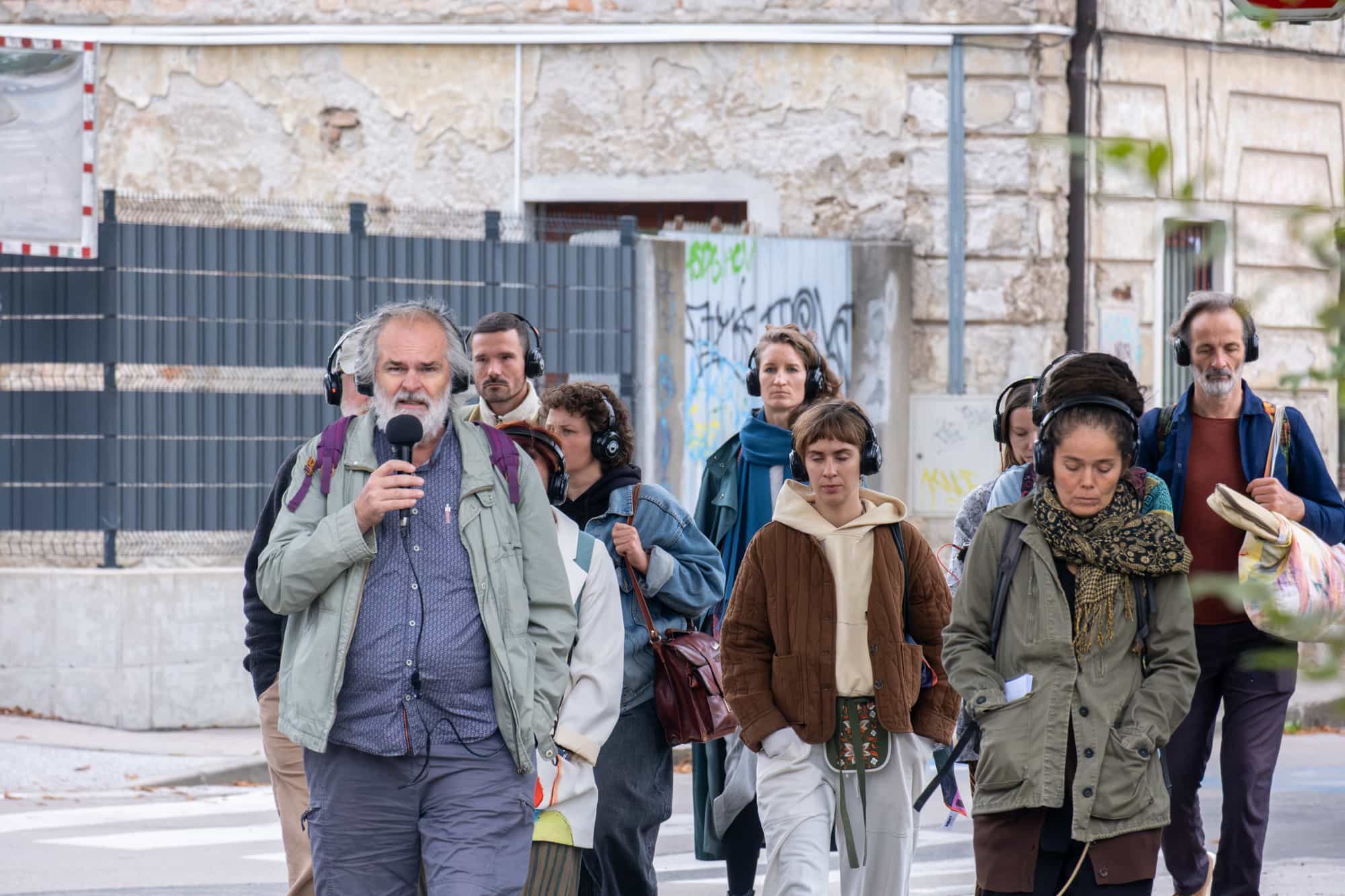
FreeThis series of lectures and peripatetic lectures explores listening as an ethical, ecological and political practice. The contributors examine listening beyond the human perspective, foregrounding relationships with more-than-human beings, spaces and sonic fields.
The lectures focus on rhythms and silences, field recording, ethical dimensions of listening, and ways in which listening can foster more caring and less extractive relationships with the environment.
Maja Bjelica: Poslušanje ritmov, poslušanje tišin
peripatetic lecture
The TO)potic presentation will focus on listening as an activity that resonates deeply in the field of ethics. We will not only ask about listening as a fundamentally ethical activity that enables the establishment of ethical interhuman or intersubjective relationships, but also about listening as a deeply connecting activity allowing for emerging ties with more-than-human beings and elements, which enables spreading of intersubjectivity far beyond the human.
An attempt to wording the described conceptual resonance of listening will be implemented through contemplative walks around the sound concepts or phenomena of rhythms and silences. Striving towards a horizon of posthuman ethics, the rhythms and silences will be explored in terms of their presence and absence, namely of their pulse, frequencies, vibrations. We will be asking about: how rhythms sound, how do silences? How are we listening to them? How are we experiencing them, how are we being-with them? Answering such questions will be attempted through contemplating (inter)subjective experience combined with a philosophical polylogue of thinkers of silence, rhythm and listening. Thinking about listening t(hr)o(ugh) silences and rhythms might allow the emergence of enriching reverberations for environmental (post)humanities as well, presented with the case study of salt-working at the Sečovlje saltern in Slovenia.
Miloš Vojtěchovský: About the Field (listening to the sounds we dismiss)
lecture
What are the animals that we are recording getting back from being in the piece that we exhibit for fee or recognition? How would we proceed when, instead of animals, we would be recording the sounds of humans? What else does the recordist or the listener learn about them besides that their sonic behaviour sounds “good” or “musically interesting”?
As a field recording practitioner, the author suggests discussing the potential impact of such activity on the objects or subjects interacted with, the so-called effect on the “fields.”
We are currently facing these issues in various aspects of human interaction with the environment. They include the ethical and ecological consequences of our “right” to mobility or our pursuit of “well-being” amidst environmental degradation. Musicians, not just them, often treat their gear and other organisms as instruments rather than recognizing them as collaborators with the agency.
If we aspire to be an integral part of ‘The Field,’ should we not approach it in a less extractive and colonialist way? This means we should (also) listen to the sounds that we do not want to hear.
Jacek Smolicki: Between Planetary and Situated Modes of Listening
peripatetic lecture
In this talk, the author proposes that in becoming more careful and caring sound makers, more emphasis must be placed on how we listen and are listened to. The talk will introduce several approaches to listening, technologically supported and unaided, each helping to reveal a different dimension of our shared environments.


Matej Tomažin
This series of lectures and peripatetic lectures explores listening as an ethical, ecological and political practice. The contributors examine listening beyond the human perspective, foregrounding relationships with more-than-human beings, spaces and sonic fields.
The lectures focus on rhythms and silences, field recording, ethical dimensions of listening, and ways in which listening can foster more caring and less extractive relationships with the environment.
Maja Bjelica: Poslušanje ritmov, poslušanje tišin
peripatetic lecture
The TO)potic presentation will focus on listening as an activity that resonates deeply in the field of ethics. We will not only ask about listening as a fundamentally ethical activity that enables the establishment of ethical interhuman or intersubjective relationships, but also about listening as a deeply connecting activity allowing for emerging ties with more-than-human beings and elements, which enables spreading of intersubjectivity far beyond the human.
An attempt to wording the described conceptual resonance of listening will be implemented through contemplative walks around the sound concepts or phenomena of rhythms and silences. Striving towards a horizon of posthuman ethics, the rhythms and silences will be explored in terms of their presence and absence, namely of their pulse, frequencies, vibrations. We will be asking about: how rhythms sound, how do silences? How are we listening to them? How are we experiencing them, how are we being-with them? Answering such questions will be attempted through contemplating (inter)subjective experience combined with a philosophical polylogue of thinkers of silence, rhythm and listening. Thinking about listening t(hr)o(ugh) silences and rhythms might allow the emergence of enriching reverberations for environmental (post)humanities as well, presented with the case study of salt-working at the Sečovlje saltern in Slovenia.
Miloš Vojtěchovský: About the Field (listening to the sounds we dismiss)
lecture
What are the animals that we are recording getting back from being in the piece that we exhibit for fee or recognition? How would we proceed when, instead of animals, we would be recording the sounds of humans? What else does the recordist or the listener learn about them besides that their sonic behaviour sounds “good” or “musically interesting”?
As a field recording practitioner, the author suggests discussing the potential impact of such activity on the objects or subjects interacted with, the so-called effect on the “fields.”
We are currently facing these issues in various aspects of human interaction with the environment. They include the ethical and ecological consequences of our “right” to mobility or our pursuit of “well-being” amidst environmental degradation. Musicians, not just them, often treat their gear and other organisms as instruments rather than recognizing them as collaborators with the agency.
If we aspire to be an integral part of ‘The Field,’ should we not approach it in a less extractive and colonialist way? This means we should (also) listen to the sounds that we do not want to hear.
Jacek Smolicki: Between Planetary and Situated Modes of Listening
peripatetic lecture
In this talk, the author proposes that in becoming more careful and caring sound makers, more emphasis must be placed on how we listen and are listened to. The talk will introduce several approaches to listening, technologically supported and unaided, each helping to reveal a different dimension of our shared environments.
Research Associate at the Science and Research Centre Koper’s Institute for Philosophical and Religious Studies. Her work focuses on the ethics of listening and environmental humanities, with salt-making as a case study of experiential ecological knowledge.
Curator, art historian and audiovisual artist based in Prague. Co-founder of the Hermit Foundation and the Center for Metamedia Plasy. His work spans field recording, sonic ecologies and curatorial practice.
Interdisciplinary artist, researcher and educator working with listening, recording and archiving practices in human and more-than-human contexts. He creates soundwalks, soundscape compositions and experimental archives.
Photo: Matej Tomažin
Miloš Vojtěchovský’s lecture is supported by The Arts Institute (AI).